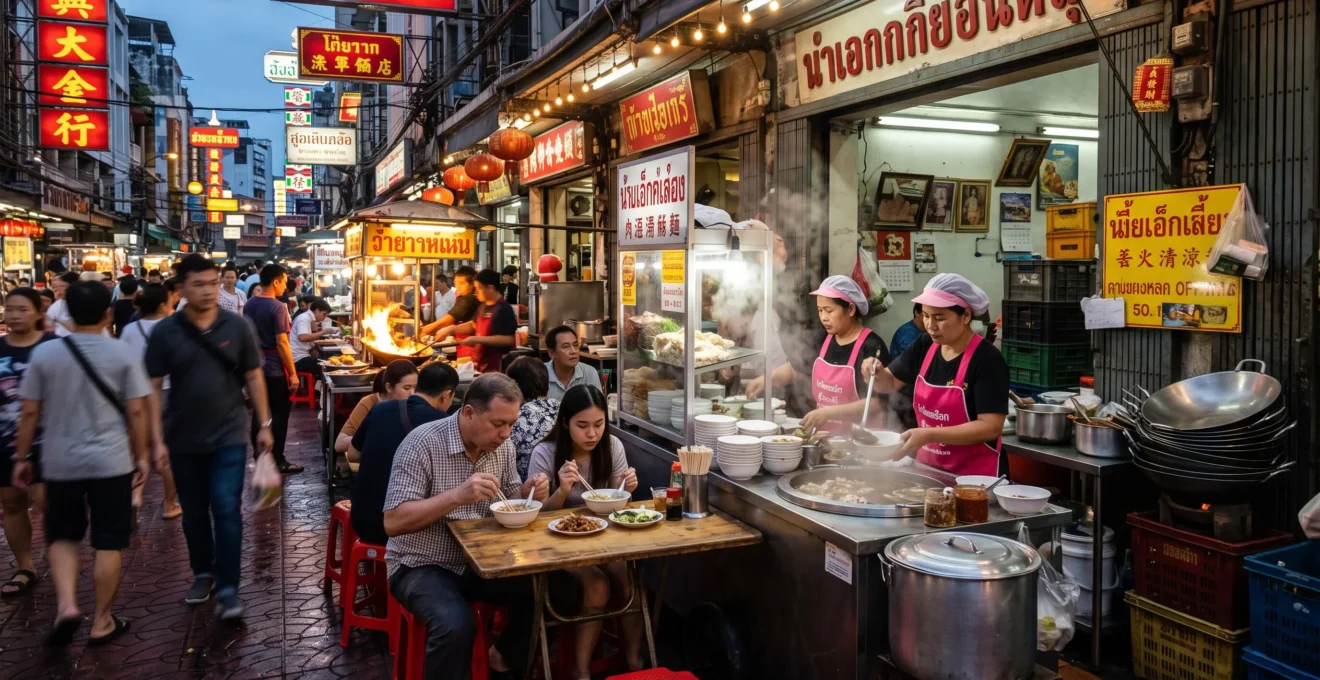
Yaowarat Road can overwhelm even experienced street-food travelers. Noodle carts compete with seafood grills, dessert counters spill into side alleys, and popular stalls develop queues while smaller kitchens continue serving a few steps away. The solution is not to eat at every famous address. It is to follow a route that balances timing, geography, appetite, and the neighborhood’s Chinese-Thai culinary heritage.
Start around Odeon Circle with a warming bowl of duck noodles, move through the old-market lanes for peppery kuay jub and wok-fried dishes, reach the seafood counters around Soi Texas when evening service gathers momentum, and finish with Chinese-style sweets toward Wat Mangkon. This eight-stop itinerary is a practical route rather than a claim that every vendor follows an identical daily schedule.
Along the way, understanding Teochew cooking, distinguishing family stalls from tourist-facing counters, and recognizing when particular foods become available will help turn a crowded night market into a manageable eating experience.
Yaowarat street food: the essential route
- Follow the eight-stop sequence: Odeon Circle duck noodles → old-market kuay jub → wok-fried noodles → side-lane snacks → Soi Texas seafood → shared-table specialty → Yaowarat toast → Wat Mangkon-area desserts.
- Plan the main evening session around 6 PM onward: some vendors open earlier, while others start later or close when ingredients sell out.
- Share small portions and leave room for desserts: the route works best as several short meals rather than one large dinner.
- Why Yaowarat Food Tastes Different From Bangkok Thai: The Teochew Chinese Influence
- Where to Find Yaowarat’s 50-Year-Old Family Stalls Before Michelin Guides Turned Them Into Queues
- Yaowarat vs Banglamphu Street Food: Chinese-Thai Hybrid or Pure Thai Flavors?
- The Yaowarat Timing That Finds Everything Closed: Why You Must Wait Until 6 PM (and How to Read Each Stall’s Real Schedule)
- When Yaowarat Goes Dark: The Chinese New Year Closure That Surprises Tourists
- 32.6: Beyond the Main Drag: Finding Yaowarat’s Family Stalls in the Side Sois Most Visitors Never Enter
- 32.7: Eating Yaowarat Like a Local: Order Sequencing, Sharing Rules, and Stall-Hopping Etiquette
- 32.8 (13): How to Extend the Route: Exploring Bangkok’s Local Neighborhoods Where Thais Actually Live and Eat
Why Yaowarat Food Tastes Different From Bangkok Thai: The Teochew Chinese Influence
Yaowarat tastes different because generations of Chinese migration shaped its noodles, broths, cooking methods, and everyday food traditions. Teochew influence is particularly important, but the neighborhood’s cuisine also reflects other Chinese communities and Thai adaptations. The result is not simply Chinese food transplanted into Bangkok: it is a distinct Chinese-Thai culinary environment.
One way to recognize the difference is through seasoning. Soy sauces, garlic, pepper, and long-developed broths are prominent in many Chinese-influenced dishes. Fish sauce, fermented shrimp paste, fresh herbs, lime, and chilies remain important across Thai cuisine, but individual recipes combine these ingredients differently. It would be inaccurate to claim that Yaowarat universally replaces fish sauce with light soy sauce.
Cooking techniques offer another clue. Steamed preparations, braised meats, noodle soups, and intensely heated woks coexist along the same streets. According to the Tourism Authority of Thailand’s feature on Chinese influences in Thai cooking, noodle-making, wok techniques, and soy fermentation contributed to Thai culinary development alongside local herbs and seasonings.
Three useful dishes illustrate the neighborhood’s character:
- Kuay jub: rolled rice noodles in a peppery broth, frequently served with pork components. Its defining experience is the combination of slippery noodles, aromatic soup, and contrasting meat textures.
- Guay tiew kua gai: rice noodles stir-fried with chicken and egg, where the heated pan contributes browned edges and a different texture from noodle soup.
- Chinese-style sweets: sesame-filled rice balls, ginger-based desserts, and traditional pastries, including sweets associated with Teochew food culture such as tao sog.
These dishes demonstrate different aspects of Chinese-Thai cooking without establishing an exclusive Teochew origin for every recipe. Cantonese and Hakka culinary traditions, alongside Hokkien contributions, add further layers through meat preparations, noodles, steamed foods, and other specialties. Not every braised duck or rice cake can reliably be assigned to a particular community by appearance alone.
40 interviews
A qualitative study of Thai-Teochew residents around Yaowarat Old Market documented inherited family recipes, specialized street-stall cooking, restaurant traditions, and ceremonial foods. This is community research, not a statistical survey of every stall.
Huachiew Chalermprakiet University’s research on Teochew food culture in Yaowarat, 2019.
The wider Bangkok food landscape is equally diverse. Central Thai, northern Lanna, northeastern Isan, southern Thai, and Chinese-Thai food traditions overlap across the capital. Comparing Yaowarat with other neighborhoods is therefore more useful than dividing Bangkok into supposedly authentic and inauthentic cuisines.
Once the flavor differences become recognizable, choosing your next stall becomes easier: look for the cooking method and specialty you want to experience, not simply the busiest counter.
Where to Find Yaowarat’s 50-Year-Old Family Stalls Before Michelin Guides Turned Them Into Queues
Finding established family stalls in Yaowarat requires attention to addresses, specialties, and service patterns rather than Michelin recognition alone. Some long-running vendors occupy prominent street positions, while others operate from modest counters or nearby lanes. Arriving near a confirmed opening time and identifying the dish a kitchen is known for usually makes more sense than following the longest queue.
A concrete historical example is Guay Jub Ouan Pochana, described as having operated for more than 50 years near the former Rama Theatre in a Tourism Authority of Thailand article published in 2020. Its signature combination of chewy rice noodles, peppery broth, and crispy pork provides a useful target for a heritage-focused stop.
That same historical guide featured White Dragon Noodle, T&K Seafood, Yaowarat Toast, and Sweettime Yaowarat. Its descriptions are useful for identifying dishes, but the operating hours and establishment details should not be treated as independently verified for 2026.
Use the following observations to evaluate a stall:
- A focused menu: a short list of specialties can indicate a concentrated cooking operation, although it does not prove longevity or superior quality.
- Visible family history: old photographs or press clippings can provide clues worth asking about, but photographs themselves cannot authenticate an establishment’s age.
- Food prepared in active batches: watch how frequently a broth, wok, or grill is used and whether ingredients are being replenished.
- Regular neighborhood customers: office workers and returning diners may suggest repeat demand, though tourists and locals can enjoy the same excellent kitchens.
For stalls that start in the late afternoon, arriving around 4–5 PM can be useful if the actual schedule supports it. Others do not begin service until 6 PM or later, making early arrival ineffective. The second strategy is to explore nearby side sois, particularly counters that share space with established daytime businesses.
Michelin recognition, including Bib Gourmand listings, can change the attention a restaurant receives. However, the available evidence does not establish that recognition caused Yaowarat vendors to lower quality, raise prices, or restrict their menus. Such effects should never be presented as proven neighborhood-wide trends.
Instead, judge the meal in front of you. A large prepared batch is not automatically poor cooking, and a rotating employee is not necessarily less skilled than a family member. Look for food temperature, ingredient handling, consistency, and a kitchen capable of explaining its specialty.
A manageable route might include one famous old counter and one lesser-known kitchen. That combination offers a more informative comparison than spending the entire evening in a single celebrated queue.
Yaowarat vs Banglamphu Street Food: Chinese-Thai Hybrid or Pure Thai Flavors?
Yaowarat is particularly rewarding for Chinese-Thai noodle dishes, peppery soups, braised meats, seafood, and traditional sweets. Banglamphu offers a different mix of central Thai dishes, snacks, neighborhood kitchens, and tourist-oriented food around Khao San Road. Neither district represents a pure cuisine: both contain local traditions, outside influences, and vendors serving different audiences.
Choose between them by what you want to eat, not by which neighborhood receives more online attention. The meaningful comparison concerns flavor, texture, and dining format rather than broad claims about authenticity.
| Criterion | Yaowarat | Banglamphu |
|---|---|---|
| Seasoning | Chinese-Thai preparations often highlight soy-based sauces, white pepper, garlic, and braising aromatics. | Many Thai-style options feature fish sauce, chilies, herbs, and curry or dipping sauces. |
| Texture | Silky noodles, broths, braised meats, crispy pork, and wok-charred rice noodles. | Grilled snacks, fried foods, salads, noodles, and sauced rice dishes. |
| Meal format | Small shared dishes, noodle counters, seafood tables, and dessert stops. | Quick snacks, casual seated meals, and food alongside nightlife. |
| Best planning role | A dedicated Chinatown food evening. | A flexible lunch, sightseeing break, or late-night meal around the old city. |
These are practical tendencies, not exclusive categories. Yaowarat also serves spicy dishes, and Banglamphu has Chinese-influenced noodles and longstanding Thai-Chinese businesses. The presence of soy sauce does not make a dish exclusively Chinese, just as fish sauce does not prove a preparation originated in central Thailand.
Banglamphu also needs a geographical distinction. Khao San Road caters heavily to travelers, while nearby residential streets and traditional food areas operate for a broader customer base. Generalizing the entire district from its backpacker nightlife strips would produce a misleading comparison.
Likewise, there is no sound basis for claiming that Yaowarat is uniformly cheaper, more locally frequented, or more faithful to traditional recipes than Banglamphu. Prices, clientele, and cooking methods vary between individual establishments.
The simplest itinerary decision is to avoid combining both neighborhoods into a hurried evening food hunt. Schedule Banglamphu for a daytime visit or a casual snack after another activity. Reserve Yaowarat for the meal when you want to study dishes, compare vendors, and move deliberately from one specialty to another.
If Chinese-Thai broths and wok cooking are your priority, make Yaowarat the centerpiece. The next decision is timing, because the right location at the wrong hour may offer an entirely different selection of food.
The Yaowarat Timing That Finds Everything Closed: Why You Must Wait Until 6 PM (and How to Read Each Stall’s Real Schedule)
Around 6 PM is a practical starting point for a Yaowarat night-food route because many evening-oriented stalls are operating or preparing to serve by then. It is not a universal opening time. Some noodle and seafood establishments begin earlier, some dessert sellers start later, and some daytime market vendors have already finished when the night crowds arrive.
Yaowarat’s changing rhythm reflects the neighborhood’s mixed commercial economy. Shops, traders, markets, and businesses operate during the day, while evening dining creates another cycle of activity. Street-food vendors have their own preparation requirements, available pavement space, staffing patterns, and customer demand.
The Tourism Authority of Thailand‘s Yaowarat street-food shortlist, published in January 2020, demonstrates why a single opening rule is unreliable. It listed T&K Seafood from 4:30 PM, White Dragon Noodle from 6 PM, Yaowarat Toast from 7 PM until sold out, and Guay Jub Ouan Pochana from 5 PM. These are historical examples, not confirmed current schedules.
Use this category-based timing framework for planning:
| Food category | Suggested visit window | What to verify |
|---|---|---|
| Old-market snacks and daytime desserts | Daytime to late afternoon | Whether the vendor serves lunch, afternoon snacks, or evenings. |
| Noodle and broth counters | Late afternoon onward, depending on the stall | Opening time and whether batches sell out. |
| Grilled seafood and cooked dinners | Evening, with 6 PM as a practical planning reference | Actual service start and expected queue. |
| Toast and late-night sweets | Evening onward | Whether service ends at a fixed hour or when stock runs out. |
On arrival, look for the operational clues that online opening-hour listings can miss. An unpacked cooking station usually means service has not begun. Open condiment containers, prepared seating, and active cooking indicate readiness, while stacked chairs and empty ingredient trays may signal closing.
Check handwritten signs for weekly days off or unexpected closures, and ask a neighboring vendor if a specific stall has temporarily moved. A vendor may be physically present while still preparing food, so avoid assuming that visible activity means orders are being accepted.
Your five-step Yaowarat route-readiness checklist
- Mark the route: save Odeon Circle, the old-market lanes, Soi Texas, and Wat Mangkon on your map. Deliverable: four usable geographic anchors.
- Choose eight dishes or stop categories: include a broth, noodles, seafood, and desserts. Deliverable: a numbered food shortlist.
- Check vendor schedules: confirm opening days and times for any named establishment shortly before visiting. Deliverable: an updated opening-time note.
- Prepare a fallback: select one alternative dish or nearby stall category for each must-try stop. Deliverable: a backup list.
- Set sharing and dietary rules: agree on portion sizes and identify ingredients to avoid before ordering. Deliverable: a short order plan everyone can follow.
Leave flexibility in the itinerary rather than treating each stop as a fixed appointment. Eating close to a vendor’s confirmed opening may reduce uncertainty, but it cannot guarantee shorter queues or full availability.
Timing also depends on the calendar. A route that works during an ordinary weekend may be unreliable during a major cultural festival or a family holiday.
When Yaowarat Goes Dark: The Chinese New Year Closure That Surprises Tourists
Chinese New Year can disrupt Yaowarat’s ordinary street-food routine because family businesses may take time off for reunions, ancestral observances, and celebrations. Yet the neighborhood can also become a major festival destination, with decorations and special activities. The important distinction is between visiting for the usual collection of food stalls and visiting for the cultural atmosphere.
Food is inseparable from celebration in Yaowarat’s Thai-Chinese communities. The 2019 Huachiew Chalermprakiet University study documented the role of symbolic Teochew foods during Chinese New Year, ancestor worship, the Dragon Boat Festival, the Mid-Autumn Festival, and the Vegetarian Festival.
Those traditions help explain why some long-established food businesses might alter their normal routines. Cooking may shift toward family gatherings or ceremonial occasions rather than everyday commercial service.
However, the available evidence does not establish that a fixed proportion of Yaowarat stalls close for Chinese New Year. The idea that only one-third remain open cannot be presented as a verified figure, and it would be misleading to describe the entire neighborhood as uniformly deserted.
Instead, anticipate two possible experiences:
- A festival-focused visit: streets may feature festive decorations, organized activities, and special food offerings. These may not be the same vendors or menus available on ordinary evenings.
- A disrupted food-hunting visit: family-run businesses may close or reduce service, making a tightly scheduled itinerary less reliable.
Other occasions worth checking include Songkran, Qingming-related family observances, and individual family ceremonies. Their effects are not uniform: one establishment may remain open while its neighbor closes.
For any visit overlapping the lunar calendar, check relevant festival dates before committing to a single evening. Review current tourism or event notices, then confirm your priority vendors individually. A district-wide festival announcement cannot substitute for a specific restaurant’s opening confirmation.
If a carefully planned food route becomes impossible, change the purpose of the evening rather than chasing closed counters. Visit for the cultural atmosphere where appropriate, or move the specialty-food route to a normal operating day.
On ordinary days, the most useful adjustment is geographical rather than seasonal: shift some attention away from Yaowarat Road into the smaller lanes around it.
32.6: Beyond the Main Drag: Finding Yaowarat’s Family Stalls in the Side Sois Most Visitors Never Enter
Yaowarat Road is the visible spine of Bangkok’s Chinatown food scene, but its side sois and covered markets offer another way to explore the neighborhood. Narrow passages connect commercial kitchens, everyday shops, market counters, and residential spaces. They are especially useful for discovering food that does not fit neatly into the familiar evening roadside-stall format.
Start by distinguishing three kinds of locations:
- Yaowarat Road: suitable for the prominent evening-food atmosphere, visible cooking stations, and well-known roadside vendors.
- Soi Itsaranuphap and the old-market area: useful for exploring traditional market activity and food businesses whose schedules may differ from night-market stalls.
- Soi Nana in Chinatown and smaller passages such as Trok Iti: possible exploratory detours rather than guaranteed concentrations of open family food stalls.
Soi Nana here refers to the Chinatown lane, not the Sukhumvit nightlife area. This distinction matters when using navigation apps or giving directions to a driver.
Side lanes are not automatically more authentic or better value than the main road. A shop operating inside an old building may be newly established, while a prominent street-facing business may have served the neighborhood for generations.
A useful selection method is to combine several observations: whether a vendor specializes in a small range of dishes, whether customers return for takeaway orders, how the food is prepared, and whether staff can explain the menu. Old photographs or a decades-long family connection provide background, but neither replaces an assessment of the actual food.
Consider an early exploration of the old market if your schedule permits. Daytime visits may reveal a different food economy from the evening stalls, making it possible to understand why Chinatown cannot be reduced to a single night market.
As a hypothetical example, imagine finding a modest counter inside a covered passage at lunchtime, serving two noodle dishes to nearby workers. That is a reasonable candidate for closer inspection, not proof of an unchanged ancestral recipe. Ask what the stall specializes in, observe cooking and hygiene, and choose based on the meal being prepared.
Remember that narrow sois can be shared with residents, shopkeepers, delivery workers, and places of worship. Keep passageways clear, avoid blocking entrances, ask permission before photographing people at close range, and stay quiet around temples and residential spaces.
A side-lane detour works best when it replaces a crowded stop or adds a genuinely different dish. Wandering into every alley without a food objective simply recreates the problem the route is designed to solve.
Once you have found several promising stops, the remaining challenge is to eat in the right order and navigate shared dining spaces without interrupting service.
32.7: Eating Yaowarat Like a Local: Order Sequencing, Sharing Rules, and Stall-Hopping Etiquette
Successful stall-hopping in Yaowarat depends on balancing portions, food temperatures, and shared-table etiquette. Rather than ordering a complete meal at every counter, sample a small selection, share when practical, and move between distinctive dishes. A five-to-eight-stop evening is a planning method, not a rule followed by every local diner.
The eight-stop route below uses recognizable geographic anchors and dish categories. It deliberately avoids promising that a specific vendor will be open at each point.
| Stop | Area | What to eat |
|---|---|---|
| 1 | Odeon Circle / eastern Chinatown approach | Duck noodles or a braised-meat noodle soup from a confirmed open vendor. |
| 2 | Yaowarat Road / old-market approach | Kuay jub with peppery broth and crispy pork. |
| 3 | Central Chinatown cooking counters | Guay tiew kua gai or another freshly wok-fried noodle dish. |
| 4 | Soi Itsaranuphap / market-lane detour | A small steamed snack, traditional pastry, or available market specialty. |
| 5 | Soi Texas / Yaowarat seafood area | Shared grilled seafood, choosing only what the vendor has available. |
| 6 | Yaowarat Road shared-table counters | One contrasting specialty, such as an oyster omelet or braised dish. |
| 7 | Yaowarat Road dessert counters | Toasted bread with a sweet filling, if available. |
| 8 | Wat Mangkon / Mangkon Kamalawat vicinity | Chinese-style dessert, such as sesame rice balls in ginger soup. |
The route is organized around a broad progression from the Odeon Circle side of Chinatown through the main dining streets, with a market-lane detour and a finish near Wat Mangkon. Depending on the precise vendors selected, some backtracking may be necessary. Treat the numbers as the eating sequence, not a surveyed shortest walking route.
Beginning with broth gives the palate a relatively gentle introduction. Wok-fried noodles provide a contrasting texture, followed by richer seafood and shared dishes. Dessert brings the meal to a natural conclusion without requiring another full serving.
At a shared counter, identify which vendor manages the table before ordering. Nearby stalls may operate independently, even when their chairs appear to form one dining area. Ask whether food from another vendor can be brought to the table rather than assuming outside orders are permitted.
Payment practices also vary. Some stalls collect money when serving, others after a plate is finished, and seated restaurants may issue a bill. Follow the vendor’s instructions instead of applying one supposed Chinatown-wide payment rule. Once you finish, freeing a busy table is considerate, but there is no need to rush while still eating.
Food restrictions deserve particular care. A dish that is not visibly spicy can still contain soy sauce, oyster sauce, wheat-based ingredients, or other allergens. Soy sauce may contain wheat; rice noodles alone do not establish that a finished dish is gluten-free.
Useful requests include:
- Mai phet (ไม่เผ็ด): not spicy.
- Mai sai nam pla (ไม่ใส่น้ำปลา): do not add fish sauce.
- Mai sai si-io (ไม่ใส่ซีอิ๊ว): do not add soy sauce.
- Mai sai nam man hoi (ไม่ใส่น้ำมันหอย): do not add oyster sauce.
These phrases communicate a request but cannot guarantee allergen-free preparation. Broths, marinades, premixed sauces, and shared cooking equipment may contain ingredients that cannot be removed. For serious allergies or coeliac disease, use a clearly translated allergy card and confirm ingredients and cross-contact risks; skip any dish the vendor cannot safely verify.
Sharing is most useful when diners have compatible dietary needs. If one person requires a separate meal, the route should accommodate that instead of forcing every dish into a shared format.
Learning to sequence dishes, read service patterns, and recognize ingredient risks creates a food-travel method that remains useful far beyond Chinatown.
What to carry into your next Bangkok food neighborhood
- Choose the neighborhood according to its daytime or evening food economy rather than assuming every market follows Yaowarat’s schedule.
- Identify a small number of food categories before visiting, then let operating vendors determine the final stops.
- Apply the same standards for preparation, dietary communication, and respect for local space wherever you eat.
32.8 (13): How to Extend the Route: Exploring Bangkok’s Local Neighborhoods Where Thais Actually Live and Eat
Once you understand Yaowarat’s food rhythm, Bangkok offers several contrasting areas where the same observation skills can guide your next meal. Wang Lang provides a daytime market experience, Talat Noi connects naturally with Chinatown’s older streets, and residential districts such as Ari or Lat Phrao offer opportunities to explore everyday eating environments without duplicating Yaowarat’s night-market format.
Wang Lang Market, across the Chao Phraya River in Bangkok Noi near Siriraj Hospital, is particularly suitable for a different type of food outing. The Tourism Authority of Thailand’s Wang Lang Market listing describes savory dishes, desserts, fruit, and a wider range of market merchandise. Its published visiting hours are 9 AM–6 PM daily, although individual vendors may follow different schedules.
Wang Lang is therefore a sensible daytime choice rather than a direct substitute for a Yaowarat night-food circuit. Plan around the market’s published schedule and confirm any specific vendor you particularly want to visit.
Talat Noi is a natural geographical extension of the Chinatown experience. Exploring its older streets and commercial surroundings gives you another perspective on the area’s history and neighborhood life. Treat it as a walking exploration with possible food stops rather than a guaranteed continuous street-food route.
Ari offers a different Bangkok dining setting, including neighborhood restaurants, markets, and contemporary food businesses. Its appeal is variety rather than reproducing the dense roadside cooking scene associated with Yaowarat.
Lat Phrao covers a broad part of Bangkok with residential and commercial areas. Rather than treating the entire district as a single food destination, choose a specific market or cluster of eateries and research its opening pattern before traveling there.
To evaluate a neighborhood food area, look beyond tourism labels. Observe whether vendors serve repeat customers, whether there are daytime food markets as well as evening venues, and how clearly the kitchen communicates its specialties.
A menu available only in Thai can signal that a business primarily serves Thai-speaking customers, but it is not proof of better food. Likewise, an English menu does not make an establishment less authentic. A higher proportion of local customers at lunchtime may provide useful context, though appearances alone cannot establish where customers live.
The transferable principle is simple: map the food economy before mapping the dishes. Find out when the neighborhood eats, which businesses operate at that hour, what they specialize in, and how to order respectfully. Then build a small sequence that fits the place rather than imposing one universal market itinerary.
For your next Bangkok meal, choose one neighborhood, identify three dishes worth exploring, verify when the relevant vendors operate, and leave one stop flexible. The same discipline that makes Yaowarat manageable can turn an unfamiliar food district into a rewarding experience.
Can you explore Yaowarat street food without speaking Thai?
Yes. Pointing to a dish, showing a translated name, and confirming the price before ordering can make basic communication easier. For allergies or important dietary restrictions, use a detailed Thai-language allergy card and obtain confirmation rather than relying on gestures alone.
Is Wat Mangkon MRT station a useful starting point for a Chinatown food walk?
Yes. Wat Mangkon MRT station provides access to Chinatown and is a practical arrival point for the old-market area. The suggested food sequence begins around Odeon Circle, so travelers arriving by MRT can adapt the direction of their walk or use the station as their return point.
What should you do if your chosen Yaowarat stall is sold out?
Replace it with another vendor preparing the same category of dish, or move to the next planned stop and return only if the original stall is expected to restock. Some vendors finish when their prepared ingredients run out, so waiting does not necessarily mean food will become available again.
Is Yaowarat suitable for vegetarian or gluten-free street-food travelers?
Options may be available, but ingredient verification is essential. Broths and sauces can contain animal products, soy sauce, wheat, or oyster sauce, and cooking equipment may be shared. Ask about the full preparation, not just the visible ingredients. Travelers who need strict avoidance should choose vendors able to confirm ingredients and cross-contact controls.
Should you visit Yaowarat during the day or at night?
Visit during the day to explore markets, shops, and food businesses that operate before evening. Choose an evening visit for the concentrated roadside dining experience, with approximately 6 PM as a useful planning reference. Individual opening hours vary, and neither period guarantees access to every well-known stall.