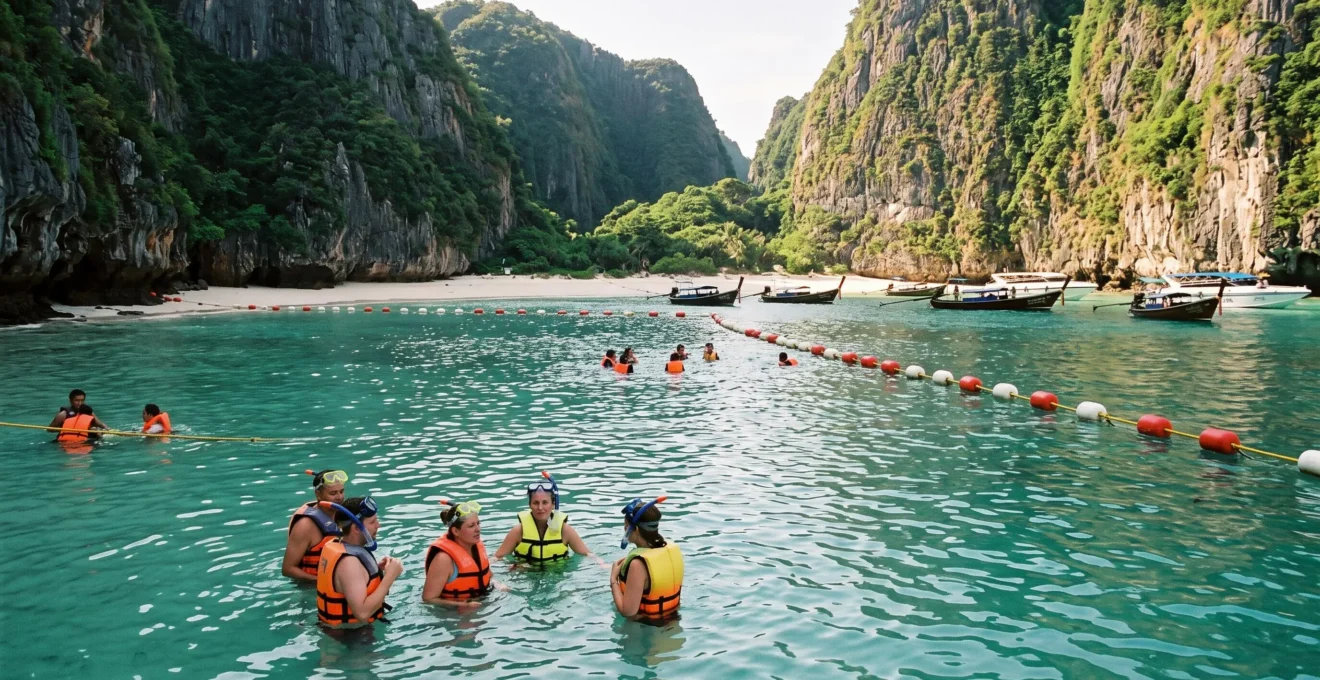
In 2018, Thailand closed one of its most photographed beaches to tourists. Maya Bay, the limestone-framed cove made internationally famous by the 2000 film The Beach, had become an example of how quickly uncontrolled visitor pressure could damage a sensitive marine ecosystem.
Before the closure, approximately 5,000 tourists were arriving each day, supported by hundreds of boats. Their presence put intense pressure on coral habitats, marine wildlife and the bay’s shallow waters. Thailand’s response was unusually decisive: remove mass tourism long enough for ecological restoration to begin, then reopen the destination under strict controls.
Maya Bay reopened on January 1, 2022, following more than three years of closure. Its recovery included coral rehabilitation and renewed sightings of blacktip reef sharks. By October 2026, the bay was operating within a seasonal conservation framework, with swimming still prohibited.
The case demonstrates an important distinction in sustainable tourism: restoring a damaged destination is not the same as returning it to unrestricted public use.
Maya Bay recovery: essential facts
- 2018–2022: Maya Bay remained closed to regular tourism for more than three years, allowing coral restoration and reduced disturbance to marine wildlife.
- 2022 reopening: Authorities introduced controlled visitor numbers, designated boat access and a swimming ban. Visitors could still reach the beach through an approved walkway.
- 2026 regulations: Maya Bay reopened on October 1 after its August–September seasonal closure, but swimming remained prohibited. Access continues to depend on park rules and sea conditions.
- Why You Can’t Set Foot on Maya Bay Beach Anymore: The New 2022 Swimming-Only Rules
- When You Can Actually Visit Maya Bay: The Seasonal Closure Calendar
- Maya Bay at 7am or 11am: Which Arrival Time Delivers Better Photos and Fewer Crowds?
- Why Maya Bay Doesn’t Look Like The Beach Movie: The Tourism Reality After 20 Years
- When to Book Maya Bay Trips Before Daily Quotas Sell Out: The Pre-Dawn Speedboat Strategy
- Why You Can’t Set Foot on Maya Bay Beach Anymore: The New 2022 Swimming-Only Rules
- Maya Bay at 7am or 11am: Which Arrival Time Delivers Better Photos and Fewer Crowds?
- How to Visit Thailand’s National Parks Responsibly: The Regulations That Protect Ecosystems
Why You Can’t Set Foot on Maya Bay Beach Anymore: The New 2022 Swimming-Only Rules
Visitors can set foot on Maya Bay’s beach, but swimming in its waters is prohibited. The restrictions introduced when the bay reopened in January 2022 were designed to separate tourism from sensitive marine habitats. Instead of landing boats directly on the famous shoreline, visitors reach the sand via a designated route behind the bay.
This distinction matters because the sometimes-repeated description of Maya Bay as a swimming-only destination is incorrect. The conservation model restricts swimming, boat movements and visitor numbers while allowing controlled beach access.
According to Channel News Asia’s report on Maya Bay’s 2022 reopening, the initial system permitted 375 people at a time, required advance booking and limited visits to one hour. Passenger boats docked behind the bay, from where a wooden walkway provided access to the beach.
The ecological mechanism was straightforward. Before closure, repeated boat movements stirred sediments and disturbed coral habitats and marine wildlife. Routing boats away from the main beach reduced direct pressure on the recovering ecosystem. Keeping swimmers out of the protected water also reduced disturbance to marine animals using the shallows.
| Activity | Documented position | Visitor implication |
|---|---|---|
| Walking onto Maya Bay beach | Permitted through controlled access at the 2022 reopening | Use the designated visitor route when the park is open |
| Swimming in Maya Bay | Prohibited in 2022 and still prohibited in October 2026 | Do not enter the water to swim |
| Landing boats on the main beach | Replaced by designated docking behind the bay in 2022 | Follow the operator’s authorized landing arrangements |
| Sunbathing and extended beach stays | Visits were time-limited in 2022; detailed current activity permissions are not established by the available sources | Follow posted ranger instructions rather than assuming unrestricted beach use |
| Drones | No Maya Bay-specific permit procedure or penalty verified in the supplied evidence | Confirm permission with park authorities before operating a drone |
Rangers and authorized access arrangements provide a practical way to enforce visitor restrictions. Operators must organize visits around permitted routes and applicable access arrangements. However, specific fines, operator-license suspensions and detailed 2026 enforcement procedures cannot be established from the available evidence and should not be presented as confirmed rules.
Most importantly, the restrictions are not simply a temporary inconvenience. Maya Bay’s restoration depends on keeping tourism pressure within limits that recovering habitats can tolerate. Coral condition, wildlife activity, water quality and visitor disturbance are relevant indicators for management, although the supplied sources do not establish a complete official threshold-based reopening formula.
For visitors, the appropriate expectation is a supervised conservation destination rather than an unrestricted swimming beach. Seasonal access rules add a second layer of protection.
When You Can Actually Visit Maya Bay: The Seasonal Closure Calendar
Maya Bay reopened on October 1, 2026, after its August–September seasonal closure. These conservation breaks are intended to reduce ecological disturbance and protect visitors during rougher southwest-monsoon conditions. However, annual closure dates should not be treated as permanently fixed: travelers must check the responsible national park’s latest announcement before departure.
The two-month closure combines environmental recovery with operational safety. Fewer tourist visits give wildlife and sensitive habitats an interval with reduced human disturbance. At the same time, monsoon weather can make boat approaches and passenger transfers less reliable.
The Thai government notice on Maya Bay’s 2024 seasonal closure documented the closure of Maya Bay, Loh Sama Bay and Lor Kor Bay from August 1 through September 30 that year. The government explicitly identified rainy-season safety and natural rehabilitation as the reasons.
That announcement should not be interpreted as proof that every future closure will use identical dates. Nor does it establish coral spawning as the specific biological basis for the selected calendar window.
| Period | Documented status | Planning implication |
|---|---|---|
| August–September 2024 | Official conservation closure | Maya Bay and two neighboring bays were closed to visitors |
| August–September 2026 | Seasonal conservation closure reported | Direct Maya Bay visits were unavailable during the closure |
| From October 1, 2026 | Reopening reported | Visits could resume subject to park restrictions and conditions at sea |
| Future seasons | Exact dates require fresh confirmation | Check official announcements before making non-refundable arrangements |
There is also an important difference between seasonal closures and daily access hours. The 2022 reopening operated between 7 a.m. and 6 p.m., with one-hour visits. Those historical operating hours do not, by themselves, establish the precise schedule applicable in October 2026.
To verify access, consult the responsible Hat Noppharat Thara – Mu Ko Phi Phi National Park‘s current announcements, including its official communication channels, and request confirmation from the tour operator. An open season does not guarantee access on a particular day when sea conditions are unsafe.
If the park closes unexpectedly, ask the operator whether the itinerary will change, the trip will move to another date or a refund is available. Refund entitlements depend on the booking conditions and applicable consumer protections; the available sources do not establish a universal Maya Bay refund policy.
Once the bay is confirmed open, the next consideration is choosing an arrival window that suits the weather, the visitor controls and the purpose of the trip.
Maya Bay at 7am or 11am: Which Arrival Time Delivers Better Photos and Fewer Crowds?
A 7 a.m. arrival is often preferable for softer morning light, while 11 a.m. may suit travelers who prefer less demanding departure times. Neither guarantees fewer people. Maya Bay operates under regulated access, and crowd levels depend on the visitors allocated to each period, actual boat arrivals and changing sea conditions.
Morning photography benefits from light that is generally less harsh than the stronger sun approaching midday. Depending on the position of the sun and the limestone cliffs, early images may capture directional illumination and softer contrasts. Later arrivals can reveal brighter turquoise water but may produce stronger highlights, deeper shadows and higher contrast.
Weather matters more than an appealing clock time. A clear, calm 11 a.m. visit can offer better photographic conditions than a rainy or wind-affected 7 a.m. arrival. Tide level, cloud cover and the orientation of the chosen composition also affect the result.
| Factor | 7 a.m. arrival | 11 a.m. arrival |
|---|---|---|
| Natural light | Usually softer; cliff shadows depend on sun position | Generally brighter with stronger contrast |
| Departure logistics | Earlier departure and potentially less sleep | More convenient for many standard daytime itineraries |
| Visitor density | No guarantee of an empty beach | No guaranteed crowd level either |
| Sea conditions | May be calmer, but weather-dependent | Can still be suitable if the forecast is favorable |
| Budget | Specialized early tours may carry a premium | Standard tours may offer alternatives; actual prices require comparison |
The historical 2022 system limited the number of visitors present simultaneously. That approach changes the meaning of crowd avoidance: actual attendance within a permitted window matters more than the assumption that every early departure is quieter.
For photographers, an early itinerary can be worthwhile when composition and soft light are the priorities. A later arrival may be preferable for travelers combining Maya Bay with other Phi Phi stops, provided the boat operator has confirmed an authorized visiting arrangement.
Swimming comfort should not determine which time to enter Maya Bay itself, because swimming remains prohibited. Visitors who want water-based activities must confirm whether their itinerary includes another location where those activities are permitted.
Even the best-timed visit will differ from the untouched paradise portrayed on screen. Understanding why requires looking at the environmental history behind the destination’s fame.
Why Maya Bay Doesn’t Look Like The Beach Movie: The Tourism Reality After 20 Years
Maya Bay no longer offers the unregulated visitor experience associated with the 2000 film The Beach. The destination’s international popularity contributed to intense tourism pressure, followed by the 2018 closure and a controlled reopening in 2022. Today, visitors encounter a managed national park landscape where ecological recovery takes priority over unrestricted recreation.
The film, directed by Danny Boyle and starring Leonardo DiCaprio, introduced international audiences to the sheltered bay on Phi Phi Leh. Its combination of turquoise water, pale sand and dramatic limestone cliffs made the location recognizable far beyond Thailand.
Tourism growth created a mismatch between the landscape’s popularity and its ecological tolerance. At peak pressure, approximately 5,000 people visited daily, accompanied by hundreds of boats. Marine scientists identified vessel movements and sediment disturbance as especially damaging to corals and wildlife.
Other pressures associated with intensive beach tourism can include physical trampling, inappropriate anchoring and pollution. However, the supplied sources do not quantify the independent contribution of sunscreen or establish a verified figure showing that precisely 80% of Maya Bay’s corals died.
More than 30,000 coral colonies
Reported growing within Maya Bay’s restoration area around the January 2022 reopening. This historical figure describes restoration activity, not the percentage of the original reef fully recovered.
Channel News Asia, February 2022, reporting on conservation work and interviews with marine scientist Thon Thamrongnawasawat.
Recovery became visible in ways that extended beyond coral planting. Blacktip reef sharks returned to use the bay’s shallow marine habitat. In December 2021, marine scientist Thon Thamrongnawasawat reported that at least 160 sharks had been recorded during a drone flight.
This finding supports the conclusion that marine wildlife was using the recovering bay, but it is not a current population estimate and does not prove a permanent increase in shark abundance.
The subsequent evidence remained encouraging. June 2024 government-reported survey recorded 92 blacktip reef sharks in the Maya Bay area. Because the observations were made at different times and the supplied information does not establish comparable survey methodologies, the two counts cannot reliably be used to calculate a population trend.
Maya Bay: from mass tourism to managed recovery
Before the 2018 closure, heavy boat traffic and thousands of daily visitors placed persistent pressure on the bay. The closure created an extended period of reduced tourist disturbance, alongside coral rehabilitation efforts.
By the 2022 reopening, reporting documented growing coral colonies and blacktip reef shark observations. Thailand then combined renewed public access with restrictions on swimming, boat movements and visitor numbers. These findings demonstrate meaningful signs of recovery without establishing complete ecological restoration.
Maya Bay offers a transferable lesson for other film-famous destinations. Recognition can accelerate tourism demand, but fragile ecosystems cannot necessarily absorb that demand. The destination becomes more sustainable only when management responds to environmental conditions rather than continually expanding access.
That distinction is particularly important when evaluating tour packages: a visit that operates within conservation restrictions can be more appropriate than an itinerary promising unusually unrestricted access.
When to Book Maya Bay Trips Before Daily Quotas Sell Out: The Pre-Dawn Speedboat Strategy
Book Maya Bay excursions once travel dates are reasonably certain, especially when seeking a specific early-morning departure. The 2022 reopening introduced advance reservations and limits on simultaneous visitors, but the available evidence does not establish current 2026 slot allocations or booking deadlines. A licensed operator who confirms the park’s applicable access requirements is preferable to an unsupported promise of guaranteed entry.
At reopening, Maya Bay operated with a reported limit of 375 people present at once and a maximum of 4,125 visitors per day. These figures illustrate the carrying-capacity approach Thailand adopted, but they must not be treated as verified October 2026 quotas.
The practical booking question is therefore not simply how many days ahead to reserve. Travelers need to establish whether the operator can provide an itinerary consistent with the park’s current restrictions, including its access arrangements and any applicable reservation requirements.
Demand can vary with weekends, holidays, weather and the broader travel season. Earlier booking offers more opportunity to compare itineraries, but there is no source-supported basis for claiming that all morning slots sell out a particular number of days in advance.
A pre-dawn speedboat departure can appeal to photographers wanting an early arrival. From Phuket, travelers must account for departure-point transfers, the boat journey and potentially challenging sea conditions. From Koh Phi Phi, a shorter local departure may simplify the itinerary, depending on the actual boarding point and operator.
Early departures also involve trade-offs. A higher-priced tour may offer fewer stops or less flexibility. Rough seas can disrupt schedules regardless of how early a reservation was made. The most useful comparison is between clearly documented itineraries rather than promotional labels such as exclusive, private paradise or guaranteed empty beach.
Five checks before booking a Maya Bay excursion
- Check the latest national park access announcement and save a dated copy or screenshot confirming the intended visit period.
- Request the operator’s business details and applicable tour authorization information; keep its written response.
- Ask for the planned Maya Bay arrival window and whether access arrangements are confirmed; retain the itinerary.
- Obtain written confirmation that swimming at Maya Bay is prohibited and identify any separate locations where water activities are scheduled.
- Review cancellation, weather-disruption and alternative-stop conditions; save the written booking terms and payment confirmation.
Be cautious about sellers claiming special permission to ignore park restrictions or offering access that contradicts current conservation rules. The supplied sources do not establish a specific licensing database or standard refund mechanism, so independently confirming the operator’s credentials and written conditions remains important.
Knowing what the tour includes also helps prevent confusion between Maya Bay and the nearby Phi Phi locations governed by different site-specific rules.
Why You Can’t Set Foot on Maya Bay Beach Anymore: The New 2022 Swimming-Only Rules
Maya Bay’s controlled reopening permits beach access but prohibits swimming, rather than permitting swimming while excluding visitors from the sand. This model reflects the balance Thailand sought after the 2018 closure: retain a limited tourism experience while protecting recovering coral habitats and the marine wildlife using the bay.
The restricted reopening followed several encouraging ecological observations. Restoration efforts had supported coral growth, and blacktip reef sharks were again being recorded in the bay. These developments supported the decision to allow visits under controlled conditions, although the available sources do not identify a precise biological threshold that automatically authorized reopening.
The visitor experience is therefore divided into distinct environments. At Maya Bay, tourists can appreciate the shoreline and limestone scenery through authorized access arrangements. The shallow marine area remains protected from recreational swimming.
This separation is also important for interpreting tour advertisements. An itinerary may include Maya Bay alongside Loh Samah Bay, Viking Cave or Bamboo Island, but the rules for one location should not automatically be applied to another.
- Maya Bay: controlled beach access and a documented swimming prohibition.
- Loh Samah Bay: associated with the designated access approach used after reopening; its own current restrictions should be verified.
- Viking Cave: a distinct attraction whose permitted activities require site-specific confirmation.
- Bamboo Island: another national park destination, not evidence that Maya Bay’s swimming prohibition applies identically throughout the archipelago.
For an educational visit, this distinction helps reveal what makes the conservation policy effective. Authorities did not need to prohibit every tourist activity throughout the entire island group. Instead, they could regulate particular behaviors and access routes around sensitive sites.
Such management depends on compliance. Visitors who enter protected waters or disregard posted instructions undermine the purpose of the reopening arrangement, even if the environmental consequences of one individual action appear small.
With those boundaries clear, travelers can focus on observing the landscape and photographing it without treating the protected lagoon as a recreational swimming area.
Maya Bay at 7am or 11am: Which Arrival Time Delivers Better Photos and Fewer Crowds?
Choose 7 a.m. primarily for the possibility of softer light, not for guaranteed solitude; choose 11 a.m. for a potentially simpler daytime itinerary. The most reliable decision incorporates the day’s weather, the operator’s confirmed access window and the purpose of the photographs. A regulated visiting system makes empty-beach promises unreliable.
For a photographer, the difference between the two times starts with how light falls across limestone cliffs and shallow water. Earlier light can produce subtler color gradations and softer highlights. Approaching midday, bright reflections and uneven cliff shadows can make exposure more demanding.
At 7 a.m., consider including the surrounding cliffs in wider compositions, using the sheltered cove’s natural geometry. If parts of the scene remain shaded, exposing for the brighter sky and water may preserve detail that would otherwise be lost.
At 11 a.m., a circular polarizing filter may help control certain reflections, depending on camera angle and conditions. Exposure compensation or bracketing can also help when bright water contrasts with dark limestone. These are photographic techniques, not guarantees of particular image quality.
Visitor density requires a separate assessment. Even when simultaneous attendance is capped, several authorized groups may share the same window. Tour operators may also organize departures around similar schedules, limiting the benefit of arriving early.
The most useful question is whether the operator can confirm the intended visiting period and explain how the route avoids unnecessary congestion. The available evidence does not provide hourly visitor counts for comparing 7 a.m. and 11 a.m. statistically.
Weather can overturn any preference. A calm, bright later visit may outperform a rainy early arrival. Tide, cloud cover and wind should be reviewed as close to departure as practical, and the operator should explain what happens if conditions prevent access.
Photographers should also remember that standing on the authorized beach does not permit unrestricted movement into protected water. Composition choices must remain within the visitor routes and activities allowed by the park.
Ultimately, the most successful visit is not necessarily the earliest or least crowded, but the one that respects the site’s ecological limits while meeting reasonable visitor expectations.
Key takeaways for responsible national park visits
- Confirm the destination’s current conservation restrictions separately from its general opening status.
- Choose operators who explain where visitors may go and which activities remain prohibited.
- Treat seasonal closures, visitor limits and wildlife-protection rules as essential elements of the destination’s recovery, not optional inconveniences.
How to Visit Thailand’s National Parks Responsibly: The Regulations That Protect Ecosystems
Responsible visits to Thailand’s national parks begin with checking official access rules, paying applicable entrance fees and following site-specific conservation restrictions. Maya Bay illustrates why these requirements matter: a protected ecosystem may be reopened to tourism while remaining vulnerable to boat disturbance, direct wildlife contact and excessive visitor pressure.
Maya Bay belongs to Hat Noppharat Thara – Mu Ko Phi Phi National Park. Its restrictions form part of a broader conservation-management approach in which access, visitor behavior and temporary closures are controlled according to each protected area’s needs.
Park admission arrangements and applicable fees should be verified for the specific destination and date. Some visits may involve operator-managed admission or reservation arrangements, but the supplied evidence does not establish one universal online booking process for every Thai national park.
Basic low-impact practices are relevant wherever sensitive wildlife or marine environments are involved:
- Avoid feeding wildlife or attempting to attract animals for photographs.
- Never touch, stand on or remove coral or other protected marine organisms.
- Follow marked visitor routes and respect restricted areas.
- Avoid leaving litter, disposable packaging or other waste in protected environments.
- Confirm whether drones or other potentially disruptive equipment require specific permission.
- Follow the instructions of park staff and comply with weather-related closures.
These principles should not be confused with a verified statement of identical legal penalties across every park. Drone restrictions, plastic controls, fines and entry procedures may differ by jurisdiction and site. When the precise rules are uncertain, park officials are the appropriate authority to consult.
For marine excursions, responsible choices also include minimizing the likelihood of pollution, selecting operators who respect designated landing areas and avoiding contact with reef habitats. Sunscreen selection is one consideration in reducing potential marine contamination, but no sunscreen product should be treated as guaranteeing zero ecological impact.
A useful final verification point is the Time Out Thailand report on Maya Bay’s October 2026 reopening. Published on September 29, 2026, it confirms the scheduled October 1 return of visitors after the seasonal closure and specifically notes that swimming remains prohibited.
This contemporary reporting complements the historical evidence rather than replacing official park announcements. It establishes the announced 2026 reopening framework, but not every operational detail for every subsequent day.
For a field-study group, the most useful outcome is an accurate understanding of how conservation objectives translate into practical visitor rules. Reduced direct disturbance, managed access and periodic closures can create better conditions for ecological recovery, even while tourism continues.
Before booking a Thai national park excursion, confirm current opening notices, permitted activities, entry requirements and weather contingencies with the responsible park and your operator. Responsible visitation begins with accepting the ecological limits that make continued access possible.
Has Maya Bay completely recovered from overtourism?
No complete recovery can be established from the available evidence. Coral rehabilitation and blacktip reef shark observations demonstrate meaningful ecological improvements, but they do not prove that every damaged habitat has returned to its previous condition. Continued management remains important.
Can visitors snorkel at Maya Bay in October 2026?
Swimming remains prohibited in Maya Bay according to September 2026 reporting. Visitors should not assume snorkeling is permitted within the protected bay. Operators may offer snorkeling at other locations, subject to those sites’ individual rules.
Did the film The Beach directly cause Maya Bay’s environmental damage?
The 2000 film significantly increased international recognition of Maya Bay, helping make it a major tourist destination. However, the environmental damage resulted from the combined pressures of intensive visitation, boat activity and other disturbances over time. Film exposure alone cannot explain the full ecological impact.
Are blacktip reef sharks still present around Maya Bay?
Blacktip reef sharks were documented during the recovery period, including observations reported in December 2021 and June 2024. The latter government-reported survey recorded 92 sharks. These historical observations establish their presence but do not provide a verified population count for October 2026.
Will Maya Bay’s seasonal conservation closures continue indefinitely?
The available evidence documents seasonal closures in 2024 and 2026, associated with ecosystem rehabilitation and rainy-season safety. It does not establish that future dates or the duration of the policy are permanently fixed. The responsible national park’s announcements remain the authoritative basis for planning.