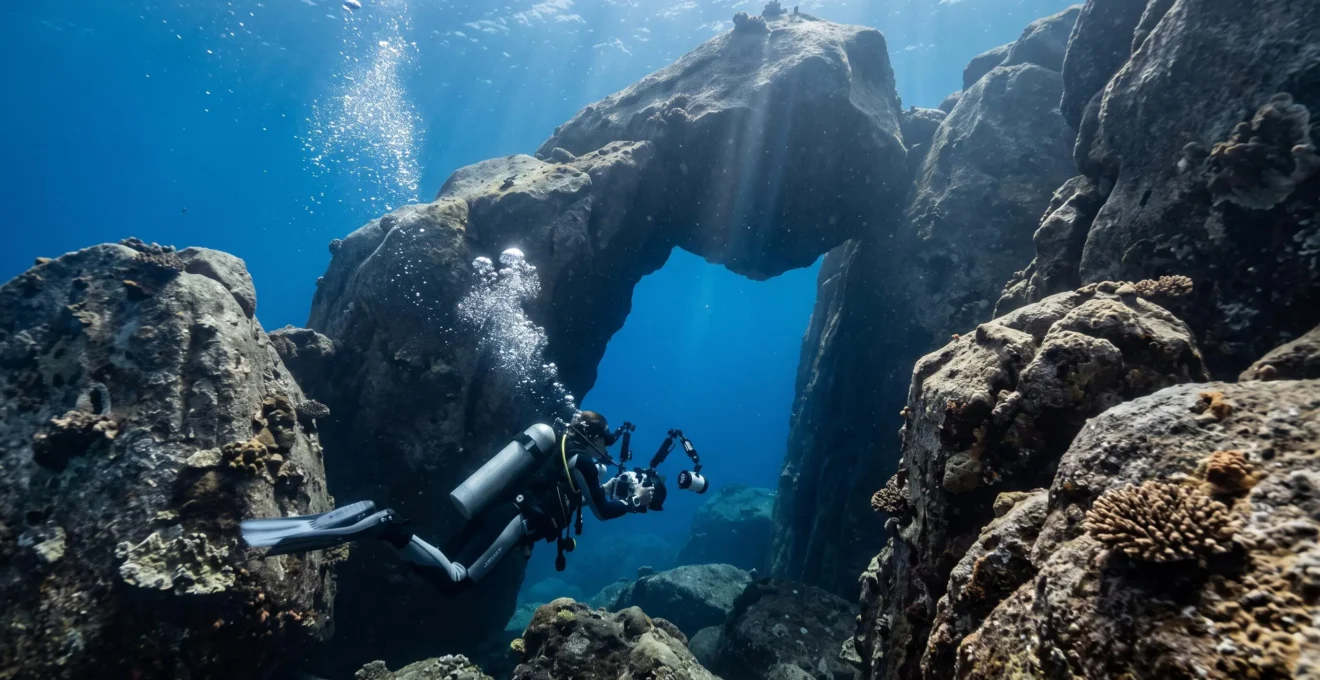
The Similan Islands offer underwater photographers something that many tropical reef destinations cannot: enormous granite boulders forming natural arches, narrow channels and dramatic blue-water compositions. But reaching these sites is only part of the challenge. Choosing the wrong boat schedule can leave a photographer with limited shooting time, crowded dive groups or an itinerary that never reaches the intended subjects.
A Similan Islands day trip provides a practical introduction to the archipelago. A three-day liveaboard offers a different experience: multiple dives, more opportunities to photograph sites under changing conditions and, on suitable itineraries, access to more distant locations such as Koh Bon and Richelieu Rock. Those outer sites are not categorically inaccessible by day boat, but reaching them from the mainland can require dedicated long-distance excursions rather than a standard Similan day trip.
For advanced divers, the real decision is therefore not simply how many nights to spend aboard. It is whether the boat’s access, dive schedule and photographic facilities match the images they want to capture.
Similan diving: the essential decision
- Choose a liveaboard for multiple photography opportunities, flexible site scheduling and itineraries combining the Similans with Koh Bon, Koh Tachai or Richelieu Rock.
- Choose a day trip when time or total budget is limited and one or two suitable dives are enough to meet your objectives.
- Check the season and itinerary first. Park closures restrict access, while February–March visibility, wildlife sightings and advertised dive sites are never guaranteed.
- Why You Can’t Dive the Similan Islands Half the Year: The Seasonal Closure Explained
- How to Navigate the Similan’s Signature Granite Boulder Sites: Elephant Head Rock and Fantasea Reef
- Similan Boulders or Richelieu Rock: Which Site for Wide-Angle vs Macro Photography?
- The £60 Similan Day Trip That Ruins the Experience: Why Speedboat Crowds Beat Liveaboard Luxury
- When to Book a Similan Liveaboard for Optimal Visibility: The February-March Window
- How to Navigate the Similan’s Signature Granite Boulder Sites: Elephant Head Rock and Fantasea Reef
- When to Book a Similan Liveaboard for Optimal Visibility: The February-March Window
- Where to Find Untouched Marine Life in the Andaman Sea: The 5 Islands 90% of Tourists Miss
Why You Can’t Dive the Similan Islands Half the Year: The Seasonal Closure Explained
You cannot plan a Similan Islands dive trip during the annual national park closure because tourism access is suspended for approximately five months. The restriction addresses southwest monsoon conditions, visitor safety and environmental recovery. For 2026, the announced closure covered 15 May to 15 October, making the officially authorised reopening date the first detail to verify before comparing liveaboards and day trips.
Thailand’s official announcement of the 2026 Similan and Surin park closures identifies the southwest monsoon as a reason for restricting tourism and overnight stays. Rough seas, elevated swell and difficult boat operations are serious considerations in an exposed offshore archipelago.
This is not an optional recommendation that a more adventurous operator can disregard. A company offering access to closed national park waters should not be treated as providing a legitimate alternative to the restrictions. Dive itineraries must comply with the applicable park rules and permissions.
15 May–15 October 2026
The announced five-month tourism closure for Mu Ko Similan and Mu Ko Surin national parks. These dates apply to the 2026 closure period and must not automatically be assumed for another year.
Public Relations Department, Government of Thailand, announcement dated 14 May 2026.
The photography season is more complicated than a simple open-versus-closed calendar. After the monsoon, water conditions may take time to settle, while plankton, currents and localised weather can change visibility. Late-season conditions can also produce rewarding encounters without delivering consistently clear water. Neither the beginning nor the end of the season is automatically superior to its middle.
Photographers should distinguish three factors: legal access, safe daily sea conditions and underwater visibility. A park being open establishes only the first. It does not guarantee that a particular dive site will be accessible or photographically productive.
The closure also has a geographic dimension. Richelieu Rock falls within Mu Ko Surin National Park rather than Mu Ko Similan National Park, and the 2026 announcement covered both parks. Other Andaman Sea dive areas may operate under different restrictions, but their availability requires individual verification rather than an assumption that nearby waters are open.
Before making a reservation, check the current Department of National Parks announcement, confirm the opening date with the operator and request the contingency policy for weather-related changes. A previous season’s blog post is not evidence of current access permissions.
Once legal access is confirmed, the next question is whether the diver has the experience and equipment to use the Similans’ granite terrain effectively.
How to Navigate the Similan’s Signature Granite Boulder Sites: Elephant Head Rock and Fantasea Reef
Navigate the Similan Islands’ granite boulder sites by understanding their structure before descending, following a route adapted to the day’s current and maintaining enough distance from the rocks to control your position while shooting. Elephant Head Rock is particularly demanding because arches, channels and depth changes create a three-dimensional environment where photographic concentration cannot replace buoyancy awareness.
Unlike a relatively continuous coral wall, a boulder site repeatedly changes the diver’s relationship with depth and water movement. Granite blocks can form sheltered pockets next to exposed passages, while a short horizontal movement may lead toward a deeper sandy channel.
At Elephant Head Rock, also called Hin Pusa, massive formations create underwater canyons, tunnels and arches. PADI‘s Elephant Head Rock dive-site description reports moderate to strong currents and a principal depth range of approximately 18–40 metres, while noting that the information is third-party contributed.
Those figures describe possible site conditions, not a depth target or a dive plan. The operational choice depends on qualifications, actual current, gas supply, no-decompression limits and the guide’s assessment.
At Elephant Head Rock, route selection should follow the current rather than a fixed photographic shot list. A guide may favour the sheltered side of a formation, approach an opening from a different direction or omit a passage entirely. A photographer should identify the planned entry, exit and regrouping locations in the briefing.
A useful composition places the boulder structure between the camera and the available ambient light, often with a diver providing scale. But framing an archway is not a reason to enter a confined passage, hold onto fragile marine life or fight a current while looking through a viewfinder.
Fantasea Reef and the nearby Deep Six area introduce additional boulder-slope photography opportunities. Their precise routes and wildlife prospects should not be treated as interchangeable: availability, depth and conditions need to be confirmed for the individual site. Exposed rock edges and current-facing structures may provide opportunities to observe passing fish, but pelagic encounters remain unpredictable.
Even during the open season, surface swell and underwater surge can make an otherwise attractive composition impractical. Operators should therefore be assessed on whether they can select an alternative site rather than force an advertised location into unsuitable conditions.
The most valuable underwater route is not necessarily the deepest or most complicated one. It is the route that provides a controllable shooting position, appropriate depth and safe return to the dive group.
Similan Boulders or Richelieu Rock: Which Site for Wide-Angle vs Macro Photography?
Similan granite sites generally offer the stronger starting point for dramatic wide-angle compositions, while Richelieu Rock provides an attractive alternative for close-focus and macro photography. The distinction comes from habitat structure, not a guarantee of better photographs. Boulder arches emphasise scale and ambient light; Richelieu’s soft corals, crevices and varied marine life offer a broader selection of small subjects.
Richelieu Rock is an isolated, horseshoe-shaped limestone pinnacle in Mu Ko Surin National Park. It is geographically separate from the Similan Islands, even though multi-day dive itineraries often market the combined area under the Similan liveaboard label.
That distinction matters when booking. A photographer whose principal target is Richelieu Rock should request the exact itinerary rather than assume that every three-day Similan cruise includes it.
The PADI Richelieu Rock dive-site profile describes soft coral gardens, walls, overhangs and crevices, along with moderate to strong currents and seasonal visibility variation. It also identifies plankton-rich conditions as one factor associated with the site’s larger marine life.
For photographers, the difference can be assessed directly:
| Decision factor | Similan granite boulders | Richelieu Rock |
|---|---|---|
| Defining structure | Large granite formations, arches and channels | Limestone pinnacle, coral-covered surfaces and crevices |
| Natural photographic emphasis | Wide-angle landscapes, diver-scale compositions | Macro, close-focus wide-angle and marine-life portraits |
| Primary positioning challenge | Surge, changing depth and rock passages | Current, exposed areas and maintaining position near reef structures |
| Visibility consideration | Clear conditions strongly benefit large-scale compositions | Plankton can reduce visibility while supporting larger-animal encounters |
| Itinerary check | Confirm individual named boulder sites | Confirm Richelieu Rock is explicitly included |
There is a photographic contradiction at Richelieu Rock. Plankton can reduce the distance over which a wide-angle subject photographs cleanly, while providing feeding conditions attractive to larger marine animals, including whale sharks. A diver seeking a crisp reef panorama may therefore prefer different conditions from one prioritising a wildlife encounter.
Lens choice should influence the itinerary, not dictate an unsafe dive. For the Similans, an appropriate wide-angle configuration and controlled natural-light exposure are valuable. For Richelieu, a macro lens with strobes or a close-focus wide-angle setup can be useful, depending on the intended subject and visibility.
Housing configuration also matters. A dome port, extension rings, focus settings and buoyancy characteristics should be checked before departure. Changing from wide-angle to macro normally requires opening the housing in a suitable dry environment, with sufficient time to inspect seals and test the assembly before entering the water.
Repeated dives offer more opportunities to work with one chosen lens than an itinerary with a single brief visit. But a liveaboard’s tighter turnaround between dives may also make frequent housing changes inconvenient.
If the objective is granite architecture, prioritise suitable Similan sites. If the objective is subject diversity around a coral-covered pinnacle, check Richelieu access. Photographers seeking both should evaluate a combined itinerary rather than treating one destination as a substitute for the other.
The £60 Similan Day Trip That Ruins the Experience: Why Speedboat Crowds Beat Liveaboard Luxury
A low advertised Similan day-trip price can be misleading when essential costs and photographic limitations are not clearly specified. A £60 offer is not evidence of the typical price of a scuba-diving excursion, and its inclusions must be checked. The meaningful comparison is the total cost against useful underwater time, site access, group size and camera-handling conditions—not the headline ticket price alone.
Day trips commonly involve a fixed departure, an offshore crossing, a predefined sequence of activities and a return schedule. This structure can work well for travellers with limited time. For a photographer carrying an underwater housing and strobes, however, transport and preparation compete with actual shooting opportunities.
The Tourism Authority of Thailand identifies Thap Lamu Pier as a principal access point and describes an approximate 90-minute speedboat crossing. Its official Similan National Park visitor information also publishes entrance fees that travellers should verify against current ticketing arrangements.
The published foreign adult national park admission figure is 500 THB. This is an entrance-fee figure, not a complete scuba-diving permit or package price. Additional diving-related charges may apply, and operators differ in what they include.
Before comparing quotes, separate transport, park admission, applicable diving fees, rental equipment, meals and any mainland transfers. A cheaper booking is not necessarily poor value, but a missing cost component prevents a fair comparison.
Timing is the next distinction. A mainland day boat’s travel schedule may concentrate its dives within a narrower daytime window. An overnight vessel already positioned near the diving area can potentially schedule an early dive before mainland arrivals, subject to permissions, weather and operational conditions.
Early dives can provide appealing ambient light and quieter boat activity, but dawn does not guarantee calm seas, superior visibility or fewer divers underwater. Dusk and night diving should never be presumed available at every national park site.
Congestion is another legitimate concern. When several dive groups use the same rock formation, photographers may have limited opportunities to frame a subject without other divers or bubbles. Close groups can also complicate positioning and contribute to accidental sediment disturbance, although the scale of these effects cannot be inferred simply from the number of boats present.
A good day-trip operator can mitigate these issues through sensible group sizes, suitable site selection and clear dive management. A poorly organised liveaboard can produce the opposite experience.
Compare the options with a practical calculation: total payable trip price divided by planned underwater minutes. Treat the result as a planning estimate because actual dive duration depends on depth, gas use, decompression limits and conditions.
A day trip is a rational choice for a diver who wants a short introduction to the Similans. A photography-focused liveaboard becomes more attractive when additional dives, multiple site visits and camera facilities justify its higher total commitment.
When to Book a Similan Liveaboard for Optimal Visibility: The February-March Window
February and March are sensible months to consider for a Similan liveaboard when clear-water photography is the priority, but they are not a reliable visibility guarantee. Seasonal weather patterns may favour settled conditions, while currents, plankton and thermoclines can alter underwater clarity at individual dive sites. Booking should combine a preferred travel window with recent dive reports and the specific boat itinerary.
The period after the southwest monsoon often attracts photographers seeking wide-angle conditions. More predictable boat operations and opportunities for clear water can favour large-scale granite compositions, although no fixed monthly visibility standard is established by the source material.
Visibility must be understood geographically. A sheltered granite site and a more exposed offshore pinnacle can produce different photographic conditions on the same day. Richelieu Rock can also experience plankton-related reductions in clarity, potentially alongside interesting wildlife activity.
This creates two competing photographic priorities. Reefscape photographers may value clear water, predictable natural light and a wide field of view. Those seeking larger marine animals may accept poorer visibility when food availability influences animal activity.
November and December can be considered as alternative booking windows for travellers who prefer an earlier-season itinerary. They should not automatically be described as quieter or greener without recent, location-specific evidence.
For a popular departure, checking availability months in advance is prudent, particularly when seeking a photography-oriented vessel with suitable camera workspaces. This is a booking recommendation, not evidence that all February–March departures routinely sell out.
Photographers should examine recent underwater reports rather than relying on a seasonal label. A useful report identifies the site, observation date, approximate visibility, current and conditions. Undated marketing photographs cannot establish what a specific week will deliver.
The best travel dates are those that combine legal access, workable weather, acceptable visibility expectations and an itinerary containing the dives that matter most—not necessarily the dates with the strongest high-season marketing.
How to Navigate the Similan’s Signature Granite Boulder Sites: Elephant Head Rock and Fantasea Reef
Successful navigation at Elephant Head Rock and the Similans’ other boulder sites depends on recognising landmarks, following a current-adapted dive plan and maintaining clear team coordination. A photographer should know the intended reference points, depth limits and exit procedure before entering the water. Complex granite terrain is poorly suited to relying exclusively on the guide’s fins for orientation.
The structural information in a pre-dive briefing can be more useful than a memorable site name. Large arches, vertical rock formations, sandy channels and distinct boulder clusters provide potential orientation references, but their positions and suitability must be established by a guide familiar with the particular route.
Before descent, ask the guide to identify the planned sequence of landmarks, the expected current direction, the maximum operating depth and the fallback route if conditions deteriorate.
For Elephant Head Rock, there is no universal safe route through every passage. A channel that appears manageable under one current pattern may be unsuitable under another. Equally, the most dramatic tunnel is not necessarily appropriate for the group’s training, equipment or experience.
Photography positioning must remain subordinate to team control. Spreading divers across an extensive boulder field can provide different viewpoints, but deliberately dispersing beyond agreed buddy distances can create separation and supervision risks.
Smaller, well-managed groups may provide photographers with more time to compose individual images. However, the relevant question is not simply the number of divers per guide. It is whether the operator can manage divers of different experience levels without compromising emergency procedures or dive planning.
Depth adds a further constraint. A route may move from relatively shallow formations toward substantially deeper channels. Time spent framing subjects at depth can increase gas consumption and reduce remaining no-decompression time.
Photographers should plan for the exposure and positioning time they actually need while retaining conservative reserves. An attractive composition does not justify extending a dive beyond the agreed gas, depth or decompression limits.
Five checks before your first granite boulder dive
- Request the site-specific briefing. Identify the named dive site, planned route and key visual landmarks; record the agreed reference points.
- Confirm the day’s current and swell assessment. Establish which passages are suitable and which will be avoided; leave the briefing with a clear alternative route.
- Agree on team positioning. Confirm buddy procedures, guide supervision and regrouping signals; establish how photographers can pause safely.
- Set the depth and gas plan. Check maximum depth, turning criteria and ascent procedures; ensure everyone can state the agreed limits.
- Prepare the camera before entry. Inspect the housing, seals, attachments and planned settings; complete a controlled pre-dive equipment check.
Better site familiarity can improve photographic efficiency, but disciplined team diving is the foundation. A repeat dive on a manageable route may ultimately provide better images than a single demanding dive through unfamiliar terrain.
When to Book a Similan Liveaboard for Optimal Visibility: The February-March Window
Book a February–March Similan liveaboard early enough to compare genuine itinerary and camera-facility options rather than accepting whatever remains available. The calendar window alone does not determine photographic quality. The number and distribution of dives, access to desired locations, departure reliability and available camera workspace can matter more than choosing one supposedly perfect week.
Two vessels operating during the same month can deliver substantially different photographic opportunities. One may concentrate on central Similan granite sites, while another may include more distant destinations such as Koh Bon, Koh Tachai and Richelieu Rock.
Before paying a deposit, request a proposed site-by-site itinerary. Check how many dives are scheduled, how many are intended for each location and whether named sites are conditional on weather or park permissions.
Night diving requires particular scrutiny. It should only be considered when permitted at the intended location, operationally offered and suitable for the diver’s training and experience. Never infer night-dive availability from the fact that a vessel operates overnight.
Camera facilities deserve equal attention. A dedicated camera table can reduce handling difficulties, but its usefulness depends on available space, freshwater care arrangements, charging facilities, equipment protection and the number of photographers sharing it.
Check contingency terms before comparing cabin prices. Weather-related route changes are a normal possibility in offshore diving. A published itinerary is not a contractual guarantee of access to every named site unless the operator’s terms explicitly establish otherwise.
Photographers should understand what happens if conditions prevent a Richelieu Rock visit, whether alternative sites are selected, and which cancellation or refund provisions apply. These answers can be more consequential than a small difference in advertised package price.
Finally, allow enough time before and after the cruise for travel disruptions and safe flying-after-diving intervals. Actual surface-interval requirements depend on the diving completed and the applicable safety guidance; the end of the last advertised dive is not automatically the earliest safe flight departure.
When two trips fall within the same seasonal window, select the vessel that offers the better combination of suitable dives, competent guidance, realistic contingencies and photography support.
Key takeaways before choosing an Andaman itinerary
- A multi-day itinerary changes the range of sites that can be combined, not just the number of dives.
- Less-visited locations should be evaluated for their habitats, current conditions and photographic subjects—not for an unsupported promise of untouched wilderness.
- For remote areas, confirm actual route coverage and permitted access rather than assuming that every liveaboard visits the same places.
Where to Find Untouched Marine Life in the Andaman Sea: The 5 Islands 90% of Tourists Miss
For divers seeking photographic variety beyond the central Similan Islands, five useful areas to investigate are Koh Bon, Koh Tachai, the Surin Islands, the northern Similan sector and the waters around Richelieu Rock. They offer different marine environments and potential subjects, but neither their untouched status nor the claim that 90% of tourists miss them is verified. Remote access is not the same as ecological isolation.
The important distinction is between less convenient diving and genuinely pristine habitat. Protected-area management, distance from departure ports and daily boat activity can influence visitor pressure, but none of those factors alone proves that marine life is undisturbed.
The five areas also differ geographically. Some are islands or island groups, whereas Richelieu Rock is a submerged pinnacle. They should be treated as itinerary areas, not five equivalent islands.
1. Koh Bon. This more northerly dive area is worth considering for photographers who want to extend beyond the central Similan boulder circuits. Exposed rock formations and open-water positioning can support wide-angle marine-life photography. Large-animal sightings are possible rather than guaranteed, and the operational suitability of specific sites depends on conditions.
2. Koh Tachai. The offshore pinnacle environment offers a different composition from shallow island reefscapes. It can be attractive for current-associated fish activity and blue-water scenes, but exposed conditions may limit where divers can operate. Verify whether the particular site is legally accessible and included in the scheduled route.
3. Mu Ko Surin. The Surin archipelago provides a broader northern Andaman setting with varied reef environments. Photographers planning a combined route should distinguish island-area diving from Richelieu Rock itself. Both are subject to relevant national park access restrictions.
4. Northern Similan sites. Not every dive within the archipelago involves the same boulder arrangement or shooting conditions. Sites away from the most familiar central routes may provide different habitat compositions. Their photographic value depends on the actual location, and quieter diving cannot be guaranteed solely by choosing a northern stop.
5. Richelieu Rock. Although not an island, this pinnacle is a major reason to investigate an extended northern Andaman itinerary. Its soft coral habitats and varied marine life make it a useful complement to the Similans’ granite landscapes. Plankton and currents can complicate photography even when conditions attract interesting subjects.
None of these places should automatically be described as inaccessible by day trip. Dedicated day excursions can reach some more distant locations under suitable conditions. Their longer travel requirements, however, make combining several such sites in a single mainland departure impractical or less convenient.
That is where a multi-day liveaboard can create a real advantage. Rather than repeating long transfers, the vessel can position itself between dive areas and offer a broader sequence of sites over successive days, subject to its actual route and operating permissions.
For photographers, the decisive booking question is straightforward: which named locations will the vessel realistically visit, and how many dives are planned at each? A remote destination listed as a possible alternative is not equivalent to a scheduled photographic priority.
Before booking, request the detailed route, confirm current park access and compare it against your intended subjects and camera setup. A liveaboard is worth choosing when its actual dive plan opens photographic opportunities that a shorter excursion cannot conveniently provide—not simply because it spends more nights at sea.
Is a three-day Similan liveaboard enough for underwater photography?
Three days can provide several opportunities to photograph granite formations and potentially other northern Andaman sites, depending on the itinerary. The important factors are the number of actual dives, their distribution, travel time and available camera preparation facilities. A longer trip does not necessarily deliver better photography if its sites do not match your objectives.
Can you dive Richelieu Rock on a day trip from Thailand?
Dedicated day trips may be offered from suitable departure points when access and sea conditions permit. Richelieu Rock is not categorically limited to liveaboard divers, although it is too remote to treat as a routine stop on every standard Similan day-trip itinerary. Confirm the actual destination, transfers and permits directly with the operator.
Do photographers need an advanced diving certification for Elephant Head Rock?
Elephant Head Rock is generally characterised as an advanced dive site because of its depths, currents and complex granite terrain. Operators should assess certification, recent experience and prevailing conditions. A camera does not justify attempting passages or depths beyond a diver’s training and demonstrated competence.
Can you stay overnight on the Similan Islands themselves?
Thailand’s official tourism information states that overnight accommodation on the national park’s islands is not permitted. This should not be confused with approved overnight diving cruises operating aboard vessels under applicable permissions. Always check the rules for the current season.
What should underwater photographers confirm before paying a liveaboard deposit?
Confirm the proposed dive sites, number of dives, group supervision, camera table arrangements, charging options, park fees, equipment provisions and weather contingency terms. Ask which destinations are planned versus merely possible, and ensure the departure falls within the authorised park season.