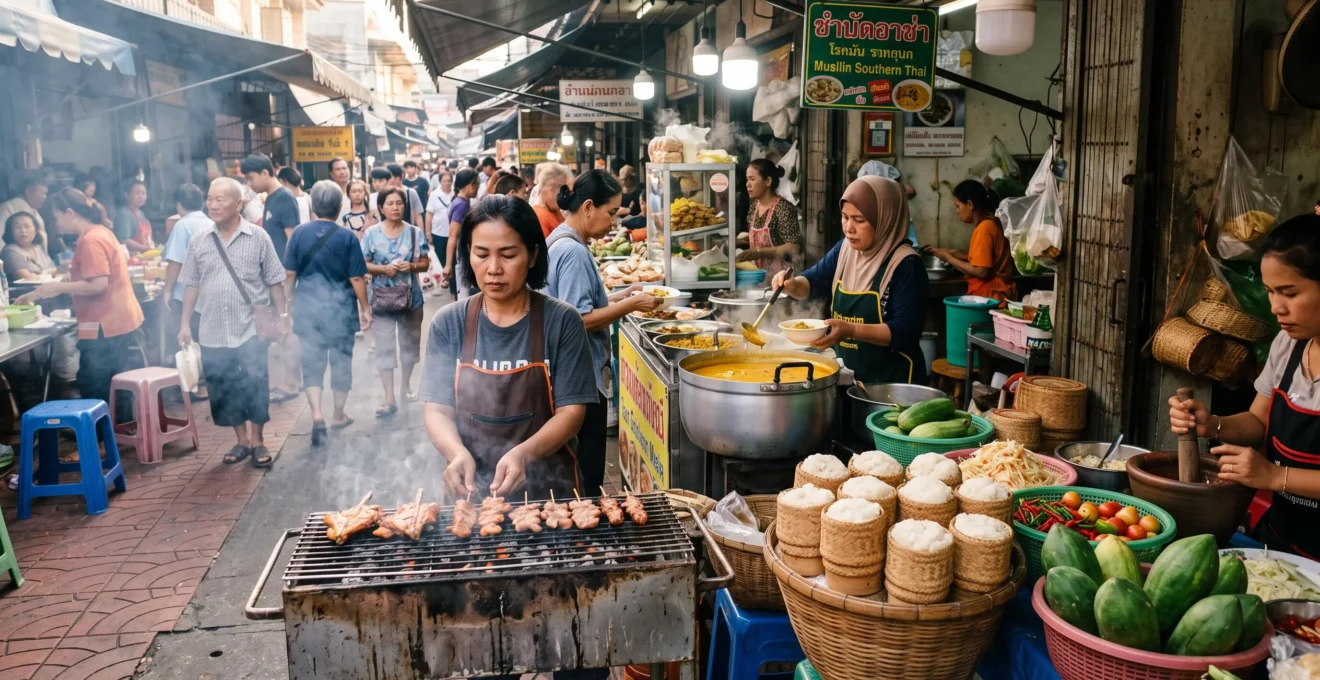
A greeting in a Chiang Mai market, a basket of sticky rice in northeastern Thailand, and a turmeric-yellow curry in the South reveal something that conventional sightseeing itineraries often overlook: Thailand is not culturally uniform.
Four broad regional traditions offer a useful starting point for understanding the country. Isan, in the northeast, shares linguistic and cultural connections with Laos. Lanna, in the North, preserves traditions associated with the former northern kingdom. Central Thailand, including Bangkok, has strongly influenced the national language and institutions. Southern Thailand reflects distinctive maritime, Buddhist, Muslim, Chinese and Malay cultural histories.
These are cultural reference points rather than rigid boundaries. Each region contains different communities, generations and local identities. Not every northern resident speaks Northern Thai, and not every southern meal is fiery.
Recognizing the differences changes how travelers listen, order food, enter temples and participate in festivals. It also encourages a more respectful approach: regional identity is something to discover through encounters, not assign to people based on geography alone.
Thailand’s four regional cultures at a glance
- Isan: Listen for Lao-related speech, look for sticky rice and fermented flavors, and discover molam music.
- Lanna: Recognize northern language traditions, Tai Tham script, distinctive temples and Chiang Mai’s historical rituals.
- Central and Southern Thailand: Compare Bangkok’s national linguistic influence with the South’s turmeric-rich cuisine, maritime heritage and diverse religious traditions.
- Why Isan Locals Speak Lao at Home: The Regional Identity Bangkok Tourists Never Notice
- 10: Why Isan Is Thailand’s Most Authentic Region: The Rural Northeast 80% of Tourists Skip
- 10.2: How to Eat Like an Isan Local: The Sticky Rice and Som Tam Ritual Bangkokians Don’t Know
- 6.2: How to Identify Lanna Culture: The Script, Temples, and Dialect That Make Chiang Mai Distinct
- 6.3: Southern Thai Curries vs Bangkok Street Food: Why the South Doubles the Chili Heat
- 6.4: The Bangkok Phrase That Confuses Locals in Isan and the South: Regional Etiquette Differences
- 49.2: How to Eat Like a Southern Thai: The Turmeric Curries and Roti That Don’t Exist in Bangkok
- 6.5: When to Experience Regional Festivals That Reveal Thailand’s Four Cultural Identities
Why Isan Locals Speak Lao at Home: The Regional Identity Bangkok Tourists Never Notice
In northeastern Thailand, many residents use Isan, a language variety closely related to Lao, in everyday conversation while also speaking Standard Thai. This reflects a regional linguistic history distinct from Bangkok’s. Travelers who recognize the difference can understand local interactions more accurately without assuming that everyone shares the same language preferences or ethnic identity.
Isan belongs to the Southwestern Tai linguistic tradition and shares substantial features with Lao. It is commonly classified officially as a regional variety of Thai, but that administrative description does not fully represent its linguistic relationships or cultural significance.
The research on diglossia and identity in Northeast Thailand, published by ST Alexander and Duncan McCargo in the Journal of Sociolinguistics, examines the hierarchy between Central Thai and phasa isan. Their research, concentrated primarily among university students in Ubon Ratchathani, describes a transitional diglossic relationship in which Central Thai holds greater institutional status.
In practical terms, Standard Thai frequently serves communication in schools, official settings and national media, while Isan remains important in informal and family interactions. Actual language choices vary by community, generation and situation.
One recognizable linguistic clue is bo or bor, a common romanization of an Isan negative or question-related form associated with Lao. Hearing it repeatedly can suggest that a conversation is taking place in Isan rather than Standard Thai. A single word, however, is not enough for certain identification.
Central Thai polite particles such as khrap and kha remain useful and generally respectful. They are not inherently offensive or incomprehensible in Isan. Regional speakers may simply use different expressions among family and friends.
The northeastern cultural landscape also reflects centuries of political relationships, migrations and population movements involving Lao-speaking communities. Nineteenth-century changes to Siam’s territories and the establishment of French control east of the Mekong shaped the modern border, but Isan’s Lao-related heritage substantially predates those events.
These connections remain visible in molam performance, the khaen mouth organ, shared food traditions and regional Buddhist practices.
Identity requires particular care. Someone may describe themselves as Thai, Isan, Lao-descended or several of these, depending on their personal understanding. Linguistic heritage should never become an ethnicity imposed by a visitor.
The most respectful approach is to notice which language people use, begin courteously in Standard Thai when necessary, and let local speakers decide whether to introduce regional expressions.
10: Why Isan Is Thailand’s Most Authentic Region: The Rural Northeast 80% of Tourists Skip
Isan offers opportunities to encounter everyday northeastern Thai culture in places less structured around international tourism. Its appeal lies in local markets, community celebrations, Khmer heritage sites and contemporary provincial cities. Calling it Thailand’s most authentic region, however, is subjective: no region possesses a monopoly on authentic Thai life, and lower tourist numbers do not automatically mean greater cultural integrity.
The familiar Bangkok–Chiang Mai–islands itinerary can obscure the northeast’s scale and diversity. Although claims that 80% of visitors skip Isan circulate in travel discussions, that percentage should not be treated as a verified regional tourism statistic.
What matters for trip planning is the difference in tourism infrastructure. Outside major centers, visitors may find fewer English-language signs, limited tourist-oriented transport and accommodation designed primarily for domestic travelers.
Rather than treating these conditions as proof of an untouched society, travelers should see them as practical circumstances requiring preparation.
Different provinces offer different introductions to the region:
| Destination | Main cultural interest | Planning consideration |
|---|---|---|
| Nakhon Ratchasima (Khorat) | Regional gateway and access to Khmer heritage, including Phimai | A practical introduction for travelers approaching from Central Thailand |
| Buriram | Phanom Rung and its Khmer architectural heritage | Travel beyond the main town is needed for the historical park |
| Ubon Ratchathani | Candle Festival, Buddhist traditions and regional cultural life | Festival visits require checking the annual program |
| Nong Khai | Mekong landscapes and Lao connections | Riverfront experiences differ from inland Isan |
| Khon Kaen and Roi Et | Molam culture, markets and contemporary northeastern society | Some cultural performances require advance local research |
The Red Lotus Lake at Nong Han Kumphawapi, in Udon Thani province, adds a seasonal natural experience. Its flowering conditions vary, making advance local checks more useful than assuming year-round displays.
Transportation also shapes the experience. Rail services connect Bangkok with major northeastern corridors, including routes toward Nong Khai and Ubon Ratchathani, but many smaller destinations require buses, local vehicles or private transport.
Less tourist infrastructure means greater responsibility for the traveler. A translation tool, accommodation address in Thai and flexible transport plan can make a substantial difference.
Modern urban life is part of Isan, too. Universities, shopping centers, cafés and regional creative communities coexist with rural traditions. These are not contradictions to be explained away.
A rewarding northeastern itinerary follows particular interests and respects the fact that residents are living contemporary lives, not preserving a cultural exhibit for visitors.
10.2: How to Eat Like an Isan Local: The Sticky Rice and Som Tam Ritual Bangkokians Don’t Know
An Isan meal is often organized around shared dishes rather than an individually plated main course. Sticky rice, grilled meat, dipping sauces, papaya salad and fresh vegetables form complementary parts of the table. Eating these foods together reveals how northeastern Thai cuisine combines texture, fermentation, herbs and communal dining, although individual households and restaurants follow different routines.
The foundation is khao niao, glutinous sticky rice, often served in a woven bamboo container. Diners take a manageable portion with clean fingers, shape it into a small ball and use it to collect dipping sauces or accompany grilled food.
Unlike ordinary steamed jasmine rice, sticky rice’s cohesive texture makes it especially suitable for eating this way.
Alongside it, a table might include gai yang (grilled chicken), jaew (a family of dipping sauces), fresh herbs and som tam (pounded green papaya salad).
One important flavor distinction is pla ra, fermented fish, which may appear in northeastern-style papaya salad. Its aroma and savory intensity differ from the fish sauce commonly used in many Central Thai preparations.
For first-time visitors, ordering several complementary dishes to share is a useful method. A basket of sticky rice, one grilled dish, a dipping sauce and a vegetable-based preparation create a manageable introduction. Ask about portion sizes before adding more food.
Som tam deserves particular attention because different recipes use different combinations of chilies, lime, fish sauce, fermented ingredients and sometimes freshwater products. Not every variation has the same food-safety profile.
Choose stalls where ingredients are stored appropriately, equipment appears clean and food is prepared to order. Busy turnover is a helpful observation, but it cannot establish whether ingredients are safe.
Travelers concerned about raw or fermented freshwater ingredients can ask about the preparation and choose versions without them. Freshly pounded papaya does not, by itself, guarantee food safety.
These meals are widely available in northeastern markets, roadside stalls and informal restaurants. Isan restaurants in Bangkok also serve them, sometimes with adaptations, so the distinction is more about context and preparation than a complete separation between regions.
Observe how local diners combine rice, vegetables and accompanying dishes before deciding what to order next. The meal becomes more revealing when the emphasis moves from tasting isolated recipes to understanding how they are eaten together.
6.2: How to Identify Lanna Culture: The Script, Temples, and Dialect That Make Chiang Mai Distinct
Lanna culture can be recognized through northern Thai speech, historical Tai Tham writing, distinctive religious architecture and regional ceremonial traditions. Chiang Mai preserves cultural features rooted in the former Lanna Kingdom, although they coexist with contemporary Thai national culture. Recognizing Lanna requires looking beyond decorative temple details to the historical practices and communities that give them meaning.
Chiang Mai was founded in 1296 and became the principal center of the Lanna Kingdom. Its political and cultural history developed through connections with other Tai societies, neighboring Burmese kingdoms and wider Buddhist networks.
The region’s gradual integration into the Siamese administrative system during the nineteenth and early twentieth centuries did not erase its cultural traditions.
One of the clearest visual markers is Tai Tham script, also called Lanna script. Historically used for religious manuscripts and regional writing, it differs from modern Standard Thai script.
Visitors may encounter it on religious objects, ceremonial decorations, manuscripts or temple displays. Not every temple sign uses Tai Tham, and modern Thai lettering is also widespread.
Architectural clues include multi-tiered temple roofs, carved wooden decoration and chedis reflecting particular northern historical styles. Some chedis have stepped or square architectural elements, but these features are not universal identifiers of Lanna architecture.
At Wat Chedi Luang, visitors can observe Chiang Mai’s historical religious environment. Wat Phra That Doi Suthep provides another major expression of the region’s Buddhist heritage and continuing devotional practices.
The spoken northern tradition, often called kham mueang, is another important distinction. Pronunciation, vocabulary and speech conventions differ from Central Thai. The polite particle chao is particularly associated with Northern Thai courteous speech, especially among female speakers in traditional usage. Its precise role depends on the sentence and speaker; it should not simply be treated as a substitute for the Central Thai pronoun khun.
For broader orientation, the Tourism Authority of Thailand’s Language & Culture article identifies distinctive regional linguistic varieties, including northern speech associated with Lanna and Chiang Mai.
Regional food provides additional clues. Khao soi, a northern curry noodle dish, and sai ua, a herb-rich sausage, illustrate flavors associated with northern culinary traditions.
Respect for elders, temple customs and the city’s Inthakhin pillar tradition adds a ceremonial dimension. These customs should not be presented as exclusive to Lanna; rather, their local expression reflects the region’s history.
Look for several clues together rather than relying on one roofline or greeting. Lanna culture is most clearly understood where historical architecture, living language and continuing religious practices meet.
6.3: Southern Thai Curries vs Bangkok Street Food: Why the South Doubles the Chili Heat
Southern Thai curries often taste considerably hotter than familiar Bangkok street-food dishes because chilies are integrated into concentrated curry pastes alongside turmeric, galangal and other aromatics. The difference reflects regional culinary traditions rather than a universal recipe. There is no reliable evidence that southern food consistently contains twice as much chili as Central Thai food.
In many southern preparations, heat is built directly into the paste before cooking. It cannot always be removed without changing the dish itself.
The Tourism Authority of Thailand’s overview of southern Thai dishes identifies turmeric, strongly flavored curry pastes and regional vegetables as characteristic elements. It also connects southern food traditions with historical maritime exchanges involving India, China and Java.
Turmeric contributes the yellow color visible in many southern curries. Shrimp paste can add fermented savoriness, while coconut milk softens and enriches selected dishes. Southern cooking is diverse: not every curry is dry, coconut-free or exceptionally hot.
Consider three representative preparations:
- Kua kling: A relatively dry, intensely seasoned minced-meat curry, commonly eaten with rice.
- Gaeng tai pla: A strongly flavored southern curry incorporating fermented fish innards and aromatic spices.
- Southern gaeng som: A sour, often turmeric-colored curry frequently prepared with fish or vegetables.
These dishes can also be found in Bangkok, particularly in restaurants specializing in southern cuisine. What changes is their everyday prominence, local variation and availability within the southern food landscape.
For travelers concerned about heat, asking for mai phet, meaning not spicy, is reasonable. However, a prepared curry paste may already contain substantial chili. A more useful question is whether the dish can actually be made milder.
Alternatives such as khao mok gai, a fragrant rice-and-chicken preparation, or some versions of massaman curry may be more approachable. Neither should be assumed mild without asking.
Fresh vegetables and rice are customary accompaniments to many strongly seasoned dishes. They make the overall meal easier to balance without requiring the cook to redesign a traditional curry.
Spice preferences also have a social dimension, but it would be misleading to suggest that every southern resident judges visitors by chili tolerance. Individual tastes differ considerably.
Rather than treating intensity as a competition, approach southern cuisine as a distinctive combination of spice, fermentation, acidity and historical influences.
6.4: The Bangkok Phrase That Confuses Locals in Isan and the South: Regional Etiquette Differences
Standard Thai expressions learned in Bangkok are generally understood across much of Thailand, but they do not always match local speech habits. Differences in vocabulary, pronunciation and conversational style can make a visitor sound noticeably formal or unfamiliar. The practical solution is not to abandon polite Thai, but to observe local interaction patterns and ask respectfully when something is unclear.
A frequently misunderstood distinction concerns khrap and kha, the widely used Central Thai polite particles. These expressions are not known to be inherently offensive in Isan or the South. They remain sensible choices for a foreign visitor.
The difference is that regional languages and dialects possess additional local speech conventions. In Isan, for example, bo appears in contexts where Central Thai uses other forms for negation or questioning.
In the South, Southern Thai vocabulary and pronunciation can differ significantly from the Central Thai varieties familiar to international learners. A common example is loroi or roi, associated with southern expressions of deliciousness. Romanized spellings vary, and local usage is more nuanced than a direct word-for-word replacement.
These examples demonstrate linguistic difference, not a predictable risk of insulting people. Standard Thai remains an effective shared communication tool in many situations.
Regional etiquette is better approached as a set of situational observations than a fixed personality map. Northern residents are not uniformly reserved, Isan residents are not uniformly informal, and southern communities cannot be described through one religious or conversational norm.
In parts of the far South with substantial Malay Muslim populations, modest clothing and attention to religious spaces are especially relevant. Elsewhere, social expectations vary with the setting.
At Buddhist temples throughout Thailand, covering shoulders and knees, removing shoes where required and following posted photography rules are reliable starting points.
A five-step regional etiquette check before exploring
- Identify the language context: Record the local language or dialect used on one sign or during one conversation, without assuming every resident speaks it.
- Prepare a courteous greeting: Save a Standard Thai greeting and one locally confirmed expression in a phone note.
- Check the venue’s customs: Note the posted dress, footwear and photography requirements before entering a temple or religious site.
- Clarify an unfamiliar word: Ask politely what it means and save the confirmed meaning rather than repeating an uncertain pronunciation.
- Review the interaction: Write down one observed local practice and whether it differed from your initial expectations.
If an expression causes confusion, a smile, an apology where appropriate and a simple request for clarification generally work better than repeating the same phrase at greater volume.
For questions about language, the Standard Thai expression phuut phasaa arai can help ask what language someone speaks, although pronunciation and phrasing should be checked with a proficient speaker.
The most transferable skill is knowing when to ask, when to listen and when to follow the example set by people in the immediate setting.
How to Eat Like a Southern Thai: The Turmeric Curries and Roti That Don’t Exist in Bangkok
Southern Thai eating traditions combine rice-based meals, aromatic curries, fresh vegetables, fermented condiments and foods influenced by Muslim and maritime trading communities. Kua kling, gaeng tai pla, khao mok and roti provide a useful introduction. These dishes are not exclusive to the South, but their regional prominence reveals culinary patterns that differ from many familiar Bangkok street-food experiences.
A practical introduction begins at a breakfast market or local food stall. Depending on the community, roti may be served with a savory curry or prepared as a sweet snack with condensed milk.
Roti is especially associated with South and Southeast Asian culinary exchanges and is familiar in many Thai Muslim food traditions. Sweetened versions also appear widely elsewhere in Thailand.
For lunch, a rice-and-curry establishment provides a chance to explore several flavors together. A modest serving of kua kling alongside rice and vegetables is one possible starting point.
Kua kling is often best approached in small spoonfuls because its concentrated seasoning can dominate a mouthful of food. Pairing it with plain rice and fresh vegetables makes its aromatic character easier to appreciate.
Gaeng tai pla offers a different experience. The fermented component contributes an intense flavor that can be unfamiliar even to travelers accustomed to other Thai curries.
For those who prefer a less aggressive introduction, khao mok gai offers an alternative built around fragrant rice and chicken. Its seasoning and preparation vary among vendors.
The southern peninsula also contains considerable religious and cultural diversity. Muslim communities are particularly significant in Pattani, Yala and Narathiwat, while their presence elsewhere along the peninsula varies by locality.
Halal restaurants, Malay-influenced preparations and foods associated with Chinese Thai communities contribute to the wider southern food landscape. No single cuisine represents every southern province.
Compared with Isan’s frequently shared sticky-rice arrangements, a southern rice-and-curry meal often places steamed rice at the center, with curries and vegetables eaten alongside it. These are common patterns rather than rules followed at every table.
When choosing market food, look for appropriate storage, clean utensils and freshly cooked dishes kept at safe temperatures. High customer turnover alone is not sufficient evidence of safety, especially for perishable seafood or fermented ingredients.
A useful one-day tasting sequence moves from roti in the morning to rice and curry at lunch, then to a different local preparation later in the day. The objective is variety and cultural understanding, not completing a checklist of the hottest foods.
What to remember before choosing a regional festival
- Choose the cultural experience first: Isan music and Buddhist candle traditions, Lanna lantern ceremonies, southern Chinese Thai celebrations or Central Thai public rituals each reveal different histories.
- Check the annual calendar: Lunar observances shift relative to Gregorian dates, and some programs change between editions.
- Plan for the type of access: Public processions, religious ceremonies and separately organized ticketed events do not necessarily have the same entry rules.
6.5: When to Experience Regional Festivals That Reveal Thailand’s Four Cultural Identities
Thailand’s regional festivals offer some of the clearest opportunities to experience language, food, music and local religious practices together. Isan’s Ubon Ratchathani Candle Festival, Chiang Mai’s Yi Peng celebrations, Phuket’s Vegetarian Festival and Central Thailand’s major Buddhist or royal ceremonies each illuminate a different cultural history. Their dates and activities must be checked annually because several follow lunar or ceremonial calendars.
In northeastern Thailand, the Ubon Ratchathani Candle Festival is associated with the beginning of Buddhist Lent, usually occurring in July. Elaborate carved candle displays and processions reflect local religious artistry.
The Tourism Authority of Thailand’s account of the 2025 festival describes processions accompanied by Isan dance, phin and khaen instruments, and molam rhythms. Its reported celebration took place from July 10 to 13, 2025; those dates should not be reused for future editions.
In the North, Yi Peng is particularly associated with Lanna communities and the lunar calendar. Chiang Mai’s celebrations can include lantern decorations, religious activities and events connected with the wider Loi Krathong season.
Large-scale sky-lantern releases may be separately organized or subject to location, aviation-safety and ticketing restrictions. Visitors should not assume lantern releases are permitted anywhere or that every event is open to the public.
In Southern Thailand, the Phuket Vegetarian Festival, also celebrated in other southern Chinese Thai communities such as Trang, reflects Chinese religious traditions. Its processions, ritual observances and vegetarian food practices illustrate another layer of southern cultural identity.
The festival generally falls in September or October, depending on the Chinese lunar calendar. It should not be interpreted as representative of every community in the religiously diverse South.
In Central Thailand, Songkran celebrations and the Royal Ploughing Ceremony offer different windows into public traditions. Songkran is celebrated throughout Thailand, with regional variations, while the Royal Ploughing Ceremony is closely associated with national royal and agricultural ceremonial traditions in Bangkok.
A regional festival therefore serves as a cultural comparison rather than a simple entertainment attraction.
The following overview helps connect festival choice with cultural interests:
| Region | Festival | Typical period | What to observe |
|---|---|---|---|
| Isan | Ubon Ratchathani Candle Festival | Usually July | Candle sculpture, Buddhist ceremonies, Isan music and dance |
| Lanna / North | Yi Peng in Chiang Mai | Usually November | Lantern traditions, religious observances and northern ceremonial culture |
| South | Phuket Vegetarian Festival | September or October | Chinese Thai processions, religious practices and vegetarian cuisine |
| Central Thailand | Royal Ploughing Ceremony | Usually May | Royal agricultural ritual and national ceremonial heritage |
| Nationwide, with regional variations | Songkran | April | New Year customs, water-related traditions and community gatherings |
For a different northeastern experience, visitors can investigate end-of-Buddhist-Lent celebrations along the Mekong, including the Naga fireball traditions associated with Nong Khai and nearby areas. Local accounts, religious interpretations and explanations of the reported phenomenon should be distinguished rather than presented as established scientific findings.
Planning requires more than knowing the month. Confirm the current festival dates with official tourism announcements and local organizers, check whether activities are public or ticketed, and distinguish religious observances from commercial visitor experiences.
Accommodation demand and domestic travel can increase around major celebrations, particularly in popular destinations. Booking arrangements depend on the particular event, year and location.
Respectful attendance also means recognizing that rituals are meaningful to participants independently of their appeal to photographers or tourists. Follow local instructions, request permission when photographing individuals and avoid disrupting religious activity.
Choose one festival that matches your interests, verify its current schedule and spend time exploring the surrounding community as well as the main event. The richest cultural encounter may be a conversation at a market, a shared meal or a locally guided explanation of a ceremony.
Can visitors travel across Thailand using only Standard Thai?
Standard Thai is widely understood through national education, media and public institutions. It is generally a practical communication language for travelers, although regional languages remain important in everyday life. English availability varies considerably by destination, and a translation tool can help outside major tourism centers.
Are Thailand’s four cultural regions official ethnic divisions?
No. Isan, Lanna, Central Thailand and Southern Thailand are useful broad cultural and geographical reference points, not four exclusive ethnic categories. Each area contains multiple communities, linguistic backgrounds and identities. Lanna also refers to a particular historical northern kingdom rather than a contemporary administrative region covering all of northern Thailand.
Is regional Thai food always more traditional outside Bangkok?
Not necessarily. Bangkok has longstanding communities and restaurants representing cuisines from across the country. Traveling to a dish’s associated region adds local context, ingredients and dining practices, but does not automatically guarantee that every preparation is more traditional or better.
How can travelers distinguish regional cultural experiences from performances designed for tourists?
Look at who organizes the activity, its stated purpose and its relationship to local communities. A visitor-oriented performance can still communicate legitimate traditions, while a community ceremony may have restrictions that should be respected. Locally guided interpretation and transparent information about the organizers provide more context than labels such as authentic or untouched.
What is the best way to learn regional Thai expressions without causing confusion?
Begin with courteous Standard Thai, then learn a small number of expressions from proficient local speakers. Ask about pronunciation, context and appropriate situations before using an unfamiliar phrase. Regional vocabularies and social conventions vary, so language learning works best as a conversation rather than a collection of assumed translations.