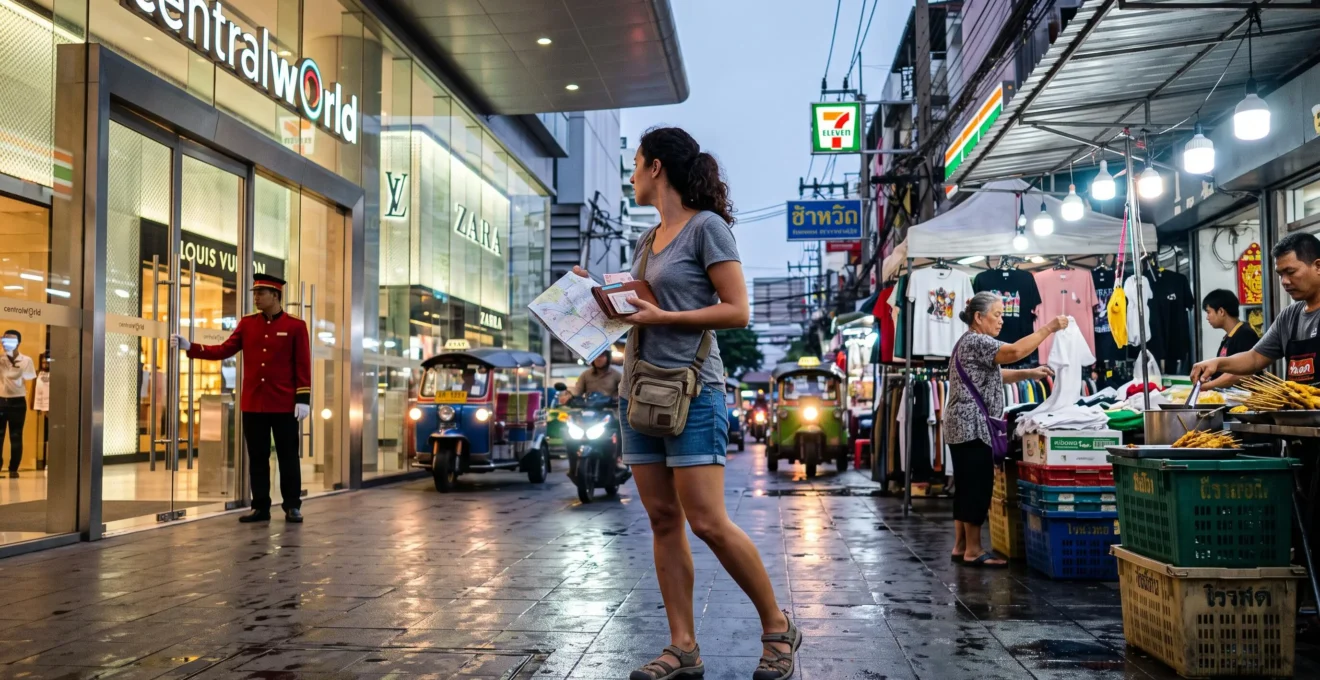
Bangkok’s shopping districts are not interchangeable. A designer handbag, a bundle of inexpensive T-shirts, a handmade ceramic bowl and a replacement phone accessory belong to different shopping routes. Choosing the wrong district can mean paying a convenience premium, losing hours in traffic or arriving when the stalls you wanted are closed.
The simplest approach is to match your purchase to the district’s retail model. Siam concentrates major malls and international brands. Pratunam specializes in affordable fashion and wholesale-style transactions. Chatuchak offers broad weekend-market variety, including crafts and homewares. MBK is a practical comparison stop for electronics, accessories and souvenirs, while neighborhood markets serve everyday shopping and food needs.
Opening schedules, product authenticity, air-conditioned access and the quantity you intend to buy matter as much as your budget. A traveler purchasing one gift should not follow the same itinerary as someone buying clothing in bulk. Use the comparisons below to identify your best starting point, then build a shopping route around the time you actually have.
Bangkok shopping districts at a glance
- Choose Siam for branded goods: Siam Paragon is the stronger luxury-first starting point, while CentralWorld suits broader shopping lists and mixed budgets.
- Choose Pratunam for inexpensive clothing: Ask whether prices apply to single pieces or multiple items, especially when shopping in the morning.
- Choose Chatuchak for market variety: Visit during the main weekend trading period for the broadest selection, or use daily markets and neighborhood shops for a less demanding experience.
- Siam Paragon vs Central World: Which Bangkok Mall Matches Your Luxury Shopping Budget?
- Where to Shop Bangkok’s Wholesale Pratunam District: The 5am-2pm Bargain Window
- Chatuchak Weekend Market or Daily Markets: Where to Shop Without 200,000 People?
- The Thai Handicraft Mistake: Why Silom Night Market Charges Triple What Chatuchak Vendors Ask
- When to Shop Bangkok’s Markets: The Chatuchak Weekend vs Daily Market Weekday Schedule
- Siam Paragon vs Central World: Which Bangkok Mall Matches Your Luxury Shopping Budget?
- Chatuchak Weekend Market or Daily Markets: Where to Shop Without 200,000 People?
- How to Explore Bangkok’s Local Neighborhoods Where Thais Actually Live and Eat
Siam Paragon vs Central World: Which Bangkok Mall Matches Your Luxury Shopping Budget?
Choose Siam Paragon when your shopping list centers on international luxury labels, watches or premium accessories. Choose CentralWorld when you want a broader mix of international retailers, Thai brands, beauty products and dining options. Neither mall is automatically cheaper for an identical product: compare the actual retailer, promotion and purchase conditions before deciding.
Both malls belong to Bangkok’s central shopping corridor, but they serve different buying priorities. Siam Paragon’s official directory lists luxury retailers including Gucci, Bottega Veneta, Balenciaga and Givenchy, alongside watch specialists such as Hublot and IWC. Its mainstream fashion stores and food outlets also make it accessible to visitors who are not buying luxury products.
CentralWorld is a wider-ranging destination. Its operator identifies more than 600 stores, including international beauty retailers and Thai wellness brands such as HARNN, PAÑPURI and Karmakamet. That breadth makes it useful when shopping for different people with different tastes.
The comparison becomes clearer when shopping goals replace vague labels such as expensive or affordable.
| Decision factor | Siam Paragon | CentralWorld |
|---|---|---|
| Best starting point | Designer fashion, luxury watches and premium accessories | Mixed-budget shopping, beauty, wellness and general retail |
| Price positioning | Prominent luxury offering alongside mainstream options | Broad mid-to-upper retail mix with premium options |
| Store character | International luxury flagships and specialist retailers | International chains alongside identifiable Thai brands |
| Convenient BTS approach | Siam | Chit Lom |
| Useful for | Targeted premium purchases | Longer, varied shopping sessions |
| Main budget risk | Confusing premium positioning with good value | Assuming every store belongs to the same price tier |
Transport can change the effective cost of a shopping session. Siam Paragon is convenient from BTS Siam, while CentralWorld is accessible from BTS Chit Lom through a covered elevated walkway. The wider pedestrian network helps shoppers move between central retail areas while reducing exposure to heat and rain. A taxi or Grab ride may be more comfortable with several heavy bags, but road congestion can undermine any time saved.
For branded products, distinguish an authorized retailer from an unrelated market seller. A lower street-market quote for a designer-looking item does not establish that it is an authentic equivalent. Ask for documentation, warranty details and a proper receipt when buying expensive goods.
Tourist VAT refunds can also affect the final expense. Under the Thai Revenue Department’s VAT refund conditions, eligible purchases must total at least 2,000 THB including VAT per store per day, at a participating retailer. Travelers need their passport and the required purchase documents. Eligibility and applicable customs procedures should be verified before payment, especially for high-value purchases.
For a specific designer item, start by identifying the authorized retailer rather than choosing solely by mall reputation. For mixed purchases, CentralWorld’s variety may save an additional shopping trip. Neither approach requires spending premium prices on everything.
Where to Shop Bangkok’s Wholesale Pratunam District: The 5am-2pm Bargain Window
Pratunam is best for shoppers buying inexpensive clothing, fashion accessories or multiple pieces of similar merchandise. The early-morning-to-early-afternoon period is a useful shopping framework, not a guaranteed discount window. Wholesale-oriented sellers may prioritize bulk buyers, while other stalls offer individual retail purchases throughout their trading hours.
The critical distinction is between wholesale quantity and retail quantity. In the alleys around Pratunam Market, clothing may be displayed in bundles or sorted by style and size for buyers purchasing stock. Around the Platinum shopping complex, visitors can also find retailers catering to smaller purchases. Individual policies differ, so a wholesale-looking display does not prove that bulk buying is required.
Before negotiating, establish what the quoted price covers. A price for one shirt may differ from the price per shirt when buying several. Some sellers quote a minimum quantity, while others use clearly marked fixed prices.
Ask three simple questions: Is this price for one piece? Is there a different price for several? Can different colors or sizes count together? The answers reveal whether a promotion fits your actual needs.
A practical timetable separates different shopping objectives:
| Time window | Shopping approach | What to verify |
|---|---|---|
| Early morning, from approximately 5am | Investigate wholesale-focused stalls and bulk purchasing | Individual stall opening times and minimum quantities |
| Later morning | Compare products, sizes and multiple-item offers | Retail versus wholesale pricing |
| Early afternoon, toward 2pm | Finish priority purchases before assuming stalls remain available | Which sellers are still operating |
| Later afternoon | Consider established indoor retailers instead of relying on morning stalls | Store-specific trading hours |
These periods describe a planning strategy rather than a universal schedule. Individual stalls and shopping complexes can open and close at different times. Avoid building a journey around a specific 5am opening without checking the intended sellers.
Price comparisons are more useful than theatrical bargaining. Before making a large purchase, examine comparable garments at multiple stalls. Check fabric composition, stitching, sizing consistency and whether the pieces actually match. A previously visited Chatuchak stall or fixed-price mall retailer can provide a baseline, provided the items are genuinely comparable.
If a seller’s first quote seems high, ask politely whether there is a better price for your quantity. If the terms remain unsuitable, move on. A fixed-price sign should be treated as a pricing policy, not an invitation to prolonged negotiation.
Logistics determine whether potential savings survive the trip. Bring cash in manageable denominations while checking whether a particular retailer accepts electronic payments. Carry a compact bag, leave room for purchases and account for the difficulty of moving through narrow, busy passages with luggage.
Pratunam is also accessible on foot from the Ratchaprarop Airport Rail Link area, although the actual walk depends on your destination and the bags you carry. Consider your return route before buying bulky bundles.
For electronics or one-off souvenirs, MBK may be a better starting point than a clothing-focused wholesale district. Compare specifications, seller policies and warranty coverage carefully, especially for expensive accessories or devices.
Pratunam offers its clearest advantage when you know what clothing you want and can compare several sellers. If you need only one carefully chosen gift, the travel and search effort may outweigh a modest saving.
Chatuchak Weekend Market or Daily Markets: Where to Shop Without 200,000 People?
Choose Chatuchak during the main weekend market when product variety matters more than comfort. Choose a weekday food market such as Or Tor Kor, an indoor retail destination or a smaller neighborhood market when avoiding crowds is the priority. The widely repeated 200,000-visitor figure should not be treated as a verified attendance forecast for your visit.
Chatuchak’s main advantage is concentration. The Tourism Authority of Thailand’s Chatuchak Market listing describes more than 8,000 stalls and merchandise ranging from clothing and ceramics to plants, antiques, food and rare books. Its official description also identifies BTS Mo Chit and MRT Kamphaeng Phet or Chatuchak Park as access options.
That scale creates a navigation problem. Entering without a shopping objective may mean spending much of the visit walking through categories you have no intention of buying.
Use the market’s section and lane signage to identify relevant shopping areas, then choose an entrance that suits your route. MRT-side access can be useful when your targets lie near that part of the market. It should not be assumed to guarantee smaller crowds than the BTS approach.
The trade-off between Chatuchak and its alternatives is substantial.
| Factor | Chatuchak weekend market | Weekday or daily alternatives |
|---|---|---|
| Product diversity | Broad concentration of fashion, crafts, plants and homewares | Depends strongly on the venue |
| Crowd exposure | Can be intense at popular times | Potentially easier to manage, without guarantees |
| Food shopping | Available among general market stalls | Or Tor Kor specializes in food and produce |
| Shopping atmosphere | Large-scale weekend bazaar | More focused or conventional retail environment |
| Availability | Full selection depends on weekend trading | Venue-specific weekday schedules |
| Best strategy | Target sections and prioritize unusual goods | Choose by product and proximity |
The crowd question is not solved by a single arrival time. Early visits often provide a more manageable starting point, but stall readiness, holidays, weather and seasonal travel patterns vary. A quiet lane can lead into a congested junction within minutes.
If your interests are primarily food, consider Or Tor Kor rather than entering the entire weekend market. If your goal is ordinary clothing, snacks or generic souvenirs, a conveniently located daily shop may offer an easier buying experience.
Before skipping Chatuchak entirely, consider what you would lose. Its value is not merely low prices; it is the opportunity to compare numerous vendors and specialized categories within one large destination. That is particularly relevant when looking for distinctive crafts, decorative objects or unusual secondhand goods.
For visitors sensitive to heat, crowding or prolonged walking, splitting the experience can be sensible: make a short targeted weekend visit and use nearby food markets or comfortable indoor locations for the remainder of the day.
Choose Chatuchak because its range matches your shopping list, not because it appears on every Bangkok itinerary. If comfort is the priority, a smaller market with the right products may be the more successful destination.
The Thai Handicraft Mistake: Why Silom Night Market Charges Triple What Chatuchak Vendors Ask
Silom-area tourist night-market stalls can charge more than comparable sellers at Chatuchak, but a threefold price difference is not a verified universal rule. Convenient evening access, tourist demand and retail-location costs can help explain price premiums. The reliable way to judge value is to compare genuinely equivalent items, materials and workmanship rather than assuming one district always costs more.
A shopper staying near Silom may value being able to buy a gift after dinner without traveling across Bangkok. That convenience has economic value. Vendors in areas with heavy visitor traffic may also price products according to what casual shoppers are willing to pay.
Chatuchak provides a different comparison environment. Its extensive range makes it possible to inspect similar product categories across multiple stalls. However, the existence of more competitors does not prove that every seller charges less or that bargaining will always succeed.
Higher prices do not certify handmade quality. Thai-style textiles, carved wood, decorative soaps, ceramics and other souvenir categories can include mass-produced goods alongside genuinely distinctive work. Similar-looking products may have different materials, origins and finishes.
Use physical inspection to separate quality from presentation:
- Textiles: Check the weave, fabric weight, seams and consistency of the pattern. Ask about the material rather than assuming a silk-like finish means silk.
- Wooden objects: Examine joins, surface finish, irregularities and any visible damage. Ask whether the item is handmade or machine-produced.
- Ceramics: Inspect glazing, cracks, chips and stability. Consider how the seller will package a fragile purchase.
- Soaps and scented products: Look for ingredient information, labeling and sensible packaging, particularly when buying products for skin contact.
- Origin claims: Ask where the item was made and whether the vendor can substantiate a specific artisan or production claim.
For example, imagine a hypothetical traveler who sees a patterned cotton bag in a Silom tourist stall. The traveler photographs the item with the vendor’s permission, notes the asking price and later compares its dimensions, fabric, lining and stitching with products at Chatuchak. Only when those details match does the price comparison become meaningful.
Silom remains a rational choice when the alternative would involve substantial transport time, an inconvenient weekend detour or another day spent shopping. A visitor buying one small present may reasonably accept a moderate premium for proximity and convenience.
Do not assume that a historic night-market name guarantees an operating venue today. Market locations and trading arrangements can change, and specific walking-street events may run only on selected days. Verify the exact market rather than relying on a general reference to Silom.
The central mistake is treating price as proof of authenticity or treating every tourist-oriented seller as overpriced. Inspect the product, compare like with like and decide how much the convenient location is worth to you.
When to Shop Bangkok’s Markets: The Chatuchak Weekend vs Daily Market Weekday Schedule
Plan Bangkok shopping around the market’s trading pattern, not simply the day you have free. Reserve a weekend slot for Chatuchak’s main market, use weekday mornings for selected wholesale and fresh-food shopping, move into air-conditioned malls during hotter hours and consider verified night markets after dark. Individual sellers and market schedules can change.
The most important scheduling distinction is between venues with a broadly regular daily retail model and those whose core experience depends on particular days. A shopping mall generally offers more predictable availability than an independently operated street-market stall. Chatuchak’s full weekend retail offering should not be confused with specialized activity in the surrounding market area on weekdays.
A useful planning view separates destinations by their typical trading rhythm.
| Venue or district | Planning window | Key caution |
|---|---|---|
| Chatuchak main market | Saturday and Sunday | Do not expect the full weekend selection on weekdays |
| Chatuchak plant and flower trading | Selected weekday periods | Check current section-specific arrangements |
| Or Tor Kor | Daily-market planning for food and produce | Individual vendors may keep different hours |
| Pratunam wholesale-oriented stalls | Early morning into daytime, depending on seller | Do not assume identical opening times |
| Siam Paragon and CentralWorld | Daytime and evening retail sessions | Check current mall and retailer hours |
| Bangkok night markets | Evening, on venue-specific operating days | Locations and schedules can change |
| Neighborhood fresh markets | Often early morning or local evening periods | Trading patterns depend on the community |
For a traveler with several days in Bangkok, the efficient sequence is to protect the least flexible shopping opportunity first. If Chatuchak is a priority, reserve an available weekend morning. Put Pratunam on a separate morning if affordable clothing is important, then use central malls for flexible afternoon or evening sessions.
Price and selection can shift with timing, but not according to a universal formula. Morning buyers may encounter fuller stock or sellers focused on larger purchases. Near closing, some vendors may consider discounts, while others retain fixed prices or have already sold desirable items. Waiting until the last hour is a gamble, not a dependable saving method.
Thai public holidays, local events and changes in market management can disrupt normal plans. For night markets, confirm both the operating days and the current physical location. Search for recent venue updates rather than assuming an old travel article describes the present market.
Five checks before finalizing your Bangkok shopping itinerary
- Write down your three main shopping categories and assign one preferred district to each; keep a short district shortlist.
- Confirm the operating days and hours of your selected venues using their latest available information; save a verified schedule.
- Identify the nearest practical BTS, MRT or Airport Rail Link access point for each destination; save a transport route.
- Set a spending limit and decide whether you need single items or multiple pieces; record a purchasing plan in Thai baht.
- Check payment options, luggage space and your return journey; prepare a cash-and-carry checklist before departure.
Protect the irreplaceable shopping window first, then fit flexible destinations around it. A workable calendar prevents more wasted time than a rushed visit to an attractive market that is only partly operating.
Siam Paragon vs Central World: Which Bangkok Mall Matches Your Luxury Shopping Budget?
Siam Paragon is the better starting point for a premium shopping session centered on luxury flagships, while CentralWorld is often the more flexible choice for a half-day mixing shopping, food, beauty and general retail. The best choice also depends on where you stay, who is traveling with you and whether your priority is a specific purchase or a comfortable afternoon.
Purpose matters beyond store names. Siam Paragon’s shopping directory identifies luxury fashion, watches, mainstream retail and ground-floor food options. Its aquarium-related attractions can also interest families, although the current operating status, admission arrangements and location details should be checked separately before planning a visit around them.
CentralWorld offers a wider multi-purpose setting, with shopping, dining and space for events and seasonal installations. Event availability is not constant, so check the current program if entertainment or a particular installation is part of the reason for visiting.
The mall’s official shopping and visitor information identifies Thai beauty and wellness brands, BTS Chit Lom access and a covered elevated walkway connecting the Ratchaprasong area with the wider pedestrian network toward Siam. It also describes tourist services, though individual promotions and benefits may change.
For a family or mixed-budget group, use a split shopping route rather than requiring everyone to browse the same stores. One person can examine a luxury brand while others explore mainstream fashion, food or beauty retailers. Agree on a meeting point and allow for the considerable walking involved in large complexes.
Inside either mall, do not assume every floor operates at the same price level. Start with the store directory, identify your target categories and route directly to the relevant shops. Food halls, international chains and premium boutiques serve different budgets despite sharing the same building.
The mall-versus-market decision also changes by product:
- Branded luxury goods: Favor authorized mall retailers for verifiable product provenance, receipts and formal sales conditions.
- Thai beauty and wellness products: Compare official retailers and product information rather than relying on packaging alone.
- Everyday clothing: Compare mainstream mall prices with Pratunam only when the materials, sizes and quality are sufficiently similar.
- Electronics: A mall retailer can be useful for documented warranties, while MBK may broaden the range of sellers and accessories to compare.
- Crafts and generic souvenirs: Markets can provide more opportunities to inspect alternatives, although authenticity and prices still require checking.
If your accommodation is close to Siam, visiting Siam Paragon can be easier than crossing town for a different shopping experience. If you are already near Chit Lom or Ratchaprasong, CentralWorld may be the natural starting point. Combining both in one outing is practical when energy and time permit, but excessive walking can reduce the benefit.
The best Bangkok mall is not necessarily the largest or most prestigious. It is the one that lets your group buy the intended products, take breaks when needed and avoid an unnecessary second journey.
Chatuchak Weekend Market or Daily Markets: Where to Shop Without 200,000 People?
If you decide to visit Chatuchak on a weekend, make it a targeted shopping trip rather than an endurance test. Arrive with a short product list, a section-based route, drinking water and a meeting point. If your main needs are food, ordinary clothing or simple souvenirs, daily alternatives may provide most of what you want with less walking and crowd exposure.
The distinction starts with product scarcity. Chatuchak’s broad mix of ceramics, plants, antiques, decorative goods, clothing and other categories can justify a dedicated visit. Shoppers searching for unusual home accessories or a specific style of handicraft may value the opportunity to compare many stalls in one place.
By contrast, a basic T-shirt, packaged snack or commonplace souvenir rarely justifies a lengthy market visit if a convenient shop already meets your needs. The market’s real advantage is choice, not guaranteed bargains on every product.
Use these practical safeguards when shopping in crowded outdoor sections:
- Carry water and take breaks away from the most congested lanes, especially during hot or humid weather.
- Save a screenshot of the section map and agree on a recognizable meeting point with traveling companions.
- Keep cash and essential belongings secure without making them difficult to access.
- Wear comfortable shoes and avoid carrying unnecessary luggage through narrow passages.
- For bulky purchases, ask about available shipping or delivery arrangements, obtain written terms and confirm costs before paying.
Mobile connectivity can be unreliable in a crowded venue, so a saved map and meeting point are sensible precautions. Do not depend entirely on being able to call another member of your group immediately.
Chatuchak also has neighboring options that can serve a different purpose. Or Tor Kor is a useful food-and-produce alternative. Specialized plant and flower trading in the broader Chatuchak area follows schedules distinct from the full weekend market, making it important to verify the intended section rather than treating the entire district as one venue.
A split-visit strategy can work well. For example, a food-focused traveler might explore a quieter food market on one day, then return for a short Chatuchak visit only if a specific craft or homeware category remains on the shopping list.
This is not always the cheapest approach in transport terms, but it reduces the pressure to cover an enormous market in one exhausting session. For travelers with limited mobility or strong heat sensitivity, the more comfortable alternative may be worth prioritizing.
Go to Chatuchak when its product diversity is essential to your visit. Otherwise, let convenience guide the decision, and save the time for another Bangkok experience.
What to remember before choosing your final shopping stop
- A local market is not automatically cheaper or more authentic than a major shopping destination; the quality and usefulness of the purchase still matter.
- Bangkok’s residential neighborhoods provide a different shopping experience, built around daily food, services and community life rather than visitor-oriented merchandise.
- If discovering local food and everyday routines matters more than acquiring goods, a neighborhood visit may suit you better than another large market.
How to Explore Bangkok’s Local Neighborhoods Where Thais Actually Live and Eat
Explore Bangkok’s residential neighborhoods when everyday food, small businesses and local street life interest you more than luxury brands or large souvenir markets. Areas such as Khlong Bang Luang and established riverside communities offer a different perspective on shopping. Visit respectfully, follow local trading hours and remember that residential streets are not attractions arranged for tourists.
Neighborhood shopping follows residents’ needs rather than a visitor’s sightseeing schedule. Morning fresh markets may concentrate on produce, prepared meals and household essentials. Small family-run shops serve nearby residents, while food vendors can become busier around commuting and meal periods.
Khlong Bang Luang, associated with canal-side community life and arts activities, is one possible starting point for travelers interested in craft and neighborhood culture. But the existence of an artist village does not mean every business sells locally handmade goods or that all workshops operate continuously. Verify specific activities before traveling for a particular purchase.
Riverside and canal-side neighborhoods can reward slower exploration, especially when the goal is understanding how food, transport and daily commerce fit together. Shopping may involve buying a snack, visiting a small independent shop or examining locally offered crafts rather than filling a large bag with souvenirs.
The term resident prices should be treated carefully. A neighborhood location does not establish that something is cheaper or that a visitor will automatically pay the same amount as a regular customer. Posted prices, fair comparisons and transparent communication are more useful than assumptions about what local goods ought to cost.
Respectful exploration also means recognizing the difference between a commercial lane and a residential one. A small alley may contain homes, family workplaces and private entrances. Avoid entering private spaces, photographing people without permission or obstructing customers simply to capture an appealing street scene.
For food-first travelers, begin with vendors visibly serving local customers and choose dishes you understand or can ask about. Keep small cash denominations available, observe hygiene and storage conditions, and respect queues. A vendor being popular with residents can be a useful observation, but it does not guarantee safety, price or quality.
Different travelers benefit from different levels of exploration:
| Traveler priority | Neighborhood approach | Alternative when unsuitable |
|---|---|---|
| Discovering everyday Thai food | Visit a functioning neighborhood food market at its active trading time | Or Tor Kor for a more focused food-market outing |
| Finding small creative businesses | Explore established arts or canal-side community areas | Chatuchak for a broader range of crafts |
| Experiencing daily Bangkok life | Walk through public commercial streets and support local businesses | A major market for concentrated retail |
| Minimizing heat and walking | Choose a short local outing with planned rest stops | An air-conditioned mall for greater comfort |
| Buying several specific products | Use neighborhood shops only when they match the list | Siam, Pratunam or MBK for targeted categories |
A neighborhood is rarely the fastest destination for a shopping list full of unrelated products. Its advantage is the ability to connect smaller purchases with food and observation. That can make it especially appealing to repeat visitors who have already explored Bangkok’s central retail areas.
Choose one shopping goal for your next free morning: a branded purchase, inexpensive fashion, distinctive market goods or everyday local food. Match it to the relevant district, confirm the venue’s current schedule and plan transport around that destination. A focused shopping trip usually achieves more than trying to visit every famous Bangkok market in a single day.
Which Bangkok shopping district is best for first-time visitors?
Siam is a practical starting point for first-time visitors because its connected shopping area offers international brands, mainstream retail, restaurants and straightforward BTS access. Choose Pratunam instead if inexpensive fashion is your main goal, or Chatuchak if your visit includes a weekend and you want market shopping.
Is MBK a better place than Pratunam to buy electronics?
MBK is a more relevant starting point for electronics, phone accessories and comparison shopping across specialist sellers. Pratunam is primarily useful for clothing and fashion-related purchases. At MBK, check the exact model, authenticity, warranty territory, return conditions and receipt before making an expensive purchase. A low quote alone is not proof of good value.
Can tourists claim a VAT refund on Bangkok shopping purchases?
Eligible visitors can claim refunds on qualifying goods bought from participating retailers under Thailand’s VAT Refund for Tourists scheme. The official guidance specifies a minimum purchase of THB 2,000 including VAT per store per day, presentation of a passport and the required documentation at purchase. Goods must leave Thailand within the applicable period, and airport inspection procedures may apply. Confirm current requirements before buying.
Can you visit Chatuchak Market on a weekday?
Some specialized trading activity occurs in the broader Chatuchak area outside the main weekend market, but visitors should not expect the full Saturday-and-Sunday selection on weekdays. Check the specific section and its opening arrangements. Nearby food markets can provide alternative shopping opportunities on other days.
Is bargaining expected everywhere in Bangkok?
No. Negotiation may be possible with some independent market vendors, particularly for multiple purchases, but malls and fixed-price retailers generally use posted prices. Ask politely whether a discount applies to the quantity you want, and respect a seller’s stated price when negotiation is not offered.