Transportation & Mobility
Every journey begins with a simple question: how will I get there? Transportation and mobility form the backbone of all travel, whether it’s a weekend getaway two hours from home or a months-long expedition across several continents. Understanding how different modes of transport work, how they compare, and how to combine them wisely can transform a stressful trip into a smooth and enjoyable experience.
This pillar page serves as your complete introduction to the world of travel transportation. Think of it as a map of maps: an overview that connects every aspect of moving from point A to point B, and that will help you navigate all the more specific topics explored throughout this category.
What Does Transportation & Mobility Actually Mean?
At first glance, the two words may seem interchangeable, but they describe complementary ideas. Transportation refers to the physical means of moving people and goods: planes, trains, buses, cars, ferries, bicycles. Mobility is a broader concept: it describes the ability to move freely and efficiently within an environment, combining multiple transport options, walking, and new solutions like bike-sharing or ride-hailing.
An easy way to picture the difference: transportation is the engine, while mobility is the entire journey. A traveler flying from London to Rome uses transportation (the airplane), but their overall mobility includes the train to the airport, security procedures, the flight itself, and the metro ride from the airport into the city center.
The Main Modes of Travel Transportation
Each mode of transport has its own personality, its strengths and its compromises. Choosing well means matching the mode to your priorities: time, budget, comfort, or experience.
Air Travel: Speed Over Long Distances
Aviation remains unbeatable for covering great distances quickly. A flight can shrink a journey that once took weeks by sea into a matter of hours. Its main trade-offs are cost, airport procedures, and a significant environmental footprint.
- Best for: international trips, long distances, urgent travel
- Watch out for: baggage fees, layovers, airport transfers that add hidden time
- Pro tip: compare the door-to-door time, not just flight duration; a 1-hour flight with 2 hours of airport procedures may lose to a 3-hour train ride
Rail Travel: The Comfortable Middle Ground
Trains offer a rare combination: you travel from city center to city center, without security lines or baggage restrictions. In many regions, high-speed networks rival airlines for journeys under 500 miles (800 km), while scenic routes turn the journey itself into the destination.
Road Travel: Freedom and Flexibility
Driving, whether your own car or a rental, gives you total control over your itinerary. It excels at rural destinations, family trips, and routes where public transport is sparse. The costs to anticipate include fuel, tolls, parking, and insurance. Alternatives like intercity buses and carpooling offer budget-friendly versions of road travel.
Maritime and Urban Mobility
Ferries connect islands and coastal regions, often accepting vehicles on board. Within cities, mobility multiplies: metros, trams, buses, bike-share systems, scooters and ride-hailing apps. The key concept here is the multimodal journey: combining two or three of these options in a single trip, which is often faster and cheaper than relying on just one.
How to Choose the Right Mode of Transport
There is no universal best option, only the best option for a specific trip. A simple decision process helps clarify things:
- Define your distance and duration. Under 3 hours: train or car usually wins. Over 6 hours or across water: flying becomes relevant.
- Rank your priorities. Budget traveler? Buses and carpooling. Time-constrained? Fly. Experience-seeker? Scenic rail or road trips.
- Calculate the true door-to-door cost. Add transfers, baggage fees, parking and airport transfers before comparing prices.
- Check the environmental impact. Trains typically emit far less CO2 per passenger than planes or cars; this increasingly influences both regulations and traveler choices.
Consider a concrete example: traveling from Paris to Amsterdam. The flight itself takes 1 hour 15 minutes, but with airport transfers and check-in, the door-to-door time reaches about 4 hours. The direct high-speed train takes 3 hours 20 minutes, city center to city center, often at a comparable price. The train wins on time, comfort and emissions — a perfect illustration of why door-to-door thinking matters.
Planning and Booking: The Practical Essentials
Good transportation planning rests on a few habits that experienced travelers apply systematically:
- Book strategically: trains and flights often open sales months in advance, with prices rising as departure approaches
- Allow buffer time: never schedule a tight connection between two separate bookings; delays happen
- Verify documents: identification requirements vary by mode, carrier and country — a domestic bus may accept nothing, while international rail requires a passport
- Keep everything accessible: digital tickets, offline maps, and carrier contact details saved on your phone
A useful metaphor: think of your itinerary as a chain. Each transport segment is a link, and the trip is only as strong as its weakest connection. Building slack into your plan — an extra hour between connections, a backup route in mind — keeps one broken link from breaking the whole chain.
Trends Shaping the Future of Mobility
The transportation landscape is evolving quickly, and several movements are worth watching as a traveler. Sustainable travel is pushing rail renaissance in many regions, with night trains returning and airlines facing stricter environmental scrutiny. Smart mobility integrates everything into single apps: one subscription or one interface covering metro, bike-share and bus. Electrification is transforming road travel, with charging networks expanding along major routes and rental fleets increasingly electric.
For travelers, these trends translate into more options but also more choices to make. The fundamentals, however, remain constant: understand your priorities, compare the full journey rather than isolated segments, and plan connections with realistic margins.
Exploring Further
This page is your foundation. From here, the category’s dedicated articles dig into each mode in detail: booking tactics for flights and trains, road trip planning, urban transit navigation, luggage rules, accessibility considerations, and much more. Use this overview as your compass: whenever you face a transport decision on a trip, come back to the core questions — distance, priorities, true cost, and connection quality — and the right choice usually becomes obvious. Safe travels, and enjoy the journey as much as the destination.

How to Use the Chao Phraya River as Bangkok’s Most Scenic Transport Corridor
The Chao Phraya River is more than a backdrop for Bangkok’s temples and sunset photographs. It is a working transport…
Lire la suite
How to Book Thailand Sleeper Trains: The Bangkok-Chiang Mai Night Journey Worth Taking
There is a particular pleasure in leaving Bangkok after dark, watching station lights slip past your window, and waking as…
Lire la suite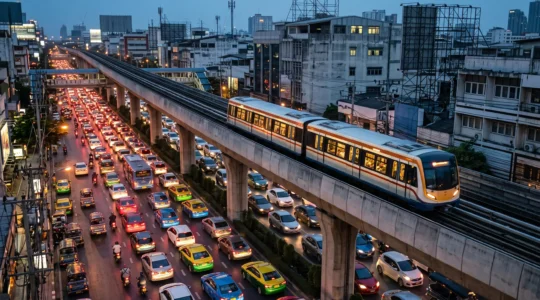
How to Master Thailand’s City Transit: BTS, MRT, and Airport Rail Systems Decoded
Bangkok has several urban rail networks, but learning one does not automatically teach you how to use the others. The…
Lire la suite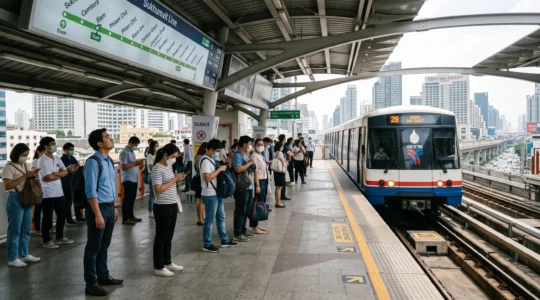
How to Use Bangkok’s BTS Skytrain Like a Local: The Route, Station, and Exit Strategy
Bangkok’s BTS Skytrain becomes much easier to navigate once you stop thinking only about station names and start planning around…
Lire la suite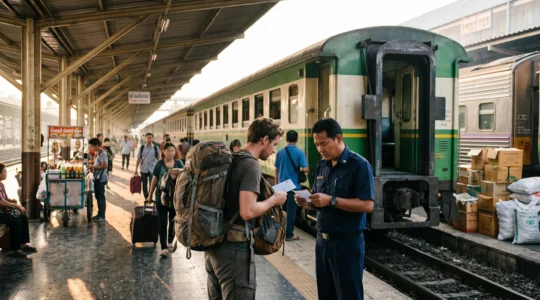
How to Travel Between Thai Provinces: The Bus, Train, and Flight Decision Matrix
Travelling between Thailand’s provinces is not simply a choice between the cheapest bus and the fastest flight. The practical winner…
Lire la suite