Culture & Traditions
Every journey begins with a map, but the most memorable journeys begin with an encounter. The smell of spices in a market, the sound of an unfamiliar greeting, the way strangers share a meal — these are the moments that turn a trip into an experience. This pillar page is your starting point for understanding Culture & Traditions: what they are, why they matter, and how to engage with them respectfully and meaningfully as a traveler.
Think of culture as an invisible operating system. It runs silently in the background of every society, shaping how people greet each other, what they eat, how they celebrate, and what they consider polite or rude. As a visitor, learning to read this system is the single most rewarding skill you can develop.
What Are Culture and Traditions?
At their core, culture and traditions are the accumulated answers a community has developed to life’s essential questions: how to live together, how to mark time, how to welcome strangers, and how to pass wisdom to the next generation.
- Culture is the broad framework: language, religion, art, cuisine, social norms, and values shared by a group.
- Traditions are the specific practices within that framework: rituals, festivals, ceremonies, crafts, and customs handed down over generations.
A helpful analogy is to imagine culture as a forest and traditions as individual trees. The forest gives context and meaning; each tree is a tangible, observable practice you can experience directly — a tea ceremony, a harvest dance, a Sunday market.
Why Culture Matters When You Travel
Some travelers treat culture as a backdrop; the savviest treat it as the destination itself. Understanding local traditions transforms your experience in three concrete ways.
Deeper Connections
When you know that removing your shoes is expected before entering a home in Japan, or that sharing food is a central expression of hospitality in Morocco, you stop being a spectator and become a participant. Locals consistently open up more to visitors who show genuine curiosity about their way of life.
Fewer Awkward Moments
Cultural misunderstandings are rarely catastrophic, but they can be uncomfortable. A simple gesture like a thumbs-up, a hand offered with the left hand, or a compliment about someone’s spouse can carry completely different meanings across cultures. Knowing the basics protects both you and your hosts.
Richer Memories
Research on travel psychology consistently shows that experiences involving genuine human connection are remembered far longer than sightseeing alone. Attending a local festival or learning three words of the local language often becomes the story you tell for years.
The Major Dimensions of Culture and Traditions
To make sense of any new cultural environment, it helps to break it down into observable dimensions. Here are the five that matter most for travelers.
1. Festivals and Celebrations
Festivals are culture at its most visible and joyful. They range from religious observances like Ramadan, Diwali, or Easter processions to secular gatherings like carnival celebrations, music festivals, and national days. Timing your trip around a major festival can be transformative — but book accommodation early, as prices rise and availability drops dramatically.
- Religious festivals often involve modified schedules, closures, and specific dress codes.
- Harvest and seasonal festivals showcase local agriculture, food, and craftsmanship.
- National celebrations reveal a country’s history and collective identity.
2. Food and Culinary Heritage
Cuisine is often called the most accessible entry point into a culture — and for good reason. Every dish carries history: trade routes, migrations, climate, and religious rules are all written into recipes. Eating street food in Vietnam, joining a family dinner in Italy, or sharing a communal platter in Ethiopia are not just meals; they are cultural lessons served on a plate.
Practical tip: learning a few phrases about food — how to order, thank, and compliment the cook — opens more doors than any other social skill.
3. Social Etiquette and Communication
Etiquette covers the unwritten rules of daily interaction. These vary enormously and are where most cultural friction occurs.
- Greetings: handshakes, bows, cheek kisses, or a simple nod — the appropriate greeting differs everywhere.
- Personal space: comfortable distance in conversation ranges from arm’s length to much closer.
- Concepts of time: some cultures prize punctuality; others view schedules as flexible suggestions.
- Gestures: the same hand sign can mean approval, money, or insult depending on where you are.
When in doubt, observe first and imitate. Watching how locals behave in queues, restaurants, and places of worship tells you more than any guidebook.
4. Arts, Crafts, and Oral Traditions
Music, dance, weaving, pottery, storytelling, and tattooing are traditions made tangible. Many are recognized through international heritage designations, and supporting their practitioners — by buying directly from artisans or attending performances — helps keep these skills alive.
5. Religion and Spiritual Practices
Sacred sites, rituals, and beliefs shape daily rhythms in much of the world. As a visitor, you are usually welcome to observe, and sometimes to participate — provided you follow the rules: dress modestly, ask before photographing, and stay quiet during ceremonies.
How to Approach a New Culture: A Practical Method
Understanding culture and traditions can feel overwhelming. Here is a simple, repeatable five-step method you can apply to any destination.
- Prepare before departure: spend an hour reading about local customs, dress norms, and taboos. Focus on essentials, not everything.
- Learn the linguistic basics: ten words — hello, please, thank you, excuse me, delicious — signal respect instantly.
- Observe before acting: on your first day, watch how people greet, queue, eat, and dress. Adapt accordingly.
- Ask with humility: most people are delighted to explain their customs. Frame questions with curiosity, not judgment.
- Reflect afterward: note what surprised you. This habit builds genuine intercultural competence over time.
Responsible Cultural Engagement
With the rise of global travel, some traditions risk becoming commodities — performances staged for tourists rather than living practices. Being a thoughtful traveler means distinguishing authenticity from spectacle and contributing positively to the communities you visit.
- Ask before photographing people, especially during religious or intimate moments.
- Pay fairly for local crafts and experiences; bargaining is welcome in markets, but extreme haggling over artisan prices harms livelihoods.
- Dress appropriately at sacred sites — covering shoulders and knees is a near-universal baseline.
- Respect restrictions: some ceremonies, spaces, or objects are simply not open to outsiders.
- Learn the context of any tradition before participating, so your involvement honors rather than trivializes it.
Think of yourself as a guest in someone’s home, scaled up to a country. Guests who are polite, curious, and considerate are welcomed back; guests who demand and judge are quietly resented.
Common Questions About Culture and Traditions
What is the difference between culture and heritage?
Culture is the living, evolving system of practices and values; heritage is what gets preserved and passed down — both tangible (monuments, artifacts) and intangible (songs, rituals, skills). All heritage comes from culture, but not all culture becomes heritage.
Can traditions change without being lost?
Yes — and they always have. Traditions are living practices, not museum pieces. A harvest festival that adapts to urban life or a craft that finds new markets is evolving, not dying. What threatens traditions is not change but the loss of the community and context that give them meaning.
How do I know if a tourist experience is culturally authentic?
Look for community involvement. Experiences designed and run by local people, with local benefit, tend to be authentic. If a performance exists solely for tour buses and the community has no ownership, treat it as entertainment rather than cultural immersion.
What if I make a cultural mistake?
Almost always: nothing serious. A sincere apology, a willingness to correct your behavior, and a bit of humor go a very long way. Locals generally forgive visitors who show good faith far more readily than visitors who show indifference.
Where to Go From Here
This page is your gateway. Culture and traditions are not subjects you master once — they are a lifelong lens that sharpens with every trip. As you browse the rest of this category, you will find focused explorations of festivals, cuisine, etiquette, spiritual practices, and regional traditions around the world.
The best way to begin? On your next trip, choose one tradition — a dish, a festival, a greeting custom — and learn its story. Ask one local about it. That single conversation will teach you more than a dozen guidebooks, and it will be the moment your travels truly come alive.
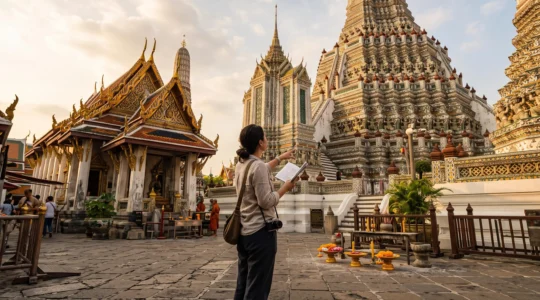
How to Read a Thai Temple: The 6 Architectural Elements That Reveal Its Century and Purpose
Two Thai temples may stand a few streets apart yet belong to remarkably different architectural traditions. One has a soaring…
Lire la suite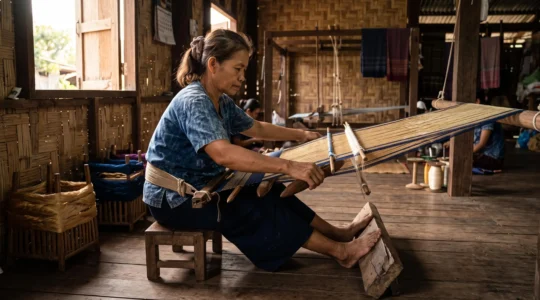
How Thai Weavers Use 500-Year-Old Backstrap Looms: The Body-Tensioned Weaving Technique
A backstrap loom does not require a heavy wooden frame to maintain the tension of its warp threads. Instead, one…
Lire la suite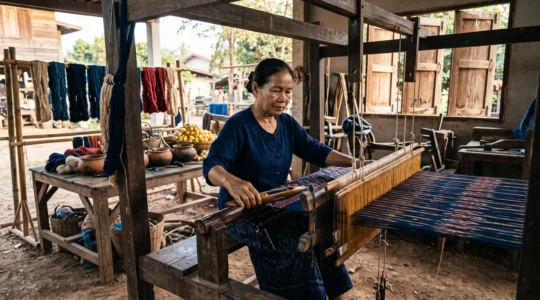
Where to Witness Traditional Thai Crafts Still Practiced in Village Workshops, Not Tourist Demonstrations
The most revealing Thai craft encounters rarely begin with a scheduled demonstration. They begin in a working household, where a…
Lire la suite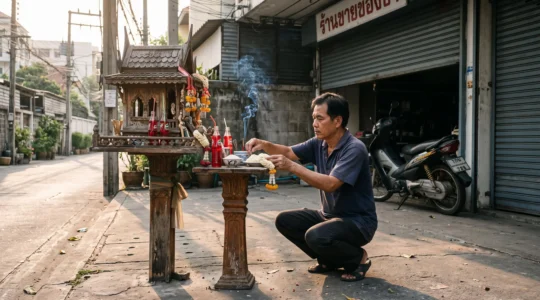
Why Thais Leave Food at Spirit Houses Daily: The Animist Practice Behind Modern Bangkok
Before Bangkok’s shops open, small plates of rice, fruit and brightly coloured drinks may already be waiting outside their doors….
Lire la suite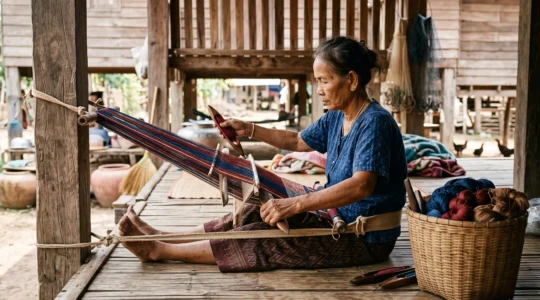
Where to See Traditional Thai Silk Weaving Still Practiced, Not Demonstrated for Tourists
For travelers seeking traditional Thai silk weaving that exists beyond tourist demonstrations, northeastern Thailand offers a compelling starting point. In…
Lire la suite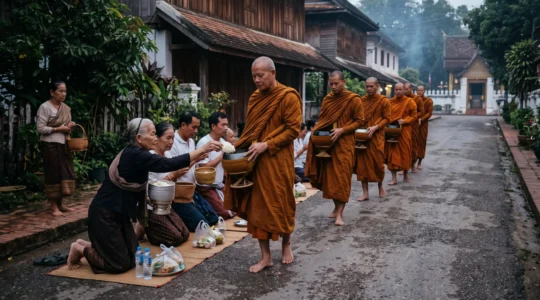
How to Offer Alms to Thai Monks: The 6 Etiquette Rules Locals Follow at Dawn
Before sunrise in Thailand, Buddhist monks may walk quietly through neighborhoods carrying alms bowls while residents wait with prepared food….
Lire la suite
How Thais Assess Your Social Standing in 30 Seconds: The Occupation, Degree, and Family Markers
At a Thai business introduction, a senior government officer may receive more ceremonial attention than a wealthy entrepreneur standing beside…
Lire la suite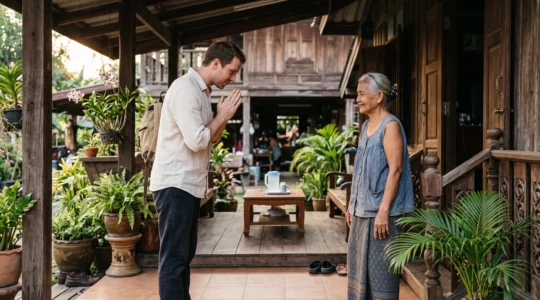
How to Wai Correctly in Thailand: The 4 Height Levels That Signal Different Respect Degrees
A Thai wai can look deceptively simple: press your palms together, bow your head and smile. Yet the distance between…
Lire la suite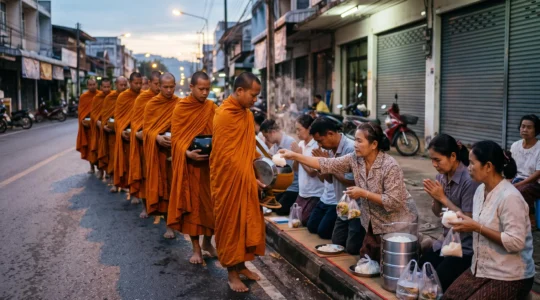
How Theravada Buddhism Shapes Thai Social Behavior: The Merit-Making System Foreigners Misunderstand
At dawn in a Thai town, a resident places rice into a Buddhist monk’s alms bowl, bows respectfully and returns…
Lire la suite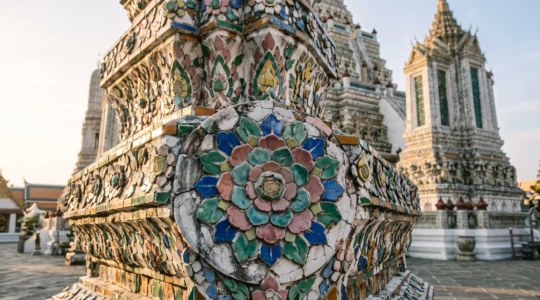
How Thai Temples Transformed Broken Porcelain Into Intricate Mosaics: The Recycled Art Technique
Look closely at the floral patterns covering Bangkok’s Wat Arun, and an extraordinary transformation becomes visible. What initially appears to…
Lire la suite