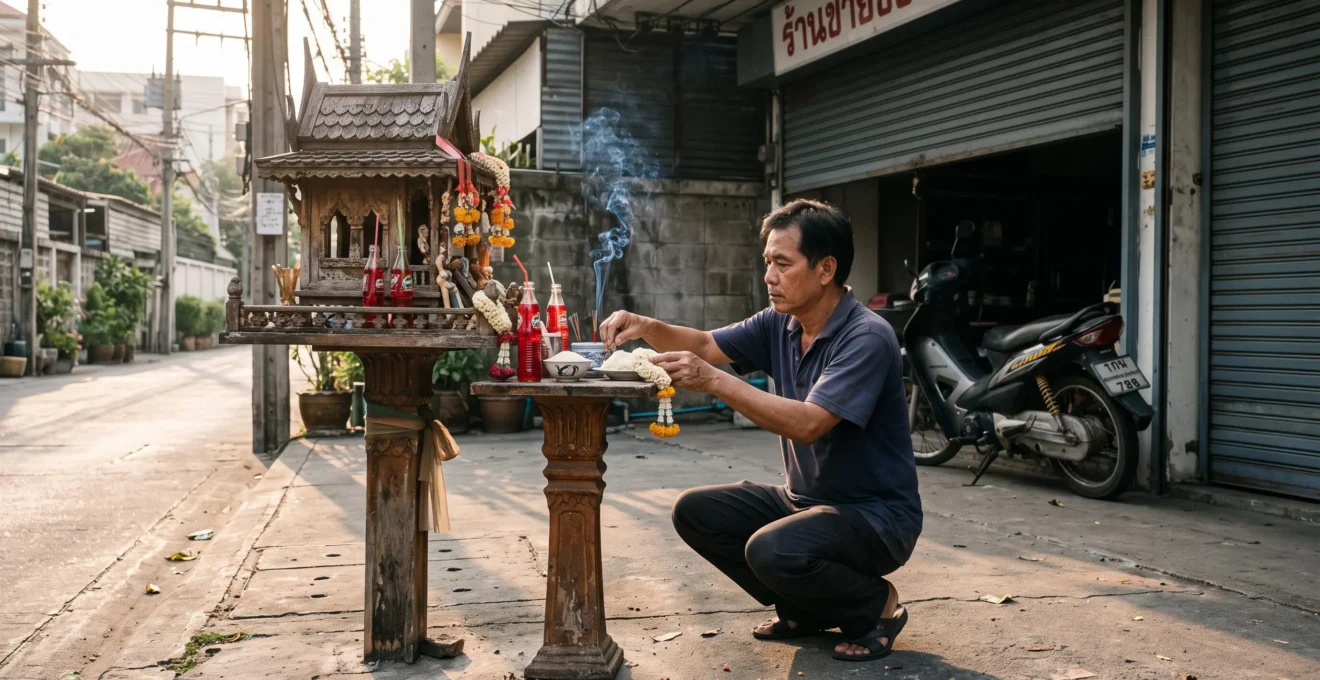
Before Bangkok’s shops open, small plates of rice, fruit and brightly coloured drinks may already be waiting outside their doors. The food sits before miniature houses raised on pillars, sometimes decorated with jasmine garlands and incense. These structures are Thai spirit houses, and their offerings express a relationship with invisible beings believed to inhabit or protect particular places.
For many Thai households and businesses, feeding a guardian spirit is a way of maintaining respectful coexistence with the spiritual presence associated with their land. The practice reflects a religious landscape in which indigenous spirit beliefs, Brahmanical traditions and Theravada Buddhism have developed alongside one another.
The distinction matters because food offered to a territorial spirit does not necessarily have the same meaning as food given to a Buddhist monk or placed before an ancestor’s memorial tablet. Understanding the recipient, rather than judging the food itself, makes Bangkok’s everyday rituals much easier to interpret.
Thai spirit house offerings at a glance
- Food and drinks at spirit houses express care and respect for guardian spirits associated with a place, rather than constituting a standard Buddhist temple ritual.
- Offerings vary between households and businesses; fruit, rice, water, flowers and sweet drinks are among the documented examples.
- Visitors are welcome to observe respectfully but should not touch, rearrange or remove offerings without permission.
- Spirit House Offerings vs Temple Offerings: Why Thais Use Meat for Spirits but Not Buddhas
- How Thais Position Spirit Houses: The Shadow Rule and Directional Auspiciousness
- Thai Food Offerings vs Chinese Ancestor Altars: How Do Buddhist and Confucian Practices Differ?
- The Spirit House Mistake That Angers Thai Construction Workers: Why Never Touch the Offerings
- When Thais Refresh Spirit House Offerings: The Twice-Daily Ritual Schedule
- How Thais Position Spirit Houses: Reading Bangkok’s Streets Through Directional Auspiciousness
- The Spirit House Mistake That Angers Thai Construction Workers: Remedies and Repair When Boundaries Are Crossed
- How Theravada Buddhism Shapes Thai Social Behavior: The Merit-Making System Foreigners Misunderstand
Spirit House Offerings vs Temple Offerings: Why Thais Use Meat for Spirits but Not Buddhas
Spirit house offerings and Buddhist temple offerings address different spiritual relationships. Food left at a Thai spirit house honours or maintains goodwill with beings associated with a particular place. Food offered to monks supports the Buddhist community and can generate merit for the donor. However, the popular claim that spirits receive meat while Buddhist monks receive only vegetarian food is incorrect.
Thai spirit houses are often called san phra phum, although Thai traditions distinguish different kinds of shrines. Some honour a territorial guardian deity, often associated with Phra Bhumi or Phra Phum, while others accommodate local or household spirits. These categories cannot always be reduced to one universal definition of chao thi, the spirit or guardian associated with a place.
Providing a suitable dwelling and maintaining offerings expresses hospitality and respect. In some understandings, these gestures encourage benevolent protection and help preserve harmonious relations with the unseen inhabitants of the land.
Thailand Foundation‘s explanation of Thai housewarming traditions describes Thai spirituality as an interaction between animism, Brahmanism-Hinduism and Buddhism. It also distinguishes different shrine forms, including single-pillar structures associated with guardian deities and multi-pillar structures associated with household spirits.
Offerings at these shrines can include rice, fruit, flowers, water and sweet drinks. Other foods may appear depending on local customs and the preferences attributed to particular spirits. The presence of meat does not, by itself, prove that an offering is animist rather than Buddhist.
Indeed, the Theravada monastic tradition does not impose a universal vegetarian diet. In the Jīvaka Sutta on monastic food rules, fish and meat are permitted under specified conditions, while meat known or suspected to come from an animal slaughtered specifically for the recipient is prohibited.
Nor is food placed before a Buddha image necessarily conceived as nourishment for a Buddha who still experiences ordinary hunger. Such offerings can function as acts of devotion, reverence and generosity.
The following distinctions help visitors interpret what they see, without assuming that any single object identifies a tradition conclusively.
| What to observe | Typical recipient or purpose | Meaning and limitations |
|---|---|---|
| Food presented to monks at a temple or during morning almsgiving | The Buddhist monastic community | Giving supports monks and may generate merit. Food is not necessarily vegetarian. |
| Food, drinks and garlands at an elevated spirit house | Guardian deity or local spirit | Expresses respect, care and a desire for harmonious coexistence. |
| Flowers, incense and candles before a Buddha image | The Buddha as an object of reverence | Symbolizes devotion and Buddhist reflection, rather than feeding a hungry deity. |
| Food and incense at a domestic memorial or ancestor altar | Deceased family members | Expresses remembrance and continuing family obligations, sometimes alongside Buddhist practices. |
These categories can overlap. The same household may support Buddhist monks, honour a guardian deity and commemorate ancestors without treating those actions as mutually exclusive.
Once the recipient is understood, another question becomes important: why does a miniature spirit dwelling occupy such a carefully chosen position outside the main building?
How Thais Position Spirit Houses: The Shadow Rule and Directional Auspiciousness
Spirit house placement commonly reflects ideas about respect, protection and the suitability of a location for its guardian. Traditional guidance may take account of the main building, sunlight, orientation and auspicious timing. The frequently cited shadow rule discourages placing a spirit house beneath the main building’s shadow, although the available sources do not establish it as an absolute rule observed throughout Thailand.
A spirit house is not merely a decorative miniature. Its position can express the relationship between the human occupants of a property and the spiritual beings believed to share that space.
Elevating a shrine on a pillar gives it a defined place above ordinary ground-level activity. It may also help distinguish sacred space from the areas used for walking, parking, cleaning and commercial work.
The commonly described shadow principle is straightforward: a larger building should not overshadow the guardian’s dwelling. Within this interpretation, overshadowing can symbolize inadequate respect or an unfavourable relationship between the two structures.
However, the shadow principle should be understood as a traditional placement consideration rather than a verified universal prohibition. Its practical application can vary with site constraints and the recommendations of those involved in installation.
In more elaborate installations, householders may consult a Brahmanical ritual practitioner or another specialist familiar with auspicious placement. Advice can involve the relationship of the shrine to the property and the selection of an appropriate time for installation.
It would be misleading to assume that every household follows an identical compass direction, calculates orientation from the owner’s birth date or employs a particular category of priest. The practices described within Thai religious life vary between communities and circumstances.
Placement is therefore better understood as a negotiated combination of ritual considerations and practical geography.
These considerations help explain why spirit houses may stand near entrances, driveways or building boundaries instead of occupying the visually central position that a landscape designer might prefer.
Redevelopment introduces another challenge. If a property changes substantially, owners may seek guidance on relocating or replacing its shrine. The appropriate procedure depends on the particular beliefs involved; it is not possible to establish a single mandatory decommissioning ritual from the available evidence.
Visitors should also avoid assuming that every apparently unused shrine has been abandoned through negligence. Its history and ritual status may not be visible from the street.
Physical location reveals part of a shrine’s meaning, but the identity of those being honoured can become more complicated in Bangkok’s Chinese-Thai neighbourhoods.
Thai Food Offerings vs Chinese Ancestor Altars: How Do Buddhist and Confucian Practices Differ?
Thai spirit houses generally concern spiritual beings associated with a place, while Chinese-Thai ancestor altars maintain relationships with deceased family members. The first practice emphasizes respectful coexistence with territorial guardians; the second emphasizes remembrance, gratitude and continuing family connections. Both can involve food and incense, and both may coexist within households that also practise Buddhism.
The distinction is relational rather than simply dietary. A guardian spirit need not be related to the people occupying the land. An ancestor, by contrast, belongs to a family history connecting living descendants with named or remembered relatives.
Among Chinese-Thai communities, ancestor veneration is influenced by Chinese familial and ritual traditions, including Confucian values concerning filial responsibility. These practices may also intersect with Chinese Buddhist, Daoist and local religious traditions.
Reducing Chinese ancestor worship to Confucianism alone would therefore obscure important elements of its religious and cultural background.
Bangkok’s Chinatown, particularly Yaowarat and its surrounding streets, offers visitors opportunities to encounter Chinese-Thai shrines and family businesses where such traditions remain visible.
Some ancestor altars contain tablets identifying deceased relatives, incense holders, candles and carefully arranged food or fruit. Spirit houses, meanwhile, are often recognizable by their miniature architectural form and placement in relation to a property.
Yet paired candles, a particular number of incense sticks or an odd number of fruits cannot be treated as universal diagnostic requirements. These details vary and cannot independently establish a shrine’s function.
The festival calendar provides another clue. Qingming, or Tomb-Sweeping Festival, is associated with visits to ancestral graves and offerings that express continuing family obligations.
Huachiew University‘s comparative study of Teochew Qingming rituals examined practices among communities in Bangkok and Shantou, China. Its qualitative research included 40 participants across the two locations.
The study associates ancestor offerings with gratitude and the belief that deceased relatives can protect their descendants. It also documents differences arising from social circumstances, religious influences and changing customs. Its small purposive sample does not support claims about every Chinese-Thai family.
Chinese ancestor observances are not confined to festival dates. Domestic remembrance may continue throughout the year, while Qingming and other ceremonial occasions can make the practice more visible.
Similarly, not every Thai spirit house receives food each day. The schedules and purposes of the two traditions can overlap more than a simple daily-versus-annual comparison suggests.
Understanding these differences also explains why offerings should not be treated as abandoned food or decorative objects available for visitors to move.
The Spirit House Mistake That Angers Thai Construction Workers: Why Never Touch the Offerings
The safest rule for visitors is never to touch or rearrange offerings at a Thai spirit house without permission. Food, drinks and ritual objects may already have been dedicated to a guardian spirit. Moving them can interfere with an observance that matters to the people responsible for the site, particularly where workers associate spiritual respect with protection and safety.
A spirit house at a construction site can have significance beyond its appearance. Workers or property owners may regard the guardian’s goodwill as important for the successful completion of the project.
Within such beliefs, unexpected difficulties may sometimes be interpreted in relation to spiritual obligations. However, it would be inaccurate to suggest that all Thai construction workers attribute accidents or delays to offended spirits.
What matters to a visitor is recognizing that an apparently minor action can carry an unintended religious meaning.
Moving a drink to obtain a clearer photograph, lifting a garland or taking a piece of fruit may seem harmless. For those maintaining the shrine, these actions can interrupt an offering or disrespect its recipient.
Respectful observation requires no special religious knowledge. A visitor can appreciate the shrine without participating in its maintenance or deciding what should happen to its contents.
A five-step spirit house observation checklist
- Identify whether the shrine is accessible from a public area; confirm that observation does not require entering private property or a restricted worksite.
- Choose a standing position that leaves entrances, footpaths and work areas clear; identify an unobstructed place to observe.
- Keep hands, bags and belongings away from the shrine and its offerings; leave every object in its original position.
- If taking photographs, frame the shrine without moving objects or blocking worshippers; obtain permission before photographing identifiable people closely.
- Before leaving, check that no belongings, litter or displaced objects remain around the shrine; leave the area as it was found.
Old flowers, food and containers may be removed or replaced by the people maintaining a shrine. There is no sufficiently established universal rule requiring old offerings to be deposited beside trees, near rivers or at the shrine’s base.
Disposal practices should therefore be left to the responsible household, business or ritual specialist rather than interpreted as a task for passersby.
Visitors can apply this boundary most easily when they understand when offerings are placed and why the contents of a shrine change during the day.
When Thais Refresh Spirit House Offerings: The Twice-Daily Ritual Schedule
Spirit house offerings are frequently refreshed in the morning, particularly outside businesses beginning their daily activities. Some households or workplaces may make additional offerings later in the day. Nevertheless, there is no documented universal twice-daily schedule applying to Thai spirit houses, and the frequency varies according to household customs, circumstances and individual devotion.
Early morning is an important period because the beginning of a working day provides a natural opportunity to perform an established household or business ritual.
A shopkeeper may prepare the shrine before opening, while another household may maintain a less frequent routine or reserve particular offerings for significant occasions.
Reporting from Bangkok in the Los Angeles Times documented offerings such as rice, bananas, water, alcoholic beverages and sweetened soft drinks. Strawberry Fanta was among the conspicuous drinks observed at spirit houses.
The newspaper also described an interpretation connecting red drinks with earlier forms of animal offering. Such an explanation should be treated as a reported belief, not as a conclusively established historical origin of the practice.
Offerings may be understood as expressing care or hospitality toward spirits rather than providing literal physical nourishment in the ordinary human sense.
Some practitioners understand the unseen recipient as accepting an offering’s spiritual substance or essence. That interpretation helps explain how the material food may remain visible after the ritual.
What happens next varies. Responsible householders may remove, replace or otherwise handle the food according to local customs, hygiene considerations and the type of offering.
There is no sound basis for assuming that every offering is subsequently eaten by people, fed to animals or discarded in one prescribed way. Food that has stood outside for an extended period may also be unsuitable for consumption.
Businesses whose owners attach particular importance to guardian spirits may maintain especially visible routines. Still, an apparent connection between offering frequency and occupational risk should not be presented as a measured general pattern without supporting research.
For travellers interested in seeing this aspect of Bangkok life, early morning is a reasonable time to look for newly placed food, garlands or incense. Witnessing someone performing the ritual is never guaranteed.
An observation can remain meaningful even when nobody is present: fresh flowers, recently arranged offerings and the relationship between shrine and business reveal how the structure participates in daily life.
Once the rhythm becomes familiar, the distribution of shrines across streets and properties offers another way to understand the city.
How Thais Position Spirit Houses: Reading Bangkok’s Streets Through Directional Auspiciousness
Bangkok’s spirit houses can be read as signs of how buildings, businesses and spiritual traditions occupy the same urban landscape. A shrine raised beside a driveway, facing a different direction from its neighbour or surrounded by garlands may reflect particular site conditions and ritual decisions. These arrangements are not necessarily random, but their exact meanings cannot always be recovered from appearance alone.
Start by observing the miniature structure in relation to its surroundings. Does it face a business entrance, stand beside a boundary wall or occupy a separate platform? Does its elevation distinguish it from the ordinary pedestrian environment?
These observations are more reliable than assuming every shrine must point toward one universally auspicious compass direction.
Traditional placement advice may reflect the particular property and the people responsible for it. Two nearby buildings can therefore make different choices without either arrangement necessarily representing a mistake.
Architectural details provide a further clue. A pointed spire on a single-pillar shrine may indicate an association with a territorial guardian deity, while a shrine resembling a small traditional dwelling on multiple supports may be associated with household spirits.
These distinctions are useful but not absolute. Individual shrines can reflect local craftsmanship, changing styles and combined religious meanings.
Bangkok’s dense redevelopment also makes older or grouped shrines visually striking. Travellers sometimes encounter multiple spirit houses near a tree, wall or roadside shrine.
Such groupings may invite questions about previous buildings, relocated objects or collective religious activity. Their history should not be inferred from clustering alone, however. The available evidence does not establish that every group represents decommissioned shrines from demolished properties.
A careful observer can record what is visible without imposing an invented explanation: the number of shrines, the condition of their structures, whether offerings appear maintained, and how the location relates to current buildings.
Maintenance is especially revealing. A weathered structure with fresh garlands demonstrates that age and neglect are not synonymous. Likewise, an elaborate shrine without visible food at one particular moment does not necessarily indicate abandonment.
This observational method turns a street walk into a way of recognizing different relationships between urban development, belief and ritual care.
The city’s religious landscape also has practical consequences when existing shrines must be moved, protected or replaced during changes to a site.
The Spirit House Mistake That Angers Thai Construction Workers: Remedies and Repair When Boundaries Are Crossed
When a spirit house or its offerings are disturbed, the appropriate response depends on the people responsible for the shrine and the significance they attach to the incident. Minor disruption may call for a simple respectful correction, while a serious alteration or relocation may lead the owners to consult a ritual specialist. There is no verified universal scale of penalties or mandatory remedies.
The distinction between an accidental disturbance and a deliberate alteration matters. Brushing against a garland is not necessarily treated in the same way as removing a shrine during demolition.
Likewise, an individual household may respond differently from a commercial property whose management has organized a formal installation ceremony.
If a visitor accidentally damages or moves an offering, the most responsible initial action is to stop interfering and inform the appropriate person. A straightforward apology may help explain that the action was unintentional.
It would be unwise for an outsider to improvise a ritual remedy by purchasing new food, lighting incense or repositioning objects without permission. Even a well-intentioned replacement may not match the household’s customs.
Where a shrine has been substantially damaged or must be relocated, the people maintaining it may seek specialist guidance. Ritual responses can include renewed offerings or ceremonial actions, but their details cannot be standardized from the available sources.
Property development illustrates why these questions can have practical significance. Owners planning an extension, driveway alteration or building replacement may need to decide what happens to a shrine already occupying the site.
The choices may involve physical relocation, replacement of the structure, ceremonial consultation or adjustments to construction planning. These are possible consequences of taking shrine-related beliefs seriously, not evidence that all Thai developments face the same requirements.
For construction crews, respectful handling can also be a matter of maintaining good relations among workers with different beliefs about spiritual protection.
Ignoring concerns may cause interpersonal tension even where no demonstrable supernatural consequence exists. Recognizing that social significance is enough to justify care prevents visitors from dismissing the practice as merely irrational.
Foreign visitors are not ordinarily expected to perform spirit-house maintenance or independently resolve ritual problems. Their responsibility is limited to respectful conduct, compliance with property restrictions and communication if something goes wrong.
The broader lesson is that ritual obligations may shape everyday decisions even where Buddhist teachings, local spirit beliefs and practical concerns remain distinct. Theravada merit-making helps explain another important dimension of that religious coexistence.
Key takeaways before exploring Buddhist merit-making
- Respecting a guardian spirit and making merit through Buddhist generosity are related parts of Thai religious life, but they are not identical actions.
- The religious meaning of food depends on its recipient, the donor’s intention and the setting, not simply on whether it contains meat or fruit.
- Travellers can understand the visible rituals without participating in them or assuming that every Thai follows the same customs.
How Theravada Buddhism Shapes Thai Social Behavior: The Merit-Making System Foreigners Misunderstand
Theravada Buddhist merit-making, known in Thai as tham bun, centres on actions understood to produce beneficial spiritual consequences. Generosity, ethical conduct and mental cultivation are important ways of developing merit. Giving food to monks is a familiar expression of this principle, while offerings to territorial spirits belong to a broader religious environment in which Buddhist and non-Buddhist practices coexist.
Merit is not simply a supernatural currency exchanged for material rewards. In Buddhist teaching, an action’s moral intention matters, as does the character of the action itself.
The Pali concept of cetanā, or intention, is central to the Buddhist understanding of karma. Generosity carried out with wholesome intention forms part of spiritual cultivation rather than functioning as a guaranteed bargain for prosperity.
Giving to the monastic community is especially significant because monks are traditionally regarded as recipients worthy of support. Their way of life provides an opportunity for lay Buddhists to practise generosity and contribute to the continuation of Buddhist teachings.
This does not mean that monks are free from every worldly need or that they can receive only symbolic offerings. They depend on food and other requisites provided by lay supporters.
Morning almsgiving makes the principle visible. Laypeople offer prepared food to monks, supporting their daily lives while engaging in a practice understood to generate merit.
Merit may also be dedicated to deceased relatives or other beings. Such dedication provides an important connection between Buddhist religious practice and Thai beliefs concerning the dead, guardians and unseen presences.
A spirit house offering, however, should not automatically be classified as Buddhist merit-making. It may express hospitality toward a guardian, the fulfilment of a customary obligation or a desire for protection rather than the same intentions involved in giving alms to monks.
Other visible acts associated with Buddhist generosity include donations to temples and contributions toward the maintenance of religious buildings. Practices involving the release of animals are also sometimes framed in terms of merit, although they can raise serious animal-welfare and ecological concerns and should not be assumed beneficial.
The broader influence of Buddhism on social life also requires nuance. Ideas such as jai yen, literally a cool heart, resonate with restraint and composure, but Thai interpersonal behaviour cannot be explained through religious doctrine alone.
Family expectations, community relationships, social conventions and individual personalities shape behaviour as well.
A Thai person who maintains a spirit house, makes donations to monks and participates in ancestor ceremonies is not necessarily attempting to reconcile three contradictory systems through a formal theological argument.
Those practices can belong to a shared social world in which different traditions serve different relational and spiritual purposes.
On a morning walk through Bangkok, notice who receives each offering, where it is placed and how others respond to the ritual. Observation without interference is enough to reveal the coexistence of Buddhist generosity, territorial spirit traditions and family remembrance in everyday Thai life.
Why do Thai spirit houses sometimes have red Fanta?
Sweet red drinks are among the offerings documented at Bangkok spirit houses. One reported interpretation connects them with older traditions involving red-coloured or animal offerings. The precise origin of this custom is not conclusively established, and red drinks should not be understood as a universal requirement.
Is a Thai spirit house the same as a Buddhist shrine?
Not exactly. Spirit houses generally honour guardian deities or local spirits associated with a place, while Buddhist shrines commonly focus on the Buddha and Buddhist practice. Their traditions overlap in Thai religious life, which also incorporates Brahmanical influences. Some shrines combine elements that do not fit neatly into separate categories.
Can tourists leave food at a Thai spirit house?
Visitors should not add offerings to someone else’s shrine without invitation or permission. The people maintaining it may follow specific household customs. Observing respectfully is sufficient, and an invitation from a local caretaker is a better basis for participation than attempting an unfamiliar ritual independently.
Are all Thai spirit houses dedicated to ancestors?
No. Many spirit houses are associated with territorial guardians or other spirits connected to a location. Ancestor veneration concerns deceased family members and may involve different domestic altars or memorial arrangements. Thai and Chinese-Thai religious traditions can incorporate both practices.
Do spirit house offerings have to be replaced every day?
No universal daily replacement obligation has been established. Some households and businesses maintain frequent routines, while others offer food or other items according to their own customs or particular occasions. Morning is often a useful time to observe newly arranged offerings, but schedules differ.