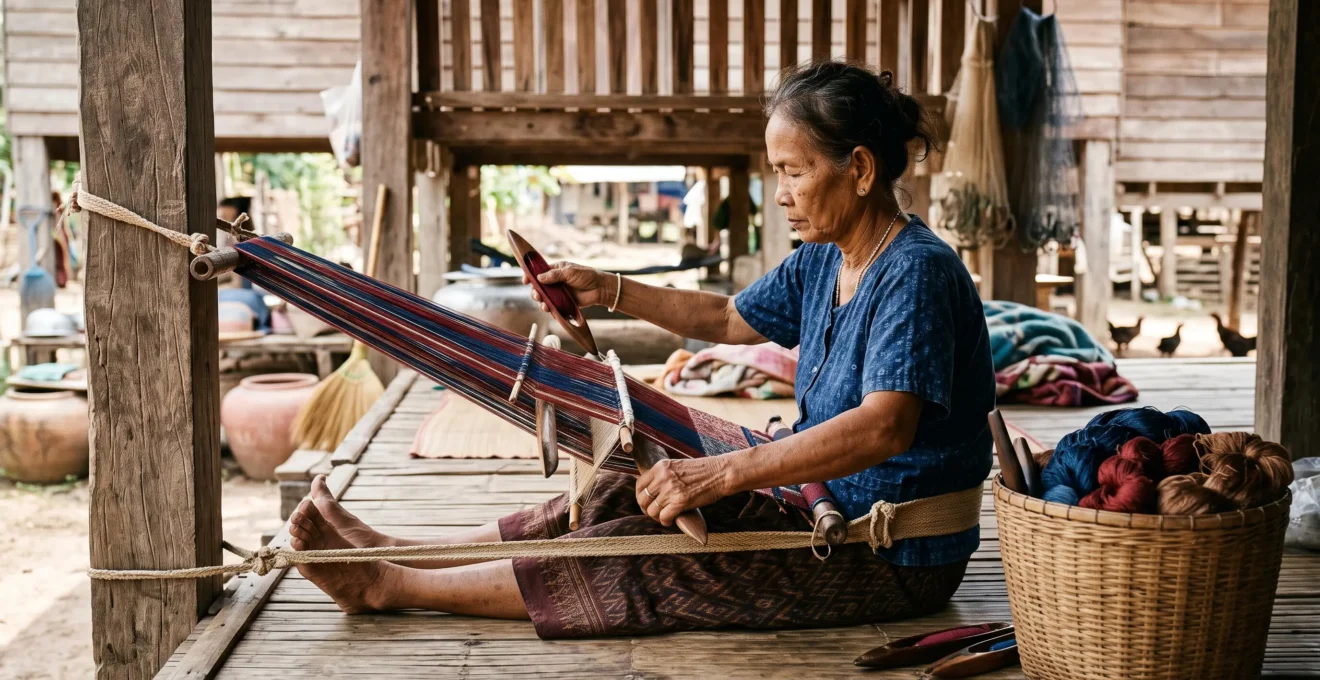
For travelers seeking traditional Thai silk weaving that exists beyond tourist demonstrations, northeastern Thailand offers a compelling starting point. In Isan, particularly around Chonnabot in Khon Kaen province and weaving communities in Surin, silk production remains connected to local textile knowledge, cultural identity, and community enterprise.
The distinction is not whether a visitor can watch someone operate a loom. It is whether the cloth being woven belongs to an actual production process, with local customers, orders, household responsibilities, and a livelihood attached. A beautifully arranged demonstration may reveal a technique, but it cannot automatically establish that weaving remains part of everyday village life.
Chonnabot and Khwao Sinarin offer particularly relevant starting points because their mudmee traditions have been documented through cultural research. Ban Tha Sawang near Surin and the Pak Thong Chai silk-producing area in Nakhon Ratchasima offer additional leads, although their individual workshops require advance verification.
Finding active weaving therefore requires more than identifying a famous silk village. Travelers need to understand regional traditions, recognize credible production practices, choose appropriate visiting periods, and approach working weavers as craftspeople rather than performers.
Where to find working Thai silk weaving
- Start in Isan: Prioritize Chonnabot in Khon Kaen and Khwao Sinarin in Surin, where distinctive mudmee traditions are documented. Ban Tha Sawang and Pak Thong Chai are additional locations worth investigating.
- Verify the production: Ask who prepares the yarn, ties the patterns, dyes the threads, and weaves the fabric. Texture, shine, and price alone cannot prove authenticity.
- Arrange visits ahead: November through February is a practical period to investigate, but actual weaving depends on agricultural work, orders, ceremonies, and individual availability.
- Why Thai Silk Weaving Survived in Isan but Faded in the North and South
- How to Identify Authentic Hand-Reeled Thai Silk: The Texture Test and Price Reality
- Isan Mudmee vs Northern Brocade: Which Thai Silk Technique Matches Your Aesthetic?
- The ‘Village Silk’ Sold in Bangkok That’s Actually From Chinese Factories: How to Spot Fakes
- When to Visit Isan Silk Villages for Active Weaving: The November–February Dry Season Window
- How to Identify Authentic Hand-Reeled Thai Silk: The Texture Test and Price Reality
- Isan Mudmee vs Northern Brocade: Which Thai Silk Technique Matches Your Aesthetic?
- How Thai Weavers Use 500-Year-Old Backstrap Looms: The Body-Tensioned Weaving Technique
Why Thai Silk Weaving Survived in Isan but Faded in the North and South
Traditional silk weaving remains particularly visible in northeastern Thailand because textile knowledge continues to circulate within communities where cloth carries cultural and economic value. Isan’s agricultural history, household production traditions, and regional textile identities help explain that continuity. However, silk weaving also survives elsewhere in Thailand; describing northern and southern traditions as having disappeared would oversimplify the country’s textile heritage.
Historically, weaving could fit around agricultural responsibilities rather than functioning exclusively as a separate industrial occupation. Thread preparation, dyeing, pattern planning, and loom work could be divided across available household time. Silk textiles also served social purposes, including ceremonial clothing, family exchanges, and expressions of community identity.
These relationships matter because a craft can remain meaningful even when its economic organization changes. A village weaver may produce cloth for local buyers, specialist collectors, cooperatives, or commercial orders without becoming a tourist demonstrator.
Research published in Journal of Cultural Approach provides a useful geographical foundation. A study of mudmee silk patterns in Chonnabot and Surin examines how textile motifs express local beliefs, environments, rituals, and cultural identity. Its researchers used interviews, participant observation, and documentary analysis.
The findings document meaningful differences between Chonnabot in Khon Kaen and Khwao Sinarin in Surin. They do not establish that every northeastern village has maintained uninterrupted household production or that other Thai regions have lost their weaving traditions.
For visitors, the more useful geographical approach is to distinguish places with documented textile traditions from workshops whose primary function is public display.
- Chonnabot, Khon Kaen: A strong starting point for researching mudmee pattern traditions and locating community producers.
- Khwao Sinarin, Surin: Relevant for understanding local silk designs, heritage, and the cultural background of weaving.
- Ban Tha Sawang, Surin: Worth investigating for elaborate silk weaving, while checking whether a particular visit involves ordinary production or a scheduled demonstration.
- Pak Thong Chai, Nakhon Ratchasima: An established silk-producing area where the individual production methods and workshop setting should be verified.
The North also maintains important handweaving traditions, including those associated with Tai Yuan and Tai Lue communities. Commercial workshops and tourism do not automatically invalidate those traditions, just as operating within Isan does not automatically establish authenticity.
Once a promising community is identified, the next challenge is recognizing the textile itself: its yarn preparation, construction, and the evidence behind claims of traditional craftsmanship.
How to Identify Authentic Hand-Reeled Thai Silk: The Texture Test and Price Reality
Authentic hand-reeled Thai silk is best assessed through several complementary checks: fiber composition, yarn irregularity, weaving structure, production records, and credible certification. Hand-reeling may create variations in thread thickness, while silk can display changing reflections as the fabric moves. None of these visual or tactile signs independently proves that a textile is hand-reeled, handwoven, or produced in Thailand.
The first distinction concerns how the yarn was produced. Hand-reeling involves manually drawing silk filaments from cocoons and combining them into thread. Mechanically reeled silk may also be genuine silk, but its production involves different equipment and often achieves greater consistency.
The second distinction is weaving. A textile woven on a household loom can use mechanically prepared silk yarn. Some producers combine different yarn types for warp and weft to obtain the strength, texture, or appearance required by a particular design.
Consequently, a fabric may be genuinely handwoven while not being made entirely from hand-reeled yarn.
Under natural light, rotate the cloth gently and observe whether the color and reflected sheen change. Examine the thread thickness, the relationship between pattern and woven structure, and any small variations in the finished edges.
These observations are useful questions to discuss with the producer, not reliable pass-or-fail tests. Iridescence can occur in various silk constructions, while irregular threads may also appear in textiles made from other fibers.
The traditional friction or « silk screech » test is similarly inconclusive. Rubbing may affect delicate fabrics, and an acoustic response cannot establish provenance. Burning fibers is destructive and inappropriate without explicit permission; even then, it cannot establish who reeled or wove the yarn.
Thailand’s Royal Peacock certification offers a more structured purchasing reference. The Royal Peacock silk certification categories explained by Thailand’s government distinguish products according to their permitted fibers and production methods.
| Product category | What to establish | What remains uncertain |
|---|---|---|
| Silk blend | Which fibers are present and in what proportions | Whether the fabric is handwoven or produced in a specific village |
| Machine-reeled silk | Whether genuine silk yarn was prepared mechanically | Whether weaving was performed manually |
| Hand-reeled silk | Who reeled the cocoons and which threads were hand-reeled | Whether every stage of production occurred in one household |
| Handwoven silk | How the loom was operated and how the yarn was sourced | Whether the yarn itself was manually reeled |
Price can support a judgment but cannot settle it. Hand-reeling and intricate weaving require skilled labor, yet costs also depend on textile dimensions, pattern complexity, materials, producer arrangements, and retail margins.
A suspiciously inexpensive item advertised as entirely hand-reeled deserves scrutiny. An expensive piece deserves the same scrutiny. Neither price point supplies independent proof of authenticity.
These distinctions become especially important when comparing regional styles, because mudmee and brocade involve different pattern-making processes that should not be confused with yarn authenticity.
Isan Mudmee vs Northern Brocade: Which Thai Silk Technique Matches Your Aesthetic?
Choose Isan mudmee if you are drawn to patterns created by resist-dyeing yarn before weaving, producing characteristic soft-edged forms and intricate geometric arrangements. Choose northern brocade if you prefer motifs built into the cloth through supplementary weaving techniques, often creating a more pronounced textured surface. Both traditions contain substantial regional and technical variation, so neither is defined by a single weight, color palette, or intended use.
The most important technical distinction concerns when the design enters the textile.
In the mudmee technique associated with northeastern Thailand, sections of weft yarn are tied to resist dye penetration. Once dyed, the bindings are removed and the patterned yarn is arranged for weaving. The weaver must carefully align successive picks to develop the intended image.
This is generally a weft-ikat process, not the warp-ikat process sometimes incorrectly attributed to all Isan mudmee.
The result can show characteristic feathered or blurred boundaries, particularly where dyed sections shift slightly during weaving.
In northern supplementary-weft brocades, the patterned elements are introduced during weaving through additional yarns. Depending on the tradition, this allows contrasting colors, denser ornamentation, and raised decorative effects.
These techniques affect the production sequence and the kinds of decisions the weaver makes. Mudmee requires considerable advance planning of tied and dyed yarns. Supplementary-weft weaving requires skilled pattern control at the loom and may permit more design decisions while weaving proceeds.
| Characteristic | Isan mudmee | Northern brocade |
|---|---|---|
| Primary pattern method | Resist-dyed weft yarn | Supplementary pattern yarn woven into the cloth |
| Typical visual effect | Soft-edged, often geometric forms | Defined woven ornament, sometimes raised |
| Production emphasis | Yarn tying, dyeing, alignment, and weaving | Pattern selection and execution during weaving |
| Relevant communities | Chonnabot, Khwao Sinarin, and other Isan producers | Tai Yuan and Tai Lue weaving communities in northern Thailand |
| Collector’s focus | Local motifs, dyeing technique, and provenance | Supplementary-weft structure, regional style, and craftsmanship |
Neither category automatically determines how light, heavy, reversible, or suitable for clothing a textile will be. Those qualities depend on its actual construction, yarn, finishing, and dimensions.
For a collector, provenance is more valuable than assigning every motif a universal label. The research on Chonnabot and Khwao Sinarin shows that patterns may express nature, religion, fertility, local lifestyles, and rituals, with interpretations shaped by particular communities.
Ask the maker what a design means in that village, whether it has been adapted, and who taught the pattern. A documented explanation is more useful than assuming a butterfly, elephant, or geometric shape has one standardized meaning throughout Isan.
Once you recognize how the pattern is constructed, it becomes easier to question misleading retail descriptions that blur the distinction between Thai design, Thai production, and genuine silk.
The ‘Village Silk’ Sold in Bangkok That’s Actually From Chinese Factories: How to Spot Fakes
A textile sold as « village Thai silk » in Bangkok is not necessarily handwoven in a Thai village. Imported fabric, industrially produced yarn, printed patterns, and genuinely handmade Thai textiles can all appear in tourist-oriented retail channels. However, the origin of any particular piece must be established individually; a Bangkok sales location or unusually perfect pattern does not prove Chinese factory production.
The central problem is the difference between design identity and manufacturing origin. A fabric can reproduce Thai motifs without having been woven in Thailand. Conversely, a genuine Thai silk product may use modern equipment or mixed production techniques without being deceptively represented.
Retail descriptions such as « traditional, » « village style, » and « Thai-inspired » should therefore be separated from verifiable claims about fiber content, country of production, and weaving method.
Examine the pattern rather than accepting a label alone. In mudmee, the motif is created by selectively dyeing yarn before weaving. A printed imitation can reproduce the overall visual appearance without following this process.
Inspect both sides of the cloth, the relationship between color and individual threads, and the finished edges. Differences can suggest questions worth asking, but highly consistent weaving is not evidence of fraud: skilled artisans may produce remarkably controlled results.
Similarly, a printed label, standardized width, or attractive retail packaging cannot independently establish where the textile was made.
The Royal Peacock system provides an additional reference. Its Gold, Silver, Blue, and Green classifications distinguish different authorized forms of Thai silk production, including blended textiles under the appropriate category. Checking the specific certification and whether it applies to the item being sold is more informative than trusting a generic silk label.
OTOP participation can help identify community products and producers, but it should not be treated as equivalent to fiber certification or proof that every production stage occurred within one village household.
| Buying channel | Useful opportunity | Verification still needed |
|---|---|---|
| Bangkok tourist market | Compare styles, finishes, and price ranges | Fiber content, producer identity, and manufacturing origin |
| Established textile retailer | Request product documentation and detailed construction information | Whether information identifies the specific piece |
| Village cooperative | Discuss production stages and local weaving relationships | Which tasks were performed locally and by whom |
| Direct purchase from a weaver | Ask about the particular cloth and potentially observe production | Yarn sourcing, fiber composition, and any claimed certification |
Budget also matters. A clearly labeled silk blend may be an entirely reasonable souvenir, while an heirloom purchase justifies more detailed scrutiny. The problem is not choosing an inexpensive or industrially produced item; it is paying for production claims that cannot be substantiated.
For travelers seeking a direct relationship with a craftsperson, the strongest next step is arranging access to a producing community rather than trying to solve the entire provenance question in a retail stall.
When to Visit Isan Silk Villages for Active Weaving: The November–February Dry Season Window
November through February is a sensible period to investigate working silk villages in northeastern Thailand because it overlaps with the cooler, generally drier season and, in many rice-growing communities, the period following harvest. It is not a guaranteed weaving season. Active looms depend on local farming schedules, outstanding orders, household commitments, available materials, and the arrangements of individual producers.
Weaving and agriculture can coexist within household economies, but that relationship should not be converted into a fixed annual visitor timetable.
One household may devote more time to silk after harvesting rice. Another may weave against commercial orders throughout much of the year. A cooperative might maintain regular production while an individual household temporarily stops because of a wedding, religious ceremony, illness, or agricultural work.
Even within the same village, neighboring looms may have different schedules.
Khon Kaen’s International Silk Festival and Phuk Siao celebrations provide another opportunity to encounter the region’s textile producers.
According to Khon Kaen province’s official report on the 2024 silk festival, that edition ran from November 29 to December 10, 2024. Its program included silk-reeling competitions, mudmee competitions, certification exhibitions, and community-product sales.
Khon Kaen’s documented 2024 silk festival
The provincial government’s account identifies organized activities focused on silk production, regional textiles, community products, and cultural presentation.
This makes the festival a useful example of how visitors can encounter numerous producers in one place. It does not demonstrate that village household looms were simultaneously operating, nor does it establish the dates of future editions.
For travelers, a festival is best treated as an introduction to potential contacts rather than the final destination. Exhibitions and demonstrations can provide context, but observing an artisan work on ordinary production requires a separate arrangement.
Contact potential hosts several weeks before traveling. Community producer groups, OTOP networks, locally established accommodation providers, and weaving cooperatives may be able to identify workshops that are producing textiles rather than conducting scheduled visitor demonstrations.
Ask whether someone will be weaving on the proposed date, whether the work is part of a current production order, and whether visitors are welcome. Confirm again shortly before traveling.
Five actions to arrange a genuine weaving visit
- Select a production area: Record one primary destination, such as Chonnabot or Khwao Sinarin, and one alternative location.
- Identify a local contact: Obtain the name and contact details of a cooperative, producer group, or locally recommended weaving household.
- Confirm actual activity: Request confirmation that a loom is expected to be operating for ordinary textile production on the intended date.
- Agree on visiting conditions: Record the appointment, permission requirements, any visit or interpretation fee, and whether photography is allowed.
- Prepare provenance questions: Bring a short written list covering the maker, yarn source, pattern, weaving method, and price of any available textile.
Good timing improves the chance of seeing production, but a valuable visit also depends on knowing how to interpret the cloth being made and recognizing the labor behind it.
How to Identify Authentic Hand-Reeled Thai Silk: The Texture Test and Price Reality
The best way to develop an informed sense of hand-reeled Thai silk is to compare known examples before evaluating unfamiliar village textiles. A reputable specialist retailer or documented producer can provide reference pieces with identified fibers and production methods. Handling these alongside other fabrics helps establish useful tactile differences, but touch remains a learning aid rather than an authentication method.
Begin by examining a range of documented textiles: silk made from different yarn preparations, silk blends, and fabrics with distinct weaving structures.
Pay attention to how the cloth bends, how the surface reflects light, how the individual yarns feel, and how the fabric’s thickness corresponds to its density.
Hand-reeled silk may feel slightly uneven where filament thickness varies. Some varieties have a comparatively dry or textured hand rather than the slippery smoothness often associated with finely prepared filament silk.
Yet finishing methods, weave density, degumming, and subsequent treatment can change these sensations substantially. A smooth silk cloth is not automatically machine-made, and an uneven surface does not prove hand-reeling.
Weight should be assessed in relation to fabric width, length, yarn size, and construction. A heavy textile may simply use thicker yarn or a denser weave. A lightweight textile may be produced by an exceptionally skilled handweaver.
The economic reality is equally important. Traditional silk production may involve cocoon reeling, yarn preparation, tying, dyeing, loom setup, and prolonged weaving. These activities consume skilled labor even when the final cloth looks visually restrained.
The exact labor commitment varies by design and process. It would be misleading to assign every full-length silk piece a fixed number of production weeks or a reliable share of the maker’s annual income without individual production records.
Instead of inventing a universal price threshold, ask what the price includes and whether the producer performed all the stated tasks personally or worked with other specialists.
A fair purchasing approach recognizes that a producer’s asking price reflects more than raw material. Intricate pattern alignment, repeated dyeing, finishing, and accumulated expertise are also part of the work.
Older textiles introduce additional complexity. Inherited cloth, unused historical stock, and pieces produced under previous market conditions may command unusually high or low prices. Their authenticity cannot be determined by comparison with contemporary retail prices alone.
For collector-quality purchases, document the textile’s measurements, fiber claims, maker or producer group, place of production, and any certification available. Where possible, record the producer’s explanation of the yarn and technique rather than relying only on a receipt bearing a village name.
This combination of physical examination and maker knowledge becomes especially valuable when a textile’s regional design carries cultural meaning beyond its decorative appearance.
Isan Mudmee vs Northern Brocade: Which Thai Silk Technique Matches Your Aesthetic?
Choosing between Isan mudmee and northern brocade is also a choice between textile histories. Mudmee traditions in northeastern Thailand are closely associated with Tai-Lao cultural heritage and other local communities shaped by the wider Mekong region. Northern supplementary-pattern weaving includes traditions associated with Tai Yuan, Tai Lue, and other groups. Their designs reflect distinct histories rather than two interchangeable versions of a single Thai textile style.
For collectors, this cultural distinction can be more interesting than a simple preference for muted geometric designs or elaborate ornament.
The technical differences begin before a finished textile becomes visible. In mudmee production, a pattern is established through tied resist sections of yarn. After dyeing and preparation, the weaver must position the patterned weft correctly during weaving.
Major alterations to the dyed design are difficult once preparation has been completed. The weaver can still affect alignment and execution, but the underlying dyed pattern has already been determined.
In supplementary-weft brocade, additional pattern threads are manipulated during weaving. Depending on the structure and tools used, the weaver may have more scope to alter individual decorative elements while working.
This does not mean brocade is inherently more spontaneous. Complex supplementary patterns can also require extensive advance planning and highly disciplined repetition.
Color offers another useful, but imperfect, orientation. Indigo and lac are historically significant dyes in Thai mudmee traditions, while many contemporary pieces use broader natural and synthetic palettes. Northern brocades similarly vary from restrained historical color combinations to highly saturated modern designs.
Neither region has an exclusive claim to natural dyes or to particular levels of color brightness.
Motif meaning is where direct engagement becomes most valuable. Cultural research into Chonnabot and Khwao Sinarin identifies relationships between mudmee designs and local environments, religion, rituals, plants, animals, and community experience.
These findings support asking a specific producer how a pattern is understood locally. They do not justify assigning every geometric figure an identical protective, fertility-related, or status-related meaning across all communities.
When choosing an heirloom textile, ask who designed the pattern, whether its name is traditional or recently assigned, and whether it represents a family or community design tradition.
Record those explanations in the maker’s own terms, ideally with permission and alongside a photograph of the piece.
For an aesthetic preference centered on soft-edged dyed geometry, prioritize mudmee-producing communities such as Chonnabot. For supplementary-pattern weaving, investigate northern weaving traditions around Chiang Mai, Lampang, and Nan while identifying the relevant community and technique.
The objective is not to rank one tradition above the other. It is to connect a textile’s visual character to its production process and the people who maintain that knowledge.
That sensitivity to technique and provenance should also extend to the loom itself: the tool, the weaver’s movements, and the working environment can reveal what kind of production a visitor is actually observing.
What to remember before entering a weaving household
- Identify the actual loom: Traditional Thai textiles are made on different loom types; a backstrap loom is not a universal feature of Isan silk production.
- Observe without disrupting: The weaver’s concentration, posture, and working rhythm matter more than obtaining a posed photograph or extended explanation.
- Respect the production setting: Permission, appropriate compensation, and accurate documentation make an encounter more meaningful than treating a private workshop as a public attraction.
How Thai Weavers Use 500-Year-Old Backstrap Looms: The Body-Tensioned Weaving Technique
A backstrap loom works by attaching one end of the warp to a fixed support and the other to a strap around the weaver’s body. By leaning backward or adjusting posture, the weaver changes warp tension while manipulating the shed and passing the weft through it. This ancient body-tensioned weaving principle is distinct from the fixed-frame and treadle looms widely used in Thai silk production.
The phrase « 500-year-old backstrap loom » should be understood as a broad reference to the antiquity of the technique, not a verified date for a particular surviving loom.
Body-tensioned weaving traditions have long histories across parts of Asia and elsewhere, but dating the introduction of a specific technique to a particular Thai village requires archaeological or historical evidence that cannot be inferred from the appearance of a wooden loom.
The mechanical principle is relatively straightforward. One end of the warp is secured to an immovable point such as a post or beam. The other is connected to the weaver through a belt or backstrap.
The weaver’s position influences tension. Heddles or shed-forming tools separate warp threads so the weft can pass through, while a beating tool helps position the newly inserted yarn.
Skilled coordination is essential because the weaver manages thread separation, tension, and cloth formation while maintaining a stable working posture.
However, backstrap weaving should not be presented as the standard method used by all Isan silk weavers. Many northeastern Thai silk workshops employ substantial wooden frame looms. These may stand beneath houses, within household workspaces, or inside community production buildings.
Likewise, the presence of a backstrap loom in a rural home does not by itself establish uninterrupted historical transmission. Its current function and the knowledge of the person operating it still need to be understood.
For a visitor, the first useful question is therefore not « How old is this loom? » but « Is this the loom normally used to produce the textile being made? »
Observe whether the craftsperson is working on an actual piece intended for use or sale, whether yarn and partially completed textiles are present, and whether the producer can explain the relationship between the loom and the finished fabric.
These details offer context but are not infallible authenticity tests. Demonstration workshops can contain genuine equipment and expert craftspeople, while active commercial production may take place in organized cooperative premises rather than domestic spaces.
Respectful observation begins with permission. Ask before entering a household, approaching a loom, touching textiles, photographing people, or recording their work.
A weaver may be unable to stop midway through a demanding pattern sequence. A short answer or refusal to pose should be understood as a normal boundary within skilled work, not a lack of hospitality.
When a textile is offered for sale, buying directly can support its producer, but no purchase should be assumed to be compulsory. Agreeing on any visit or interpretation fee beforehand is often more respectful than expecting free access to working time.
Before traveling, select a documented silk-producing community, establish contact with a working producer, and confirm that observation is welcome during ordinary production. A brief encounter grounded in real work can teach more than an elaborate demonstration designed around a visitor’s schedule.
Can travelers visit Thai silk-weaving villages without booking a tour?
Independent visits may be possible, but access to working households should not be assumed. Contact a producer group, cooperative, or local host before arriving. Confirm that someone is weaving on the intended date, ask whether visitors are accepted, and respect private spaces and working schedules.
Does a Royal Peacock label guarantee that silk was woven inside a village household?
No. The Royal Peacock system identifies certified Thai silk categories and their permitted production characteristics. It does not, by itself, establish that a particular piece was woven inside a private household. Ask for item-specific production information if household weaving is important to your purchase.
Is mudmee always made from pure silk?
No. Mudmee describes a resist-dyeing and weaving technique rather than a single fiber composition. Traditional mudmee textiles may be made from silk or cotton. Ask about the material separately from the pattern-making technique.
Can visitors buy unfinished silk directly from a weaver?
That depends on the producer and the purpose of the textile being made. A piece on the loom may already be reserved for a customer, intended for a cooperative order, or unavailable until finishing is complete. Ask whether any completed pieces are offered for sale rather than assuming ongoing work can be purchased.
How can travelers tell whether weaving is part of ordinary village production rather than a staged demonstration?
Ask about the textile currently being produced, its intended use or buyer, the maker’s usual working schedule, and the steps performed locally. Regular production records, direct explanations, and the presence of work in progress can help establish context. No single visual detail conclusively distinguishes ordinary production from a demonstration, so advance confirmation and transparent communication remain important.