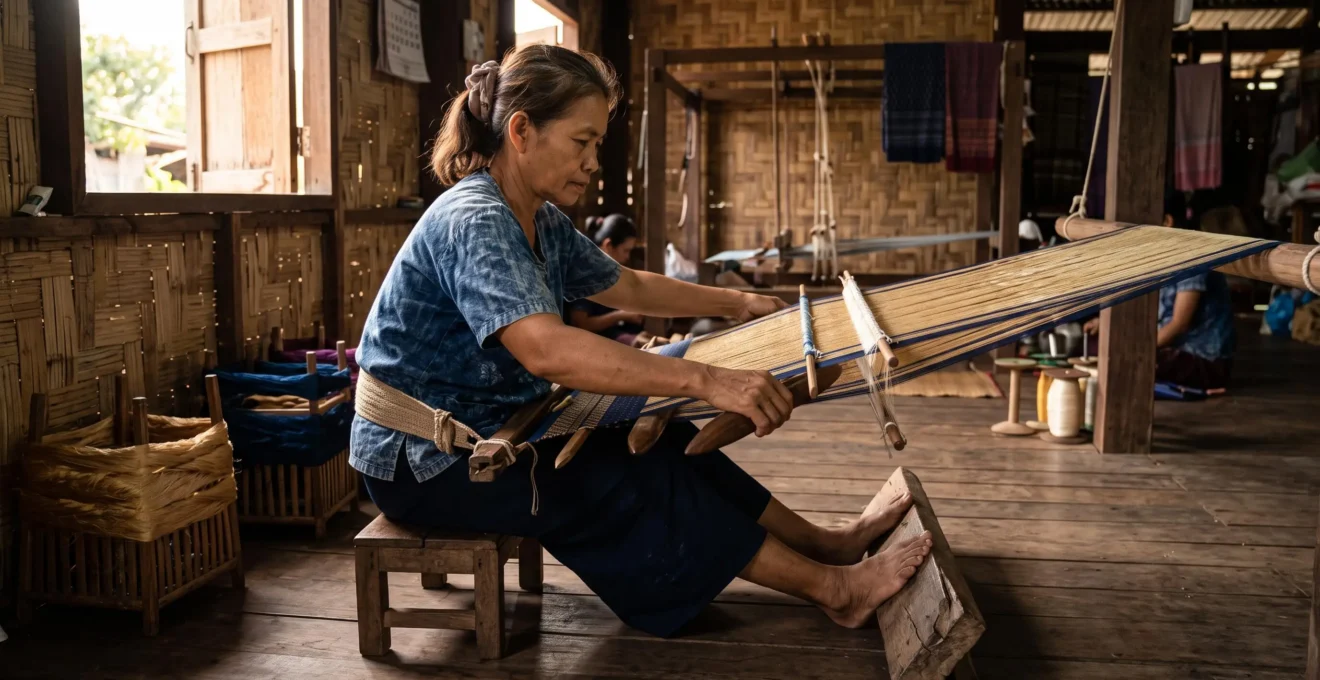
A backstrap loom does not require a heavy wooden frame to maintain the tension of its warp threads. Instead, one end of the warp is secured to a stationary anchor, while the other connects to a strap around the weaver’s body. By adjusting her seated position and leaning backward or forward, the weaver changes the tension acting on the threads.
This seemingly simple arrangement makes the human body an active component of the weaving mechanism. The weaver controls the relationship between warp tension, shed formation, weft insertion and beat-up through a combination of movement, manual skill and tactile feedback.
Backstrap weaving belongs to a long history of textile production across Asia and the Americas. In Thailand, documented traditions include communities in the northeast, although loom structures, fibers and working methods vary considerably between ethnic groups and regions.
The title’s 500-year reference evokes the historical depth of traditional weaving, not an independently established date for every Thai backstrap-loom tradition. Understanding the technology requires distinguishing its basic mechanics from the particular techniques used in different communities.
Thai Backstrap Weaving: Essential Mechanics
- The weaver regulates warp tension: a strap transfers part of the warp’s pulling force to the body, allowing posture changes to increase or reduce tension.
- Fabric width and structure depend on the setup: narrow cloth is practical on many backstrap looms, but 60 cm is not a universal Thai standard.
- Technical sophistication comes from control: experienced weavers coordinate tension, shedding, beating and pattern selection without relying on a large mechanized frame.
- Why Traditional Thai Silk Comes in 60cm Widths: The Backstrap Loom Limitation
- How Thai Weavers Control Thread Tension With Their Bodies: The Backstrap Technique
- Thai Backstrap Looms vs Guatemalan Versions: How Do Asian and Latin American Traditions Differ?
- Why Backstrap Looms Aren’t « Primitive »: The Complex Patterns Only Body-Tension Can Create
- When to Visit Thai Weaving Villages to See Looms in Action: The 1pm-5pm Weaving Window
- How Thai Weavers Control Thread Tension With Their Bodies: The Backstrap Technique
- Why Backstrap Looms Aren’t « Primitive »: The Complex Patterns Only Body-Tension Can Create
- Where to See Traditional Thai Silk Weaving Still Practiced, Not Demonstrated for Tourists
Why Traditional Thai Silk Comes in 60cm Widths: The Backstrap Loom Limitation
Some traditional Thai handwoven silk panels measure approximately 60 cm across because narrow cloth is manageable on certain body-tensioned looms. However, this dimension is not a universal standard, and not all narrow Thai silk is made on a backstrap loom. Actual weaving width depends on loom construction, regional practice and the textile being produced.
The mechanical issue is the relationship between the weaver’s body, the working width and the length of the tools. A backstrap loom can support a relatively broad warp, but the weaver must still reach across it to manipulate yarns, operate the shed and position the weft.
As working width increases, managing the shed, keeping warp tension reasonably even and beating the weft across the whole fabric can become more demanding. A narrow warp simplifies these actions, particularly on compact looms without a rigid surrounding frame.
This is an ergonomic constraint, not a mathematical rule derived directly from arm span. The width of the warp beam, heddle arrangement and other components also matter.
Narrow fabric widths also influence garment construction. A traditional pha sin, or tubular skirt, may incorporate separately woven sections joined to form the finished garment. Different sections can carry distinct colors, textures or decorative motifs.
These construction decisions turn the dimensions of the woven cloth into elements of garment design. A seam may be intentional, structurally necessary or part of a regionally distinctive textile tradition.
For historians examining surviving garments, panel dimensions are useful evidence. They can indicate how the cloth was organized before assembly, although they cannot independently establish the type of loom used.
The same caution applies when buying silk. A visible join, slight width difference or irregular selvedge can be consistent with handweaving, but none proves backstrap production. Thai silk is also produced using fixed-frame handlooms, and industrially woven fabrics can imitate aspects of handmade appearance.
Compare several sections of a textile, inspect the selvedges, and ask the seller how the cloth was woven. Regional information matters because Isan, northern Thai and Tai Lue textile traditions cannot be reduced to a single width convention.
The practical significance of a narrow loom becomes even clearer when examining how the weaver maintains the tension needed to produce consistent cloth.
How Thai Weavers Control Thread Tension With Their Bodies: The Backstrap Technique
Thai backstrap weavers control warp tension by connecting one end of the warp to a fixed support and the other to a strap around the lower back or hips. Leaning backward generally increases tension; moving forward reduces it. The weaver combines these adjustments with heddle manipulation and beating to control the formation of cloth.
To understand the mechanism, follow the line of force through the loom.
- Fixed anchoring: one end of the warp is attached to a stable support, such as a post or structural member.
- Body connection: the opposite end connects through a beam and strap arrangement to the weaver.
- Tension adjustment: changes in seated posture alter the distance and loading between the body and the fixed anchor.
- Shed formation: heddles and other shedding tools separate selected warp threads so the weft can pass between them.
- Beat-up: a beater or weaving sword packs the inserted weft against the growing fabric.
The key principle is that the body supplies an adjustable counterforce to the fixed anchor. The weaver is not necessarily pulling every thread individually; the whole warp system responds to the position of the body.
Some loom arrangements use additional supports or bracing, but an angled foot bar is not a universal defining feature of Thai backstrap weaving.
The Metropolitan Museum of Art‘s description of an Andean backstrap loom illustrates the same underlying principle: a fixed anchor, wooden components and a connection around the weaver’s back maintain the warp under tension. The museum’s example is Peruvian, however, and should not be treated as evidence for the details of a particular Thai loom.
Successful weaving involves continuous sensory feedback. The weaver can detect changes in resistance through the strap, observe the separation of warp threads and feel how the beater moves against the fabric.
Too little tension may make a clean shed harder to maintain. Excessive tension can place unnecessary stress on yarns and make manipulation difficult. The appropriate level depends on fiber properties, yarn preparation, weave structure and the current operation.
Learning to coordinate those variables takes practice. The loom may be mechanically simple, but maintaining a predictable interaction between body movement and yarn behavior requires considerable skill.
Controlling tension is only one part of the work. A comparison with other backstrap-weaving traditions reveals how similar mechanical principles can support different textile structures and cultural designs.
Thai Backstrap Looms vs Guatemalan Versions: How Do Asian and Latin American Traditions Differ?
Thai and Guatemalan backstrap looms share a basic mechanical principle: a fixed anchor opposes tension applied through the weaver’s body. Their textile traditions differ in locally developed tools, materials, pattern systems and garment forms. Neither region has one standardized loom configuration, so comparisons must distinguish particular communities and weaving techniques rather than assume national uniformity.
In both traditions, the backstrap system makes the loom comparatively portable. Unlike a large fixed-frame loom, its principal elements can be assembled around an available anchor and moved when necessary.
However, the way a community organizes the warp, controls the shed and inserts decorative yarns depends on its inherited technical practice.
The comparison is clearest when separating loom mechanics from textile aesthetics.
| Technical feature | Thai traditions | Guatemalan traditions |
|---|---|---|
| Warp tension | Body tension in documented backstrap-loom traditions; other Thai traditions use fixed-frame looms. | Body tension in backstrap weaving traditions. |
| Principal fibers | Silk and cotton, depending on community and textile type. | Cotton is prominent in many traditional textiles, alongside other materials. |
| Decorative approaches | Regional traditions include supplementary-weft designs and ikat textiles. | Many Maya weaving traditions feature elaborate supplementary-weft brocade. |
| Garment traditions | Regional skirts, shoulder cloths, sashes and other woven garments. | Regional garments including huipiles and other woven clothing. |
| Loom construction | Varies by weaving community and technical application. | Varies by Maya community, textile and workshop practice. |
One important distinction concerns patterned cloth. In northeastern Thailand, mudmee refers to an ikat tradition commonly associated with resist-dyed weft yarns. Those yarns are patterned before weaving, and their placement creates the design as the cloth develops.
This technique should not be confused with supplementary-weft decoration, in which additional yarns form motifs on a woven ground. Both approaches can create complex visual effects, but they use different structural operations.
Nor should all Thai mudmee textiles be classified as backstrap woven. Fixed-frame looms are important in Thai silk production, and ikat can be woven using multiple loom systems.
In Guatemalan weaving, many richly patterned textiles are produced through brocading techniques that introduce decorative yarns into selected parts of a woven structure. The resulting visual language reflects particular communities, clothing traditions and design conventions.
These comparisons show why identifying geographical origin from appearance alone is unreliable. Fiber composition, motif placement, selvedge structure and yarn interlacement offer useful clues, but none is a conclusive national signature.
The backstrap loom is a broadly shared technical solution, not a device belonging exclusively to one civilization. Its significance lies partly in the different kinds of skilled textile production that communities have developed around it.
Why Backstrap Looms Aren’t « Primitive »: The Complex Patterns Only Body-Tension Can Create
Backstrap looms are not primitive machines. They replace a large supporting frame and some mechanical tension-control components with the weaver’s body and manual adjustments. This arrangement can support sophisticated pattern weaving, but complex motifs are not exclusive to body-tensioned looms. Their technical achievement lies in coordinated human control, not in an inability of other looms to reproduce them.
Calling a loom primitive because it has relatively few components confuses mechanical complexity with the complexity of the weaving process.
A loom’s purpose is to maintain the warp, form a shed, permit weft insertion and help consolidate the woven fabric. A backstrap loom can perform these functions without the rigid architecture or treadle systems found on many other looms.
The apparent simplicity shifts responsibility toward the weaver. Depending on the setup, she must coordinate several interacting operations through hand movements, body position and the handling of shedding tools.
Pattern pick-up is a particularly instructive example. Selected warp threads can be manipulated to create motifs that do not arise automatically from a repeating plain-weave sequence. This requires understanding which threads must be raised or lowered and how those choices affect the visible pattern.
Supplementary-weft weaving introduces another set of decisions. Decorative yarns may travel across selected areas rather than continuously across the entire cloth. The weaver must manage their placement, tension and relationship to the ground fabric.
Such methods can be intricate on body-tensioned looms, but neither manual pick-up nor supplementary-weft weaving is technically exclusive to them.
Documented Backstrap-Weaving Skill Development in Northeastern Thailand
Research by Nimnual Chantaroon, published in 2018, examined traditional backstrap weaving and skills development among groups including Ban Nonsabang and Ban Nasinuan.
The study describes participatory learning, decorative traditions including Naga-related patterns, changes in yarn sourcing and efforts to develop more portable weaving equipment. It documents the adaptation and transmission of weaving knowledge rather than proving that any specific motif can be produced only on a backstrap loom.
The study is available as research on backstrap-loom weaving skills in northeastern Thailand.
Another technical distinction is the relationship between loom design and pattern accuracy. For ikat textiles, yarns are resist-dyed before weaving. Aligning their patterned sections requires careful management of the yarns during cloth production.
Body-controlled tension can contribute to that process when a backstrap loom is used. Nevertheless, precise ikat alignment is also achievable on fixed-frame looms, so it would be inaccurate to attribute the technique exclusively to body tension.
Several visible characteristics are worth examining when assessing a patterned textile:
- Whether motifs are formed by the base warp and weft or by additional decorative yarns.
- Whether color changes follow pre-dyed yarn segments, as in ikat.
- How consistently pattern elements align between adjacent woven sections.
- Whether the selvedges and yarn interlacements reveal manual construction decisions.
These characteristics help explain technical complexity, although they cannot by themselves authenticate a particular loom or village of origin.
The principal trade-off is between portability, working width, production speed, physical effort and the kind of control desired by the weaver. A backstrap loom is therefore best understood as one effective weaving architecture among several, not as an unfinished version of a mechanical loom.
Appreciating that skill also requires observing the conditions under which weaving takes place, including how production fits into the working day.
When to Visit Thai Weaving Villages to See Looms in Action: The 1pm-5pm Weaving Window
The 1pm–5pm period is a useful provisional window for planning an afternoon weaving visit in some Thai villages, but it is not a documented nationwide schedule. Weaving hours depend on the community, season, household responsibilities and production commitments. Contact a local weaving group before traveling, and confirm both the working time and the loom type.
Traditional textile production rarely consists solely of sitting at a loom. Yarn preparation, warping, dyeing, pattern planning and finishing all require time, and may occur at different stages of the working day.
In communities where households combine weaving with agriculture or other livelihoods, the available weaving hours can change according to planting, harvests and family obligations.
For a visitor interested specifically in body-controlled tension, the most valuable observation is an uninterrupted stretch of active weaving. This makes it possible to distinguish the movements used for tension regulation from those used for shedding and beating.
A morning visit may instead offer insight into preparatory operations, depending on what the workshop is doing that day. Dyeing and setting up the warp can reveal how pattern placement and thread preparation affect the eventual weaving process.
For textile historians, both kinds of observation are valuable. Seeing how the yarns are organized before they enter the loom explains many of the constraints that appear during actual weaving.
Where possible, an agreed full-day visit offers a broader perspective than arriving without notice for a short demonstration.
Five Steps for Planning a Technical Weaving Visit
- Identify the loom: ask the host whether a backstrap loom will be in use and record the confirmed equipment type.
- Verify the schedule: contact the weaving group before departure and obtain a confirmed date and working period.
- Define the observation: prepare three questions covering warp anchoring, strap placement and tension adjustment.
- Request permission: agree on whether photography or video recording is allowed and note any restrictions.
- Document the textile: with permission, record the fiber, approximate fabric width, weaving method and maker’s explanation.
Respect for the working environment is essential. Visitors should avoid touching warp threads, moving loom components or standing where they interfere with the weaver’s movement.
Photography should be requested rather than assumed. A weaving session is a working activity, and the weaver may need to concentrate on operations that do not benefit from interruption.
Purchasing directly from a maker or an artisan-controlled cooperative can be one way of supporting textile production, but the economic benefit depends on the actual selling arrangement.
The timing of a visit becomes more meaningful once the observer understands what the weaver is physically controlling at each stage of the process.
How Thai Weavers Control Thread Tension With Their Bodies: The Backstrap Technique
Expert backstrap weaving depends on a continuous feedback loop between body pressure, yarn resistance and fabric formation. The weaver senses the warp through the strap, adjusts her position and evaluates how the yarns respond during shedding and beat-up. The objective is controlled tension appropriate to each operation, rather than holding one unchanging body position.
For a beginner, the distinction between pulling harder and producing better cloth is crucial.
Warp tension must be sufficient to maintain a workable weaving structure, but higher tension does not automatically improve the result. An excessively tight warp can make threads difficult to separate and increase the force needed to operate the loom.
Likewise, allowing the warp to slacken excessively can make the shed less stable and interfere with orderly yarn placement.
The expert’s task is to maintain the range of tension that works for the fiber, loom arrangement and intended weave structure.
Tension by feel describes the practical coordination of these judgments. The strap transmits pressure to the body, while the hands receive feedback from yarns, shedding tools and the beater.
The sound and movement of the beater may also provide useful feedback, although there is no universal acoustic signal proving that tension is correct.
These sensations become meaningful through repeated practice. The weaver learns to associate particular resistance patterns with successful shed formation, smooth weft insertion and consistent cloth construction.
A workshop participant can experience this principle quickly, but demonstrating the motion is not equivalent to mastering it. There is no reliable universal number of years required to become proficient; the learning process depends on training, frequency of practice and the complexity of the techniques involved.
Body posture also introduces an occupational dimension. Prolonged seated work and repeated tensioning movements can place demands on the lower back, hips and surrounding muscles.
Actual exposure depends on the individual, working posture, session duration and loom arrangement. It should not be assumed that every backstrap weaver experiences chronic injury.
Equipment development may address aspects of portability or comfort. Chantaroon’s research documents efforts to adapt backstrap equipment for easier use and learning, illustrating that traditional weaving technology can evolve without losing its underlying principles.
For historians, this matters because technical change is part of the history of craft. A modification to an anchoring arrangement or weaving position does not automatically make the resulting work culturally less significant.
Once that feedback loop is understood, the next question is how it supports elaborate motifs without making body tension the sole explanation for their complexity.
Why Backstrap Looms Aren’t « Primitive »: The Complex Patterns Only Body-Tension Can Create
The sophistication of backstrap weaving comes from the number and precision of decisions the weaver makes while operating a compact loom. Pattern selection, yarn handling, tension regulation and beat-up may all require deliberate intervention. Although body tension provides valuable flexibility, there is no sound basis for claiming that particular complex motifs are impossible to weave on rigid-frame looms.
A useful engineering distinction is between the complexity embodied in the machine and the complexity supplied through skilled operation.
A loom with more moving parts may automate repeated operations, while a relatively minimal loom can leave more of those operations under direct human control.
Backstrap weaving is an example of the second arrangement. Its capabilities depend not only on the physical equipment but on the knowledge of the person operating it.
For patterned textiles, this includes understanding the relationship between individual yarns and the emerging design. The weaver must identify where color, texture or interlacement needs to change and then execute those choices within the structure of the fabric.
Those decisions can be particularly visible in hand-selected patterns, where different warp or weft groups are manipulated deliberately rather than through a fully automated repeat mechanism.
Yet pattern complexity should not be equated with irregularity. A highly skilled handweaver may produce exceptionally consistent work, while irregularities may also arise from materials, wear or production faults.
Similarly, a handmade appearance does not prove that a textile was created on a backstrap loom. Machine production and finishing techniques can imitate certain characteristics associated with handwoven cloth.
The most useful approach is therefore to investigate construction and provenance together.
- Identify the weave structure: determine whether motifs are produced by the ground weave, supplementary yarns or resist-dyed threads.
- Inspect pattern transitions: observe how decorative elements begin, end or repeat across the textile.
- Examine edges and joins: distinguish woven selvedges from cut, folded or sewn edges.
- Ask about production: identify the maker, community, loom type and stages of textile preparation.
The cultural significance of complex textile production is also relevant. A 2024 investigation of Tai Lue textiles in Chiang Kham, Phayao Province, identifies geometric, botanical, animal, mythical, religious and architectural categories of motifs.
The researchers connect these designs to community beliefs and distinguish uses associated with dress, practical activities and religious contexts.
Readers can consult a 2024 study of Tai Lue textile patterns and cultural meanings for this regional evidence. Its scope is cultural interpretation rather than proof that all the studied textiles were made on backstrap looms.
This distinction prevents the loom itself from being credited with every characteristic of Thai traditional cloth. Textile design also reflects the knowledge, values and historical practices of particular communities.
A finished textile can consequently embody different kinds of expertise: preparation of fibers, dyeing, warp organization, motif selection, weaving and garment assembly.
The strongest appreciation of traditional weaving comes from recognizing the entire production process and the people who sustain it, rather than treating a particular loom as a guarantee of authenticity.
Key Takeaways for Understanding Living Weaving Traditions
- Identify the actual equipment: traditional Thai silk is woven on different types of looms, and not every community uses a backstrap system.
- Look beyond the finished fabric: warp preparation, tension control and manual pattern decisions reveal the technical knowledge behind the textile.
- Prioritize ongoing production: a community where weaving serves local needs or commercial orders can provide insight into the craft as a working livelihood.
Where to See Traditional Thai Silk Weaving Still Practiced, Not Demonstrated for Tourists
To encounter traditional Thai weaving as an ongoing practice, focus on communities where textile production supports household use, cultural activities or local trade. Northeastern Isan weaving groups and Tai Lue communities in northern Thailand provide historically documented starting points. However, the presence of weaving traditions does not guarantee that a particular household currently uses a backstrap loom or accepts visitors.
The distinction between a working textile community and a demonstration organized primarily for tourism requires careful observation.
A staged demonstration can accurately present a weaving technique and may be taught by a highly skilled artisan. It is not inherently less valuable. The difference is that a working production environment allows visitors to observe weaving as part of a wider sequence of economic and social activities.
Rather than asking whether an experience is simply authentic, examine what the weaver is making, for whom and under what working conditions.
Several geographical contexts are useful starting points.
Northeastern Thailand, or Isan: the region has important silk and cotton weaving traditions, including mudmee textiles. Chantaroon’s study specifically documents backstrap-loom skills among selected weaving communities in the northeast. Travelers seeking that mechanism should contact the relevant community organization and confirm current use.
Nan Province: Tai Lue textile traditions have been documented in Silalang Sub-District, Pua District. Research describes weaving alongside agricultural activities and identifies textile production associated with household needs and community relationships.
The historical evidence is summarized in the Anthropology Centre‘s research summary on Tai Lue textile communities in Nan. The original study dates from 2003, so it does not establish present-day workshop schedules or access arrangements.
Chiang Kham, Phayao Province: research on Tai Lue textiles documents the cultural roles of motifs and woven garments. This makes the area relevant to visitors studying textile symbolism and community identity, although the research does not establish universal backstrap-loom use.
These examples identify research-supported textile communities, not a verified list of currently operating visitor workshops.
For access, weaving cooperatives and community-based tourism contacts may provide introductions to working artisans. Ask specifically whether the visit involves routine production, teaching, a commissioned demonstration or some combination of these activities.
Questions about the finished cloth are equally revealing. A weaver may be preparing fabric for personal use, a family occasion, local sale or an external customer. Each production context provides different information about how traditional skills remain economically and socially relevant.
Low visitor numbers may allow a quieter observation experience, but they do not independently establish historical continuity or greater authenticity.
Visitors who wish to support weaving livelihoods can ask who receives the payment, how textiles are priced and whether the artisan or cooperative controls the sale. Such questions are more informative than assuming that every direct purchase has the same economic effect.
Finally, distinguish silk production from loom type. A genuine handwoven silk textile may have been made on a fixed-frame loom, just as a genuine backstrap-woven textile may be made from cotton.
For research purposes, the most useful record combines the name of the community, the observed loom mechanism, the fiber, the technique and the maker’s own explanation of the work.
Choose a community contact, confirm that the desired technique will be in use, and request permission to observe a normal working session. Document what can actually be seen and explained, rather than relying on a textile’s appearance or a tourism label to establish its origin.
Are all traditional Thai silk textiles made on backstrap looms?
No. Traditional Thai silk is produced using different loom systems, including fixed-frame handlooms. Backstrap weaving is documented among particular Thai communities, but it cannot be assumed to represent every regional silk tradition. The fiber and appearance of a textile alone do not reliably identify its loom type.
Does a backstrap loom use the weaver’s full body weight to tension the warp?
Not necessarily. The weaver uses body position and an opposing anchor to create tension, but the force transmitted through the strap depends on posture and the loom arrangement. The entire body weight does not have to act on the warp. Small changes in position can alter tension without major movements.
Can a backstrap loom weave silk as well as cotton?
Yes. Both silk and cotton are documented in Thai backstrap-weaving contexts. The suitability of a particular yarn depends on how it is prepared, its strength, the weave structure and the loom arrangement. A fiber’s presence does not identify the equipment that produced the fabric.
Is Thai backstrap weaving proven to be exactly 500 years old?
The sources examined here do not establish an exact 500-year chronology for Thai backstrap weaving. The technology belongs to a long history of body-tensioned weaving traditions, but evidence for its use in another region cannot date its introduction or development in Thailand. Specific historical claims require locally relevant documentation.
What is the easiest way to recognize a backstrap loom during a workshop visit?
Look for warp threads stretched between a stationary anchor and a beam connected to a strap around the weaver’s lower back or hips. The weaver adjusts tension through body position instead of relying entirely on a fixed surrounding frame. Confirm the setup with the artisan, since different traditional loom systems may share wooden beams, heddles and beating tools.