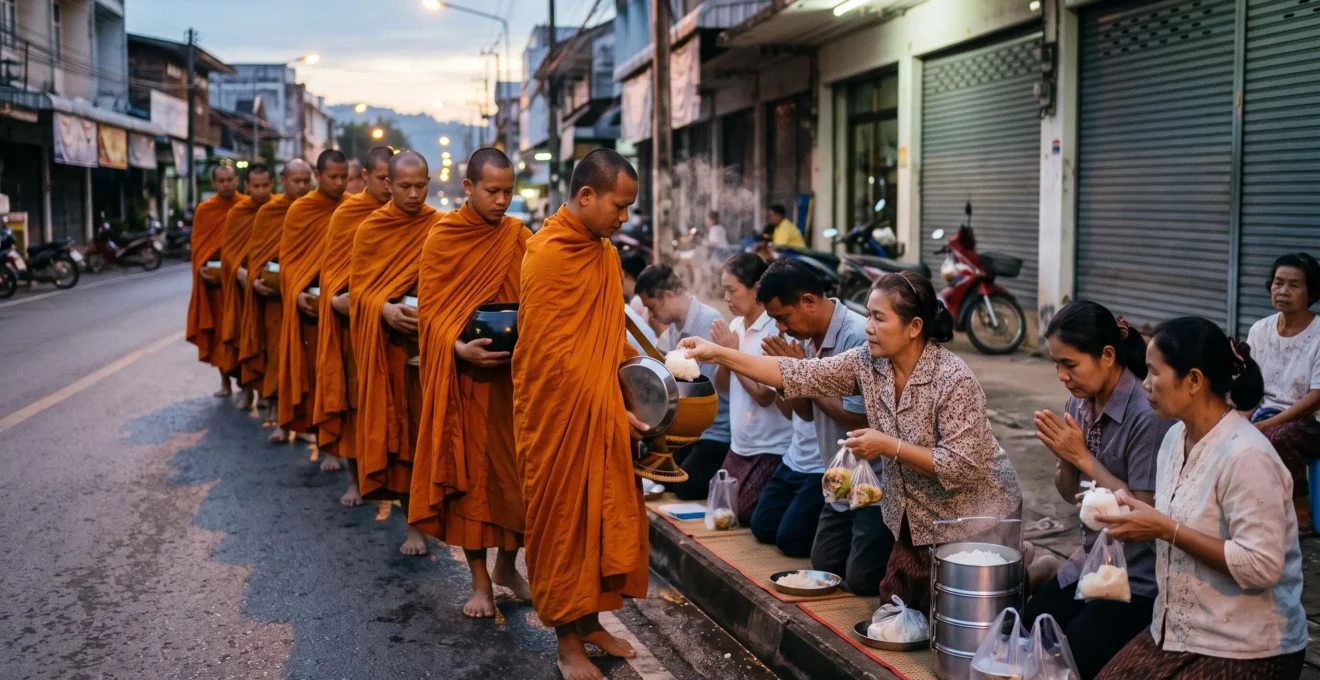
At dawn in a Thai town, a resident places rice into a Buddhist monk’s alms bowl, bows respectfully and returns home. To a foreign visitor, the exchange may look like charitable giving. Within Thai Theravada Buddhism, however, the giver also receives something meaningful: an opportunity to cultivate merit, known in Thai as bun.
Merit-making, or tham bun, helps explain how Buddhist beliefs influence Thai generosity, respect for monks, family rituals and everyday social relationships. Giving food, supporting temples, observing ethical precepts and developing the mind are understood as wholesome actions with consequences extending beyond the immediate moment.
This does not mean Thai society operates according to a single religious formula. Regional traditions, personal faith, economic circumstances and secular social expectations all matter. Nor is merit simply a supernatural reward exchanged for a donation.
Understanding the distinction changes what visitors see. A morning food offering becomes more than charity. A funeral becomes an occasion for supporting the deceased through religious dedication. Even the layout of a temple reveals how communities organize religious practice, social responsibility and public generosity.
Thai Buddhist merit-making: the essential distinctions
- Merit is cultivated through intentional conduct: generosity, ethical behavior and mental development all matter. Donations are only one expression.
- Monks and laypeople maintain a reciprocal relationship: lay supporters provide necessities, while the monastic community provides opportunities for religious practice and teaching.
- Religious customs have practical consequences: posture, food offerings, sacred spaces and lunar observances influence how visitors should behave.
- Why Thais Visit Temples Weekly to « Make Merit »: The Kammic Accounting System Explained
- How to Witness Monk Alms-Giving in Thailand Without Committing the 5 Tourist Errors
- Theravada Thai Monks vs Mahayana Japanese Monks: How Do Monastic Rules Differ?
- The Temple Mistake That Offends Thai Buddhists: Foot Positioning and What It Symbolizes
- When to Experience Thai Buddhism at Peak Devotion: The Lunar Calendar of Holy Days
- Why Thais Visit Temples Weekly to « Make Merit »: The Kammic Accounting System Explained
- When to Experience Thai Buddhism at Peak Devotion: The Lunar Calendar of Holy Days
- How to Read a Thai Temple: The 6 Architectural Elements That Reveal Its Century and Purpose
Why Thais Visit Temples Weekly to « Make Merit »: The Kammic Accounting System Explained
Thai Buddhists visit temples to make merit because wholesome intentions and actions are believed to produce beneficial karmic consequences. Offering food, practicing generosity, observing ethical precepts and supporting religious communities cultivate bun. Temple visits are not compulsory weekly services, however, and merit is not a numerical balance that automatically cancels wrongdoing.
The Pali term puñña, commonly translated as merit, describes the beneficial moral quality associated with wholesome action. In Thai religious life, tham bun means making merit through conduct that practitioners understand as spiritually beneficial.
The Thailand Foundation’s explanation of Buddhist merit-making identifies three principal foundations: generosity (dāna), ethical conduct (sīla) and mental development (bhāvanā). Buddhist teachings also describe a broader range of meritorious practices, including humility and reverence.
These categories matter because making merit does not require spending money. A person may give food to a monk, observe precepts, meditate or behave respectfully toward a teacher or elder. Each activity represents a different form of intentional wholesome conduct.
Foreigners sometimes imagine a literal karmic accounting system: one donation earns a positive entry, one misdeed produces a negative entry, and the two cancel each other. That metaphor helps explain why people seek beneficial future consequences, but it becomes misleading when treated as Buddhist doctrine.
Kamma concerns intentional action and its consequences, not a mechanically calculated moral bank account. A generous offering does not automatically erase the effects of harmful conduct.
Alms-giving demonstrates the social significance of this belief. Monks depend on lay supporters for material necessities, while laypeople regard supporting the monastic community as an opportunity to cultivate merit. The donor is therefore not necessarily understood as the sole benefactor of the encounter.
This helps explain why a person giving food may bow or express gratitude. The recipient represents an important opportunity for religious generosity. The interaction is reciprocal without establishing a literal debt owed by the monk.
Merit-making also appears at birthdays, graduations, weddings, funerals and during illness. A household may invite monks to chant or offer food in connection with an important transition. Such practices connect religious intention with family responsibility and community relationships.
Visitors should also distinguish merit-making from Thai social etiquette. The wai, public restraint and respect for seniority may express Buddhist-influenced values, but age hierarchy, local custom and social expectations also shape these behaviors. Public disagreement is not automatically understood as destroying accumulated merit.
Once this relationship between generosity and intention is understood, the morning alms round becomes easier to interpret without reducing it to either superstition or a picturesque scene.
How to Witness Monk Alms-Giving in Thailand Without Committing the 5 Tourist Errors
To observe Thai monk alms-giving respectfully, remain unobtrusive, follow local positioning customs, avoid touching monks, offer suitable food only when participation is appropriate, and keep photography discreet. The dawn ritual, called tak bat, sustains the monastic community while providing lay supporters an opportunity to make merit. Visitors may observe without participating.
During an alms round, monks or novices receive food from laypeople. The practice expresses the interdependence of the monastic community, or sangha, and the wider Buddhist population.
Some residents prepare cooked rice at home. Others arrange offerings nearby or contribute food at the temple. The precise procedure varies across communities and ceremonies.
Understanding that the offering is a religious act, rather than an exhibition staged for visitors, clarifies five common mistakes.
- Dominating the ritual space. Standing directly over a seated participant, obstructing the monks’ route or occupying the offering area for photographs can disrupt worship. Observe how local participants position themselves and leave adequate room.
- Moving too close for photographs. Avoid flash photography, intrusive close-ups and attempts to redirect participants. A camera should never determine the ceremony’s pace.
- Initiating physical contact with monks. Visitors should not touch monks or their robes. Women must take particular care to avoid direct physical contact in accordance with Thai Theravada monastic conventions.
- Offering unsuitable items. Cooked rice and suitable food are familiar offerings. Money should not be placed directly into a monk’s alms bowl; financial support, where appropriate, should follow the monastery’s designated arrangements.
- Treating participation as a purchased experience. A religious offering is not a payment for access, a blessing or a photograph. Visitors can participate respectfully when invited or remain silent observers.
The rules are especially important when offering food. Theravada monastic discipline distinguishes the correct reception of permitted food from other exchanges of objects. A foreign visitor should follow the local arrangement rather than improvise a procedure.
For women offering objects to monks, an intermediary, receiving cloth or designated surface may be used to avoid direct contact. The correct method depends on the setting and the receiving monk’s instructions.
This boundary concerns physical interaction, not ordinary conversation. A monk speaking with a female traveler is not necessarily violating monastic etiquette, and a monk avoiding contact should not be interpreted as expressing personal disapproval.
Town alms rounds and organized ceremonies at markets or waterfront locations may look different. A boat ceremony, for example, introduces different practical arrangements from a roadside procession. It is therefore inappropriate to assume that the posture or transfer method observed at one location applies universally.
Five checks before observing a Thai alms round
- Identify an appropriate observation position: choose a place outside the monks’ walking route and confirm that worshippers can pass without obstruction.
- Check local offering arrangements: identify the designated place or person responsible for suitable food offerings before purchasing anything.
- Prepare respectful clothing: check that shoulders and knees are covered and that footwear can be removed where required.
- Decide whether to photograph: establish a position that requires neither flash nor interruption, or keep the camera away entirely.
- Confirm the transfer method: if participating, identify how offerings are accepted locally, particularly when avoiding direct physical contact with monks.
Respectful observation does not require mastering every monastic rule. It begins with recognizing that food offerings are religious actions governed by obligations and customs that extend beyond the tourist encounter.
Theravada Thai Monks vs Mahayana Japanese Monks: How Do Monastic Rules Differ?
Thai Theravada monks and many Japanese Buddhist priests follow different institutional models. Fully ordained Thai Theravada monks observe a celibate Vinaya discipline that restricts ordinary food consumption to the period before noon. In several Japanese Buddhist traditions, priests may marry, raise families and inherit temple responsibilities. Neither model represents every Buddhist tradition or practitioner.
For travelers who have visited temples in Japan, Thailand can present an unfamiliar relationship between religious specialists and laypeople.
Fully ordained Theravada monks, or bhikkhus, traditionally observe 227 disciplinary rules recorded in the Pātimokkha. These cover matters including conduct, food, possessions and interactions with other people.
The specialist guide The Bhikkhus’ Rules: A Guide for Laypeople explains the permitted eating period and the practical importance of food received from lay supporters.
Ordinary food is generally consumed between dawn and noon. This does not mean every monk eats only one meal daily. Food can also be delivered to monasteries instead of collected on foot, and monastic communities may receive permitted support through arrangements involving laypeople and novices.
Japanese Buddhist clerical traditions developed under different historical conditions. Richard M. Jaffe‘s academic study, Neither Monk nor Layman: Clerical Marriage in Modern Japanese Buddhism, documents changes associated with the Meiji period and the widespread acceptance of clerical marriage in modern Japanese Buddhism.
The comparison is not simply Theravada versus Mahayana doctrine. Japanese Buddhist institutions are diverse, and their rules also reflect denomination, history and clerical status.
The practical differences can be summarized without treating either country as religiously uniform.
| Aspect | Thai Theravada bhikkhus | Many Japanese Buddhist priests |
|---|---|---|
| Marriage | Celibacy is part of the monastic discipline. | Marriage is accepted in several major traditions. |
| Meals | Ordinary food is restricted to the permitted period before noon. | The same Theravada eating restriction does not generally govern married temple priests. |
| Food support | Dependence on lay offerings is central to monastic discipline. | Support and temple responsibilities vary by institution and denomination. |
| Temple succession | Monastic positions are not inherited through a monk’s children. | Family succession occurs in some temple traditions. |
| Visitor participation | Alms-giving and merit-making are prominent opportunities for lay involvement. | Rituals and participation arrangements depend on the temple and school. |
These differences affect what a visitor should expect. A Thai monk receiving food is participating in a form of material dependence established by monastic discipline. A Japanese temple priest managing a family-associated institution may occupy a different social and religious role.
Yet foreign participation in alms-giving is not obligatory. Thai monastic communities have established local networks of support. Visitors can learn about this system through observation without assuming that tourism is necessary to sustain it.
Nor should travelers assume that every Japanese temple welcomes casual meditation visits or that every Thai temple expects an offering. Access policies and local practices should be checked individually.
These institutional differences become visible inside temples, where physical space, visitor conduct and ritual access communicate how religious life is organized.
The Temple Mistake That Offends Thai Buddhists: Foot Positioning and What It Symbolizes
Pointing the soles of your feet toward a Buddha image or a monk is one of the most recognizable breaches of Thai temple etiquette. Thai cultural conventions associate the head with elevated status and the feet with the lowest bodily position. Visitors should sit with their feet directed away from sacred images, remove shoes where required and avoid stepping over people or religious objects.
This head–foot hierarchy provides a practical way to understand behaviors that otherwise seem unrelated.
When entering a temple hall, footwear is usually removed. Once seated, worshippers commonly kneel or position their legs to one side so that the soles of their feet are not directed toward the Buddha image.
Stretching both legs toward the principal image may feel comfortable to a foreign visitor, but it can communicate disrespect through the orientation of the body.
The Tourism Authority of Thailand’s temple etiquette advice recommends covering shoulders and knees, removing footwear before entering temple buildings, keeping feet away from Buddha images and stepping over raised thresholds rather than onto them.
These recommendations provide useful rules for visitors without requiring the assumption that every practice originates exclusively in Buddhist scripture. Thai temple etiquette combines Buddhist reverence with broader cultural conventions.
Consider four frequent situations.
- Sitting before a Buddha image: kneel or sit sideways with the feet tucked away, rather than extending the legs toward the image.
- Crossing a raised doorway threshold: step over the threshold instead of placing a foot on it. Local spiritual explanations may differ.
- Indicating a sacred object: use a restrained, open-handed gesture rather than pointing aggressively with a finger or foot.
- Taking photographs near monks or Buddha images: avoid physical contact, intrusive poses and positions that diminish the dignity of the sacred setting.
Claims that every raised threshold houses a spirit should be treated cautiously. Such explanations may reflect local beliefs, but the documented visitor recommendation is simply to step over raised thresholds.
Similarly, visitors should not turn the head–foot hierarchy into an absolute rule that a layperson can never stand above a monk. Context, posture, architecture and the activity taking place all influence respectful positioning.
Outside temples, the same cultural framework helps explain why people avoid directing feet toward others, stepping across someone’s body or placing feet on furniture in formal settings.
In a home or a shared vehicle such as a songthaew, keeping feet tucked away is a useful default. Stepping over a book, especially one treated as important or sacred, can also appear disrespectful.
The broader principle is spatial consideration: the position of the body communicates how a person recognizes others and the environment.
Once the physical etiquette makes sense, visitors can concentrate on the rhythms of worship itself, particularly the lunar observances when many temples become especially active.
When to Experience Thai Buddhism at Peak Devotion: The Lunar Calendar of Holy Days
To experience Thai Buddhist devotion beyond ordinary temple sightseeing, visit on a Buddhist lunar observance day, known as Wan Phra, or during a major annual holy day. These occasions can include merit-making, precept observance, chanting and candlelit circumambulation. The most important ceremonies depend on the specific festival and monastery, so local schedules are more reliable than assumptions about every holy day.
Thailand’s Buddhist religious calendar follows lunar phases, producing a recurring pattern of observances rather than a single weekly congregational service.
Wan Phra days occur around the major lunar phases, roughly every seven or eight days. Some observances attract relatively small gatherings, while major festivals bring larger numbers of lay worshippers to temple compounds.
At certain temples, visitors may encounter people bringing food to monks, listening to teachings, observing additional ethical precepts or spending time in meditation.
The rhythm is not uniform. A busy urban temple, a village monastery and a meditation-focused forest monastery may arrange their observances differently.
One of the most recognizable public devotional practices is wian tian, a candlelit procession performed on major Buddhist holy days.
Participants typically walk clockwise around a significant religious building three times, carrying devotional objects such as candles, incense and flowers. The three circuits honor the Buddha, the Dhamma (the teachings) and the Sangha (the monastic community).
It would be misleading, however, to suggest that every Wan Phra evening includes a large candle procession. Wian tian is especially associated with particular major festivals.
For planning, four annual observances are particularly useful.
| Observance | Religious significance | Typical visitor experience |
|---|---|---|
| Makha Bucha | Commemorates an important gathering of the Buddha’s disciples. | Temple worship, merit-making and candlelit processions at participating temples. |
| Visakha Bucha | Commemorates the Buddha’s birth, enlightenment and passing away. | Major devotional activities, chanting and wian tian ceremonies. |
| Asanha Bucha | Commemorates the Buddha’s first teaching. | Merit-making, religious teachings and evening observances. |
| Khao Phansa | Marks the beginning of the monastic rains retreat. | Offerings to monks, candle-related traditions and retreat-related ceremonies. |
During Khao Phansa, monks traditionally remain associated with their residence for the rains retreat, subject to recognized exceptions. The period also brings opportunities for laypeople to renew religious commitments.
These dates have practical consequences for travel. Thailand imposes restrictions on alcohol sales on designated major Buddhist holidays, subject to applicable exemptions and changing regulations. Some businesses may modify their opening arrangements, while ceremonies can affect local traffic and crowd levels.
Visitors should verify the current year’s holiday calendar, local ceremony times and applicable restrictions. Lunar dates shift relative to the Gregorian calendar, so recurring festivals should not be assigned a permanent Western date.
A festival provides an especially visible encounter with devotion, but it is only one part of a much wider merit-making tradition that accompanies people through ordinary life, family transitions and bereavement.
Why Thais Visit Temples Weekly to « Make Merit »: The Kammic Accounting System Explained
Thai Buddhists make merit at temples because giving, ethical conduct and religious practice are understood as sources of beneficial karmic consequences. Yet the frequency and motivation of temple visits differ among individuals. Some attend on lunar holy days, while others visit for birthdays, funerals, personal concerns or family obligations. Merit-making is neither a compulsory weekly service nor a reliable way to cancel past misconduct.
The everyday merit economy becomes especially revealing when generosity, social recognition and personal aspirations intersect.
A large temple donation may be both a sincere religious act and a public expression of generosity. Where donors receive recognition, the offering can also convey social standing or community membership.
It is important not to assume that every conspicuous donation is motivated by status competition. The available evidence describes merit-making practices but does not establish how frequently public recognition, prestige or rivalry motivate individual donors.
Similarly, a person who has behaved badly may subsequently make an elaborate religious offering. A foreign observer might interpret the act as purchasing moral forgiveness.
That interpretation mistakes a possible popular understanding of merit for a universal Buddhist principle. Generosity does not automatically neutralize the karmic consequences of harmful actions. Ethical intention and conduct remain central to Buddhist teachings.
The social importance of merit becomes particularly clear at funerals.
Thai Buddhist families may sponsor chanting, food offerings and other ceremonies on behalf of deceased relatives. The seventh, fiftieth and hundredth days after death are documented occasions for funeral-related merit-making, although local and family practices vary.
Merit may be dedicated to deceased relatives through a practice often described as sharing or transferring merit. The underlying religious understanding is not simply that one person moves a measurable quantity of spiritual wealth into another person’s account.
Rather, the dedication gives religious significance to the wholesome actions performed by the living and expresses their continuing concern for the deceased. Interpretations of how the deceased benefits can vary.
This helps explain why a funeral is more than an occasion for mourning. It can involve coordinated giving, religious observance, hospitality and family solidarity.
Merit-making also follows a flexible personal calendar. A student preparing for an examination, someone facing a difficult decision or a family celebrating a birthday may visit a temple as part of their religious practice.
These are illustrative circumstances rather than proof that all Thai Buddhists behave alike.
There is no compulsory Thai Buddhist equivalent of a weekly Christian Mass. Temple participation may be frequent, occasional or concentrated around major events.
The same distinction helps explain why the lunar calendar matters even to people who do not visit a temple every week: it creates shared occasions for devotion without imposing identical schedules on everyone.
When to Experience Thai Buddhism at Peak Devotion: The Lunar Calendar of Holy Days
Thai Buddhist devotion is often most visible during major lunar festivals, but travelers do not need to wait for a national religious holiday to encounter meaningful temple activity. Wan Phra observances recur throughout the lunar month and may include offerings, precept-taking and religious instruction. For evening candle processions, travelers should specifically identify temples holding wian tian ceremonies rather than assuming every holy day includes them.
The most useful planning distinction is between a recurring temple observance and a major public ceremony.
A traveler staying in Thailand for several days may have an opportunity to encounter a Wan Phra observance. A visitor seeking a larger candlelit procession, however, should plan around a festival and confirm that the chosen temple holds one.
At many temples, the morning is particularly significant because laypeople bring food and other offerings to monks. Older devotees or people with flexible schedules may spend longer periods participating in religious activities.
On major observance days, some lay practitioners undertake the eight precepts, a stricter temporary discipline than the five precepts commonly associated with ordinary lay Buddhist practice.
These observances can change the atmosphere of a temple without transforming the entire surrounding town. Visitors should not expect every market to become quiet or every resident to suspend ordinary routines.
The annual rains retreat adds another dimension. During Khao Phansa, temporary ordination and increased religious commitments may occur in some communities. The extent of participation differs by locality and individual circumstances.
For a visitor, the most reliable method is to choose the desired experience first and then verify the relevant ceremony.
- For morning merit-making: ask whether the selected monastery has a regular food-offering period and whether observers are welcome.
- For candlelit devotion: look for a confirmed wian tian ceremony associated with a major Buddhist observance.
- For a quieter religious experience: inquire about ordinary Wan Phra activities, religious teachings or permitted public meditation sessions.
- For the rains retreat: investigate local Khao Phansa ceremonies and temple-specific visitor arrangements.
There is no universal hour for these events. Monasteries establish their own schedules, and regional traditions can differ markedly. It is better to obtain a local announcement than rely on an itinerary stating that every temple performs the same ceremony at sunset.
Religious calendars also help visitors anticipate practical restrictions. Alcohol-sale controls on specified Buddhist holidays may affect nightlife and commercial arrangements, but the precise rules and exemptions should be checked for the relevant date.
With the timing established, the next challenge is interpreting the temple itself: its buildings reveal where ceremonies occur, how monastic and lay activities are organized, and how generations of donors have supported the religious community.
What to know before entering a Thai temple
- Identify the function of the building: the ordination hall, assembly hall and relic monument are not interchangeable spaces.
- Read architectural features cautiously: shapes and decorative traditions can suggest historical influences, but they rarely establish a building’s exact date by themselves.
- Notice the evidence of community support: restoration plaques, sponsored projects and offerings reveal how merit-making contributes to temple upkeep.
How to Read a Thai Temple: The 6 Architectural Elements That Reveal Its Century and Purpose
Thai temple architecture can be understood through six recurring elements: the chedi, prang, ubosot, wihan, roof ornamentation and naga stair decoration. Together, they help visitors identify religious functions, architectural traditions and historical influences. However, a building’s appearance alone rarely establishes its exact century because Thai temples are frequently restored, expanded or rebuilt.
A Thai Buddhist temple, or wat, is not necessarily a single religious building. It can be a compound containing worship spaces, monastic residences, monuments and facilities serving the surrounding community.
The distinction between these spaces matters because their functions influence where visitors may go and how they should behave.
The six elements provide a practical framework for reading the complex.
| Element | What to recognize | What it can reveal |
|---|---|---|
| 1. Chedi | A stupa or reliquary monument, sometimes with a bell-shaped profile. | Relic veneration, commemorative functions and possible regional or historical influences. |
| 2. Prang | A tower form associated with Khmer-influenced architectural traditions. | Historical and artistic connections, particularly where Khmer-derived forms were adopted. |
| 3. Ubosot | An ordination hall, identified by its consecrated boundary, often marked by sema stones. | The formal space used for important monastic ceremonies, including ordination. |
| 4. Wihan | An assembly or image hall, commonly containing a principal Buddha image. | A setting for worship, religious gatherings and lay devotion. |
| 5. Roof ornamentation | Tiered rooflines and decorative finials such as chofa. | Regional artistic traditions, architectural status and later restoration choices. |
| 6. Naga stair decorations | Serpent-like forms along stairways or entrances. | Religious imagery and protective symbolism linked to Buddhist and regional traditions. |
These elements are best interpreted together. A bell-shaped chedi may recall Sri Lankan-influenced forms, while a prang may suggest Khmer-derived architectural vocabulary. Neither observation, by itself, dates the present building conclusively.
Later construction can reproduce older styles. A temple may also combine buildings from different periods, making the compound’s founding date different from the date of its surviving structures.
The ubosot and wihan distinction is particularly useful for visitors.
The ubosot is a consecrated monastic ritual space, while the wihan commonly serves as a gathering and devotional hall. An ubosot is not necessarily closed to lay visitors, nor is every wihan automatically open at all hours.
Look for signs, barriers or instructions before entering either building. Monastic ceremonies may limit access regardless of the building’s architectural type.
The chedi offers another way to connect architecture with religious practice. Stupas may be associated with relics or commemoration and can serve as focuses of reverence. Where circumambulation is appropriate, clockwise movement is customary.
Decoration can also reveal the temple’s relationship with the surrounding community.
Lay donors may contribute toward construction, roof restoration, gilding and other religious projects. Such offerings can be understood as merit-making. Donation plaques sometimes preserve names and details of particular contributions, offering clues to the temple’s social history.
Nevertheless, visible architectural wealth should not be treated as a complete record of merit or proof that one donor possesses greater spiritual standing than another.
Other prominent elements require careful interpretation. The Emerald Buddha’s ceremonial robes are changed seasonally in a royal ritual. Guardian figures such as yaksha are protective elements of temple iconography rather than simply threatening monsters.
Naga figures likewise participate in rich religious and regional symbolic traditions. Their precise meaning depends on their setting; visitors should avoid assigning a single interpretation to every serpent image or hybrid figure.
Architecture helps explain religious activity, but it does not replace local knowledge. Building inscriptions, official temple information and knowledgeable local guides are more dependable than visual guesswork for establishing dates, access conditions and specific ritual purposes.
On a next temple visit, begin by identifying the ubosot, wihan and chedi, then observe where offerings are made and which spaces people use for prayer. This turns architecture into a way of understanding the living relationship between Buddhist belief and Thai social behavior.
Can a non-Buddhist make merit at a Thai temple?
A non-Buddhist visitor can participate respectfully in appropriate acts of generosity, including permitted food offerings or temple support. Buddhist teachings connect merit with wholesome intention, while the visitor’s own interpretation may differ. Participation should follow local instructions, and observing without giving is also acceptable.
Do Thai Buddhists believe donations erase bad karma?
There is no general Buddhist teaching that donating money automatically cancels harmful past actions. Merit-making emphasizes wholesome intentions and conduct. Individuals may express hopes for favorable consequences, but a literal system in which donations purchase forgiveness misrepresents the complexity of kamma.
Is it disrespectful to visit a Thai Buddhist temple without making an offering?
Not generally. Many temples welcome respectful visitors who simply observe, learn or appreciate the architecture. Appropriate dress, considerate behavior and adherence to local access rules matter more than making an unsolicited donation. Some religious activities or spaces may have additional restrictions.
Why do Thai Buddhists dedicate merit to deceased family members?
Merit dedication expresses the intention that wholesome religious actions benefit deceased relatives. It forms part of established Buddhist devotional practice and helps explain offerings, chanting and ceremonies associated with bereavement. The belief should not be reduced to transferring a measurable quantity of merit between accounts.
Can tourists speak with Buddhist monks in Thailand?
Yes, when a monk is available and willing to speak. Visitors should use respectful language, avoid interrupting ceremonies and observe rules concerning physical contact. Women can have appropriate conversations with monks; avoiding direct touch does not mean ordinary conversation is prohibited. Temple-specific arrangements should always take precedence.