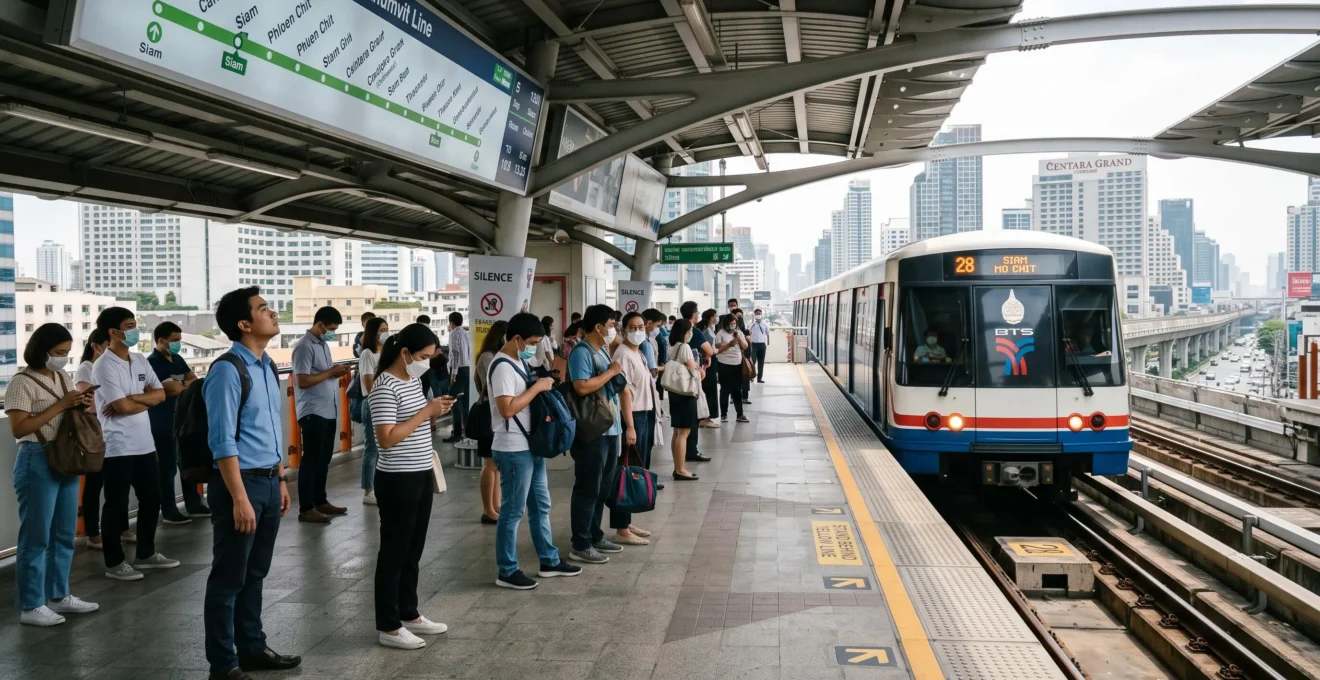
Bangkok’s BTS Skytrain becomes much easier to navigate once you stop thinking only about station names and start planning around three decisions: which line serves your destination, which direction the train travels, and which exit brings you closest to the correct entrance.
The elevated network has two principal lines: the dark-green Sukhumvit Line and the light-green Silom Line. They connect at Siam, while several stations provide connections to Bangkok’s separate MRT system. The important distinction is that an interchange between BTS lines is not the same as changing transport operators.
For first-time visitors, small navigation choices can make a significant difference. Choosing the wrong platform may send you away from your destination; choosing the wrong exit can leave you on the opposite side of a busy intersection. Ticket queues and commuter crowds introduce further delays.
The practical approach is to plan each journey from the destination’s exact entrance backward to the station, platform and payment method.
Bangkok BTS navigation essentials
- Understand the two lines: Sukhumvit and Silom connect at Siam. Asok and Sala Daeng provide useful connections to the MRT.
- Choose your exit before arriving: station maps, elevated walkways and building entrances matter more than the apparent straight-line distance.
- Plan around transfers and queues: a Rabbit card can simplify frequent BTS trips, while off-peak travel and shorter final walks improve comfort.
- Why Every Bangkok Journey Routes Through Siam: The Central Interchange Explained
- How to Pick the Right BTS Exit: Why Siam Station Exit 5 Is 800 Meters From Exit 1
- BTS or MRT: Which Bangkok Rail Line Gets You Closest to Your Destination?
- The BTS Ticket Queue That Wastes 5 Minutes Per Journey: Why Rabbit Cards Save Time
- When to Ride Bangkok BTS Without Being Crushed: Peak Hours Decoded
- How to Choose Your Bangkok District: Where to Stay Based on Night Markets, Galleries, or Temples
- How to Read Bangkok’s Districts Through Their Architecture: From Temple Roofs to Modern Towers
- Putting It All Together: A Step-by-Step Method to Plan Any Bangkok Journey on the BTS
Why Every Bangkok Journey Routes Through Siam: The Central Interchange Explained
Siam is Bangkok’s principal interchange between the Sukhumvit and Silom BTS lines, but not every journey needs to pass through it. If your departure and destination stations are on different BTS lines, Siam is normally where you change trains. If both stations share one line, remaining aboard is usually simpler.
The BTS official route and station overview identifies the two main routes:
- Sukhumvit Line, dark green: runs between Khu Khot and Kheha, passing through major central Bangkok areas including Mo Chit, Phaya Thai, Siam, Chit Lom, Asok and Phrom Phong.
- Silom Line, light green: runs between National Stadium and Bang Wa, serving Siam, Sala Daeng, Chong Nonsi and the Saphan Taksin area before continuing across the river.
Bangkok’s rail network becomes manageable when you picture these as two intersecting corridors rather than a complicated web of colored routes. Siam is their shared interchange; National Stadium is the Silom Line terminus, not another point where both BTS lines meet.
At Siam, platforms are distributed across two levels. Changing trains can therefore require moving between platform levels, depending on the direction of travel. Follow the directional signs for the train’s destination rather than choosing a platform based only on its color or level.
The distinction becomes especially important when connecting to the MRT. Three useful interchange pairs are BTS Asok with MRT Sukhumvit, BTS Sala Daeng with MRT Si Lom, and BTS Mo Chit with MRT Chatuchak Park. Unlike changing between BTS lines at Siam, these transfers involve leaving one fare system and entering another.
| Journey situation | Recommended approach | What to check |
|---|---|---|
| Both stations on one BTS line | Stay on the same line | Train direction and terminal |
| Stations on different BTS lines | Change at Siam | Correct platform level and direction |
| Destination closer to an MRT station | Consider a BTS–MRT transfer | Transfer walk, second fare and final walk |
| Destination beyond convenient rail coverage | Combine rail with another mode | Total door-to-door journey |
Consider a hypothetical journey from Asok to Chong Nonsi. You could take the Sukhumvit Line toward Siam and transfer to the Silom Line. Alternatively, you could compare an MRT connection through Sukhumvit and Si Lom. Which is faster depends on actual waiting times, walking distances and crowding; a route with fewer stops is not automatically quicker.
One common visitor mistake is treating Siam as an obligatory stop even when the train already serves the destination directly. Another is mistaking the direction displayed on a platform for the line name. Khu Khot, for instance, indicates one Sukhumvit Line direction rather than a different network.
Once you know where to change trains, the next challenge is identifying where to leave the station. At busy intersections, the correct exit can matter almost as much as the correct route.
How to Pick the Right BTS Exit: Why Siam Station Exit 5 Is 800 Meters From Exit 1
The correct BTS exit is the one that provides the most practical walking route to your destination’s actual entrance, not necessarily the exit closest to its map pin. Bangkok stations can connect to different sidewalks, shopping centers and elevated walkways. However, the claimed 800-meter distance between Siam Exit 5 and Exit 1 is not independently established by the available official documentation.
BTS station design commonly separates street access, a concourse with ticket gates, and train platforms. Station-area maps at concourse level help passengers identify nearby destinations and numbered exits.
At an interchange such as Siam, leaving through an unfamiliar exit can put you on the wrong side of a major road or lead you into a building whose pedestrian access is less convenient than expected. A route that appears shortest in straight-line distance may require a considerable detour to reach a legal crossing.
The official BTS station-design documentation describes typical distances of 800–1,000 meters between successive stations. That measurement does not establish the distance between individual exits at Siam or any other station.
A more reliable exit-selection method follows the final destination rather than the station name:
- Find the precise entrance of your hotel, restaurant, mall or attraction.
- Identify the nearest practical BTS station and look at its numbered exit map.
- Check whether a skywalk, footbridge or connected building provides pedestrian access.
- Compare the actual walking routes rather than just the distances displayed between map pins.
- Confirm that the planned entrance or connected passage will be accessible at the time of your visit.
Skywalks can be particularly valuable around busy commercial corridors because they may avoid street-level crossings. Nevertheless, a skywalk is useful only if it connects to the side of the road or building you need.
Temporary closures create another complication. A walkway connected to a shopping center may have different access conditions from a public stairway, particularly outside commercial hours. Where a planned route depends on entering a building, verify its operating hours and identify an alternative street exit for the return journey.
For example, imagine a hotel described as being 300 meters from a BTS station. If the nearest station exit is on the opposite side of a divided roadway, the actual walking route may be noticeably longer. That example is hypothetical; the correct distance must be checked for the individual address.
The useful question is not simply which exit is nearest, but which exit minimizes walking, road crossings and uncertainty under the conditions you will encounter.
Exit planning also changes how you choose between Bangkok’s rail networks. A station on another line may put you significantly closer to the destination’s real entrance.
BTS or MRT: Which Bangkok Rail Line Gets You Closest to Your Destination?
Choose the BTS when its Sukhumvit or Silom routes provide convenient access to your destination, and consider the MRT when its stations reduce the final walking distance or offer a more direct journey. The best option depends on the complete door-to-door route, including transfers, separate fares and walking in Bangkok’s heat.
The BTS and MRT complement each other geographically rather than operating as interchangeable services.
The BTS is especially useful for areas along Sukhumvit Road, the Siam commercial district, Silom and parts of the riverside corridor. The MRT Blue Line expands rail coverage toward additional districts, including areas closer to Bangkok’s historic center.
According to the BEM official MRT network map, the Blue Line covers approximately 48 kilometers with 38 stations. The operator also provides information about service intervals and connections.
Neither network directly reaches every attraction, and choosing between them based only on the name of the nearest station can be misleading.
| Decision factor | BTS Skytrain | MRT Blue Line |
|---|---|---|
| Main geographic strengths | Sukhumvit, Siam, Silom and connected corridors | Additional coverage around historic and other urban districts |
| Typical station environment | Elevated platforms on the principal lines | Underground and elevated sections |
| Cross-network transfers | Require leaving the BTS fare system | Require entering the MRT fare system |
| Ticket planning | Check BTS ticket and Rabbit card conditions | Check MRT-specific payment acceptance |
| Final walking distance | Depends on station exits and pedestrian access | Depends on station exits and pedestrian access |
Separate fares matter. A BTS–MRT transfer should not be treated as a free continuation of the same ticket. Unless a particular fare product explicitly provides otherwise, budget for the fare requirements of each operator.
For a visitor taking several journeys daily, paying for two networks can change the economics of an otherwise convenient route. Compare the additional fare against the time and physical effort saved by transferring.
A straightforward calculation is:
Total journey time = rail travel + waiting + interchange walking + final walking.
Use realistic estimates for each component, particularly when a transfer involves escalators, ticket gates and outdoor pedestrian sections.
The final walking leg is especially important in tropical weather. A somewhat longer rail journey may be more comfortable if it delivers you much closer to your destination.
Rail also has practical limits. Attractions deep within the historic center or along smaller Thonburi streets may require another transport mode. A bus, river boat, taxi or app-booked ride can complete the trip where neither BTS nor MRT provides a suitable final connection.
After selecting the network, the next potential delay occurs before boarding: deciding how to pay without spending unnecessary time at ticket machines.
The BTS Ticket Queue That Wastes 5 Minutes Per Journey: Why Rabbit Cards Save Time
A Rabbit card can reduce repeated ticket-purchasing delays for frequent BTS passengers, but it does not guarantee a five-minute saving on every journey. Single-journey tickets may be more economical for occasional riders. The right payment method depends on how many BTS trips you expect, the upfront card cost and current ticket-payment options.
For a first-time visitor, three payment approaches deserve consideration:
- Single-journey tickets: useful for occasional travel, although buying a ticket before each journey can involve waiting at a machine or ticket office.
- Rabbit stored-value card: allows eligible journeys to be paid from a preloaded balance, reducing the need to purchase individual tickets repeatedly.
- Other electronic payment methods: acceptance depends on the specific network, station equipment and currently supported payment products. Do not assume an ordinary contactless bank card works at every BTS gate.
The operator’s official BTS Rabbit card purchase and top-up instructions list a 120-baht THB issuance fee with no refundable card deposit. They also specify a minimum stored-value top-up of 100 baht and a maximum stored balance of 4,000 baht.
120 THB + 100 THB
Published Rabbit card issuance fee plus minimum initial stored-value top-up. The 100 baht is travel balance, not another card fee. These operator terms should be rechecked before purchase.
Bangkok Mass Transit System Public Company Limited, Rabbit card issuance instructions.
That distinction is essential. The issuance fee represents an upfront cost, while the stored value pays for eligible journeys. Buying a Rabbit card does not automatically mean receiving discounted fares on every trip.
To assess whether the card is worthwhile, estimate your total BTS journeys, the time spent buying tickets and the likelihood of using the remaining balance. Then compare that convenience with the nonrefundable issuance cost and any applicable fare products.
For a hypothetical two-journey visit, paying an issuance fee solely to avoid two ticket purchases may offer little value. Someone making multiple BTS journeys every day over a longer stay may place greater value on the convenience, even without a fare discount.
The often-repeated five-minute queue saving is best treated as an illustrative possibility, not a measured universal result. Queues differ between stations, days and departure times. When crowds are light, buying a ticket may take very little time.
Visitors using single-journey tickets should check the available machine instructions and accepted payment methods before queuing. Having an appropriate payment option ready and selecting a less busy machine can help. Use the staffed ticket office when assistance is needed.
Ticket-purchase savings also depend on how often you enter the system. Changing between BTS lines at Siam is not the same as exiting and purchasing a new ticket for another operator.
Even with payment arranged, boarding at the busiest times can affect comfort and journey reliability. Understanding commuter flow provides another opportunity to travel more efficiently.
When to Ride Bangkok BTS Without Being Crushed: Peak Hours Decoded
The most comfortable BTS journeys are generally those outside the strongest weekday commuting flows. Morning services toward central employment and commercial districts and evening services carrying commuters away from those areas can become crowded. Rather than relying on one universal timetable, consider your direction of travel, the station and the queues visible on the platform.
Bangkok’s rush-hour experience is directional. A train approaching central Bangkok during the morning commute may be considerably busier than a service traveling the opposite way. In the evening, heavily used sections may experience a different balance of passenger movement.
Siam and Asok are particularly useful locations to keep in mind because they combine major destinations with significant interchange activity. Nevertheless, crowding changes across the route and from one train to another.
The MRT operator publishes peak periods of 07:00–09:00 and 16:30–19:30 for its Blue Line. These are MRT service-planning periods, not verified universal BTS crowding hours. They can provide context for commuter travel without establishing exactly when every BTS train will be busiest.
On the BTS platform, several immediate observations are more useful than assuming every carriage has identical occupancy:
- Look for queues accumulating at individual boarding positions.
- Observe whether one end of the platform has fewer waiting passengers.
- Check the occupancy visible through train windows as the train arrives.
- Avoid standing directly beside escalator entrances if they create concentrated queues.
- Allow passengers to leave before boarding and follow the platform markings.
Carriages near stairs and escalators can attract more passengers because those boarding positions are convenient. However, there is no guarantee that the first or last carriage will always be less crowded.
For sightseeing, a useful planning adjustment is to shift nonessential rail journeys by 30–60 minutes when your schedule permits. Mid-morning or mid-afternoon can offer relatively comfortable alternatives to conventional commuting periods, although shopping events, holidays and local demand may change conditions.
Visitors with luggage face additional constraints. A crowded carriage leaves less space to maneuver bags, particularly around doors. There is no basis for assuming that a dedicated luggage carriage will be available on an ordinary BTS service.
With large suitcases, prioritize accessible station routes, lift availability and less crowded travel periods. If a congested train arrives, allowing it to depart and reassessing the next service may be preferable to forcing luggage into an already packed boarding area.
Daily travel comfort also depends on where your journeys begin. Choosing accommodation near the right part of the network can reduce avoidable transfers throughout an entire Bangkok stay.
How to Choose Your Bangkok District: Where to Stay Based on Night Markets, Galleries, or Temples
The most convenient Bangkok district is not necessarily the one closest to the greatest number of attractions. It is the district that gives you a practical daily departure station, manageable walking access and straightforward connections to your preferred activities. A hotel near a useful station can save more effort over several days than a centrally located property with poor pedestrian access.
Visitors concentrating on shopping, restaurants and modern commercial districts may find central Sukhumvit or Siam convenient. Travelers interested in Silom, Sathorn and sections of the riverside can benefit from Silom Line access. Those prioritizing temples or the historic center should compare nearby MRT stations and supplementary transport instead of assuming every destination is close to the BTS.
| Visitor priority | Districts to consider | Transport consideration |
|---|---|---|
| Shopping and central city attractions | Siam and adjacent central areas | Access to both BTS lines at Siam |
| Dining, nightlife and contemporary city life | Sukhumvit corridor | Convenient Sukhumvit Line departures |
| Business districts and riverside connections | Silom and Sathorn | Silom Line access and transfer options |
| Historic temples and older neighborhoods | Old Town and nearby MRT-connected areas | Potential need for MRT, boats or road transport |
| Creative neighborhoods and galleries | Selected central and riverside areas | Check each venue’s exact location and last-mile access |
The location of a night market, art gallery or temple should be checked individually. Labels such as « near the night markets » or « central Bangkok » are too broad to establish a reliable transport advantage.
The phrase « near BTS » also deserves scrutiny. Hotel listings may describe distance in a straight line, while the actual pedestrian route involves intersections, inaccessible shortcuts or a long walk along a side street.
Before booking, identify the property’s entrance on a walking map, trace the route to the nearest practical numbered station exit, and check whether the route remains usable at night.
There is another trade-off between central and outer-line accommodation. Staying close to Siam gives access to the network’s main BTS interchange, but does not eliminate congestion. Staying farther along a line may provide direct trips to some destinations while creating longer journeys to others.
A useful hypothetical comparison is between two hotels: one located near a Sukhumvit Line station and another close to an MRT station. If most planned attractions fall along the Blue Line, the MRT-connected hotel may prove more practical despite being farther from Siam.
For a multi-day visit, group attractions by corridor and estimate repeated daily travel rather than optimizing only the airport-to-hotel journey or one sightseeing trip.
The neighborhood choice also shapes how you experience the city. Elevated journeys provide changing views of Bangkok’s buildings and urban form, which can serve as supplementary orientation clues.
How to Read Bangkok’s Districts Through Their Architecture: From Temple Roofs to Modern Towers
Bangkok’s elevated Skytrain offers a useful visual introduction to the city’s changing urban landscape. High-rise commercial districts, older low-rise neighborhoods and occasional temple roofs create different surroundings along the network. These features can help orient visitors, but architectural landmarks should complement station signs and maps rather than replace them.
Along central Sukhumvit and around Siam, dense commercial development, contemporary towers and large shopping complexes dominate many views. These districts often feature substantial pedestrian infrastructure, including elevated connections between transport stations and adjoining buildings.
The Silom corridor introduces a different combination of commercial towers, established urban streets and routes toward the river. Around Saphan Taksin, the surrounding environment changes as the elevated line approaches the Chao Phraya corridor.
Travelers may also notice architectural details that distinguish religious buildings from modern commercial development. Traditional Thai temple complexes often feature tiered roofs, decorative gables and elaborate roofline ornamentation. Their visibility from a moving train, however, depends on the particular location, sightlines and intervening buildings.
Older neighborhoods can contain combinations of shophouses, buildings influenced by historic international architectural styles and later modernist structures. These patterns are not always easily classified from a moving carriage, and individual buildings should not be assigned a precise historical period from appearance alone.
Short explorations near well-connected stations can reveal these contrasts more clearly than train-window views.
- Siam: observe the scale and connected pedestrian infrastructure of Bangkok’s modern retail core.
- Chong Nonsi: explore the relationship between high-rise business development and the surrounding street network.
- Saphan Taksin: use the riverside setting to understand the transition between elevated urban rail and river-oriented transport.
These are starting points for observing urban form, not guarantees that a particular historical landmark will be visible from every platform or carriage.
Architecture becomes useful for navigation when a landmark has a clearly identifiable shape and can be matched to a map. A distinctive building near a station exit may help confirm that you have emerged on the intended side of the street.
Yet landmarks can mislead. High-rise towers may remain visible from several directions, and a building that looks adjacent from an elevated track may require a longer pedestrian approach.
For reliable orientation, use a three-part check: identify the building, confirm its position relative to the station, then verify the walking route on the ground. Station numbers, exit maps and street layouts remain the primary references.
These visual clues are most valuable when combined with a consistent route-planning routine. The same sequence of decisions can be applied to almost any journey across Bangkok’s rail network.
Key takeaways before your next BTS journey
- Start with the destination’s actual entrance, not simply the station that appears closest on a network map.
- Treat transfers, payment and pedestrian access as parts of one journey rather than separate decisions.
- Keep a backup exit or transport option ready when closures, crowds or incomplete rail coverage could disrupt your route.
Putting It All Together: A Step-by-Step Method to Plan Any Bangkok Journey on the BTS
A reliable BTS journey follows a repeatable sequence: locate the exact destination, compare rail routes, identify the correct direction and interchange, select the arrival exit, prepare payment and account for crowding. This method is more effective than simply boarding toward a familiar station and deciding what to do afterward.
Begin with the destination’s physical entrance. A shopping complex, hotel or attraction may have several entrances, and its position on a map may not correspond to the most convenient pedestrian approach.
Next, identify potential BTS and MRT arrival stations. Compare the routes using estimated rail time, interchange requirements and final walking distance. Choose the option that makes the entire journey practical, not merely the one with the fewest rail stops.
At the departure station, confirm the line and direction by reading the station’s destination signage. On the Sukhumvit Line, the Khu Khot and Kheha termini identify opposite directions. On the Silom Line, National Stadium and Bang Wa serve the same purpose.
Where a change at Siam is necessary, follow signs for the onward line and direction rather than assuming that changing platforms always means going up or down one level.
Before passing through the gates, confirm your payment method. If using a Rabbit card, ensure it has sufficient stored value for the intended eligible journey. For a single-journey ticket, use the displayed fare and ticket-machine instructions.
Your five-step BTS departure checklist
- Pin the destination entrance: save the exact entrance or street address, not just the general attraction name.
- Save the rail route: record the departure station, arrival station and any required interchange.
- Confirm the train direction: note the displayed terminal destination for each leg.
- Identify the arrival exit: record its number, pedestrian route and one alternative if access is unavailable.
- Prepare payment and timing: check the ticket or card, then select a departure window that accounts for expected crowds.
Even a carefully planned journey can go wrong. The most useful response is usually to correct the specific mistake rather than restart the entire route.
| Problem | Practical response |
|---|---|
| Boarded in the wrong direction | Get off at the next station and follow signs for the correct direction; check whether changing platforms is possible within the paid area. |
| Reached the wrong exit | Check the street map and pedestrian crossings before deciding whether to return toward the concourse or walk around the block. |
| Required destination is outside BTS coverage | Locate the nearest practical MRT station, river connection or road-transport option. |
| Usual exit or walkway is closed | Use the station-area map to choose an accessible alternative and recalculate the final walk. |
| Platform is too crowded | Assess another boarding position or wait for a later service if your schedule permits. |
Taking the wrong train direction does not necessarily mean buying a completely new ticket. Whether a correction can be made without leaving the paid area depends on station layout and fare-system conditions. Avoid making assumptions about refunds or extra charges; seek station staff assistance if uncertain.
For a longer stay, the same method becomes a planning system. Group nearby attractions along the Sukhumvit or Silom corridors, compare occasional MRT transfers, and review whether repeated BTS use makes a stored-value card worthwhile.
Leaving spare time for connections is particularly helpful when carrying luggage, traveling in the evening or reaching a venue with restricted entry hours.
For your next Bangkok journey, save the destination entrance, the station exit and the correct train direction before leaving your accommodation. Those three details provide a practical foundation for navigating the BTS confidently, even when the city around the tracks feels unfamiliar.
Can you change between the Sukhumvit and Silom BTS lines without buying another ticket?
Yes. Siam is the interchange between the two principal BTS lines, and passengers can transfer within the station’s paid area without purchasing a separate single-journey ticket solely for the line change. The fare applicable to the complete journey still depends on the ticket or payment product.
Can a Rabbit card be used on Bangkok’s MRT Blue Line?
A standard Rabbit card should not be assumed to work on the MRT Blue Line. BTS and MRT have distinct payment arrangements. Check the current acceptance rules of the specific MRT service before traveling, particularly when combining networks.
What should you do if your planned BTS exit is closed?
Use the station’s area map and directional signage to identify another accessible exit. Recheck the pedestrian route to your destination, especially if the original exit connected through a shopping center, footbridge or other restricted-access passage.
Is the BTS always the best transport option for Bangkok’s temples?
No. The BTS serves important central corridors, but some historic attractions are more conveniently reached using the MRT Blue Line, a river boat or a combination of rail and road transport. Compare the destination’s actual entrance and final walking distance before choosing.
How can visitors navigate BTS stations with heavy luggage?
Check station accessibility, suitable entrances and lift access before departure. Allow extra time for moving through concourses and changing platforms, avoid the busiest commuter periods when practical, and do not assume that dedicated luggage space is available on ordinary trains.