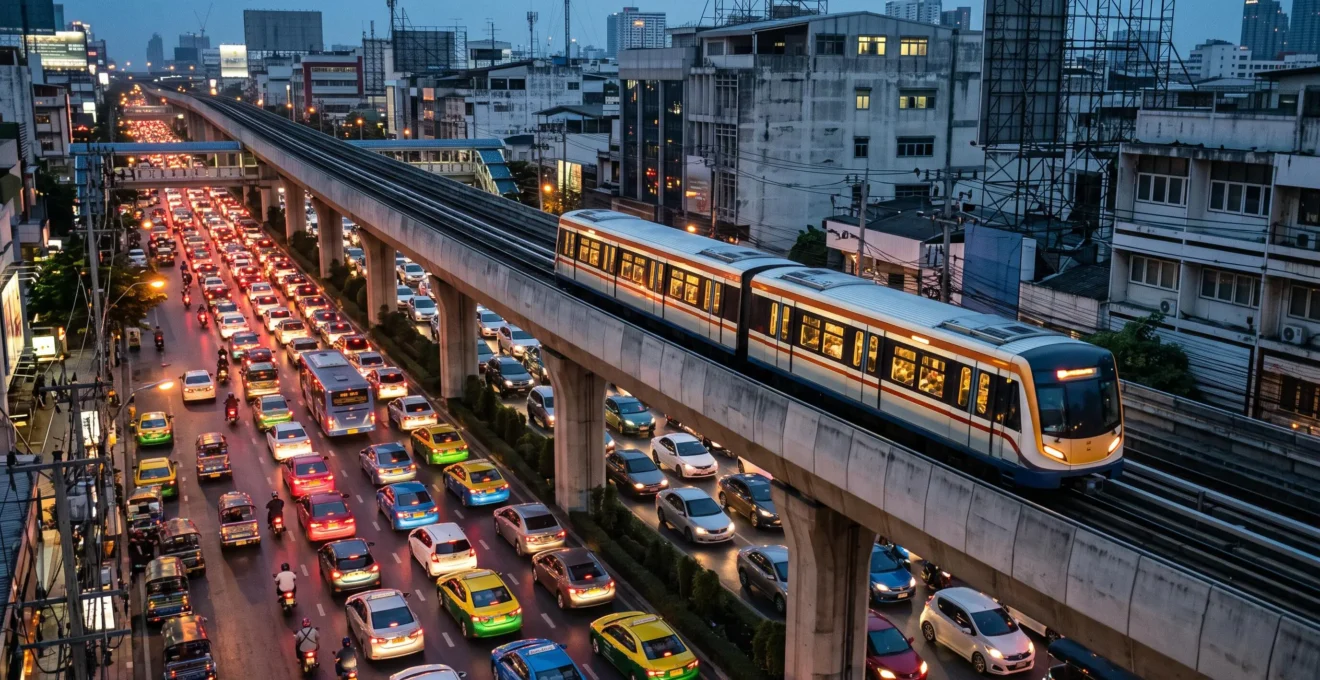
Bangkok has several urban rail networks, but learning one does not automatically teach you how to use the others. The elevated BTS Skytrain, underground and elevated MRT services, and Airport Rail Link serve different corridors, operate with different ticketing arrangements, and require travelers to understand where transfers actually happen.
The first practical distinction is geographical. Bangkok offers an extensive combination of urban rail lines. Chiang Mai relies on road-based transport, including shared red songthaews, while Phuket has buses and other road-based services but no comparable operational urban rail network. A Bangkok transit card will not solve your transportation needs across all three destinations.
For visitors, the most useful skill is not memorizing every station. It is learning to identify the right network, check the final walking distance, choose a compatible payment method and anticipate peak-hour congestion. Once those habits become familiar, planning journeys between hotels, markets, business districts, cultural attractions and airports becomes considerably easier.
Thailand urban transit: the essentials
- Bangkok rail networks have separate payment arrangements. A Rabbit Card is not a universal BTS, MRT and Airport Rail Link ticket. Check the specific line before boarding.
- Rail is generally more predictable during road congestion. BTS and MRT can avoid much of Bangkok’s traffic, although platforms and trains become crowded during commuter peaks.
- Each destination needs its own transport strategy. Chiang Mai uses songthaews and other road-based options; Phuket also has bus services, including Phuket Smart Bus, rather than an urban rail system.
- Why You Can’t Use One Card for BTS and MRT: The Bangkok Transit Fragmentation
- Rabbit Card or Single Tickets: Which Bangkok Transit Payment Saves Money for 5-Day Visits?
- Bangkok Rail vs Chiang Mai Songthaews: Why Northern Thailand Has No Modern Transit
- The Bangkok Rush Hour Mistake: Taking Taxis When BTS Skytrain Runs Above Gridlock
- When to Avoid Bangkok BTS Crush Hour: Peak Windows and Crowd-Avoidance Tactics
- Why You Can’t Use One Card for BTS and MRT: The Bangkok Transit Fragmentation
- BTS or MRT: Which Bangkok Rail Line Gets You Closest to Your Destination?
- How to Use Bangkok’s BTS Skytrain Like a Local: The Route, Station, and Exit Strategy
Why You Can’t Use One Card for BTS and MRT: The Bangkok Transit Fragmentation
You cannot assume that one Bangkok transit card works across BTS and MRT because their fare systems developed under different operating arrangements. The Rabbit Card is associated with BTS and certain compatible services, while MRT Blue and Purple Line passengers use their own accepted ticket media. Even when stations connect physically, payment compatibility and fare integration remain separate questions.
Bangkok’s fragmented ticketing reflects the development of rail infrastructure through different operators, authorities and concession arrangements. BTS Skytrain and the MRT Blue and Purple Lines did not begin as one coordinated fare system. Their access gates, ticket products and fare policies consequently evolved independently.
This matters most at interchanges. At Asok and Sukhumvit, for example, passengers can move between BTS and MRT stations, but must exit one fare-controlled system before entering the other. The connection is physically convenient without being a continuous paid journey.
BTS publishes specific Rabbit Card purchase and loading conditions. Its official instructions for purchasing and topping up a Rabbit Card identify a 120–baht issuance fee, no refundable card deposit and a minimum stored-value top-up of 100 baht. These charges should not be confused with the fares deducted as passengers travel.
MRT Blue and Purple Line passengers have different options, including single-journey tokens and eligible EMV contactless media. The airport connection requires separate attention: the Airport Rail Link is not automatically covered by a standard BTS Rabbit Card simply because both are rail services.
| Network | Visitor payment options | Important limitation |
|---|---|---|
| BTS Skytrain | Rabbit Card or appropriate single-journey ticket | Rabbit Card acceptance does not extend automatically to MRT Blue and Purple Lines |
| MRT Blue and Purple Lines | Single-journey tokens and eligible EMV contactless media | Eligibility depends on the specific payment product |
| Airport Rail Link | Its own accepted airport-rail ticketing options | Do not assume a BTS Rabbit Card opens its gates |
| Other MRT-branded lines | Line-specific approved ticket media | Do not generalize Blue and Purple Line rules to every MRT-branded service |
For a visitor using the BTS occasionally, individual tickets may be sufficient. Someone traveling on BTS repeatedly might prefer Rabbit Card convenience, while an MRT-focused itinerary may need no Rabbit Card at all.
Contactless payment and fare-integration policies continue to evolve, so travelers should verify their chosen lines before departure. The next decision is whether buying reusable media actually makes financial sense for a short visit.
Rabbit Card or Single Tickets: Which Bangkok Transit Payment Saves Money for 5-Day Visits?
For a five-day Bangkok visit, single tickets can be cheaper than buying a new Rabbit Card because Rabbit carries an issuance fee. A Rabbit Card may still be worthwhile for frequent BTS journeys or a qualifying fare package, but savings are not automatic. The correct comparison depends on BTS ride frequency, MRT usage, applicable fares and any unusable balance remaining at departure.
The key distinction is between paying for transport and paying for the right to use a reusable card. The Rabbit Card’s published 120-baht issuance fee is a separate upfront expense, not travel credit and not a refundable deposit. Loading 100 baht onto the card creates spending balance, rather than another unavoidable fee of the same kind.
To compare options, define B as your expected BTS journeys per day and M as your expected MRT journeys per day. Across five days, the estimated journey counts are 5B and 5M respectively. Calculate BTS and MRT spending independently before combining totals.
Hypothetical five-day payment comparison
Traveler A plans four BTS journeys and one MRT journey daily: 20 BTS journeys and five MRT journeys over the stay. Traveler B plans one BTS journey and four MRT journeys daily: five BTS journeys and 20 MRT journeys.
Using the published 120-baht Rabbit issuance fee, Traveler A would spread that upfront cost across 20 BTS journeys, equivalent to 6 baht per planned BTS journey. Traveler B would spread it across just five, equivalent to 24 baht per planned BTS journey. These are allocations of the issuance fee, not fare prices or demonstrated savings.
A usable calculation is:
Rabbit total cost = 120-baht issuance fee + actual BTS fares or qualifying travel-package charges + MRT spending + any unusable card balance.
Single-ticket total cost = actual BTS single-journey fares + actual MRT journey charges.
When comparing stored-value journeys with single tickets, do not assume every adult Rabbit journey receives a discount. If applicable fares are identical, the card’s issuance fee makes it more expensive in direct monetary terms, although avoiding repeated ticket purchases may be worth something to the traveler.
Passengers staying close to an MRT station should also check whether an eligible contactless card makes repeat MRT travel straightforward without buying separate stored-value media.
The MRT ticketing landscape changed in 2026. According to BEM’s MRT and MRT Plus card discontinuation announcement, the legacy cards stopped being accepted on June 1, 2026, following the end of top-ups on April 1. The operator directed passengers toward EMV contactless alternatives. This does not establish universal acceptance of every foreign debit card or a common BTS-MRT fare.
For unused Rabbit credit, separate three issues: the nonrefundable issuance fee, the published validity of stored value, and any balance-refund procedure that may apply. The BTS instructions identify two years of stored-value validity from the last transaction and a seven-year card validity period, but do not establish a universal cash-refund outcome for every departing tourist.
Convenience and financial savings are different benefits. Once payment is understood, the next challenge is recognizing where Bangkok’s rail-based habits stop being useful elsewhere in Thailand.
Bangkok Rail vs Chiang Mai Songthaews: Why Northern Thailand Has No Modern Transit
Bangkok’s BTS, MRT and Airport Rail Link do not operate in Chiang Mai. Visitors arriving in northern Thailand must switch from fixed urban rail routes to road-based options, including red songthaews, taxis and other available local transport. Chiang Mai does not have a comparable operational metropolitan rail network, but that does not mean it lacks public transport altogether.
Geography is the first planning adjustment. Bangkok’s rail network is designed around densely traveled urban corridors, commercial centers and major interchange locations. Chiang Mai’s visitor trips are distributed across its historic center, surrounding neighborhoods and destinations that can extend into mountainous areas.
The red songthaew, locally called Rod Daeng, is one of Chiang Mai’s recognizable shared transport options. These adapted pickup trucks can provide passenger journeys without following the same station-by-station model as urban rail.
The Tourism Authority of Thailand’s Chiang Mai-Lamphun article specifically identifies red songthaews as a way to reach Wat Phra That Doi Suthep. This is evidence of their practical tourist use, rather than proof that songthaews are the city’s only public transportation option.
Before boarding a songthaew, explain your destination and establish the offered fare. A vehicle operating as a shared service may follow a different pickup and drop-off pattern from a privately arranged journey. Travelers should not assume that payment or route selection resembles the BTS.
Ride-hailing and booked drivers can be helpful when carrying luggage or traveling somewhere poorly served by shared transport. Scooter rental is another available mode, but it requires appropriate licensing, insurance, safe riding conditions and realistic assessment of local road risks.
The difference between Bangkok and Chiang Mai has several plausible planning explanations: the scale of travel demand, urban density, capital investment and historical infrastructure priorities. These help explain why high-capacity rail developed around Bangkok’s metropolitan corridors, but the supplied evidence does not support reducing Chiang Mai’s infrastructure history to a single cause.
Phuket requires another adjustment. It also lacks Bangkok-style operational urban rail, yet it does have public bus services, including Phuket Smart Bus. Visitors do not automatically need to rent a vehicle or use taxis for every trip. The suitability of buses depends on the specific airport, beach, town or accommodation route.
| Destination | Core transport choices | Planning habit |
|---|---|---|
| Bangkok | BTS, MRT, Airport Rail Link, buses, boats and road-based services | Find the closest relevant station and verify fare compatibility |
| Chiang Mai | Songthaews and other road-based transport | Arrange or confirm the route, pickup point and price |
| Phuket | Public buses, taxis, booked rides and suitable rental transport | Check whether an available bus route serves your accommodation |
For an arrival in Chiang Mai, establish the onward airport journey before leaving the terminal. For Phuket, compare bus availability with your intended hotel location rather than assuming rail connectivity or universal taxi dependence.
The broader lesson is to plan transportation city by city. Within Bangkok itself, the next major skill is knowing when road traffic makes rail the more reliable choice.
The Bangkok Rush Hour Mistake: Taking Taxis When BTS Skytrain Runs Above Gridlock
During Bangkok’s weekday commuter peaks, taking a taxi for a journey already served conveniently by BTS can introduce significant uncertainty. Elevated trains travel on tracks separated from road traffic, while taxis remain exposed to intersection delays and congestion. Rail is often the more predictable option, although the walking distance, transfers, luggage and final destination still matter.
The BTS advantage comes from its dedicated elevated infrastructure. A train is not delayed merely because cars are queuing below it. Instead, passenger demand, service frequencies, incidents and station congestion become the main factors affecting the rail journey.
Taxis are subject to the wider road network. A short geographical distance does not guarantee a short trip when an avenue is heavily congested or access roads are backed up.
Ride-hailing prices may also increase when demand outpaces vehicle availability. A driver may be reluctant to accept a difficult pickup or a congested route. These possibilities are most relevant when many travelers seek road transport simultaneously, although no specific refusal rate or guaranteed price increase can be inferred.
The following planning windows are approximate commuter-pattern guides, not official BTS schedules or fixed congestion measurements.
| Approximate period | Typical conditions | Practical choice |
|---|---|---|
| Before 7:00 a.m. | Often less commuter pressure on many routes | Compare direct road transport with available rail service |
| 7:00–9:30 a.m. | Morning commuter demand, often toward employment centers | Favor rail where stations serve the journey well |
| 9:30 a.m.–4:30 p.m. | Variable road traffic and generally less commuter crowding | Compare total journey time and last-mile distance |
| 4:30–7:30 p.m. | Evening commuter pressure on central routes | Prioritize rail when road delays are substantial |
| Later evening | Conditions vary with nightlife, events and rail operating hours | Check the last train and available road transport |
Direction matters. Inbound trips toward busy commercial districts may encounter stronger demand in the morning, while some outbound journeys experience greater pressure in the evening. Bangkok’s multiple employment centers mean this is a pattern, not a universal rule.
For passengers arriving at Suvarnabhumi Airport, the Airport Rail Link can avoid substantial road congestion on its rail segment. However, a transfer at Phaya Thai or Makkasan may introduce walking and additional ticketing steps. If the hotel is far from an appropriate connecting station, a door-to-door journey may still be preferable.
Travelers with large luggage, reduced mobility or late-night arrivals should compare the entire route, not just the fastest rail section. Station access, available lifts, operating hours and final transport connections can reverse the apparent advantage.
Rail avoids much of the road congestion problem, but it introduces another challenge: knowing which journeys and platforms will be crowded.
When to Avoid Bangkok BTS Crush Hour: Peak Windows and Crowd-Avoidance Tactics
Bangkok BTS trains are commonly busiest during weekday morning and evening commuting periods, particularly around important interchanges and major commercial districts. A practical starting point is to expect heavier demand around 7:00–9:30 a.m. and 4:30–7:30 p.m. These are approximate planning windows; actual crowding changes with route direction, station, day and events.
At a busy interchange, congestion can develop before passengers reach the train. Escalators, ticket gates, corridor junctions and platform queues may all slow the journey. A route that appears shorter on a map can therefore take longer or feel less comfortable than a less direct alternative.
The first tactic is to observe the entire platform rather than joining the nearest queue automatically. Walking toward a less crowded boarding position can sometimes make boarding easier, provided the station layout and staff instructions allow it.
Platform position should also reflect your destination. If you know which station exit you will use, choosing a suitable section of the train may reduce walking after arrival. However, crowd distribution is not identical from one station to another, and no particular carriage is guaranteed to be less busy.
Another tactic is to compare a nearby MRT route. Where BTS and MRT cover similar destinations, an alternative line may provide a less stressful journey. This only works when the additional station access, ticketing and final walking distance do not outweigh the benefit.
For itineraries involving busy transfer points, consider whether a slightly longer direct journey is preferable to navigating multiple crowded passages. Route choice is not simply a matter of minimizing stops.
Weekends, public holidays and large events change the pattern. Concerts, shopping events or ceremonies can create heavy passenger surges outside normal office commuting hours.
Five checks before boarding during a busy period
- Identify your travel window. Write down your planned departure time and whether it overlaps a typical weekday commuting period.
- Check the direction. Note the terminal station shown for your required platform and verify you are traveling toward your destination.
- Mark the interchange. Record any station where you must change trains or leave one operator’s fare gates.
- Choose a platform position. Identify a safe boarding queue with manageable crowding and a practical route to your intended exit.
- Prepare an alternative. Save a second rail route or suitable road-based option in case the preferred journey becomes impractical.
Once crowding is accounted for, the remaining friction is often not on the train itself but at the gates separating Bangkok’s networks.
Why You Can’t Use One Card for BTS and MRT: The Bangkok Transit Fragmentation
A traveler can simplify Bangkok’s fragmented rail payment system by choosing ticket media for the network used most often, rather than trying to find one product for every journey. Rabbit Card covers its participating services, while MRT Blue and Purple Line journeys require their accepted tokens or contactless products. Cash remains useful for purchasing tickets and handling payment contingencies.
Consider the practical difference between carrying a Rabbit Card, an eligible contactless bank card and some cash. Those three items may give a visitor convenient access to several journeys, but they do not necessarily create a unified account or shared fare across operators.
| What you carry | What it helps with | What still needs checking |
|---|---|---|
| Cash only | Purchasing eligible single-journey tickets or tokens | Accepted purchase methods and ticket-machine requirements |
| Rabbit Card | Repeated travel on participating BTS services | Separate payment for MRT Blue and Purple Lines and Airport Rail Link |
| Eligible contactless card | Direct gate payment where that card type is accepted | Card scheme, issuer, debit eligibility and specific operator rules |
| Rabbit Card plus eligible contactless card | Potentially convenient BTS and MRT travel | Independent charges, separate gates and unsupported lines |
MRT single-journey token handling is a useful example. The passenger touches the electronic token to the entry reader and inserts it into the appropriate exit-gate slot when leaving. These procedures are described in BEM’s official MRT ticket types. The token is not a reusable Rabbit Card and should not be kept as though it were a multi-journey pass.
A straightforward visitor setup starts with an accommodation-based decision. If your hotel is closest to a BTS station and most of your destinations follow BTS corridors, consider single BTS tickets first, then Rabbit Card if the volume and convenience justify the issuance fee. If your hotel sits on the MRT Blue Line, eligible contactless payment or tokens may be more appropriate.
At mixed-network interchanges, follow exit signs, leave the first paid area using the correct medium and enter the second system with its accepted payment. A successful physical transfer does not imply that the second fare has already been paid.
The location of your hotel can reduce repeated ticketing friction. Staying beside the network used for most journeys means fewer cross-operator transfers and less uncertainty each morning.
This also explains why a seemingly small accommodation difference matters. Walking an additional block to a station on a more useful line may simplify multiple days of travel. The correct choice depends on actual station entrances and final destinations, not an assumed standard walking distance.
Payment integration remains an evolving policy area. BEM‘s 2026 EMV transition is an important change, but by itself it does not demonstrate that all BTS, MRT and airport rail journeys have become interchangeable or subject to a shared fare cap.
Once payment options are settled, the next decision becomes geographical: which rail line takes you closest to the place you intend to visit?
BTS or MRT: Which Bangkok Rail Line Gets You Closest to Your Destination?
Choose between BTS and MRT by comparing the complete journey to your destination, not merely the number of stations traveled. BTS is especially useful for several shopping and commercial corridors, while MRT serves additional historic districts, markets and business areas. The best choice is the route with practical station access, manageable transfers and the shortest realistic final connection.
Bangkok’s transit map becomes easier to understand when destinations are grouped by activity. Shopping areas such as Siam and the Sukhumvit corridor are strongly associated with BTS access. The MRT Blue Line provides useful connections toward locations such as Chatuchak, Chinatown and parts of the older city.
Neither category is exclusive. Some districts are served by multiple lines, and a destination may sit between stations that belong to different operators.
| Destination type | Useful network examples | Last-mile consideration |
|---|---|---|
| Major malls and shopping districts | BTS around Siam, Chit Lom and Phrom Phong | Check shopping-mall walkway connections |
| Chinatown and older city attractions | MRT Blue Line, including Wat Mangkon and Sanam Chai | Confirm the individual attraction’s walking route |
| Chatuchak area | BTS Mo Chit or MRT Chatuchak Park | Choose the exit nearest your intended market entrance |
| Central business districts | BTS Silom/Sukhumvit corridors and MRT Blue Line | Compare office-building access and interchange walking |
| Riverside attractions | Selected MRT or BTS approaches with walking or boat connections | Identify the correct pier or river crossing |
A good example of interconnected rail navigation is the BTS Asok and MRT Sukhumvit interchange. Both serve the same general urban area, but changing from one to the other requires navigating separate station spaces and ticketing systems.
The station-exit method is particularly valuable in Bangkok. Once you identify the correct station, check the numbered exit associated with your destination. Some exits lead toward pedestrian bridges, connected shopping centers or office complexes. Others place you on the opposite side of a busy road.
For locations near a large intersection, using the appropriate exit can avoid unnecessary street-level crossings. Official station diagrams and signs are more reliable than assuming the station marker on a digital map represents every entrance equally.
The last mile also changes the calculation. A short walk from a slightly more distant station may be easier than a route involving two rail changes followed by another vehicle. For longer gaps, a suitable taxi or other local road service can complete the journey, with safety and accessibility considered.
Before choosing a line, compare four things: the station entrance, the direction of travel, any interchange and the final distance from your exit to the actual destination.
With a practical route selected, the final step is learning the BTS station routine so that buying, boarding, changing trains and exiting become straightforward.
What to remember before your first BTS ride
- Identify both your destination station and the line’s terminal direction before entering the platform.
- Prepare the correct payment method and allow time for any cross-network fare-gate transfer.
- Check your destination’s numbered exit, because choosing the right station does not automatically mean choosing the shortest walking route.
How to Use Bangkok’s BTS Skytrain Like a Local: The Route, Station, and Exit Strategy
Using the Bangkok BTS Skytrain confidently involves five basic actions: identify your destination station, select the correct line and terminal direction, obtain a valid ticket, board from the appropriate platform, and leave through the exit closest to your destination. Mastering those steps is more important than memorizing the entire rail map.
Begin by locating your origin and destination on the current BTS network diagram. The two main BTS corridors are commonly identified as the Sukhumvit Line and Silom Line, but color alone is not enough to navigate. Follow the current signs showing the destination or terminal station for your intended direction.
For example, travelers changing between the main BTS lines at Siam should check the sign for the correct onward direction rather than assuming every train serving the interchange will reach their destination.
Before passing through the fare gates, purchase a valid single-journey ticket or prepare an accepted Rabbit Card. At the gate, follow the displayed instructions for the ticket medium you are using. Keep any ticket required for the exit procedure accessible throughout the trip.
Platform information identifies the direction and expected services. Stand in the designated waiting area, allow passengers to leave the train before boarding and follow any station staff instructions.
Inside a crowded carriage, keep luggage clear of doorways and avoid blocking passengers who need to exit. Moving toward the door shortly before your stop is sensible when conditions permit, but staying clear of closing doors and allowing safe movement takes priority.
After leaving the train, do not immediately follow the largest group of passengers. Find the station’s exit-number map and identify the route toward your actual destination. In central Bangkok, an exit may lead directly to an elevated walkway connected to nearby buildings or commercial centers.
When a fare gate refuses your card, avoid repeatedly attempting entry without checking the message. Incorrect media, insufficient usable balance or a ticketing irregularity may require assistance. Station staff can identify the applicable resolution without requiring passengers to guess at the problem.
If a line is disrupted, look for a reasonable alternative before leaving the station. Depending on the origin and destination, this may involve an MRT connection, a bus, a river service or road transport. A fallback route should be checked against current service availability rather than assumed to operate at every hour.
For airport travel, confirm which airport you are using. Suvarnabhumi’s Airport Rail Link is a separate service from the BTS, while Don Mueang is associated with a different rail-access arrangement. Do not treat either airport as a normal BTS destination without checking the connection.
The most useful local habit is to plan journeys around the exit, not simply the station name. A correct train can still leave you with an awkward final walk if you choose an unsuitable station entrance or side of the road.
For your next Bangkok journey, save the origin station, destination station, terminal direction, payment method and preferred exit together. That short route note gives you a practical plan to follow even when a station is busy or mobile reception is unreliable.
Can tourists use foreign contactless cards on Bangkok’s MRT?
Eligible contactless bank cards can be used on participating MRT services, but acceptance depends on the payment scheme, card type and issuer. BEM’s 2026 transition identifies eligible credit, debit and prepaid EMV products. A foreign card should not be assumed compatible solely because it displays the contactless symbol. Verify your card category and the relevant line’s latest requirements.
Does the Airport Rail Link take passengers directly to every part of Bangkok?
No. The Airport Rail Link serves a specific route between Suvarnabhumi Airport and its city-side stations. Travelers heading to destinations outside that corridor need an onward connection, which may involve another rail system or road transport. Allow for separate payment and transfer time.
Should you exchange money before using Bangkok’s rail networks?
Having some Thai baht available is a useful precaution for ticket purchases and situations where your preferred payment product is not accepted. However, cash requirements differ by network, machine and ticket type. Eligible contactless products may reduce the need for cash on participating services.
Can passengers travel around Chiang Mai without renting a scooter?
Yes. Red songthaews and other road-based transport options allow visitors to make journeys without personally driving a scooter. The practical choice depends on destination, availability, luggage and agreed pricing. Travelers should confirm the route and fare where necessary.
Is Phuket completely without public transportation?
No. Phuket has public bus services, including Phuket Smart Bus, but does not have a Bangkok-style operational urban rail network. Bus routes may be useful for some airport, beach and town journeys, while other destinations require different transport arrangements. Check the current route and timetable before deciding whether a taxi or rental vehicle is necessary.