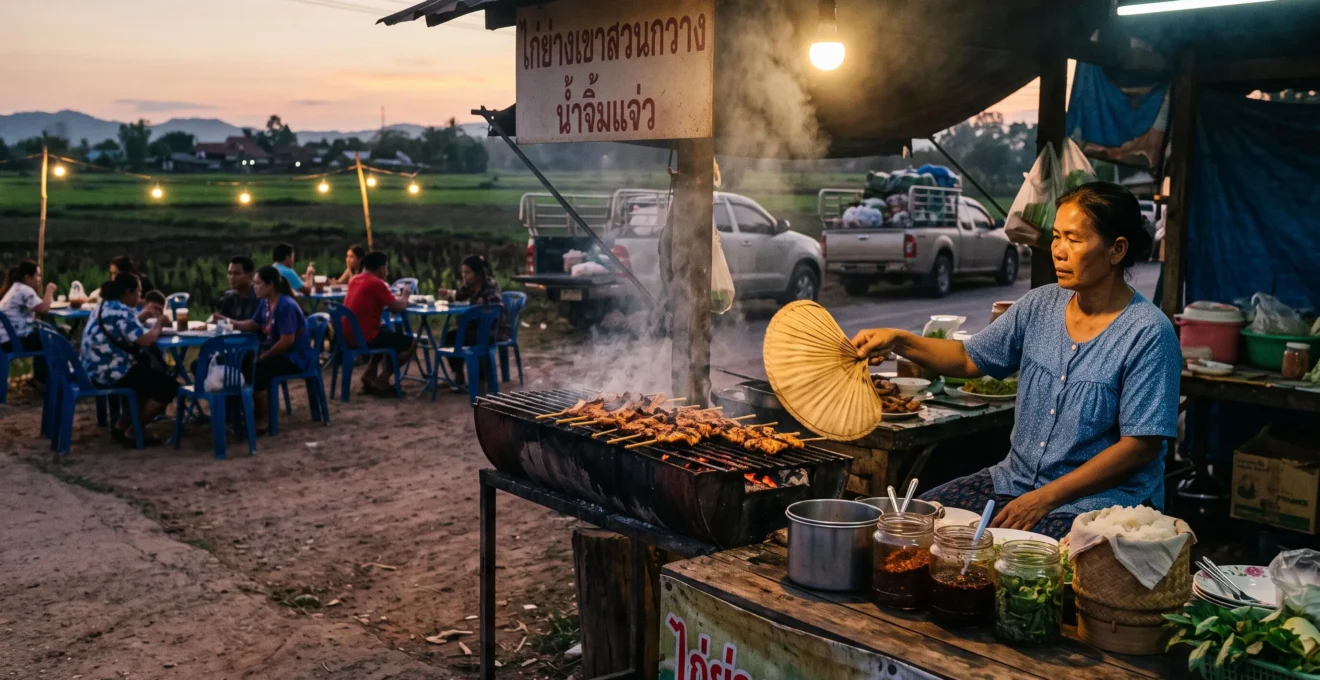
In northeastern Thailand, dinner might begin with a basket of sticky rice, a bowl of fermented-fish papaya salad and grilled chicken shared beneath the lights of a roadside restaurant. The conversation around the table may be in Isan, a language variety closely related to Lao. Beyond the restaurant, farming families prepare for the next stage of the rice-growing cycle.
This is Isan, Thailand’s expansive northeastern region, where Lao-influenced traditions, agricultural livelihoods and centuries-old Khmer monuments form a cultural landscape distinct from the country’s more familiar tourist destinations.
Calling Isan Thailand’s most authentic region requires care. Its people are no more authentic than those elsewhere, and the Northeast has modern cities, universities and contemporary lifestyles. What makes it especially rewarding for culturally curious travelers is the opportunity to encounter regional traditions within ordinary daily life rather than exclusively through tourist attractions.
From Udon Thani and Khon Kaen to rural villages, temple complexes and Yasothon’s rocket celebrations, Isan rewards travelers who approach it as a living place, not an untouched destination.
Isan at a glance: what makes the Northeast different
- Distinct regional identity: Isan language, mor lam music, sticky rice and agricultural festivals reveal a strong Lao-influenced cultural heritage.
- Living history: Khmer-era monuments such as Phanom Rung and Phimai offer a different historical perspective from the former Siamese capital of Ayutthaya.
- Timing matters: The rainy-season agricultural cycle shapes landscapes and festivals, while cooler dry months generally offer more comfortable conditions for exploring.
- Why Isan Produces Thailand’s Best Music and Food but Remains the Poorest Region
- How to Eat Like an Isan Local: The Sticky Rice and Som Tam Ritual Bangkokians Don’t Know
- Isan’s Khmer Temples vs Ayutthaya: Which Reveals Thailand’s Pre-Thai Empire History?
- The Isan Timing Mistake: Arriving During Dry Season and Finding Brown Fields, Not Emerald Paddies
- When to Experience Isan’s Rocket Festivals: The May-June Monsoon Rituals That Launch 9-Meter Bamboo Missiles
- Why Isan Locals Speak Lao at Home: The Regional Identity Bangkok Tourists Never Notice
- How to Eat Like an Isan Local: The Sticky Rice and Som Tam Ritual Bangkokians Don’t Know
- How to Recognize Thailand’s 4 Regional Cultures: The Dialect, Dish, and Dance That Define Each Zone
Why Isan Produces Thailand’s Best Music and Food but Remains the Poorest Region
Some of Thailand’s most recognizable cultural traditions have strong northeastern roots. Som tam, grilled chicken, sticky rice and mor lam music have traveled far beyond Isan. Yet the region’s cultural influence contrasts with its comparatively low household incomes, creating a paradox that reveals how cultural vitality and economic advantage do not necessarily develop together.
According to Thailand’s National Statistical Office household income statistics, the Northeast recorded the lowest regional average monthly household income in 2023. Its figure of THB 22,524 stood below the national average of THB 29,030 and Greater Bangkok’s THB 39,087.
THB 22,524
Average monthly household income in Northeast Thailand in 2023, compared with THB 39,087 in Greater Bangkok. These are historical household averages, not individual wages or 2026 income figures.
National Statistical Office, Statistical Yearbook Thailand 2024, Household Socio-Economic Survey.
Thailand’s concentration of national administration, commercial headquarters and major investment in Bangkok provides important context for regional inequalities. However, the income comparison alone does not establish the precise causes of Isan’s economic position. Agricultural dependence, differences in employment opportunities and migration also belong in the broader discussion.
Isan’s influence is particularly evident in popular culture. Mor lam, rooted in Lao-speaking communities, combines distinctive vocal performance with storytelling and musical accompaniment, traditionally associated with the khaen mouth organ. Contemporary performers have adapted these forms for concerts, recordings and urban audiences.
The same cross-regional movement happened with food. Dishes associated with northeastern eating traditions are now familiar across Thailand, partly through the movement of workers and families between Isan and larger cities.
For travelers, the region’s everyday economy changes the nature of a visit. Family-run guesthouses, ordinary food markets and local transport can provide opportunities to interact with residents outside heavily packaged tourist settings. But fewer international tourism facilities should not automatically be interpreted as evidence that poverty has preserved authenticity.
Economic hardship is not a cultural attraction. Visitors can instead support local communities through direct spending at markets, locally owned accommodation and appropriately arranged village experiences. Ask permission before photographing people, respect working spaces and pay fairly for services.
Isan is not exclusively rural. Khon Kaen, Udon Thani, Nakhon Ratchasima—often called Korat—and Ubon Ratchathani are substantial urban centers with contemporary cultural scenes, transport connections and educational institutions.
The most meaningful encounters are neither staged performances nor observations of hardship. They emerge through ordinary exchanges, especially around food, where regional identity becomes immediately tangible.
How to Eat Like an Isan Local: The Sticky Rice and Som Tam Ritual Bangkokians Don’t Know
An Isan meal often revolves around sticky rice, shared dishes and strongly seasoned accompaniments rather than individual plates of jasmine rice with curry. Diners pinch small portions of steamed rice into manageable balls, then combine them with grilled meat, spicy dips or minced-meat salads. This communal eating style is closely associated with Lao-influenced food traditions.
The essential starting point is khao niao, steamed glutinous rice commonly served in a woven bamboo basket. Its cohesive texture makes it easy to eat by hand. Take a small portion, shape it gently with clean fingers and use it to accompany other dishes.
At a shared table, several complementary flavors usually appear together: the richness of grilled chicken, the sharp acidity of lime, the heat of chilies, fresh herbs and the fermented depth of certain sauces.
Reading the menu becomes easier once several important distinctions are clear.
- Laab: A seasoned minced-meat dish commonly combining herbs, lime, chili and toasted rice powder. Preparations differ, and some traditional versions contain blood or raw ingredients. Request a fully cooked version if preferred.
- Goi: A family of chopped or minced preparations that may include raw meat or fish. Ask how a particular version is prepared before ordering.
- Som tam: Pounded green papaya salad with multiple regional variations. Tam Thai generally has a sweeter profile, while versions with pla ra introduce pronounced fermented-fish flavors.
- Tam pa: A more elaborate, often intensely seasoned papaya salad variation, sometimes containing additional vegetables and preserved ingredients.
- Jaew: A broad category of dipping sauces that can accompany grilled meat, vegetables and sticky rice.
For a first meal, order sticky rice, fully cooked grilled chicken, cooked laab and a papaya salad suited to your preferred chili level. Once comfortable, try a small portion of a pla ra-based dish to appreciate how fermentation changes the flavor.
Fermentation itself is not a reason to reject a dish, but safe preparation matters. Choose vendors with good food-handling practices, appropriately stored ingredients and thoroughly cooked meat or fish when needed. Raw freshwater fish dishes deserve particular caution because of parasite risks.
Morning markets reveal ingredients before they become finished dishes, while roadside grills and evening markets show how people eat after work. A busy stall serving local families can be an encouraging sign, although popularity is not a guarantee of hygiene.
A shared meal reveals more than a list of specialties: it shows how food brings together families, vendors, agricultural ingredients and the wider Lao-influenced identity of northeastern Thailand.
Isan’s Khmer Temples vs Ayutthaya: Which Reveals Thailand’s Pre-Thai Empire History?
Isan’s Khmer temples are the stronger choice for understanding the Angkorian civilizations that shaped parts of present-day northeastern Thailand before the rise of Ayutthaya. Ayutthaya, by contrast, reveals the political, religious and architectural history of a later Siamese kingdom. Neither replaces the other: they illuminate different chapters of the region’s past.
Phimai in Nakhon Ratchasima Province and the temple complexes around Phanom Rung in Buriram connect Isan to the historical Khmer world centered on Angkor, in present-day Cambodia.
The UNESCO Tentative List documentation for Phanom Rung and Muang Tam identifies construction phases at Phanom Rung spanning the 10th through 13th centuries. The complex includes Hindu symbolism, Angkorian architectural techniques and carved scenes drawn from Indian epic traditions.
Phanom Rung’s elevated setting adds another dimension. A long ceremonial approach leads toward its central sanctuary, where architecture and the annual movement of the sun interact. The site’s solar alignments are an important part of its interpretation, although travelers hoping to witness a particular sunrise should verify the relevant dates and viewing arrangements separately.
Nearby Muang Tam, approximately eight kilometers southeast of Phanom Rung, preserves another important Khmer-era sanctuary. Its architectural style and iconography are associated with the 11th century.
These sites belong to Thailand’s UNESCO Tentative List documentation; that designation should not be confused with an inscription on the World Heritage List.
For travelers choosing between historical itineraries, the comparison is practical as well as chronological.
| Travel priority | Isan’s Khmer temples | Ayutthaya |
|---|---|---|
| Historical focus | Angkorian cultural and architectural connections | Later Siamese royal and religious history |
| Principal experience | Stone sanctuaries, Hindu imagery and Khmer architectural planning | Ruined monasteries, royal complexes and Buddhist monuments |
| Travel planning | Multiple sites spread across northeastern provinces | Major monuments concentrated around the historic city |
| Best suited to | Travelers exploring pre-Ayutthaya regional history | Travelers focused on Thailand’s classical Siamese heritage |
Phimai can be incorporated into a journey through the Korat area, while Phanom Rung and Muang Tam form a useful paired excursion in Buriram. Combining them may require several transport stages, so a carefully planned road itinerary can be more convenient than relying on spontaneous connections.
Before arriving, read a basic history of the Khmer Empire or arrange appropriate local guiding. On-site English-language interpretation may vary, and having context makes it easier to distinguish religious imagery, construction phases and later restoration.
Do not assume quieter surroundings mean unrestricted access. Follow site-specific conservation rules and avoid climbing protected structures.
Once that older historical layer becomes visible, Isan’s landscapes take on additional meaning: agricultural settlements and sacred sites have been connected across this region for centuries, even as their societies and identities have changed.
The Isan Timing Mistake: Arriving During Dry Season and Finding Brown Fields, Not Emerald Paddies
Travelers expecting vivid green rice paddies can be disappointed when they arrive in Isan during the dry season. Much of the region’s rice cultivation depends on seasonal rainfall, so the landscape changes substantially between planting, growing and post-harvest periods. The most comfortable travel weather and the greenest agricultural scenery do not necessarily occur together.
The contrast is especially important because photographs of flooded paddies and intensely green fields represent particular stages of the agricultural calendar, not permanent conditions.
During the rainy season, farmers prepare fields, establish seedlings and manage rice cultivation according to local rainfall and growing conditions. As plants mature, the countryside can become remarkably green.
Following harvest, many fields become dry, brown or covered in stubble. Some agricultural land may be used for other crops, remain fallow or follow different irrigation arrangements.
The exact timing differs between provinces, individual farms and years. Rainfall variability means no national calendar can guarantee emerald fields on a particular travel date.
Rather than asking for a single best month, decide which experience matters most.
| Priority | Seasonal conditions to consider | Principal trade-off |
|---|---|---|
| Green agricultural landscapes | Rainy-season growing periods after sufficient rainfall | Wet roads, humidity and changing field conditions |
| Comfortable outdoor sightseeing | Cooler dry-season periods | Harvested or less-green paddies |
| Rice-planting traditions | Locally confirmed planting periods | Uncertain timing dependent on rainfall |
| Village harvest activity | Locally confirmed harvesting periods | Limited resemblance to lush planting-season photographs |
Dry weather also has advantages. It can make journeys between historic sites easier, support outdoor markets and allow visitors to observe post-harvest agricultural life. A brown field is not evidence that Isan has lost its rural character; it reflects another stage of a working landscape.
Five checks before booking an Isan countryside trip
- Choose your priority: Write down whether green paddies, festivals, historical sites or comfortable weather matter most.
- Select specific provinces: Create a shortlist of the areas you intend to visit rather than relying on a general Thailand seasonal forecast.
- Check recent field conditions: Find dated local photographs or reliable updates and record when they were taken.
- Confirm the agricultural calendar: Ask a local accommodation provider or knowledgeable contact about current planting or harvesting conditions; note the response.
- Prepare a weather alternative: Identify one indoor cultural activity or accessible historical stop for days when rain makes countryside exploration impractical.
The agricultural calendar also explains one of the Northeast’s most distinctive celebrations, when communities mark the hoped-for arrival of the rains with elaborate rocket festivals.
When to Experience Isan’s Rocket Festivals: The May-June Monsoon Rituals That Launch 9-Meter Bamboo Missiles
Isan’s bun bang fai rocket celebrations are associated with the period leading into the rainy season, when communities seek favorable conditions for rice cultivation. May and June are useful months to investigate, but individual festival schedules differ by community and year. The celebrations combine religious and agricultural traditions with processions, local performances and competitive rocket launches.
To understand the event, begin with its meaning rather than its spectacle. Rocket traditions are closely associated with requests for rain, communal merit-making and the renewal of agricultural activity.
The festival is therefore not simply a display of homemade projectiles. It connects religious practice, village organization, music and seasonal expectations in a public celebration.
Yasothon is among the best-known destinations for visitors interested in this tradition. According to Thailand’s official Yasothon Rocket Festival 2026 schedule, that year’s announced program covered May 8–10, with rocket displays and opening festivities followed by cultural performances, a grand parade and a final-day launch program.
Those dates refer to the 2026 edition, not a permanent annual schedule. The government announcement explicitly warned that activities could change.
Although particularly large homemade rockets may be part of festival imagery, rocket dimensions and construction vary. A nine-meter bamboo rocket should not be assumed to represent every launch or be treated as a verified specification for a particular event.
Practical preparation matters because these are active celebrations rather than conventional tourist performances. Rockets can be loud, launch areas may involve genuine hazards, and crowds can gather around processions and viewing spaces.
Stay inside designated public areas, respect event marshals and avoid approaching launch equipment. Rocket-related accidents are a genuine concern, even though the available official itinerary does not provide a reliable accident rate.
The atmosphere can also differ between locations and events. Expect a mixture of community gatherings, performances, food vendors and celebrations; do not presume that every festival has the same program or drinking culture.
For a future visit, identify the intended town first, then confirm the current year’s dates through local tourism authorities or event organizers. Check which day includes the public parade and which is assigned to launches, since these experiences may occur separately.
Accommodation and onward transport should also be checked against the actual schedule, particularly when visiting a smaller town with fewer options than a provincial capital.
The music, ceremonies and agricultural symbolism surrounding bun bang fai also reveal a deeper connection: much of Isan’s cultural vocabulary belongs to a Lao-influenced world that remains audible in everyday language.
Why Isan Locals Speak Lao at Home: The Regional Identity Bangkok Tourists Never Notice
Many people in northeastern Thailand speak Isan, a regional language variety closely related to Lao, alongside standard Thai. This linguistic distinction reflects centuries of regional history and cultural exchange across the Mekong area. Language choice varies between individuals, generations and situations, so it would be inaccurate to assume every Isan resident speaks Lao at home.
Isan’s linguistic identity cannot be understood solely through modern national borders. The Northeast shares historical connections with Lao-speaking communities across the Mekong, while its incorporation into the Siamese political sphere contributed to the present relationship between regional speech and national language institutions.
In academic terminology, phasa isan occupies a particularly interesting position. It is officially categorized as a Thai dialect but is linguistically close to Lao.
Alexander and McCargo’s research on language and identity in Northeast Thailand, published in the Journal of Sociolinguistics in 2014, examines how Central Thai and Isan occupy different social positions.
The researchers describe a transitional diglossic relationship: standard Thai holds higher institutional prestige, while Isan has historically occupied a lower-status position in formal hierarchies. Their investigation included interviews, surveys, reflective writing and field observations, conducted mainly among university students in Ubon Ratchathani.
Those findings illuminate broader language pressures but should not be interpreted as a complete portrait of every community or as a current statistical measurement of language use.
In practical terms, travelers may hear one language variety in family conversations and another in formal settings. Standard Thai is important in education, administration and national media, while Isan remains meaningful in many informal and regional contexts.
Switching between varieties can be a normal part of social interaction, rather than a sign that residents possess competing identities.
Language also helps connect experiences that otherwise appear unrelated. Mor lam performance, local storytelling, food terminology and festival traditions all carry cultural meanings associated with Isan’s regional heritage.
Visitors do not need fluency to acknowledge these distinctions. Asking a resident how to pronounce a greeting in local speech, listening carefully and using the phrase respectfully can be more meaningful than assuming standard Bangkok Thai represents every community.
However, avoid insisting that someone identify as Lao rather than Thai. Linguistic heritage and personal national identity are not interchangeable. Residents should define their own relationship to their language and culture.
Food provides an especially accessible way to continue that learning: the names, ingredients and eating habits of northeastern dishes carry regional history into markets and family tables.
How to Eat Like an Isan Local: The Sticky Rice and Som Tam Ritual Bangkokians Don’t Know
Eating like an Isan local is not only a matter of ordering som tam and sticky rice. It also means discovering how ingredients, specialties and shared meals change between provinces and communities. Markets provide a useful entry point because they reveal the herbs, preserved foods, fresh produce and everyday cooking practices behind the region’s cuisine.
A food-centered journey can connect larger urban bases with smaller local markets rather than treating meals as convenient interruptions between temples.
Khon Kaen offers an urban setting for exploring northeastern restaurant culture. Udon Thani and Nong Khai provide opportunities to investigate food traditions shaped by connections across the Mekong. Ubon Ratchathani is another useful base for observing the relationship between local markets, regional cooking and a wider Lao-influenced culinary heritage.
These are practical itinerary suggestions rather than claims that any specialty belongs exclusively to one province. Recipes, ingredients and cooking methods overlap extensively across the Northeast.
At a morning market, observe how fresh herbs, chilies, vegetables, fermented fish products and prepared snacks are displayed. Sellers may also offer edible insects and other ingredients less familiar to international visitors. Their presence does not mean every household regularly eats every item.
When ordering a shared meal, begin with a rice basket and several contrasting dishes. A grilled preparation, a cooked laab, vegetables and a papaya salad can create a balanced introduction to the meal’s different textures.
Ask whether a dish includes pla ra, how spicy it will be and whether meat or fish is fully cooked. These are ordinary dietary questions, not requests to make the entire meal less authentic.
Shared dining also calls for basic etiquette. Use clean hands or serving utensils as appropriate, take modest portions and follow the habits of the people hosting you. When unsure, politely ask rather than treating informal dining as a performance to imitate.
Local street stalls can offer good value compared with tourist-oriented dining, but prices vary by province, venue, ingredients and portion size. The available sources do not establish a reliable current price range, so checking posted menus or asking before ordering is preferable to assuming a universal cheap-meal price.
Food exploration becomes more rewarding when repeated over several days. Return to a market, recognize familiar ingredients and try one new preparation at a time instead of attempting every unfamiliar dish in a single meal.
The distinction between Isan cuisine and food commonly encountered in Bangkok also raises a broader question: how many different regional cultures can travelers recognize within Thailand?
Key takeaways before exploring Thailand’s regional cultures
- Recognize Isan through its combination of language, shared food traditions and music, rather than through a single supposedly authentic attraction.
- Use regional differences to deepen cultural understanding without assuming that every resident follows one fixed tradition.
- Consider how food, language and performances encountered in Bangkok may represent traditions originating elsewhere in Thailand.
How to Recognize Thailand’s 4 Regional Cultures: The Dialect, Dish, and Dance That Define Each Zone
Thailand can be understood through four broad cultural regions: North, Central, Northeast and South. Each has recognizable linguistic, culinary and performance traditions, although their boundaries overlap and their populations are diverse. Isan stands out through Lao-related speech, sticky-rice-centered meals and mor lam, while the other regions offer different cultural reference points.
This four-zone framework is useful for travelers because it challenges the idea that one national style of food, music or language can represent the entire country.
Northern Thailand has distinctive Lanna-related traditions, including northern language varieties, foods such as khao soi and regional forms of dance. Central Thailand is strongly associated with standard Thai, the historical royal centers and classical performance traditions. Southern Thailand includes its own dialects, seafood-centered cuisines, Muslim-influenced culinary practices and nora dance traditions.
Isan adds another set of reference points: Lao-influenced language varieties, sticky rice, laab, som tam, mor lam and seasonal agricultural celebrations.
The differences are best treated as starting points for observation, not rigid cultural rules.
| Region | Language and cultural clues | Food and performance traditions |
|---|---|---|
| North | Northern Thai and Lanna-related heritage | Khao soi and regional finger-dance traditions |
| Central | Standard Thai and historic Siamese court influences | Central Thai cooking and classical Thai dance |
| Northeast / Isan | Isan language closely related to Lao | Sticky rice, laab, som tam and mor lam |
| South | Southern Thai dialects and diverse coastal communities | Seafood, Muslim-influenced dishes and nora dance |
Bangkok complicates this picture in an interesting way. As Thailand’s major metropolitan center, it brings together residents and traditions from all four regions. A Bangkok restaurant serving som tam or a city concert featuring mor lam does not make those traditions centrally Thai in origin.
Equally, visiting Bangkok does not mean encountering only Central Thai culture. Migration, contemporary media and commerce create constant exchanges between regions.
Travelers can use three simple observational questions: What languages are used in ordinary conversations? Which dishes appear repeatedly in local markets? What music or performances are associated with community celebrations?
The answers help identify regional influences, but they cannot definitively classify a person or place. Tourism, migration, multilingualism and shared traditions mean Thailand’s cultural landscape is more complex than four separate categories.
For off-the-beaten-path travelers, that complexity is the real reward. Visiting Isan provides a chance to explore traditions that may be familiar across Thailand while discovering the communities and historical settings in which they remain important.
For a first journey, choose one provincial base, add a local market and a historical or agricultural excursion, and allow time for unplanned conversations. Isan is best understood through ordinary participation, respectful curiosity and attention to the people whose culture continues to evolve there.
Is Isan suitable for travelers visiting Thailand for the first time?
Yes, particularly for travelers interested in food, rural culture and historical sites. Larger cities such as Udon Thani, Khon Kaen and Nakhon Ratchasima can provide practical starting points. Independent countryside travel may require more advance planning than conventional tourist itineraries, especially when public transport connections are limited.
Can you travel through Isan without speaking Thai or Isan?
It is possible, but communication may be more difficult in smaller towns and rural communities. Basic Thai phrases, translated destination names and offline translation tools can help. Local guiding is particularly valuable when visiting culturally significant sites or arranging experiences with village communities.
How much time should you allow for a first Isan itinerary?
As an illustrative planning approach, several days in one province can provide a more relaxed introduction than rushing between distant locations. A longer trip allows time for markets, historical monuments and rural experiences across multiple provinces. Exact travel durations depend on transport options and the selected route.
Are homestays in Isan more culturally authentic than hotels?
Not automatically. A thoughtfully organized homestay can create opportunities for respectful cultural exchange, but authenticity depends on the experience, relationships and local participation rather than accommodation type. A locally owned urban hotel or guesthouse can also support the regional economy and provide meaningful contact with residents.
Is it necessary to visit during a festival to experience traditional Isan culture?
No. Festivals make certain community traditions particularly visible, but everyday markets, restaurants, local music, places of worship and agricultural activities provide cultural context throughout the year. Visitors should remain mindful that religious ceremonies, farm work and family events are not automatically open to tourists.