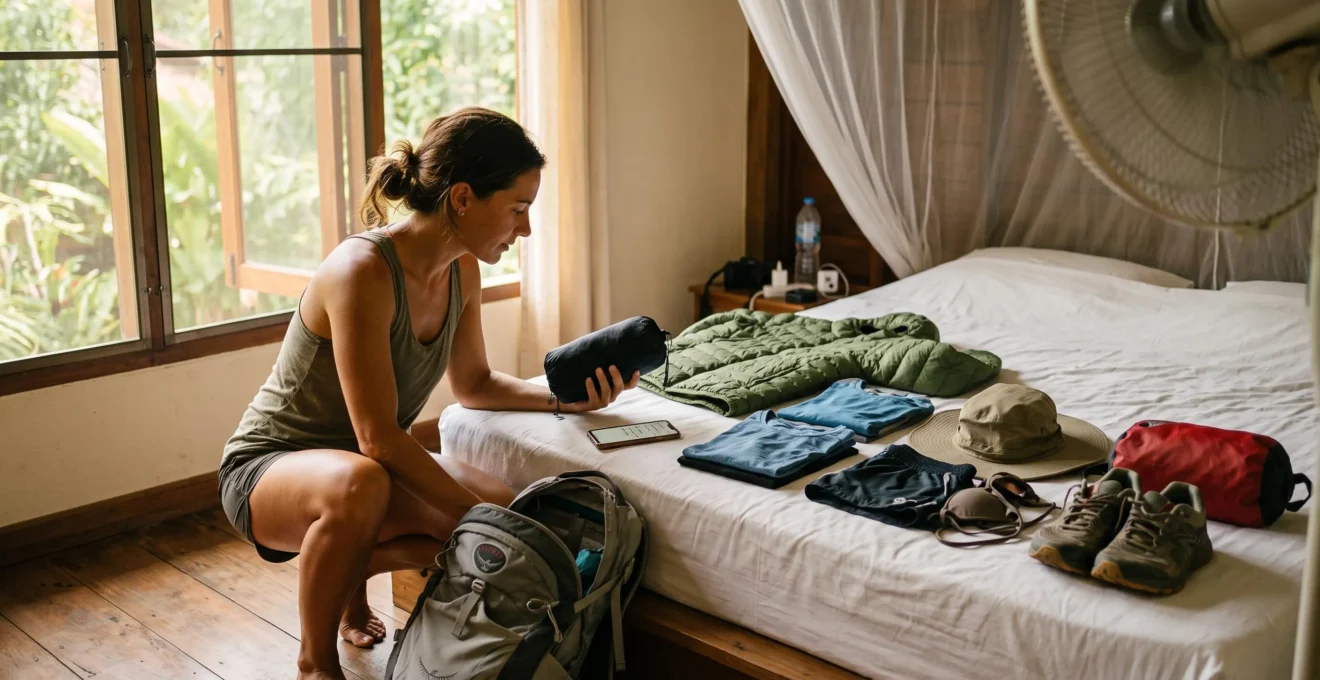
A suitcase packed for Bangkok’s tropical heat can leave you shivering on a northern mountain at sunrise or struggling through persistent rain on a southern island. Thailand’s geography creates striking differences in temperature, humidity and rainfall, sometimes within the same journey.
For practical travel planning, the country can be organised into four climate-and-packing zones: northern mountains, interior plains and plateaus, the Andaman coast, and the Gulf coast. These are travel categories, not four officially recognised meteorological regions. Thailand’s government actually distinguishes five meteorological regions: North, Northeast, Central, East and South.
Three geographical factors explain most packing decisions: elevation determines how much insulation you need, seasonal monsoons influence rain exposure, and coastal orientation affects sea conditions. Latitude and local terrain further modify these patterns.
Understanding these differences helps you choose destinations that match your preferred landscapes, identify realistic travel windows and pack appropriately without carrying separate wardrobes for every stop.
Thailand’s climate zones at a glance
- Northern mountains: Pack breathable daytime clothing, an insulating layer and walking shoes suitable for steep or slippery trails.
- Interior plains and plateaus: Prioritise sun protection and ventilation, adding rain protection during wetter months and a light layer for cooler northern interior evenings.
- Andaman and Gulf coasts: Both are tropical, but their rainfall patterns differ. Pack lightweight beach clothing, water protection and sun protection while choosing your coastline according to season.
- Why Northern Thailand Can Be Bone-Dry While Southern Islands Flood: The Monsoon Split Explained
- How to Choose Your Thailand Region Based on Landscape: Mountains vs Rivers vs Coasts
- Northern Forests vs Southern Mangroves: Where to Find Thailand’s Richest Wildlife Diversity?
- The Elevation Mistake That Ruins Northern Thailand Treks for 40% of Lowland Visitors
- When to Visit Northern Thailand for Emerald Rice Terraces vs Golden Harvest Fields
- Andaman White Sand vs Gulf Beige Beaches: Which Matches Your Beach Aesthetic?
- Khao Sok vs Doi Inthanon: Which Park Offers Better Chances for Wild Elephant and Gibbon Sightings?
- How Thailand’s Two Coasts Offer Opposite Beach Experiences: Gulf Calm vs Andaman Drama
Why Northern Thailand Can Be Bone-Dry While Southern Islands Flood: The Monsoon Split Explained
Northern Thailand can experience cool, relatively dry conditions while southern Gulf-facing destinations receive substantial rain because the country’s two seasonal monsoons interact differently with its geography. The northeast monsoon typically brings drier continental air southward, but that air can collect moisture over the Gulf of Thailand and produce rain along the southeastern peninsula.
The geographical distinction becomes clearer when the monsoons are considered separately.
The southwest monsoon generally operates from mid-May to mid-October. Moisture transported from the Indian Ocean encourages cloud formation and rainfall across much of Thailand, particularly around exposed coasts and mountain ranges.
The northeast monsoon generally operates from mid-October to mid-February. It brings cooler, drier conditions to northern and northeastern Thailand, while its passage over the Gulf can create wet weather in southern Gulf-facing areas, sometimes continuing into December.
These typical periods are documented in the Thai government’s explanation of Thailand’s two monsoons, based on information from the Thai Meteorological Department.
| Region | Broad seasonal pattern | Packing priority |
|---|---|---|
| Northern mountains | Wetter during much of May–October; generally cooler and drier during the northeast monsoon. | Rain shell in wet months; insulating layers for cool-season elevation. |
| Interior plains | Southwest-monsoon rainfall followed by a generally drier period; local heat and rainfall vary. | Breathable clothing, sun protection and seasonal rain gear. |
| Andaman coast | More exposed to southwest-monsoon conditions, with potentially rougher seas. | Waterproof storage, quick-dry clothing and flexible boat plans. |
| Southern Gulf coast | Rain exposure can remain significant during the northeast monsoon, including late in the year. | Light rain protection, waterproof electronics storage and adaptable beach plans. |
Consider a hypothetical trip combining Chiang Mai and Ko Samui in November. The northern portion may favour comfortable outdoor exploration, while the island portion could encounter persistent showers or disrupted boat services. A single national monthly weather chart would conceal that difference.
Transition months deserve particular care. Around October–November, monsoon influences change, but not simultaneously across every region. March–April can bring substantial inland heat even when coastal conditions are relatively favourable. Northern smoke and haze can also affect outdoor comfort during parts of the dry season, although their severity varies.
Seasonal averages establish a useful starting point, not a forecast. Checking destination-specific conditions shortly before travel is especially important when the itinerary includes mountains, islands or weather-dependent transfers.
How to Choose Your Thailand Region Based on Landscape: Mountains vs Rivers vs Coasts
Your preferred landscape is also a practical way to choose your clothing. Northern mountains favour layers and footwear with grip; central river lowlands favour ventilated fabrics and sun protection; northeastern plateaus combine exposed terrain with seasonal variation; and southern coasts require lightweight clothing, water protection and attention to sea conditions.
Thailand’s physical geography explains why one tropical-country packing list cannot cover every location equally well.
The Thai government’s geographical overview of Thailand describes mountains and valleys in the north, a plateau in the northeast, predominantly low-lying central terrain, and a southern peninsula bordered by the Andaman Sea and the Gulf of Thailand. It also recognises the eastern region separately.
For packing purposes, the central, northeastern and eastern interiors can be considered together, provided their local climatic differences are not ignored.
| Preferred experience | Geographical match | What changes in your bag |
|---|---|---|
| Mountain viewpoints and trekking | Chiang Mai, northern ranges and highland parks | Fleece or light insulated jacket, shell, grippy walking shoes. |
| Rice fields, rivers and historic cities | Central plains and selected northern valleys | Breathable shirts, sun hat, comfortable walking shoes and compact umbrella. |
| Plateau landscapes and rural exploration | Northeastern Thailand | Light sun-covering layers, drinking-water capacity and seasonal rain protection. |
| Rainforest, rivers and mangroves | Southern peninsula and coastal wetlands | Quick-dry clothing, waterproof bag, insect protection and secure footwear. |
| Beaches and island excursions | Andaman or Gulf coast | Swimwear, sun protection, water-resistant storage and appropriate beach footwear. |
Elevation can outweigh latitude for immediate comfort. A high mountain location in northern Thailand may feel markedly colder than a southern seaside town, particularly around sunrise during the cooler months. Conversely, a lowland northern city can be hot during the afternoon despite its proximity to mountains.
The same logic applies to activities. River excursions expose belongings to splashes, forest walks require more protective clothing, and exposed coastal viewpoints call for sun protection even when wind makes conditions feel comfortable.
Instead of creating a different suitcase for every region, build a lightweight base wardrobe and add small climate-specific modules.
This method avoids packing for the country’s reputation as a tropical destination and focuses on the actual terrain, elevation and seasonal exposure of each stop.
Northern Forests vs Southern Mangroves: Where to Find Thailand’s Richest Wildlife Diversity?
Southern rainforests and mangrove systems offer a strong combination of tropical habitats, but northern forests are equally valuable for travellers interested in mountain birds and altitude-related ecological changes. There is no reliable single winner for wildlife diversity without defining the area, habitats and species being compared. Choose by wildlife interests, viewing conditions and accessible habitats.
Northern Thailand’s forest environments change with elevation. Depending on location, travellers may encounter different combinations of broadleaf vegetation, evergreen forest and high-elevation plant communities. Birdwatchers can seek species associated with mountain forests, while visitors interested in landscape ecology can observe how vegetation changes along an ascent.
Southern Thailand provides a different experience. Tropical rainforest environments support forest-dependent mammals, birds and other wildlife, while mangrove habitats occupy sheltered coastal wetlands where saltwater and freshwater influences meet.
Mangroves are particularly interesting for observing animals adapted to muddy tidal environments. Southern rainforest excursions, meanwhile, may offer opportunities to hear or occasionally see primates, although encounters are never guaranteed.
Habitat matters more than the generic label “jungle.” A boat journey through coastal mangroves, a rainforest walk and a mountain birdwatching trail target different ecological communities.
Season also changes what visitors can observe. Wet conditions may make forest vegetation especially lush while reducing visibility, making trails muddy and complicating access. Drier periods may improve walking conditions, but do not guarantee more animals.
For northern forest walking, carry a moisture-resistant insulating layer when elevation warrants it, alongside footwear with grip and protective socks. In wetter environments, ask a local guide whether leech protection is appropriate.
For southern rainforest and mangrove trips, prioritise a waterproof pouch for electronics, quick-dry long trousers, insect repellent and shoes that tolerate moisture. On boats, secure loose equipment and use an appropriately fitted life jacket.
Wildlife encounters should take place at a respectful distance. Avoid feeding animals, using playback indiscriminately or entering sensitive habitat solely to improve a photograph.
The most rewarding nature itinerary is one that matches the ecosystem to your preferred species and prepares you for the conditions required to observe them responsibly.
The Elevation Mistake That Ruins Northern Thailand Treks for 40% of Lowland Visitors
The critical trekking mistake is using a lowland forecast to choose clothing for a mountain route. Higher elevations can be substantially colder, windier and wetter than nearby cities, especially around dawn. The “40%” figure in this heading is illustrative, not a verified visitor statistic; the underlying risk is geographical and practical.
Doi Inthanon, Thailand’s highest mountain, rises to approximately 2,565 metres above sea level. A traveller leaving Chiang Mai in comfortable daytime clothing may encounter much cooler conditions at higher elevations.
Altitude changes air temperature because atmospheric conditions vary with height. The National Weather Service explanation of temperature lapse rates describes how vertical temperature gradients relate to atmospheric stability.
Although air temperature often decreases as elevation increases, the exact gradient varies. No single temperature adjustment guarantees the conditions on a particular Thai mountain.
For a hypothetical example, imagine a traveller checking a warm city forecast before setting out on a high mountain trail. The city forecast does not necessarily account for the trek’s altitude, exposure, wind or early departure. Without additional clothing, the traveller may become uncomfortable even if the city weather prediction was accurate.
The practical correction is a three-layer clothing system: a breathable base layer, an insulating middle layer and a protective outer shell.
A lightweight fleece can provide useful insulation, while a rain-resistant shell helps manage wind and showers. Gloves or a warm hat may be appropriate for particularly cold departures, depending on the mountain forecast.
Temperature is only part of the challenge. Steep trails, uneven steps, moisture and reduced visibility can make a route more demanding than its distance suggests. Conditions around Doi Inthanon or Doi Luang should be assessed individually rather than assumed equivalent.
Five checks before a northern Thailand mountain trek
- Identify your highest point. Record the mountain, trail and approximate maximum elevation in your itinerary.
- Check the relevant forecast. Save a forecast covering the mountain area and planned departure time, not just the nearest city.
- Prepare removable layers. Lay out a base layer, insulating garment and protective shell, adjusting insulation to the forecast.
- Inspect your footwear. Confirm that shoes fit securely and provide adequate grip for the expected trail surface.
- Confirm access and conditions. Save the park or guide’s latest information about trail availability, route requirements and weather-related restrictions.
A mountain forecast, the planned elevation and the actual route should determine your final clothing choices. A theoretical temperature adjustment is useful for understanding the risk, but never replaces local conditions.
When to Visit Northern Thailand for Emerald Rice Terraces vs Golden Harvest Fields
For lush green rice landscapes, the northern wet-season growing period is generally the more promising choice. Golden fields become more likely as crops mature before harvest, often later in the season. The exact dates differ by location, crop variety, planting schedule and rainfall, so there is no single guaranteed viewing calendar for northern Thailand.
Rice-field appearance follows the agricultural cycle rather than a fixed tourism timetable.
After planting, young rice creates increasingly green landscapes as the crop develops. As plants mature, their colour can shift towards yellow and gold before harvesting changes the scene again.
The seasonal monsoon provides much of the water supporting rain-fed cultivation, connecting the appearance of the landscape to the rainfall patterns described earlier.
A useful location-specific example comes from the Tourism Authority of Thailand’s seasonal guide to Phrae. It describes rice fields near Wat Nakhuha as typically green from June through October, with golden colours appearing in early November before harvest.
Phrae: a documented seasonal colour change
The Tourism Authority of Thailand identifies fields near Wat Nakhuha in Phrae province as a green-season attraction and describes a transition towards golden colour before harvest.
This is a local observation, not a national rice-calendar rule. It does not establish identical viewing windows for mountain terraces elsewhere in northern Thailand.
Travellers should distinguish cultivated lowland fields from hillside terraces. Differences in altitude, irrigation and planting practices can affect when each location reaches its most photogenic stage.
| Priority | Green growing period | Golden pre-harvest period |
|---|---|---|
| Visual character | Fresh green vegetation and lush surroundings. | Yellow-gold mature rice and warmer field tones. |
| Typical conditions | Greater likelihood of rain, humidity and muddy access. | Potentially improving access as the wet season withdraws, depending on locality. |
| Photography preparation | Rain cover, lens cloth and protective footwear. | Sun protection, light layers and flexible timing around harvest. |
| Planning uncertainty | Planting and rainfall timing. | Crop maturity and actual harvest date. |
For either period, local confirmation is more useful than an attractive photograph posted in a previous year. Ask accommodation providers or local guides about current field colour and whether visitor access is permitted.
Choosing the season also means choosing its inconveniences: greener landscapes may involve wetter walking conditions, while a later visit can offer different colours and potentially more comfortable temperatures.
Andaman White Sand vs Gulf Beige Beaches: Which Matches Your Beach Aesthetic?
The Andaman coast is often associated with pale sand, turquoise water and dramatic limestone scenery, while many Gulf beaches offer gentler coastal landscapes and warmer-toned sand. Neither appearance is universal. Sand composition, underwater terrain, light and recent weather determine how individual beaches look, so choose a specific beach rather than assuming every coastline follows a colour rule.
Thailand’s two coastlines face different marine environments and contain varied geological settings.
The Andaman side includes well-known limestone formations, rocky headlands and islands where dramatic topography shapes the coastal view. Beaches associated with pale sand and clear water can deliver striking visual contrasts, particularly when sea conditions are favourable.
The Gulf side includes broad sandy bays, sheltered coves and island shorelines with considerable variety. Some beaches have golden or beige tones, while others are pale enough to challenge the idea that Gulf sand is always darker.
Sand colour is a local geological characteristic, not a dependable coast-wide classification. Grain composition, nearby rock, shell fragments and sediment transport can all influence beach appearance.
Water colour also changes with depth, suspended sediment, seabed characteristics, cloud cover and sunlight. A turquoise promotional image should not be interpreted as a year-round water-clarity guarantee.
| Decision factor | Andaman coast | Gulf coast |
|---|---|---|
| Characteristic scenery | Limestone cliffs, islands and dramatic coastal relief in many destinations. | Curved bays, island beaches and varied tropical coastal landscapes. |
| Sand appearance | Can be very pale; varies between beaches. | Ranges from pale to warmer golden or beige tones. |
| Water clarity | Highly dependent on location, weather and sea conditions. | Also dependent on location, weather and sea conditions. |
| Seasonal consideration | Greater exposure to southwest-monsoon sea conditions. | Different rainfall rhythm, particularly on southern Gulf-facing shores. |
| Useful equipment | Dry bag, sun protection and suitable footwear for rocky approaches. | Dry bag, sun protection and footwear matched to the chosen beach. |
For photography, compare actual locations at similar times of day rather than comparing promotional images taken under different lighting. For swimming, assess the beach’s current conditions rather than its appearance.
Use sunscreen appropriate for your skin and local environmental guidance, preferably with clear information about its ingredients. Products marketed as “reef-safe” do not necessarily meet a universally recognised environmental standard. Protective clothing and avoiding contact with coral remain important.
A beautiful beach is only the right choice when its seasonal conditions support the activities you actually intend to enjoy.
Khao Sok vs Doi Inthanon: Which Park Offers Better Chances for Wild Elephant and Gibbon Sightings?
Khao Sok is generally the more relevant choice for travellers hoping to encounter rainforest mammals such as gibbons or wild elephants, because those animals are associated with its tropical forest habitat. Doi Inthanon is more strongly suited to high-elevation forest exploration and birdwatching. Neither park offers guaranteed sightings, and reliable comparative sighting probabilities are unavailable in the supplied evidence.
The two parks represent different ecological experiences.
Khao Sok, in southern Thailand, contains tropical rainforest environments where visitors may look and listen for forest wildlife. Gibbons are often easier to detect by their calls than to observe clearly through vegetation. Wild elephants can be much harder to encounter, even in suitable habitat.
Doi Inthanon, in northern Thailand, offers a contrasting mountain environment. Its elevation and forest variation make it particularly attractive for birdwatching and observing highland vegetation.
Although wildlife exists beyond the species most frequently discussed in tourism materials, a visit should not be planned around an assumed elephant or gibbon encounter at Doi Inthanon.
| Criterion | Khao Sok | Doi Inthanon |
|---|---|---|
| Main habitat appeal | Tropical rainforest and forest waterways. | Mountain forests and high-elevation ecosystems. |
| Gibbon interest | Relevant rainforest habitat; sightings uncertain. | Not a dependable destination for targeted gibbon sightings. |
| Wild elephant interest | Wildlife possibility, never a guaranteed encounter. | Not a realistic primary destination for elephant sightings. |
| Birdwatching | Forest birdlife. | Particularly appealing for mountain and forest birdwatching. |
| Packing emphasis | Waterproofing, humidity management and trail grip. | Warm layers, weather protection and suitable mountain footwear. |
Animal visibility depends on several interacting factors, including habitat, weather, movement patterns, visitor activity and individual species behaviour. Early-morning guided excursions may create useful opportunities for observation, but cannot establish a universal increase in encounter probability.
Choose a properly authorised guide familiar with the park’s access rules and wildlife ethics. Keep a respectful distance, avoid feeding animals and never request that guides pursue or corner wildlife for photographs.
Wild elephants should be observed as wild animals, not treated as scheduled attractions. A venue offering close contact or staged animal encounters is not equivalent to responsible wildlife observation in a national park.
For gibbons, patience and attentive listening may be more useful than moving rapidly through forest trails. For birds, binoculars and a quiet approach are valuable in either destination.
If wildlife observation is your main objective, build enough flexibility into your itinerary to appreciate the forest itself even when the animals you hoped to see remain hidden.
What to decide before choosing your final region
- Select your coastline using the likely monsoon exposure during your actual travel dates, not the country’s overall dry-season label.
- Decide whether scenery, swimming, snorkelling or boat excursions matter most; these activities have different weather requirements.
- Use the mountain layers and rainforest protection already identified to complete a compact multi-region bag rather than packing duplicate outfits.
How Thailand’s Two Coasts Offer Opposite Beach Experiences: Gulf Calm vs Andaman Drama
Thailand’s Andaman and Gulf coasts can deliver very different beach experiences because they face different weather systems and seasonal sea conditions. The Andaman side is known for dramatic limestone scenery and can experience stronger southwest-monsoon swells. The southern Gulf has a different rainy-season rhythm, sometimes remaining wet while northern Thailand is relatively dry.
For beach-focused travel, coast selection is one of the most consequential weather decisions in the entire itinerary.
The Andaman coastline includes destinations such as Phuket, Krabi and islands surrounded by striking marine landscapes. Its exposed waters can become challenging during the southwest monsoon, influencing swimming safety, visibility and the availability of certain boat excursions.
The Gulf offers island environments such as Ko Samui and Ko Pha Ngan, where travellers often seek beaches, swimming and island-hopping activities. However, it is inaccurate to describe the Gulf as permanently calm: waves and heavy rainfall can also affect these destinations, especially during their wetter periods.
The phrase “opposite seasons” is a useful planning shortcut, not an absolute weather rule. Both coastlines can experience unsettled weather during seasonal transitions, and different stretches of the Gulf do not necessarily share identical rainfall patterns.
A broad planning approach is to assess Andaman destinations particularly carefully during the southwest monsoon and southern Gulf destinations during the wetter northeast-monsoon period. Short-term forecasts, marine warnings and local operator advice remain essential for water-based activities.
| Zone | Essential clothing | Useful additional equipment |
|---|---|---|
| 1. Northern mountains | Quick-dry base layer, fleece or light insulated jacket, rain shell, sturdy shoes. | Warm hat when forecast warrants it, spare socks and a compact daypack. |
| 2. Interior plains and plateaus | Breathable shirts, lightweight trousers or shorts, comfortable walking shoes. | Sun hat, sunglasses, reusable water bottle and compact rain protection. |
| 3. Andaman coast | Swimwear, lightweight clothing, sun-protective layers and appropriate sandals. | Dry bag, secure boat footwear where needed and waterproof electronics pouch. |
| 4. Gulf coast | Swimwear, breathable clothing, lightweight rain shell and comfortable sandals. | Dry bag, sun protection and flexible arrangements for weather-dependent excursions. |
For a hypothetical itinerary combining Chiang Mai, Bangkok, Krabi and Ko Samui, the most efficient bag would share basic warm-weather clothing across all destinations. A compact fleece addresses the northern elevation difference, while a rain shell and waterproof pouch protect against wet conditions in multiple regions.
Quick-dry shirts, interchangeable layers and practical footwear reduce the need for duplicate outfits. A hat and sun-protective clothing remain useful across the country, while specialised equipment should be added only for activities actually booked.
Before finalising the bag, examine each stop through three questions: How high is it? Which monsoon influence is relevant during the trip? What will the planned activity expose you to?
Build your packing list destination by destination, starting with the clothing needed everywhere and adding only the mountain, rainforest or marine equipment your route requires. Then check regional forecasts and activity conditions close to departure. One adaptable bag can cover Thailand’s contrasting landscapes without pretending they all share the same climate.
Does Thailand officially have four climate zones?
No. The four-zone structure in this guide is a practical packing framework. Thailand’s official meteorological overview distinguishes five regions: North, Northeast, Central, East and South. The four travel zones instead group destinations by the climate factors most useful for choosing clothing: northern elevation, interior conditions and the different monsoon exposures of the Andaman and Gulf coasts.
Do I need a winter jacket for northern Thailand in December?
Not necessarily for lowland sightseeing. However, high-elevation locations can be much colder than nearby cities, particularly around dawn. Travellers planning early mountain excursions should check the elevation-specific forecast and consider an insulating jacket, a protective shell and additional warm accessories when conditions require them.
Can I visit Thailand’s islands during the rainy season?
Yes, but conditions vary by coastline and destination. Rain does not automatically prevent all beach activities, yet rough seas, thunderstorms and reduced visibility can affect swimming and boat transport. Choose the coast according to its regional seasonal pattern, keep alternative activities available and follow local marine safety advice.
What footwear is most useful for a trip combining Bangkok, mountains and beaches?
A comfortable pair of walking shoes with reliable grip covers many city and moderate-trail activities, while lightweight sandals work for suitable beach environments. More demanding mountain routes may require dedicated hiking footwear. Check trail difficulty and surface conditions before deciding whether two pairs are enough.
How far in advance should I check Thailand’s regional weather?
Use typical seasonal patterns when choosing destinations and booking the broader itinerary. Check regional forecasts again closer to departure, and review current mountain or marine conditions shortly before weather-sensitive activities. Forecasts are especially important during monsoon transitions, when conditions can differ substantially from seasonal averages.