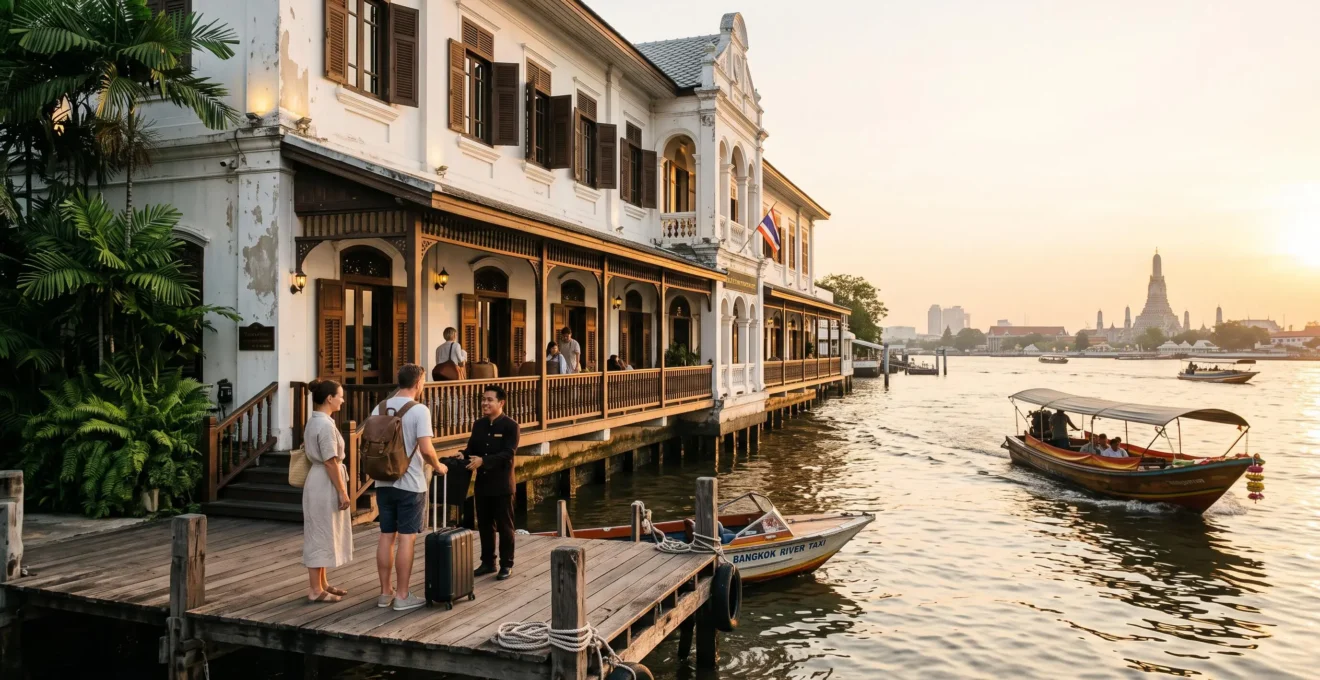
Bangkok’s riverside heritage hotels offer something a contemporary luxury tower cannot manufacture: the opportunity to stay inside a building with its own architectural history. Original timber floors, historic verandas, distinctive room proportions and connections to the Chao Phraya’s past can make accommodation part of the destination rather than simply somewhere to sleep.
But the label « heritage hotel » covers considerably different experiences. A restored aristocratic residence, a historic hotel wing and a modern property decorated with antiques are not interchangeable. Nor does a century-old building necessarily provide better service, greater comfort or a more authentic experience than a recently constructed hotel.
For travellers considering a 30–50% premium over a comparable modern room, the booking decision should begin with architectural provenance, the exact room category and the practical consequences of staying in an older structure. Properties such as Praya Palazzo, Chakrabongse Villas and Old Capital Bike Inn deserve consideration for different reasons, but their locations, building histories and accommodation types must be assessed individually.
Bangkok heritage hotel booking essentials
- Pay for a documented historic building and a specific heritage room, not simply colonial-style decoration or an evocative hotel name.
- Confirm stairs, air conditioning, room location and river transfers directly with the property before making a non-refundable reservation.
- Compare the total booking cost across seasons and room categories; an April–October stay is not automatically cheaper or more comfortable.
- Why Bangkok’s Heritage Hotels Are All on the West Bank: The Development History
- What to Expect in Bangkok Heritage Hotels: The Antique Charm and Modern Compromise
- Heritage Character or Modern Luxury: Which Bangkok Riverside Hotel Matches Your Priorities?
- The Heritage Hotel That Has No Elevator: Why 19th-Century Buildings Challenge Mobility
- When to Book Bangkok Heritage Hotels for Best Rates: The April-October Low-Season Bargains
- What to Expect in Bangkok Heritage Hotels: The Antique Charm and Modern Compromise
- Heritage Character or Modern Luxury: Which Bangkok Riverside Hotel Matches Your Priorities?
- How to Use the Chao Phraya River as Bangkok’s Most Scenic Transport Corridor
Why Bangkok’s Heritage Hotels Are All on the West Bank: The Development History
Bangkok’s historic riverside hotels are not all on the west bank. Significant heritage accommodation exists on both sides of the Chao Phraya, reflecting the city’s intertwined royal, residential and commercial development. The more useful distinction is between a building with a verifiable historical past and a newer hotel borrowing architectural details from Bangkok’s earlier periods.
The west bank, associated with Thonburi, was already an important urban centre before Bangkok became the capital in 1782. Across the river, the Rattanakosin area developed around the Grand Palace, temples and royal administration. International commerce also shaped the eastern riverfront, particularly farther south, where trading operations, foreign institutions and river-facing commercial buildings became part of the urban landscape.
Consequently, the assumption that foreign traders occupied only the Thonburi side while the east bank remained exclusively royal is historically misleading. The river connected administrative, residential, religious and trading districts rather than separating them into two uniform architectural zones.
For hotel selection, three architectural categories matter more than the bank itself:
- Converted historic masonry buildings: former residences or other documented buildings adapted for hospitality, sometimes featuring European-influenced architectural elements.
- Traditional Thai houses: restored timber residences, sometimes with raised floors, verandas and domestic layouts fundamentally different from colonial masonry architecture.
- Heritage-inspired hotels: newer buildings using period furniture, shutters, decorative teak or traditional motifs without necessarily occupying historic structures.
Praya Palazzo provides a particularly clear example of documented building reuse. According to Praya Palazzo’s official hotel and heritage information, the riverside property dates to 1923, began as a noble family’s residence, subsequently became a school and underwent restoration in 2009. The hotel reports 15 rooms and access exclusively by private barge.
Those details establish a residential heritage narrative, not an origin as a colonial trading house. They also show why researching the building’s original purpose is more informative than relying on the adjective « colonial. »
On the east bank, Mandarin Oriental Bangkok‘s historic accommodation demonstrates that heritage can also coexist with an established luxury hotel operation. Its original building’s Authors’ Wing remains an important reference point for comparing historical architecture with contemporary hospitality.
Location can therefore guide an architectural itinerary, but it should never serve as proof of authenticity. Ask for the building’s original use, construction period, restoration history and the location of the actual bookable rooms.
The smaller inventory of some restored properties makes room-category availability especially important. Their heritage character may justify a premium to the right traveller, but neither age nor limited room count establishes that a particular rate is good value.
What to Expect in Bangkok Heritage Hotels: The Antique Charm and Modern Compromise
Bangkok’s heritage hotels can offer distinctive interiors, intimate surroundings and a stronger connection to the city’s architectural past, but comfort varies by property and room category. Older structures may have irregular layouts, less predictable sound insulation and modern systems fitted around existing architectural features. The best choice depends on which historic details matter and which conveniences are essential.
A restored building is not necessarily uncomfortable. Equally, expensive furnishings do not guarantee that every original architectural element has survived. Restoration, reconstruction and decorative styling can produce visually similar rooms with very different historical significance.
Before paying a premium, examine the relationship between the historic structure and the hotel’s contemporary facilities.
- Climate control: check whether the booked room has individual air-conditioning controls, how recently the equipment was serviced and whether recent guests report uneven cooling.
- Room geometry: expect the possibility of non-standard floor plans, ceiling heights, window positions and furniture arrangements rather than identical rooms across a floor.
- Acoustic comfort: investigate noise from corridors, adjoining rooms, floors and river activity rather than assuming older masonry or timber will provide effective insulation.
- Bathroom installations: verify shower configuration, water-pressure feedback and any recurring maintenance complaints in recent reviews.
- Hotel facilities: establish whether dining, swimming pools, spa services and other amenities are on site, shared with an adjacent facility or unavailable.
Some heritage-focused accommodation prioritises historical atmosphere over extensive facilities. Other hotels integrate an original wing into a much larger contemporary hospitality operation. The difference is visible in the exceptional Royal Suite at Mandarin Oriental Bangkok.
A documented example: Mandarin Oriental Bangkok’s Authors’ Wing
The hotel’s Royal Suite occupies the original building’s Authors’ Wing and measures 306 square metres (3,294 square feet), according to Mandarin Oriental Bangkok’s Royal Suite accommodation page.
It includes private elevator access, a marble bathroom, a kitchen, a study, a private gym and 24-hour butler service. This exceptional suite illustrates that historic surroundings and extensive modern luxury can coexist; its facilities and dimensions should not be assumed to represent ordinary heritage rooms.
For a reliable condition assessment, examine recent guest photographs from more than one review platform. Search descriptions for terms such as « musty, » « renovated, » « air conditioning, » « noise » and « dated, » then compare recurring comments with the hotel’s published room descriptions.
Separate complaints about ageing decorative details from evidence of functional problems. Worn timber can be an authentic material characteristic; repeated reports of water intrusion or inadequate cooling warrant a different response.
Ask whether your room is in the original building, a restored annex or a newer wing. Also request written confirmation of any renovation work scheduled during your dates.
Heritage is an architectural attribute, not a hospitality rating. The aim is to understand exactly which original features remain and whether the property’s modern adaptations meet your expectations.
Heritage Character or Modern Luxury: Which Bangkok Riverside Hotel Matches Your Priorities?
Choose a heritage hotel when architectural immersion, intimate surroundings and distinctive interiors matter more than standardised facilities. Choose a modern riverside hotel when accessibility, predictable room layouts, extensive amenities and operational convenience take priority. For travellers who value both, a split stay can deliver a historic experience without requiring every night to involve the same compromises.
The appropriate accommodation type depends on how a trip will actually unfold.
A couple planning quiet mornings, architectural photography and visits to temples may enjoy a smaller riverside residence where rooms differ from one another. A business traveller with early appointments may place greater value on dependable ground transport, workspace and a predictable departure routine.
Families need to examine sleeping arrangements, connecting-room availability and supervision around pools, staircases and piers. Travellers with mobility requirements must assess physical access separately from a property’s aesthetic appeal.
The following comparison identifies tendencies to investigate, not guaranteed attributes of every hotel.
| Booking criterion | Historic heritage property | Modern riverside hotel |
|---|---|---|
| Architectural character | Potentially original building fabric and distinctive spatial layouts | Contemporary architecture, sometimes with heritage-inspired decoration |
| Room consistency | May vary significantly between categories and floors | Often more standardised within each category |
| Climate control | Retrofitted installations may require closer verification | Integrated systems, with performance still dependent on maintenance |
| Accessibility | Potential restrictions involving steps, older layouts or piers | Often easier to navigate, but accessible routes must still be confirmed |
| Noise insulation | Depends on original materials and later alterations | Depends on construction quality and room positioning |
| Service and facilities | Potentially intimate service with fewer on-site options | Often broader facilities and larger operational teams |
| Nightly price | Can reflect scarcity, location and architectural appeal | Varies widely by brand, view, amenities and demand |
For a five-night Bangkok visit, one possible arrangement is two nights in a heritage property followed by three nights in a modern hotel. This is an illustrative itinerary, not a prescribed minimum stay. The historic segment becomes a deliberate architectural experience, while the remaining nights provide a different base for activities, work or relaxation.
When planning such a transfer, compare the actual road journey with possible boat connections. Two properties can look close across the river while being inconveniently connected by land.
Another important consideration is the exact room allocation. A premium may be justified for accommodation inside a documented historic building but less compelling for a newer room with only decorative heritage references.
Request the building or wing name, room photographs representative of the booked category and any differences in access or facilities. These details can matter more than the broad hotel classification.
The strongest choice is not necessarily the most historic or the most luxurious property. It is the one whose specific building, room and operating arrangements match the purpose of the trip.
The Heritage Hotel That Has No Elevator: Why 19th-Century Buildings Challenge Mobility
Some older Bangkok hotel buildings may have stair-only access to particular rooms, narrow circulation spaces or difficult river approaches. However, age alone does not prove that a lift is absent, and restrictions on alterations depend on the building’s actual circumstances. Anyone with mobility limitations should obtain property-specific confirmation of every required access route before booking.
Historic building conversions frequently involve compromises between preserving architectural features and introducing contemporary circulation systems. Staircases can occupy narrow spaces, floor levels may differ between rooms, and installing a lift may require substantial structural changes.
Whether such alterations are legally restricted cannot be established from a hotel’s historic appearance alone. A building described as « heritage » is not automatically subject to a particular statutory protection regime.
Equally, a historic building can incorporate modern accessibility features. Mandarin Oriental Bangkok’s Royal Suite, for example, has private elevator access, although that fact says nothing about accessibility throughout the rest of the property.
The practical difficulty is that a hotel may describe itself as accessible while a particular booked room, restaurant, pool or river entrance remains difficult to reach.
Consider three separate stages of arrival: reaching the property, entering the building and reaching the allocated room. None should be assumed accessible merely because another stage is manageable.
At a river-dependent property, also consider the possible presence of sloping gangways, changes in boat-to-pier height, narrow boarding spaces or uneven walking surfaces. These conditions require individual confirmation rather than assumptions about Bangkok river transport generally.
Praya Palazzo offers a useful illustration of why arrival arrangements deserve particular attention. The hotel describes its access as exclusively by private barge. This establishes the importance of planning a water transfer but does not, by itself, confirm the accessibility of boarding, disembarkation or movement within the hotel.
For travellers with heavy luggage, temporary injuries or reduced stamina, the same precautions apply even when wheelchair access is not required.
Five checks to complete before confirming a heritage hotel
- Verify your exact room: request written confirmation of its floor, building or wing and the number of steps required to reach it. Keep the hotel’s reply with the reservation.
- Confirm a suitable route: ask whether step-free access exists from the arrival point to the room and all facilities you intend to use. Obtain a description of any unavoidable steps.
- Document luggage assistance: provide the number and approximate weight of bags, ask what porter assistance is available and retain the confirmed arrangement.
- Check river boarding: if a boat transfer is necessary, request details of the departure pier, boarding surfaces, assistance arrangements and alternatives where available. Save the transfer instructions.
- Secure the room assignment: ask the property to attach your mobility requirements and any confirmed ground-floor or accessible-room allocation to the booking record. Obtain written acknowledgment before final payment.
A ground-floor room is not automatically step-free. Historic thresholds, bathrooms and garden paths may still pose difficulties, while a modern elevator does not solve access problems at an external pier.
If the property cannot confirm a safe and workable arrival-to-room route, an alternative hotel is the more dependable decision. Architectural significance should never substitute for verified practical access.
When to Book Bangkok Heritage Hotels for Best Rates: The April-October Low-Season Bargains
April through October can offer opportunities to compare more attractive Bangkok hotel rates, but it is not a guaranteed discount period for heritage accommodation. April is generally hot, while Thailand’s rainy season runs approximately from mid-May to mid-October. Actual savings depend on individual hotel demand, room availability, events and booking conditions, not the climate calendar alone.
Thailand’s official seasonal guidance distinguishes three broad periods: a hot season from approximately mid-February to mid-May, a rainy season from mid-May to mid-October, and a cooler season from mid-October to mid-February. Seasonal boundaries can vary.
The Thai government’s explanation of Thailand’s seasons therefore provides useful weather context, but it is not evidence that heritage hotel prices consistently fall between April and October.
For a smaller heritage property, an individual room category can matter as much as the overall hotel’s occupancy. A room inside the original building may have fewer direct substitutes than accommodation in an additional wing or an ordinary modern hotel.
Booking several months ahead can be a sensible strategy for fixed high-demand travel dates or a very particular historic room. This is a planning recommendation, not a documented sell-out threshold. For flexible low-season dates, comparing refundable rates and checking for later changes may provide more options.
Consider seasonal celebrations separately. Songkran in April can affect local travel demand, while Chinese New Year occurs on varying dates, typically outside the April–October window. Neither event supports a blanket rule about rates across all Bangkok heritage properties.
Weather also changes the experience of historic architecture. During humid or rainy periods, rooms with imperfect seals or older cooling installations may be less comfortable, although this varies by building and maintenance condition.
Before accepting a lower rate, examine recent reviews for moisture, odour, ventilation and cooling complaints. Ask whether the booked room has undergone maintenance or refurbishment and whether any issues mentioned in reviews have been addressed.
The atmosphere can also be rewarding: rain moving across the Chao Phraya, sheltered verandas and tropical gardens offer a different experience from the cooler tourist season. Such appeal is subjective, and neither quieter common spaces nor reduced visitor numbers should be assumed for specific dates.
A practical comparison uses exactly the same room category, occupancy, cancellation terms and included services across different dates. Include breakfast, applicable taxes, transfers and potential non-refundable penalties before concluding that one offer represents better value.
For a historically significant room with limited availability, securing the right category and acceptable comfort conditions may be more valuable than pursuing the lowest advertised nightly rate.
What to Expect in Bangkok Heritage Hotels: The Antique Charm and Modern Compromise
Inside a Bangkok heritage hotel, the most memorable details are often the materials, proportions and sounds that distinguish the original building from contemporary accommodation. Teak flooring, shuttered windows, unusual room shapes and adaptations for modern bathrooms can enrich the experience. Their presence, condition and authenticity must nevertheless be verified for the precise room being reserved.
Historic residences were rarely designed around modern hotel requirements. Rooms originally intended for domestic use may have been divided, combined or adapted to accommodate bathrooms, air conditioning and other facilities.
When original materials survive, their visual qualities may include aged timber grain, handmade details, worn thresholds and differences in finish. These characteristics can be architecturally interesting without guaranteeing superior comfort.
Conversely, newly installed decorative timber, replica shutters or vintage-style furniture may create a similar visual impression without belonging to the building’s original construction.
Room descriptions should therefore distinguish between surviving fabric, restored elements and reproduction furnishings.
Photographs deserve particularly close examination. Wide-angle images can make a compact room look spacious, while a carefully framed bed or antique cabinet may conceal the position of a bathroom, window or air-conditioning unit.
Request photographs showing the room from its entrance, the complete bathroom and the view from its windows. If architectural authenticity drives the reservation, ask which visible details are original.
The soundscape is another consideration. A riverside room may expose guests to passing boats or activity at nearby piers. Depending on its location, a property may also be affected by temple announcements, traffic, courtyard activity or sounds transmitted through timber floors.
River-facing does not necessarily mean quieter. Garden-facing accommodation may reduce some exposure to river activity but could introduce different sources of noise. Upper-floor rooms may offer views while requiring stairs; ground-floor rooms may simplify access but provide less privacy.
Smaller properties can also offer a different service atmosphere from large hotels. Familiarity with guests, personal recommendations and continuity among staff are possible advantages, but these should be judged through current reviews rather than assumed from a property’s age or size.
Likewise, intimate staffing does not inherently imply slow check-in or limited professionalism. The relevant questions are whether staff availability, dining hours, luggage assistance and late-arrival arrangements meet your itinerary.
For the most meaningful heritage experience, prioritise the actual room over a photogenic lobby. The preserved spaces guests can occupy matter more than architectural details visible only in marketing images.
A room with fewer decorative antiques but more surviving original materials may offer greater architectural interest than a more elaborate reproduction interior. Personal comfort remains an equally legitimate criterion.
Heritage Character or Modern Luxury: Which Bangkok Riverside Hotel Matches Your Priorities?
A Bangkok heritage hotel premium is justified when it purchases an experience the traveller genuinely values: a verified historic room, unusual architectural fabric, an intimate setting or a desirable riverfront position. It becomes harder to defend when the additional cost buys only period-style decoration or when access, room comfort and inclusions fall short of the traveller’s priorities.
The proposed 30–50% premium is a useful hypothetical purchasing threshold, not an independently established average for Bangkok’s heritage accommodation market. The available hotel sources do not provide comparable nightly rates across equivalent properties, dates and room categories.
To evaluate that threshold properly, distinguish three elements of the booking price: the accommodation’s architectural character, its riverfront location and the level of hospitality service it provides.
A premium riverside view may explain part of a price difference even if the building is modern. Similarly, an extensively serviced hotel room can cost more than a historically significant residence because its facilities and staffing differ.
Consider an explicitly hypothetical comparison. If a modern hotel room costs THB 8,000 and a heritage room costs THB 11,200 on the same dates, the premium is THB 3,200, or 40%. This example illustrates the calculation only; neither amount is a verified hotel offer.
The question is whether the additional expenditure buys access to documented original architecture and a meaningful stay experience, rather than simply a different decorative style.
Illustrative value test: the heritage-room premium
For a hypothetical two-night stay, the modern option totals THB 16,000 while the heritage option totals THB 22,400, before any differences in taxes, inclusions or additional charges. The hypothetical premium is THB 6,400.
If the heritage rate includes accommodation inside the documented original structure and that experience is the main reason for travelling, the additional cost may be worthwhile. If the booked room is in a newer extension and historic interiors are accessible only in shared spaces, the same premium may be difficult to justify.
For travellers who want architectural atmosphere without paying a substantial premium, smaller boutique properties, adapted shophouses and accommodation near historic neighbourhoods may be alternatives worth investigating.
However, a shophouse hotel should not automatically be classified as colonial, historic or formally protected. Each building’s provenance must be checked independently. Old Capital Bike Inn, for instance, belongs in a broader heritage-accommodation search rather than being assumed to provide a riverfront room.
Review patterns are particularly revealing. A hotel that receives strong praise for atmosphere but recurrent criticism for sleep quality may suit an architecture enthusiast and disappoint a traveller focused on effortless comfort.
Look beyond the average star rating. Compare positive and negative reviews discussing the same room category, and determine whether criticisms concern subjective preferences or recurring functional shortcomings.
Then calculate the total cost for the exact dates and services required. A less expensive room may become less attractive once additional transfers or excluded meals are considered.
Architectural value is personal, but its underlying facts should be verifiable. Pay more for a building and experience you have identified, not for an architectural promise that has never been confirmed.
Key takeaways before planning your river journeys
- Verify whether the hotel has a usable private pier, relies on a particular public pier or requires a separate transfer from a road-accessible meeting point.
- Check current passenger-boat routes and pier notices before selecting sightseeing days; a riverfront address does not guarantee convenient access to every service.
- Build in a reliable road-transport alternative for late returns, unsuitable boarding conditions or changes to river services.
How to Use the Chao Phraya River as Bangkok’s Most Scenic Transport Corridor
The Chao Phraya can function as both a practical transport route and an architectural introduction to Bangkok. Public express boats connect river districts with important sightseeing areas, while some hotels operate separate transfers. The essential booking task is to identify the correct pier, operating service and last usable departure rather than assuming every riverside property has direct public-boat access.
For guests interested in urban history, travelling by water provides a perspective that road journeys cannot reproduce. Temple complexes, older riverfront buildings, commercial structures, traditional neighbourhoods and contemporary hotels become part of a continuous landscape.
Public express-boat services and tourist or hotel boats should be treated as different transport products. They may have different routes, boarding points, schedules, fares and ticketing arrangements.
Under the published Chao Phraya Express Boat schedule effective 6 October 2026, the Orange Line listed flat fare runs between Nonthaburi and Rajsingkorn with a listed flat fare of 19 THB . Other published routes include the Yellow, Green-Yellow and Red Lines, with fares varying by service.
THB 19
Published Orange Line flat fare under the Chao Phraya Express Boat service information effective 6 October 2026. This does not describe tourist-boat or hotel-shuttle fares.
Chao Phraya Express Boat, official operator information.
One especially important operational detail is the operator’s notice identifying Oriental Pier (N1) as closed for renovation. This status is time-sensitive and must be verified again before travelling. The official service page also distinguishes individual route schedules, so the general description of network operation should not be mistaken for a guarantee that every line operates daily.
For current routes, fares, pier notices and the available tracking link, consult Chao Phraya Express Boat’s official routes and fares.
Before boarding, identify the actual service rather than relying only on boat colour or a tourist map. Confirm the route’s stopping pattern, the destination pier and ticket-payment options with the operator or pier staff. The supplied official information does not establish Rabbit card acceptance or a universal coins-only payment rule.
A heritage-focused sightseeing day can be organised around the historic river corridor, with the Grand Palace and Wat Pho on the eastern side and Wat Arun across the river. Cross-river ferries may be relevant, but their boarding points and operating hours should be checked separately from express-boat services.
For travellers combining temple visits with historic architecture, an illustrative route is to begin near the Grand Palace, continue to Wat Pho, cross to Wat Arun and then follow a suitable river service towards another historic riverside district. The exact order should be adjusted to actual pier access, attraction opening hours and weather conditions.
Nearby sights are not always served by a single direct boat. Nor should a pier shown near a hotel on a map be treated as an active boarding point without confirming its current status.
Praya Palazzo requires particular planning because its operator describes access by private barge. Guests should request the designated mainland pickup point, transfer availability, luggage arrangements and instructions for returning after an evening excursion.
Build an alternative into the itinerary. If a preferred boat does not operate when required, road transport may provide a practical fallback where the property has road access. Boat-only properties require direct coordination with the hotel instead.
Heavy rain or changing river conditions may affect the convenience or safety of a journey, but service cancellations should be checked through current operator information rather than assumed from the weather alone. Evening return plans likewise require confirmation of the final applicable service.
From an architectural perspective, the river journey is part of the reason to choose this kind of accommodation. Observing older riverside settlements, historic institutional buildings and contemporary development illustrates how Bangkok’s urban fabric evolved around the Chao Phraya.
Before reserving, shortlist properties with verifiable histories, obtain written confirmation of the exact room and access arrangements, and check how the river will connect the hotel to the places you intend to visit. A well-chosen heritage hotel should make Bangkok’s architectural history tangible without leaving the practical details of the stay to chance.
Is a colonial-style hotel necessarily a historic building?
No. Colonial-style decoration may appear in modern buildings, restored historic properties or extensively reconstructed structures. Ask for the original construction period, previous use, restoration history and location of surviving architectural features. A room furnished with antiques does not necessarily occupy an original historic space.
Can visitors stay in historic Bangkok buildings without booking a riverside hotel?
Yes. Heritage-oriented accommodation also exists away from the river, including properties associated with older residential and commercial neighbourhoods. The key is to distinguish documented historic buildings from heritage-themed interiors and to assess transport requirements separately.
Does Praya Palazzo require guests to arrive by boat?
Praya Palazzo states that access is exclusively by its private barge. Before booking, confirm the current mainland pickup location, available transfer times, luggage assistance and procedures for late arrivals. Travellers with mobility requirements should request specific details about boarding and the route from the pier to their room.
Are all rooms in a heritage hotel equally historic?
Not necessarily. Some properties combine original buildings with newer accommodation, while individual room categories can contain different amounts of surviving historic material. Confirm the booked room’s building or wing, its architectural features and whether photographs represent that exact category.
Should heritage hotel bookings be made directly with the property?
Direct contact is particularly useful when room provenance, accessibility or boat transfers affect the decision. It allows the hotel to clarify specific arrangements in writing. Compare the final price and cancellation terms across booking channels, and obtain confirmation that any special room or access requests have been recorded.