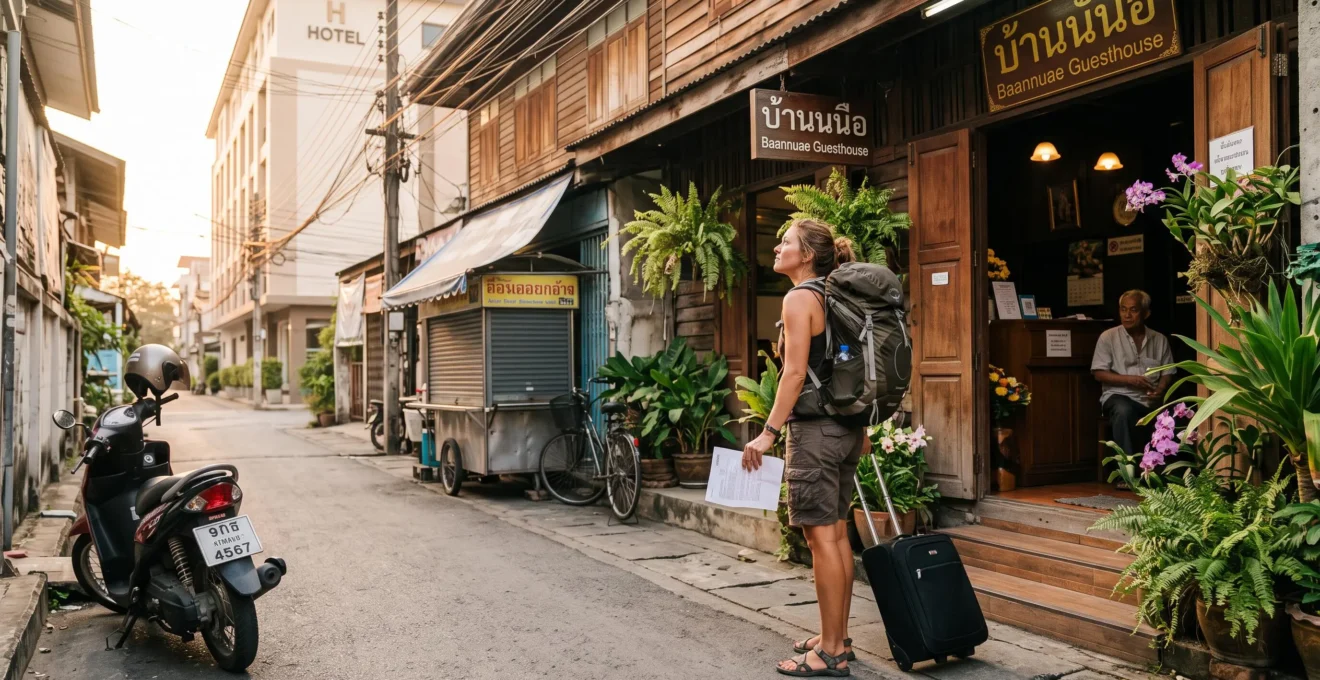
Choosing accommodation in Thailand involves more than deciding how much to spend on a room. A hostel in Bangkok, a family-run guesthouse in Chiang Mai, a beachfront resort and a rural homestay can produce entirely different travel experiences, even when their advertised prices seem comparable.
For first-time visitors, the most useful distinction is what each accommodation type actually delivers. Hostels prioritise affordability and social interaction; guesthouses favour personal hospitality and local connections; hotels offer more predictable services; and homestays provide opportunities for cultural participation. None is automatically the best choice.
Location can matter as much as accommodation category. A cheaper room far from Bangkok’s transport network might require additional taxi journeys, while a conveniently located guesthouse could eliminate several daily transfers. Seasonal demand, cancellation conditions and expectations around privacy also affect the decision.
The right approach is to compare the complete experience: nightly cost, transport requirements, opportunities to meet people, sleep quality and how much involvement with local life feels comfortable.
Thailand accommodation: the essential choices
- Choose by experience: hostels suit sociable budget travellers, guesthouses offer personal hospitality, hotels provide structured comfort, and homestays support deeper cultural engagement.
- Compare total costs: include daily transport, meals, additional charges and travel time rather than relying on the advertised nightly rate.
- Match location and season: check practical transport connections and book earlier when visiting popular destinations during busy periods.
- Why Thai Guesthouses Beat Chain Hotels for Cultural Experience: The Family-Run Difference
- How to Calculate True Accommodation Cost: Why £10 Savings Can Cost £40 in Taxi Fares
- Khao San Backpackers vs Sukhumvit Business Hotels: Which Bangkok Neighborhood Matches Your Style?
- The Bangkok Hotel Mistake That Adds 90 Minutes Daily: Booking Off the BTS Line
- When to Book Thailand Accommodation: The 50-Day Advance Window for High Season
- Why Thai Homestays Go Further Than Guesthouses: Living With the Family, Not Just Beside It
- Hostels and Capsule Hotels: Getting the Lowest Price Without Sacrificing Sleep or Security
- How to Choose Your Thailand Accommodation: A Decision Framework Based on Your Travel Priorities
Why Thai Guesthouses Beat Chain Hotels for Cultural Experience: The Family-Run Difference
Family-run guesthouses can offer a more personal introduction to everyday Thai life than chain hotels because guests interact directly with the people operating the property. Recommendations, conversations and small acts of hospitality may come from the owners themselves. However, this cultural advantage depends on how the guesthouse operates, not simply on its name or price.
In a genuinely family-operated guesthouse, the owner may live on the premises or nearby, oversee breakfast, welcome returning guests and explain which restaurants, markets or transport services local residents use. Over several nights, these interactions can provide an understanding of the neighbourhood that goes beyond conventional sightseeing.
Chain hotels generally organise hospitality around defined roles, service standards and scheduled staffing. This structure can deliver predictable check-in procedures, housekeeping and facilities, but it does not necessarily encourage sustained interaction with the same person. The difference is between buying accommodation alone and finding accommodation that also creates opportunities for local conversation.
The word « guesthouse » is not proof of family involvement. Some properties operate much like small hotels, with hired receptionists and limited owner contact. Conversely, independent boutique hotels can offer highly personal service.
Before booking, look for several signals rather than relying on the property’s category:
- Owner involvement: recent reviews describe conversations with identifiable hosts or family members.
- Property scale: a relatively small number of rooms makes regular host interaction more plausible, although it does not guarantee it.
- Shared spaces: a breakfast area, courtyard or communal table creates opportunities for informal conversation.
- Review consistency: multiple recent guests describe specific hospitality experiences rather than generic friendliness.
These clues are useful, but none is definitive. Photos of owners may be promotional, and a property can change management. Ask whether the owners are usually present and whether guests have opportunities to interact with them.
The trade-offs deserve equal attention. A small guesthouse may lack a permanently staffed reception, soundproofing, a lift or late-night arrival arrangements. A traveller arriving after a delayed international flight could reasonably prefer a hotel with confirmed overnight check-in.
Hybrid properties complicate the distinction further. Some family guesthouses add hotel-style services, while others expand without preserving much personal interaction. Confirm the actual experience through recent reviews and direct questions about staffing, breakfast and arrival arrangements.
Guesthouses are particularly appealing when local recommendations and personal hospitality matter more than standardised amenities. Travellers wanting greater involvement in family routines can explore the more immersive homestay model discussed later.
How to Calculate True Accommodation Cost: Why £10 Savings Can Cost £40 in Taxi Fares
The cheapest advertised room is not necessarily the least expensive place to stay. Calculate accommodation value by adding the nightly rate, transport to planned activities, necessary extras and any relevant fees. A £10 nightly saving can disappear when an inconvenient location creates repeated taxi journeys, although the £40 taxi figure is an illustrative scenario rather than a standard cost in Thailand.
A useful comparison starts with the total expected cost over the complete stay:
Total stay cost = accommodation charges + required transport + additional accommodation expenses.
Divide that total by the number of nights to establish an effective nightly cost. Keep meals that would be purchased regardless of accommodation separate, and include only the additional expenditure caused by one lodging choice.
Consider a hypothetical Bangkok stay lasting four nights. Property A costs £30 per night and is conveniently located near useful public transport. Property B costs £20 per night but requires additional taxi journeys.
Illustrative comparison: when £10 cheaper becomes more expensive
Property A: £30 × 4 nights = £120 accommodation. Assume £12 in total additional local transport costs, giving a hypothetical total of £132.
Property B: £20 × 4 nights = £80 accommodation. Assume £80 in additional transport costs caused by its location, giving a hypothetical total of £160.
Result: the property advertised at £10 less per night costs £28 more across the four-night stay under these assumptions. The figures illustrate the calculation, not actual Bangkok fares.
Transport assumptions must change with the destination. In Bangkok, practical access to BTS or MRT stations can reduce reliance on road journeys. In Chiang Mai, a combination of walking and local shared transport may be more relevant. On an island, an isolated property could require arranged transfers or additional vehicle hire.
A scooter should not automatically be treated as a cheap solution. Licensing requirements, insurance conditions, riding experience and road safety must be considered before including scooter hire in a travel plan.
Beyond daily transport, compare the following expenses:
- Breakfast charges where one property includes a meal and another does not.
- Airport or ferry transfers, including charges for inconvenient arrival times.
- Deposits, their payment methods and refund conditions.
- Currency conversion costs, card surcharges where applicable and cash withdrawal expenses.
- Luggage storage, early check-in and late check-out charges.
Time also has value, even when no money changes hands. An additional hour travelling each day reduces time available for sightseeing, relaxation or spontaneous activities. Instead of assigning an arbitrary monetary value to that hour, record the expected time difference beside the financial totals.
Compare prices in one currency using a consistent conversion basis. Check whether the final booking amount includes taxes and mandatory charges, and distinguish refundable deposits from actual expenses.
Once two properties have comparable all-in costs, their surrounding neighbourhoods become the next important differentiator. In Bangkok, the same room budget can support radically different experiences depending on where the accommodation is located.
Khao San Backpackers vs Sukhumvit Business Hotels: Which Bangkok Neighborhood Matches Your Style?
Choose the Khao San area when meeting other travellers and enjoying busy nightlife are central to your Bangkok stay. Choose Sukhumvit when rail connections, varied dining and modern urban conveniences matter more. Neither area guarantees a particular experience: the exact street, accommodation type and proximity to transport can be more important than the neighbourhood label.
Khao San Road and its surrounding streets are strongly associated with backpacker travel. Hostels, bars and traveller-oriented services make it easy to arrange activities and meet people passing through Bangkok. That concentration of nightlife also brings noise, especially near the busiest streets.
A hostel within easy walking distance of Khao San Road may offer a better balance than a room directly above nightlife venues. Guesthouse options in quieter neighbouring streets can work for visitors seeking the area’s social advantages without participating in late-night activity every evening.
Sukhumvit offers a different daily routine. Major sections of the corridor provide access to BTS stations, shopping centres, restaurants, offices and accommodation ranging from budget properties to international hotels. Travellers can prioritise independent meals, evening shopping and convenient rail journeys instead of hostel-based socialising.
Sukhumvit is not universally quiet or business-oriented. Individual areas contain nightlife, busy roads and substantial variation in pedestrian comfort. Evaluate the property’s street rather than assuming its district guarantees uninterrupted sleep.
Bangkok also offers useful alternatives to this familiar comparison.
| Area | Typical appeal | Most suitable priorities |
|---|---|---|
| Khao San area | Backpacker social scene and nightlife | Meeting travellers and spontaneous evenings |
| Sukhumvit | Urban conveniences and access to rail corridors | Transport, dining and hotel facilities |
| Ari | Cafés, residential streets and a more neighbourhood-oriented atmosphere | Independent travellers wanting an urban base away from major tourist nightlife |
| Thonglor | Contemporary restaurants and nightlife | Dining-focused travellers comfortable with an active evening scene |
| Riverside | River views and access to waterfront attractions | Scenic stays and river-focused itineraries |
| Old City (Rattanakosin) | Historic streets and proximity to major temples | Temple visits, heritage and walking-oriented exploration |
The riverside is not automatically peaceful, nor is every Old City property within easy walking distance of major attractions. Both areas include different micro-locations and transport arrangements.
To narrow the choice, answer four questions: Will most evenings involve nightlife or relaxation? Is reliable rail access essential? How sensitive are you to street noise? Do you prefer meeting travellers or spending time independently with a partner or family?
For example, a solo traveller planning social evenings might prefer a hostel near Khao San. A couple exploring several districts by public transport might favour a quiet Sukhumvit side street. Visitors concentrating on historic landmarks could benefit from accommodation in Rattanakosin without prioritising BTS access.
Once the neighbourhood fits your preferred travel rhythm, verify the transport network around the exact property. A convenient-sounding district can still contain hotels whose access routes add substantial time to everyday journeys.
The Bangkok Hotel Mistake That Adds 90 Minutes Daily: Booking Off the BTS Line
Booking accommodation far from useful public transport can add considerable travel time in Bangkok, particularly when daily journeys depend on taxis navigating congested roads. The suggested 90-minute daily penalty is a possible scenario, not a measured rule. The relevant test is whether a hotel provides reliable access to your specific destinations, including the walking journey to the nearest station.
Bangkok’s road congestion makes this distinction important. TomTom‘s Traffic Index report for Thailand recorded average congestion level in Bangkok of 67.9 % in 2025, alongside 115 hours of annual time lost during rush-hour travel under its measurement methodology.
These are city-level traffic indicators, not estimates of how much time a particular visitor will lose. They nevertheless explain why a journey that appears short on a map can be less predictable when it depends entirely on road transport.
A hotel near a usable BTS or MRT station may offer more consistent travel planning. Bangkok’s official BTS Skytrain route and fare planner allows travellers to investigate station connections, journey times and fares before selecting a property.
However, a hotel advertised as « near the BTS » can still involve an inconvenient walk. Major roads, canals, limited pedestrian crossings and station access arrangements may make the real walking route substantially longer than the apparent straight-line distance.
To estimate the practical penalty, compare complete door-to-door journeys rather than train travel times alone. Include walking to the station, expected waiting and transfer time, the final walk to the attraction, and the likely road journey under relevant traffic conditions.
For an explicitly hypothetical example, suppose an inconvenient hotel adds 15 minutes to each outward journey and 30 minutes to each return journey compared with a better-connected alternative. Across two return outings in a day, the additional time would total 90 minutes. Different itineraries could produce a much smaller difference, or none at all.
Five checks before booking a Bangkok hotel
- Pin the exact entrance. Locate the property rather than relying on the neighbourhood name; save its map location.
- Identify the relevant station. Find the nearest useful BTS or MRT station and record its name.
- Verify the pedestrian route. Check the actual walking distance and crossings; record a realistic walking estimate.
- Test two planned journeys. Compare door-to-door routes to two priority attractions at the times you expect to travel; save both estimates.
- Compare the alternative. Repeat the exercise for a second hotel and create a simple comparison of total room cost, transport cost and daily journey time.
Rail access should not become a rigid requirement. Travellers focusing on the Old City or Chao Phraya riverfront may find river transport, walking and appropriate local connections more convenient than a BTS-focused location. Outside congested periods, a taxi or ride-hailing journey may also be practical, depending on the route.
After confirming location, consider when the room needs to be reserved. A suitable hotel is only useful if availability and cancellation conditions still match your travel dates.
When to Book Thailand Accommodation: The 50-Day Advance Window for High Season
There is no universally optimal 50-day booking window for Thailand accommodation. Booking lead times should depend on destination, season, local events, property size and cancellation flexibility. Reserving around seven weeks ahead can serve as a planning checkpoint, but small island properties and popular accommodation during major holidays may require earlier attention, while quieter periods can allow more flexibility.
Thailand’s accommodation demand cannot be understood through a single national calendar. November to February is commonly treated as an important travel period for many northern destinations and Andaman coast resorts, but regional weather patterns differ. A booking strategy that suits Phuket may not suit Ko Samui at the same time of year.
The UK Met Office explanation of monsoon and rainy seasons identifies May to October as Thailand’s broad monsoon period while recognising geographical variation in rainfall. That national range is useful background, not a property-level availability forecast or a complete description of every island’s weather.
Travellers should consider three distinct demand situations.
- Popular travel periods: sought-after resorts, well-reviewed guesthouses and accommodation with distinctive facilities can become harder to secure as arrival approaches.
- Festivals and holidays: Songkran, Chinese New Year and local celebrations such as Loy Krathong can concentrate demand in particular destinations or on specific dates.
- Quieter or wetter periods: accommodation options may remain available closer to arrival, although the effect varies by destination, property and weather conditions.
Smaller islands such as Ko Lipe and Ko Tao illustrate the importance of limited local supply. When a traveller wants a particular beachfront location or a small boutique property, fewer acceptable alternatives may exist if the preferred rooms sell out.
Property structure also matters. A guesthouse with a limited number of rooms faces a different availability constraint from a large hotel. A larger property may offer more room categories, but this does not guarantee lower prices or late availability.
A useful booking process is to identify the desired property well before travel, record the available rate and cancellation deadline, then check again at a second planned date if flexibility allows. Compare the same room category, guest occupancy, included meals and payment conditions.
Flexible cancellation can make an early reservation less risky, but inspect its exact terms. Deadlines may follow local property time, advance payments may be subject to separate conditions, and cancellation rules can differ between room rates at the same hotel.
For high-priority dates, reserving an acceptable refundable option may preserve choice while allowing further research. Avoid assuming that waiting will produce a discount or that an early booking always represents the lowest available rate.
Once the dates and location are secure, the remaining question is what kind of experience the accommodation should provide. For travellers seeking direct participation in local life, a homestay deserves separate consideration from an ordinary family guesthouse.
Why Thai Homestays Go Further Than Guesthouses: Living With the Family, Not Just Beside It
A Thai homestay can offer deeper cultural involvement than a guesthouse because visitors may share aspects of the host family’s living environment and daily activities rather than simply renting a room in a family-operated business. The level of participation varies considerably, so travellers should confirm what « homestay » means at the specific property before booking.
The fundamental distinction concerns the relationship between guest and host. A guesthouse primarily sells accommodation, even when owners live nearby and provide personal recommendations. A homestay is more likely to connect lodging with household life, community activities or shared traditions.
Depending on the programme, visitors might share home-cooked meals, learn about local food production, participate in agricultural activities or discuss daily routines with their hosts. Such opportunities are not automatic entitlements; they depend on the arrangements made and the family’s preferences.
Community-based initiatives offer a particularly useful example. The Tourism Authority of Thailand documents homestay accommodation in Baan Tha Kha, Samut Songkhram Province, where visitors can experience local food and activities associated with the surrounding community.
Baan Tha Kha: an established community homestay example
The Tourism Authority of Thailand describes the Tha Kha Floating Marketing Homestay initiative in the Amphawa District of Samut Songkhram Province. Documented activities include visiting Tha Kha Floating Market, observing coconut sugar production and travelling through local gardens.
The authority also identifies accommodation certification by the Office of Tourism Development. This provides a specific example of accommodation linked to community experiences, without demonstrating that every Thai homestay offers the same activities or standards. Further details appear in the Tourism Authority of Thailand’s Baan Tha Kha homestay information.
Rural northern Thailand, agricultural communities and locally organised tourism initiatives can also provide opportunities for this kind of stay. However, it is important to distinguish community participation from assumptions about where money goes. If supporting local households is a priority, ask who operates the accommodation and how payments are handled rather than assuming every property labelled « homestay » has the same economic model.
The immersive setting also brings obligations. Household schedules may begin early, meals might be served at agreed times, and shared spaces can have expectations concerning shoes, clothing or respectful behaviour. A visitor should ask about these arrangements rather than imposing assumptions about Thai family life.
Physical comfort varies widely. Some homestays provide private bathrooms and contemporary bedrooms, while others offer simpler sleeping arrangements and shared facilities. Language compatibility can influence the experience, particularly where hosts and guests do not share a fluent common language.
Before reserving, confirm four practical details: the sleeping and bathroom arrangements, which meals or activities are included, how to reach the property and whether recent independent guest feedback is available. Ask what level of family interaction is offered and whether participation is optional.
Homestays work best for travellers willing to adapt their routines and engage respectfully with hosts. Someone needing consistent privacy, uninterrupted work time or hotel-style flexibility may prefer a guesthouse while arranging cultural activities separately.
For shorter urban stays, however, cultural immersion may be less important than affordable accommodation, good sleep and the ability to meet other travellers. This shifts the comparison towards hostels and capsule-style lodging.
Hostels and Capsule Hotels: Getting the Lowest Price Without Sacrificing Sleep or Security
Hostels generally offer an economical way to stay in Thailand while providing opportunities to meet other travellers, but the lowest bed price should not determine the choice alone. Dormitory size, sleeping privacy, secure storage, air-conditioning and noise management strongly affect comfort. Capsule-style accommodation may provide additional visual privacy, though it does not necessarily offer better sound insulation or security.
Two hostels with similar advertised rates can provide very different experiences. A four-bed dormitory offers fewer potential disturbances than a twelve-bed room, but a smaller room is not automatically quieter if it faces a busy street or contains disruptive guests.
Look beyond promotional room photographs. Recent reviews describing sleep quality, cleanliness, air-conditioning reliability and staff response to problems are often more useful than an overall rating alone.
Important details to verify include:
- Bed configuration: dormitory occupancy, bed curtains, individual reading lights and accessible charging sockets.
- Personal security: lockers large enough for valuables, suitable locking arrangements and controlled access to sleeping areas.
- Sleep environment: air-conditioning, street-facing windows, nearby bars and rules concerning noise after quiet hours.
- Shared facilities: bathroom numbers, cleanliness and whether hot water or towels are included.
- Operational reliability: check-in hours, luggage storage and arrangements for late arrivals.
Never assume a locker is secure simply because it appears in a listing photo. Check its size and whether guests supply their own locks. Valuable documents and electronics should be managed according to the storage arrangements actually available.
Capsule hotels and pod-style hostels occupy an intermediate position between open dormitories and private rooms. Enclosed or curtained sleeping spaces can reduce visual disturbance and create a stronger sense of personal space.
That privacy should not be confused with complete acoustic separation. Many pods remain part of shared sleeping rooms, and their partitions may transmit conversations, alarms and movement. Capsule dimensions, ventilation, luggage storage and access arrangements also need checking.
For a one- or two-night Bangkok stopover, a well-located capsule property may offer a practical compromise. A longer stay involving substantial luggage or a need for private working space could make an ordinary guesthouse room more comfortable.
Hostels and guesthouses solve different problems. Hostels make spontaneous social contact easier through shared spaces and organised activities. Guesthouses are often better suited to travellers wanting a private base and potentially more sustained interaction with local hosts.
For solo travellers changing cities frequently, hostel flexibility can be valuable. Couples, light sleepers and travellers recovering from overnight journeys may find that paying more for a private room provides better overall value.
Accommodation decisions become easier when cost, social expectations, cultural involvement and comfort are assessed together. The final step is to build a selection framework that works across different destinations and stages of the same trip.
Key takeaways before making your accommodation choice
- A good accommodation category can still be the wrong booking if its location creates inconvenient daily journeys.
- Evaluate the real experience behind a label: hostels differ in sleep quality, guesthouses in host involvement, and homestays in cultural participation.
- Build flexibility into the itinerary by matching accommodation types to each destination rather than imposing one lodging style throughout Thailand.
How to Choose Your Thailand Accommodation: A Decision Framework Based on Your Travel Priorities
The best Thailand accommodation is the property type that meets your most important travel requirement without creating unacceptable trade-offs. Choose a hostel for affordable social travel, a guesthouse for personal hospitality, a hotel for structured services or a homestay for cultural participation. Then verify total cost, transport access, sleeping arrangements and availability before committing.
Instead of searching for one universally superior accommodation type, rank your priorities. A traveller who values nightlife and meeting new people should not use the same selection criteria as someone planning a quiet family holiday or a stay in a rural community.
The comparison below summarises typical strengths and limitations. These are general tendencies, not guarantees for every property.
| Travel priority | Accommodation type to consider first | Essential trade-off to check |
|---|---|---|
| Low accommodation cost and social contact | Hostel | Dormitory noise, privacy and secure storage |
| Personal hospitality and local recommendations | Family-run guesthouse | Owner involvement, room facilities and check-in flexibility |
| Consistent services and private comfort | Hotel | Actual location, facilities and complete price |
| Participation in community or household life | Homestay | Shared facilities, cultural expectations and transport access |
Every option must also pass four practical tests. First, can the total accommodation and transport cost fit your budget? Second, does the location work for your daily itinerary? Third, will the sleeping environment provide adequate rest? Fourth, does the level of social or cultural involvement match your preferences?
These questions prevent category labels from becoming rigid stereotypes. A private hostel room can provide a social environment without a shared dormitory. A guesthouse may offer hotel-like facilities. A boutique hotel may provide personal local advice, while a commercial property marketed as a homestay may offer limited contact with its hosts.
Mixing accommodation types is often more useful than choosing one for an entire itinerary. For example, consider a hypothetical two-week trip:
- Bangkok: a well-connected hostel or hotel for efficient sightseeing and urban activities.
- Chiang Mai: a family-run guesthouse for a quieter base and local recommendations.
- A rural destination: a carefully researched homestay for community participation.
- A coastal destination: a hotel or resort chosen for relaxation, facilities and practical transport arrangements.
This is an illustrative combination, not a prescribed route. Travellers prioritising rest might use hotels throughout the trip; sociable solo visitors may prefer hostels for several consecutive destinations. Shorter itineraries generally benefit from fewer accommodation changes, since packing and transfers consume travel time.
Four recurring mistakes are especially worth avoiding. Comparing only room rates overlooks transport and extras. Booking in Bangkok without checking useful transport connections can complicate daily plans. Choosing a famous neighbourhood without considering noise or evening preferences can create a poor fit. Finally, using the same booking timeline for every destination overlooks seasonal demand and limited availability.
Before confirming a reservation, reduce the shortlist to two or three genuinely comparable properties. Record the complete price, door-to-door access to planned activities, cancellation deadline and any specific comfort requirements. Remove options that fail an essential criterion even if their photographs or headline rates look attractive.
Start by choosing your two most important priorities, then shortlist properties in the right locations that satisfy both. Calculate their real costs, check recent guest feedback and confirm booking conditions. The result should be accommodation that supports the way you want to experience Thailand, rather than a room selected solely because it appears cheap or popular.
Is it better to book accommodation in Thai baht or pounds sterling?
Compare properties in a single currency, but check the currency in which the accommodation will actually charge you. If a booking platform offers currency conversion, compare its final amount with the possible charges from your card provider. The most useful figure is the total payable amount, including any applicable conversion costs.
Should first-time visitors book every hotel before arriving in Thailand?
Not necessarily. Advance reservations are particularly useful for arrival nights, popular properties, fixed itineraries and busy travel periods. Flexible travellers visiting less busy destinations may prefer to leave some nights unbooked. The sensible balance depends on accommodation availability, cancellation conditions and how comfortable you are with uncertainty.
Can families with children stay in Thai guesthouses or homestays?
Yes, where the property accepts children and provides suitable facilities. Check room occupancy rules, sleeping arrangements, bathroom access, stairs, meal arrangements and transport accessibility. A family-friendly guesthouse may be an excellent alternative to a hotel, while a homestay requires additional clarity about shared spaces and household routines.
Are private hostel rooms a good alternative to budget hotels?
They can be, especially for travellers who want privacy while retaining access to a social environment. Confirm whether the bathroom is private, how much noise reaches the room and whether shared facilities are included. Compare the total rate with nearby guesthouses and budget hotels rather than assuming a hostel private room will be cheaper.
What should travellers confirm before arriving late at night?
Confirm reception or self-check-in availability, whether the property accepts arrivals after the stated check-in window, and the safest practical transfer from the arrival point. Small guesthouses and homestays may require advance coordination with the host. Keep the property’s contact details and arrival instructions accessible without relying on an internet connection.