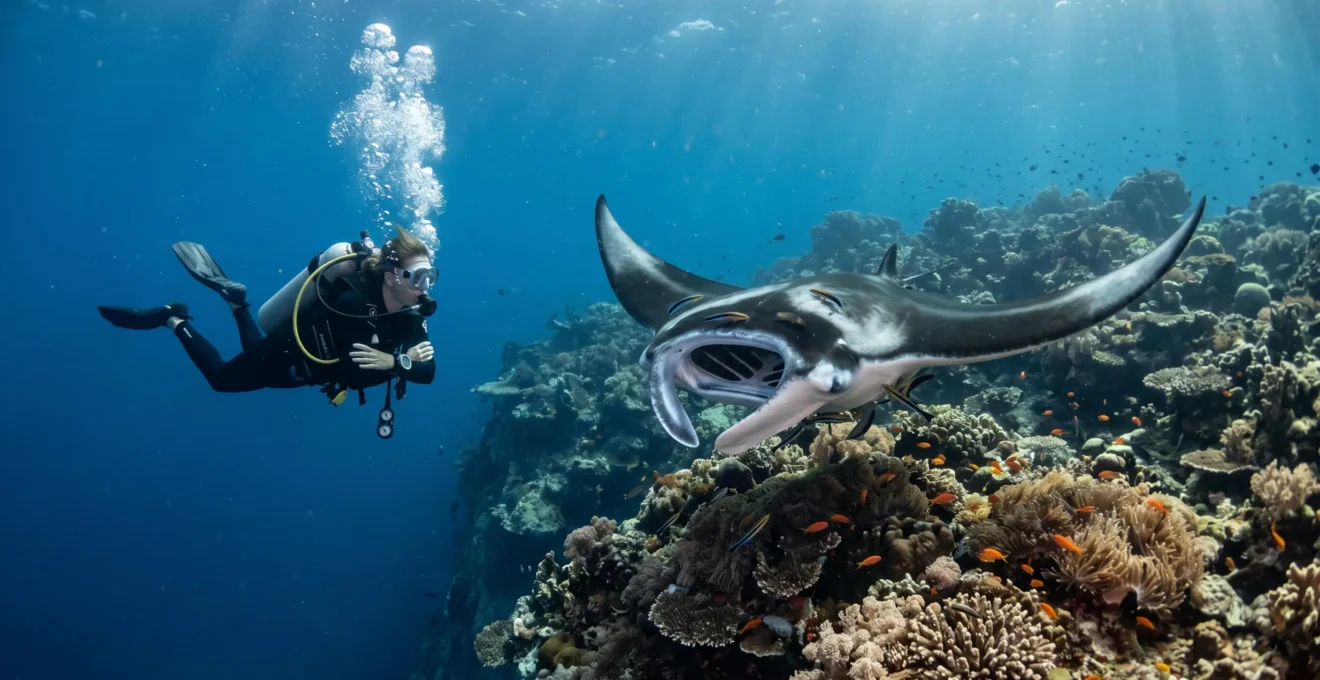
The Andaman Sea’s most rewarding wildlife encounters are rarely found by following the busiest island-hopping routes. Beyond Phuket’s crowded beaches and the familiar Phi Phi excursions lie offshore reefs, marine protected areas and underwater habitats where manta rays, reef sharks and exceptionally diverse reef communities may still be encountered.
Five island destinations and clusters deserve particular attention: the Similan Islands, Koh Bon, Koh Tachai, the Surin Islands and the Koh Lanta archipelago. Richelieu Rock, a submerged reef rather than an island, and the southern dive sites of Hin Daeng and Hin Muang expand the possibilities for experienced divers.
These places are not untouched in the literal sense. Climate-related bleaching, seasonal tourism and changing ocean conditions affect even remote reefs. Nor is there reliable evidence that exactly 90% of tourists miss them. Their appeal lies instead in more selective access, distinctive habitats and the opportunity to explore with responsible operators.
Finding the right marine sanctuary starts with three decisions: which wildlife matters most, what experience level the water demands, and when conditions make access possible.
Andaman Sea wildlife: the essential planning decisions
- Choose habitats, not just islands: shallow fringing reefs suit snorkellers, while offshore cleaning stations and deeper channels offer different wildlife possibilities.
- Plan around the marine season: November to April is generally the more practical period for western Thailand, but individual park opening dates and sea conditions must be checked.
- Match the boat to the destination: day trips suit accessible reefs; multi-day expeditions can make remote northern sites more practical.
- Why the Andaman Sea Harbours More Coral Species Than Thailand’s Eastern Coast
- How to Choose Your Ideal Andaman Island: Beginners vs Advanced Divers
- Day Trips or Liveaboard: Which Gets You to the Andaman’s Best Reefs?
- The Costly Mistake: Booking Andaman Diving Trips During the Wrong Season
- When to Dive the Andaman for Manta Rays: The Sighting Window Wildlife Photographers Target
- Phuket vs Krabi vs Koh Samui: Which Matches Your Idea of ‘Beach Paradise’?
- Why the Gulf of Thailand Is Swimmable Year-Round While the Andaman Faces Monsoon Waves
- How Thailand’s Two Coasts Offer Opposite Beach Experiences: Gulf Calm vs Andaman Drama
Why the Andaman Sea Harbours More Coral Species Than Thailand’s Eastern Coast
The Andaman Sea supports an exceptionally varied reef environment because its offshore islands, deep-water connections and exposure to Indian Ocean currents create habitats unlike those of the shallower Gulf of Thailand. Greater habitat variety can support greater ecological diversity, although a precise percentage difference in coral species between Thailand’s two coasts is not established by the available evidence.
Western Thailand faces the Andaman basin, where offshore channels, submerged pinnacles, rocky slopes and coral-fringed islands create different depth, current and light conditions. The Gulf of Thailand is comparatively shallow and receives sediment and freshwater from major river systems, particularly around its northern reaches. Yet conditions also vary substantially within each coast: clear-water Gulf reefs and sediment-affected Andaman reefs both exist.
The Andaman’s connection to the wider Indo-Pacific marine system matters more than any promotional biodiversity ranking. Ocean circulation can transport larvae between reef habitats, while changes in depth and exposure create ecological niches. Nutrient availability, however, does not automatically mean healthier coral: excessive nutrients, sediment and heat stress can all damage reef ecosystems.
Seasonal protection also shapes the visitor experience. Thailand’s Department of National Parks applies location-specific closures partly for safety and ecological recovery, as explained in Thailand’s official 2026 national park closure announcement. Sites in the Similan and Surin archipelagos may therefore be inaccessible during parts of the monsoon period. Closure schedules and any visitor limits must be verified for the specific park; there is no universal cap that applies to every Andaman reef.
Wildlife encounters also depend on habitat. Manta rays may visit cleaning stations, reef sharks patrol suitable reef margins, whale sharks occasionally appear in open-water feeding environments, and dugongs depend on seagrass ecosystems. These animals do not share one universal hotspot, and none should be treated as an indicator that a particular reef is undamaged.
84.4%
Approximate proportion of global coral reef area exposed to bleaching-level heat stress between January 2023 and September 2025. This is not a measurement of coral mortality or a figure specific to the Andaman Sea.
Remote reefs remain exposed to marine heatwaves. The global bleaching events of 2010 and 2023–2025 demonstrate why distance from tourist beaches cannot guarantee ecological health. Before a trip, request recent site photographs, local ecological updates and park notices, rather than relying on an operator’s description of a reef as pristine.
Once the ecological differences are clear, the practical question becomes which sites are suitable for your swimming or diving experience.
How to Choose Your Ideal Andaman Island: Beginners vs Advanced Divers
The best Andaman island depends on whether you snorkel, hold an entry-level scuba certification or have experience in deeper water and currents. Beginners generally benefit from sheltered, shallow reefs near established coastal bases; experienced divers can consider offshore pinnacles and channel sites. Remoteness is not a substitute for suitable conditions, and advanced wildlife encounters cannot be promised by choosing a particular island.
For a practical shortlist, use these five island destinations or clusters as a starting point, then select the actual dive site according to the day’s conditions.
| Destination | Marine experience | Access and suitability |
|---|---|---|
| Similan Islands | Fringing reefs, reef fish and offshore dive sites | Snorkelling and scuba options; individual sites vary in difficulty |
| Koh Bon | Exposed reef formations and possible manta encounters | Scuba-focused; experience requirements depend on site and currents |
| Koh Tachai | Offshore rocky habitats and pelagic possibilities | Advanced planning essential; access restrictions must be checked |
| Surin Islands | Shallow reef environments and marine biodiversity | Potentially suitable for snorkellers; park access is seasonal |
| Koh Lanta archipelago | Coastal reefs and a departure base for southern expeditions | Mixed-ability groups can combine coastal activities with specialist dives |
The Tourism Authority of Thailand‘s overview of diving destinations identifies Similan snorkelling areas around Koh Miang and Beacon Reef, alongside scuba destinations such as Koh Bon. These examples illustrate why choosing an entire archipelago is less precise than selecting an appropriate site within it.
Strong currents, exposed surfaces and demanding entries can make Koh Bon, Koh Tachai or Richelieu Rock unsuitable for some newly certified divers. An Advanced Open Water course or additional supervised experience may broaden available options, but the certification card itself cannot replace current-management skills or the guide’s assessment.
Snorkellers and freedivers have different priorities. Shallow fringing reefs, protected bays and healthy nearshore habitats can provide memorable observations without scuba equipment. Seagrass beds are ecologically valuable, but visitors should avoid trampling them or approaching protected animals. Freedivers should follow appropriate buddy and breath-hold safety practices.
Ask prospective operators for the named sites, expected depths, current exposure, qualification requirements and contingency plans. Separately confirm park access rules, because permitted locations and activities may change.
The right island narrows the search, but the departure point and expedition format determine which habitats can actually be reached.
Day Trips or Liveaboard: Which Gets You to the Andaman’s Best Reefs?
Day trips are generally better for travellers seeking flexibility, a lower initial commitment and accessible reefs near a coastal base. Liveaboards become more attractive when the goal is to explore multiple remote sites, particularly around the northern Andaman archipelagos. The difference is geographic reach and repeated diving opportunities, not an automatic guarantee of better wildlife encounters.
A day boat usually follows a defined departure and return schedule. Crossing time limits the available diving window and may constrain the number of sites visited. Staying ashore makes it easier to accommodate non-divers, change plans or rest between excursion days.
Liveaboards combine accommodation, transport and multiple diving sessions across consecutive days. They can reach offshore sites without repeating long daily crossings, and may offer early dives when day boats have not yet arrived. Some routes include the Similan Islands, Koh Bon and Richelieu Rock near the Surin archipelago; itineraries are conditional on park permissions, vessel operations and sea conditions.
There is also a middle ground. Staying in Khao Lak or Koh Lanta for several days allows travellers to combine standard excursions with a longer specialist trip, where offered. Selected overnight packages can provide more reach without committing to an extended liveaboard itinerary.
| Decision factor | Day trip | Liveaboard |
|---|---|---|
| Best suited to | Short stays and flexible schedules | Multi-day, diving-focused itineraries |
| Reach | Depends on departure port and boat speed | Potential access to more distant offshore sites |
| Daily experience | Return to land accommodation | Eat, sleep and dive aboard |
| Costs | Usually a smaller single-trip commitment | Higher total booking commitment; inclusions vary |
| Principal drawback | Repeated crossings and limited time offshore | Less flexibility once underway |
Whichever format you choose, assess safety before convenience. Divers Alert Network‘s dive boat safety recommendations highlight emergency oxygen, first-aid supplies, appropriate crew qualifications, dive briefings and procedures for accounting for divers.
Five checks before paying for an Andaman dive expedition
- Request the complete itinerary and permitted dive sites; save the operator’s written route confirmation.
- Confirm guide qualifications and the planned guide-to-diver ratio; retain the written reply.
- Ask about onboard oxygen, first aid, emergency evacuation and diver accounting; keep the operator’s safety checklist or response.
- Check whether your diving insurance covers the planned depths and activities; save the relevant policy confirmation.
- Obtain written cancellation, weather-diversion and refund terms; keep a copy alongside the booking receipt.
A smaller group does not necessarily mean a safer boat, and a premium price does not establish operator competence. Also ask how dive sites are rotated and whether mooring practices minimise damage to coral habitats.
Once the expedition format is settled, the largest remaining logistical risk is booking it during the wrong part of the year.
The Costly Mistake: Booking Andaman Diving Trips During the Wrong Season
The most expensive Andaman diving mistake is committing to non-refundable excursions without checking the southwest monsoon and national park closures. Roughly May to October, western Thailand can experience stronger waves, unsettled conditions and reduced underwater visibility. Some marine destinations close seasonally, making a previously advertised itinerary impossible even when flights and accommodation remain available.
The southwest monsoon brings prevailing winds and waves towards Thailand’s Andaman coast. Exposed offshore sites can become difficult or unsafe to reach, while increased water movement may stir suspended sediment and reduce visibility. Conditions vary by island, site orientation and individual weather system: a sheltered coastal dive might remain possible while an offshore expedition is cancelled.
National park access introduces a second constraint. The Thai government confirms that closure dates differ between protected areas and that seasonal restrictions address both visitor safety and ecological recovery. Published diving calendars are useful planning references, but they should never override the responsible park authority’s current notices.
Early November and late April may provide opportunities for travellers seeking fewer crowds. However, these shoulder-season dates come with uncertainty. A favourable forecast does not mean a park has officially reopened, and an open park does not guarantee that every dive site will be accessible.
The financial consequences of a mistimed booking are highly individual. Consider a hypothetical traveller who has prepaid accommodation, several diving days and transport to a remote departure port. If weather prevents the planned crossing, the operator might offer a substitute site, reschedule the excursion or apply contractual cancellation terms. The original diving plan could become much more expensive even without any change to the advertised tour price.
There is no verified universal £1,200 loss associated with May-to-October bookings. The potential cost depends on deposit terms, alternative transport, accommodation flexibility, insurance coverage and the number of excursions affected.
Hypothetical booking scenario: an offshore trip disrupted by weather
A traveller reserves a multi-day northern Andaman diving package before confirming seasonal park access. The intended offshore route is subsequently unavailable because of a closure or unsafe sea conditions.
The traveller’s eventual loss would depend on the contract: the operator might provide a refund, alternative itinerary, credit or no reimbursement for certain components. This hypothetical example illustrates booking exposure, not an actual documented cancellation or a guaranteed financial outcome.
Before making any payment, verify the park’s opening status, ask the operator to identify the official access restrictions relevant to the itinerary, and obtain weather-cancellation terms in writing. Check whether park fees are included, whether they are refundable if access is denied, and what happens when the operator substitutes a different reef.
Travel insurance deserves equal scrutiny. Standard policies may exclude certain weather-related disruptions or treat cancellations differently depending on when warnings were issued. Confirm coverage for diving activities and the specific circumstances that could interrupt the expedition.
With access and weather accounted for, travellers pursuing a particular marine species can refine the timing further without assuming wildlife will appear on schedule.
When to Dive the Andaman for Manta Rays: The Sighting Window Wildlife Photographers Target
For manta ray photography in Thailand’s Andaman Sea, the more favourable planning period generally falls within the northeast monsoon’s calmer western-coast season, particularly during parts of the late dry season. Koh Bon is a recognised destination for possible manta encounters, while Hin Daeng and Hin Muang offer southern alternatives. No fixed eight-week window reliably guarantees sightings across these sites.
Manta rays are mobile animals whose movements respond to feeding opportunities, cleaning behaviour and wider ocean conditions. At cleaning stations, small reef fish remove parasites and dead tissue from visiting animals. Such locations can offer photographers opportunities to observe repeated, relatively predictable behaviours when mantas are present.
Plankton availability creates a different attraction. Mantas may move through areas where food becomes concentrated by currents, tides and changing oceanographic conditions. Productive feeding water is not always exceptionally clear, creating an important trade-off for underwater photographers: the conditions that attract marine life can also make photography more challenging.
For northern expeditions, Koh Bon is a logical site to investigate. In the southern Andaman, Hin Daeng and Hin Muang are frequently included in diving itineraries focused on larger marine species. However, habitat reputation is not equivalent to a current sighting forecast, and access must be checked independently of seasonal wildlife expectations.
Rather than relying on a precisely defined calendar window, ask an operator for recent, dated observations from the exact reefs on the proposed itinerary. Sightings from previous years are helpful context, but they cannot establish present-day encounter probability.
Photographers seeking several opportunities may prefer consecutive diving days over a single high-stakes excursion. Repeated visits can provide more chances to experience suitable conditions, provided park rules, sea states and responsible wildlife practices permit them. A liveaboard can support this approach when its route includes the relevant sites, but operators should never promise encounters or remain at a location in ways that disturb marine animals.
Underwater positioning requires particular care. Currents influence the direction from which mantas approach and the stability of a diver’s position. Maintain neutral buoyancy, avoid touching reef structures, and leave cleaning-station approaches unobstructed. Do not pursue, touch or crowd mantas for a photograph. Follow site-specific instructions issued by the guide and park authority.
Plan photographic equipment around variable visibility rather than assuming consistently transparent water. Confirm the permitted dive profile, practise camera handling without compromising buoyancy, and prioritise safe separation from animals and other divers.
Finally, build a wildlife itinerary with alternatives. Reef sharks, schooling trevallies, smaller reef fish and other pelagic visitors can make a dive worthwhile even when mantas are absent. Whale sharks are possible visitors to Andaman waters, but should never be treated as a fallback sighting guarantee.
Species-specific planning only becomes practical once the traveller chooses a coastal base with suitable connections to the intended dive sites.
Phuket vs Krabi vs Koh Samui: Which Matches Your Idea of ‘Beach Paradise’?
Phuket is a practical base for travellers who value a broad choice of diving operators and access to northern Andaman expeditions. Krabi and Koh Lanta suit those interested in southern island environments and selected offshore excursions. Koh Samui serves an entirely different coastline: the Gulf of Thailand. The right choice depends primarily on target reefs, travel dates and diving experience rather than beach scenery alone.
Phuket offers extensive tourist infrastructure, accommodation choices and connections to diving services. Its operator density makes it convenient for arranging training, equipment and excursions. However, for many northern Andaman liveaboards, Khao Lak and nearby departure facilities may provide a more practical starting point than staying on Phuket itself.
Krabi provides access to coastal limestone landscapes, nearby islands and established marine tourism areas. Travellers prioritising the southern Andaman can also consider Koh Lanta, where specialist operators may arrange excursions towards offshore sites such as Hin Daeng and Hin Muang when conditions permit.
Neither coastal base automatically delivers solitude. Popular excursion routes can attract considerable boat traffic, while genuinely remote sites may demand longer transfers, additional expense or more experienced diving skills.
Koh Samui offers a different solution. Located in the Gulf of Thailand, it provides access to Gulf-side activities and island destinations. Koh Tao is an established diving destination, while the Ang Thong archipelago offers island scenery and marine excursions. These locations cannot substitute for an itinerary specifically intended to explore the Similan or Surin reef systems.
| Base | Best reason to choose it | Consider before booking |
|---|---|---|
| Phuket | Operator choice, diving services and connections to Andaman excursions | Busy tourist areas and potential additional transfers to northern departure ports |
| Krabi / Koh Lanta | Southern Andaman access, scenic islands and specialist dive excursions | Offshore routes, transport schedules and available operators vary |
| Koh Samui | Gulf-side island hopping and an alternative seasonal travel option | Not a departure base for Andaman marine sanctuaries |
Seasonality can change the comparison completely. When exposed Andaman diving sites are affected by the southwest monsoon, certain Gulf locations may offer more suitable conditions. Conversely, northeastern monsoon weather later in the year can affect Koh Samui and nearby islands while western Thailand experiences a more favourable marine season.
Before choosing accommodation, write down four non-negotiables: the species or habitat you most want to encounter, the certification level of everyone travelling, your fixed travel dates and your tolerance for crowded boats or long transfers.
Someone seeking manta photography and willing to spend several days on a northern Andaman vessel has different needs from a mixed group wanting gentle snorkelling, beaches and flexible excursions. Choosing one universally best beach destination ignores that distinction.
The final decision should account for how the two coastlines experience different monsoon patterns, especially when travel dates cannot be changed.
Why the Gulf of Thailand Is Swimmable Year-Round While the Andaman Faces Monsoon Waves
The Gulf of Thailand can offer useful swimming and diving alternatives when western Thailand’s Andaman coast experiences southwest monsoon waves, but it is not uniformly calm throughout the year. The two coasts face different wind systems and exposure patterns. The Andaman is generally more affected by the southwest monsoon around May to October, while parts of the Gulf face rougher conditions during the northeast monsoon later in the year.
Thailand’s geography explains much of the seasonal contrast. The Andaman coastline opens westward towards the Indian Ocean. Southwest monsoon winds can bring swell and wave conditions that interfere with boat crossings, snorkelling and exposed dive sites.
The Gulf of Thailand is a shallower, semi-enclosed marine basin east of the Thai peninsula. Its orientation creates different patterns of wind exposure, wave development and seasonal rainfall. However, the Gulf is not one uniform weather zone: Koh Samui, Koh Tao, Pattaya and the eastern Gulf islands do not necessarily experience identical conditions at the same time.
During parts of the southwest monsoon, islands around Koh Samui and Koh Tao may enjoy conditions suitable for marine activities even while the Andaman coast is unsettled. That advantage changes as northeast monsoon winds become more influential, particularly around the southern Gulf.
Storms, heavy rainfall, poor visibility and occasional transport disruptions remain possible on either coast. Calling the Gulf swimmable year-round is therefore a generalisation, not a safety assurance. Some beaches may be sheltered while nearby channels or offshore routes are unsuitable for small vessels.
For travellers who have already selected a particular Andaman marine sanctuary, switching to the Gulf involves changing the biological objective as well as the location. Koh Tao’s reefs offer a different ecosystem and wildlife experience from the offshore pinnacles of Koh Bon or Richelieu Rock.
A practical strategy is to identify a preferred Andaman travel period, generally within November to April, and develop a Gulf-side alternative for dates that fall outside it. This does not mean all parks open on the same day or that every Gulf excursion will operate safely during the western monsoon.
Within the days leading up to departure, check marine weather forecasts, wave conditions, official advisories, national park access notices and relevant ferry announcements. The forecast for the precise boat route matters more than a broad regional seasonal label.
When conditions deteriorate, accept operator cancellations and local swimming warnings. No anticipated wildlife encounter justifies entering unsafe water or pressuring a captain to depart.
These seasonal differences also explain why the Andaman and Gulf should be treated as complementary travel experiences rather than interchangeable versions of the same beach holiday.
Key takeaways before choosing a coast
- Start with the marine experience: remote pinnacles, manta habitats and advanced diving may point towards the Andaman; more flexible coastal activities can make Gulf destinations attractive.
- Match the season to the actual route: national park opening status, marine forecasts and operator access matter more than broad descriptions of dry or wet seasons.
- Plan a workable alternative: travellers with fixed dates should identify another suitable location or activity rather than rely on a single offshore wildlife excursion.
How Thailand’s Two Coasts Offer Opposite Beach Experiences: Gulf Calm vs Andaman Drama
Thailand’s Gulf and Andaman coasts offer distinct marine experiences shaped by geography, seasonal winds and access to different habitats. The Gulf often appeals to travellers seeking relaxed island hopping, accessible snorkelling and beach-focused holidays. The Andaman attracts those interested in dramatic limestone scenery, offshore reefs and opportunities to explore deeper-water marine environments. Neither coastline is permanently calm, and neither guarantees healthier reefs or more wildlife.
The Andaman’s appeal extends beyond the familiar images of Phuket and Phi Phi. Its northern island groups, offshore pinnacles and protected areas offer a network of habitats requiring different combinations of boats, experience and timing. Koh Bon and Koh Tachai illustrate the appeal of exposed offshore reef environments; the Similan and Surin archipelagos offer additional possibilities for marine exploration.
Farther south, the Koh Lanta area provides a different expedition base, while submerged sites such as Hin Daeng and Hin Muang extend the options for appropriately experienced divers. Richelieu Rock adds another important destination in the northern Andaman, despite not being an island.
The Gulf provides an alternative rather than an inferior version of the same experience. Koh Samui, Koh Phangan and Koh Tao have different tourism cultures, marine conditions and access arrangements. A traveller prioritising shore-based flexibility or coastal snorkelling may find a Gulf itinerary more suitable than an extended Andaman diving expedition.
Three sample itineraries demonstrate how to choose between the coasts:
- The northern Andaman expedition: travel during a suitable park-opening period, stay around Khao Lak and book an appropriately matched liveaboard exploring permitted Similan, Koh Bon and northern offshore sites. Best for scuba-focused travellers who prioritise marine habitats over resort time.
- The flexible Gulf alternative: consider a Koh Samui or Koh Tao base during a period when the Andaman is less accessible, subject to Gulf weather conditions. Combine suitable snorkelling or diving with island excursions, checking transport and sea conditions before each trip.
- The two-coast journey: during a seasonal transition, allow enough flexible days to visit a Gulf destination and an Andaman base such as Krabi or Koh Lanta. Treat travel between coasts as a substantial itinerary component and avoid scheduling essential offshore activities immediately after transport days.
The headline’s five island destinations are therefore not five interchangeable secret beaches. Some support introductory marine experiences, others demand offshore expertise, and several are subject to seasonal closures or restrictions. The idea that 90% of tourists overlook them is an editorial framing rather than a verified tourism statistic.
Similarly, the word untouched should describe a conservation aspiration, not a scientific conclusion about reef condition. Even reefs far from established resort centres experience climate stress, marine debris, fishing pressure or tourism impacts. Responsible travel means keeping a respectful distance from wildlife, following park regulations, choosing operators with sound safety and environmental practices, and never touching or collecting marine organisms.
For the strongest itinerary, choose the desired habitat before choosing the hotel. Decide whether the priority is sheltered shallow coral, reef sharks, offshore pelagic encounters or manta cleaning stations. Then match that goal to qualifications, boat access, official openings and likely seasonal conditions.
Build a shortlist of suitable dive sites, request written confirmation of current access and recent conditions from a reputable operator, and reserve an itinerary with realistic alternatives. The most valuable Andaman wildlife encounter is one that respects both the marine ecosystem and the limits of the traveller exploring it.
Can you snorkel in the Andaman Sea without a diving certification?
Yes. Snorkelling does not require a scuba certification, and selected shallow reefs around the Similan, Surin and other Andaman islands can provide marine-life encounters. Access depends on park rules, weather, site conditions and operator availability. Travellers should use suitable safety equipment and follow local guidance, especially where currents are present.
Are the Similan and Surin Islands open to visitors throughout the year?
No. Marine national parks in the Andaman region may have seasonal closures, with dates determined by the relevant park authorities. A historically recommended visiting period does not confirm current access to every island or dive site. Check the Department of National Parks’ latest announcements and obtain confirmation from the operator before booking.
Is it possible to see manta rays in the Andaman Sea on a single dive?
Yes, but sightings are unpredictable. Offshore sites such as Koh Bon are associated with possible manta encounters, yet no single dive, month or operator can guarantee one. Travellers primarily interested in manta photography can consider multiple suitable dive days and request recent site-specific observations, while maintaining realistic expectations.
How can you tell whether an Andaman reef is currently healthy?
Look for recent local reef assessments, dated underwater imagery and information from park authorities or credible conservation programmes. Visible coral cover, bleaching, disease and physical damage are relevant indicators, but casual observation is not a substitute for scientific monitoring. Global coral bleaching data provide context, not a definitive assessment of an individual reef.
Should non-divers book accommodation on an Andaman liveaboard?
Only if the operator explicitly accommodates non-diving guests and the itinerary offers suitable activities. Many liveaboards are designed principally for certified scuba divers, with limited alternatives during repeated offshore dives. Mixed groups may find shore accommodation in Khao Lak, Phuket or Koh Lanta more flexible, arranging separate excursions according to each traveller’s interests and experience.