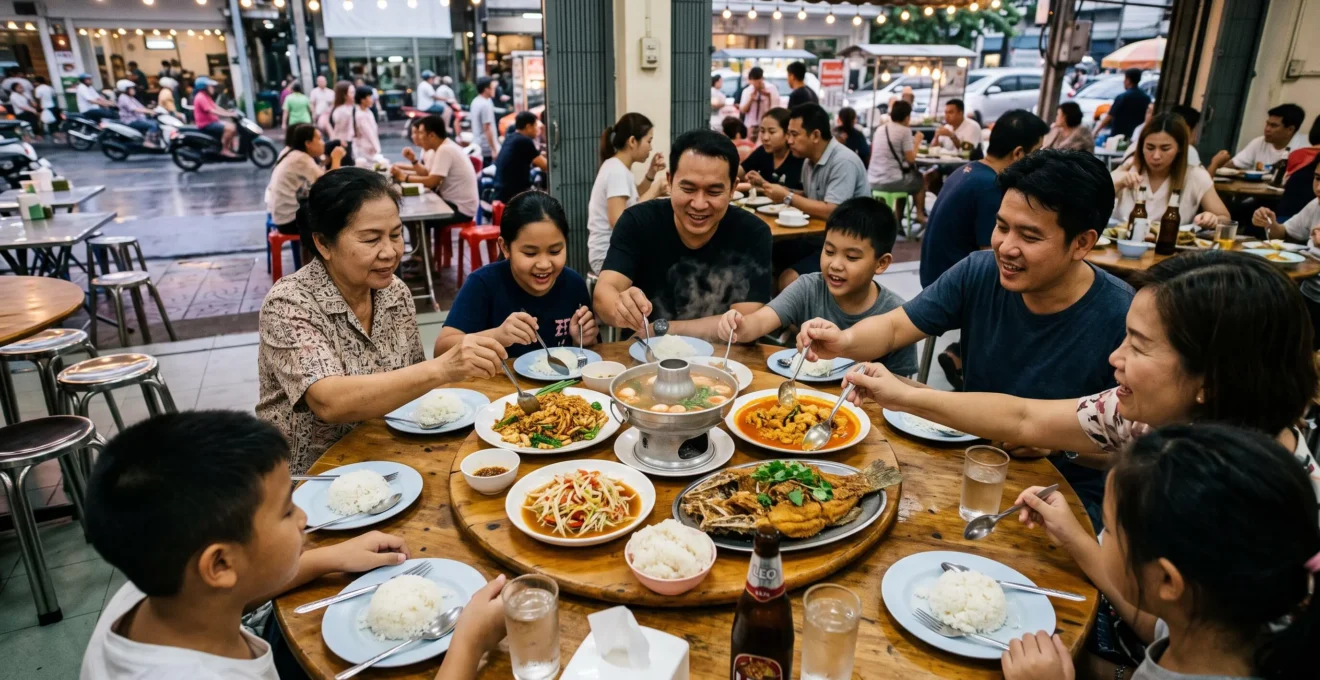
A Thai meal is not simply a collection of recipes placed on a table. In traditional family-style dining, it is a coordinated system of shared dishes, individual rice portions, contrasting flavors, and social interactions. The meaning of each dish emerges partly from its relationship with everything else being eaten.
This arrangement can surprise visitors accustomed to ordering separate main courses. A curry, soup, salad, and stir-fry may appear together rather than forming successive stages of a meal. Diners move among these preparations, taking small portions according to appetite, preference, and the changing intensity of each bite.
The result is an edible conversation: individual choices occur within a collective framework. Rice provides a personal foundation, shared dishes create opportunities for exchange, and the composition of the table expresses practical considerations alongside relationships between diners.
Understanding this structure changes how travelers order, eat, and interpret Thai hospitality. It also reveals why evaluating a shared Thai meal through the conventions of an individual restaurant entrée can miss much of the experience.
Thai communal dining: the essential principles
- Shared composition: Traditional family-style meals combine dishes intended to be enjoyed together, rather than following a rigid sequence of courses.
- Collective flavor balance: Rice, soups, curries, salads, and other preparations create contrasts in richness, heat, acidity, texture, and sweetness.
- Social etiquette: Small servings, attention to fellow diners, respect for elders, and appropriate use of utensils make sharing comfortable.
- Why Thai Restaurants Bring All Dishes at Once: The Simultaneous Harmony Principle
- How to Order a Balanced Thai Meal: The Five-Taste Harmony Thais Achieve Across Dishes
- Thai Shared Dishes vs Chinese Lazy Susan: How Do Asian Communal Dining Styles Differ?
- The Thai Restaurant Mistake That Costs 40% More: Ordering Individual Dishes Instead of Sharing
- When to Observe Authentic Thai Communal Dining: The Weekend Family Restaurant Rush
- How to Order a Balanced Thai Meal: Composing a Shared Table Where Dishes Complement Each Other
- How to Start a Thai Shared Meal: Why Rice Always Goes on Your Plate First
- How to Navigate a Thai Shared Table Without Committing the 5 Etiquette Errors
Why Thai Restaurants Bring All Dishes at Once: The Simultaneous Harmony Principle
Traditional Thai family-style meals organize savory dishes as a shared collection rather than a succession of independent courses. Curries, soups, stir-fries, and salads can be eaten during the same stage of the meal, allowing diners to alternate between contrasting flavors. This is a principle of meal composition, not a guarantee that every restaurant dish arrives at precisely the same moment.
The distinction matters because the complete table, rather than each individual plate, becomes the principal unit of flavor balance. A fiery curry may sit beside a mild vegetable preparation, while rice provides a neutral foundation between strongly seasoned bites.
The Royal Thai Embassy‘s introduction to Thai food, republishing material credited to Sawadee.com, describes traditional Thai meals as arrangements served together rather than through successive courses. It also emphasizes complementary tastes and textures across the meal.
In a course-based restaurant model, a diner often evaluates each dish as a complete, self-contained experience. In a shared Thai meal, a preparation may intentionally contribute only one part of a broader sensory composition. A salty or strongly spiced dish does not necessarily need to taste balanced when eaten in isolation.
This creates a different social rhythm. Rather than waiting for individual courses to finish, diners can participate in a common selection of dishes while choosing their own sequence of bites.
A visitor might initially interpret a table filled with separate bowls, individual rice plates, and dishes arriving in quick succession as disorganized service. Yet the arrangement can reflect an established method of eating: the dishes are available for combination throughout the meal.
It is important to distinguish this principle from Western-style food pairing. The goal is not necessarily to identify one perfect accompaniment for each preparation. Instead, the entire assortment offers a changing range of complementary possibilities.
Actual restaurant service remains practical rather than mathematically simultaneous. Cooking times, staffing, and restaurant style influence when dishes arrive, while some noodle dishes and other individual meals follow different conventions.
Once this principle is understood, the next task is to compose a selection that offers genuine contrast instead of repeatedly ordering dishes with similar characteristics.
How to Order a Balanced Thai Meal: The Five-Taste Harmony Thais Achieve Across Dishes
To order a balanced Thai shared meal, choose dishes with contrasting flavors, textures, and cooking methods instead of selecting several preparations with similar intensity. Sweet, sour, salty, spicy, and bitter elements provide one useful framework, but authentic Thai meal composition is not governed by a universal requirement to include exactly five tastes. Group size, regional cuisine, and individual preferences all matter.
For a moderately sized group, a practical starting point is to consider five culinary roles: a stir-fry, a soup, a curry, a fried or steamed preparation, and a salad. These categories are an ordering framework, not a compulsory formula.
A hypothetical table might include a rich coconut curry, a clear vegetable soup, a crisp fried fish, a sour green papaya salad, and a mild stir-fry. Each dish contributes something distinguishable, giving diners opportunities to change both flavor intensity and mouthfeel.
The MICHELIN Guide‘s feature on Thai family-style dining describes quantity, texture, flavor, and social interaction as considerations when planning a shared meal. It includes observations from Thai chef Ton Thitid Tassanakajohn about balancing spicy preparations with gentler accompaniments.
For travelers reading an unfamiliar restaurant menu, the following distinctions provide a practical alternative to selecting dishes solely by popularity.
| Meal component | Useful contribution | Example |
|---|---|---|
| Curry | Richness, aromatic intensity, and potentially significant heat | Green curry or red curry |
| Soup | Broth, moisture, acidity, or a gentler contrast | Clear vegetable soup |
| Stir-fry | Vegetables, savory depth, and contrasting textures | Stir-fried morning glory |
| Salad | Freshness, acidity, crunch, and often chili heat | Som tam |
| Fried or steamed preparation | A contrasting cooking method and mouthfeel | Steamed fish or crispy fish |
| Rice | A relatively neutral base that moderates intense flavors | Steamed jasmine rice |
A common ordering mistake is to select several rich, strongly seasoned dishes without a gentler counterpoint. Three creamy curries may offer variety in ingredients, but considerably less contrast in texture and intensity than a curry accompanied by a clear soup and vegetables.
Rice enables each diner to regulate that intensity. More rice can soften the impact of a powerful mouthful; a smaller quantity permits stronger seasonings to remain prominent.
Smaller parties need not reproduce an elaborate family spread. Two diners might share a curry, vegetables, and rice, adding a soup or salad according to appetite. A solo traveler can choose a rice-based individual dish or ask whether smaller shared preparations are available.
Good composition does not require the maximum number of dishes. It requires enough variety for the selected preparations to contribute meaningfully to one another.
Thai Shared Dishes vs Chinese Lazy Susan: How Do Asian Communal Dining Styles Differ?
Thai family-style dining and Chinese communal dining both involve shared food, but their table arrangements can create different serving rhythms. A common Thai arrangement places individual rice plates around centrally shared dishes, while some Chinese banquet settings use a rotating Lazy Susan to make dishes accessible across a large table. Neither configuration represents every restaurant or household in either culture.
The distinction is best understood through the relationship between personal eating space and shared food.
In a typical Thai rice-based shared meal, individual rice serves as an anchor. Diners take relatively small amounts from the communal preparations and eat them with their rice, returning to the shared selection as the meal progresses.
A Chinese banquet table with a rotating platform organizes access differently. The central surface moves, bringing serving dishes within reach of people seated around it. The rotating mechanism helps manage physical accessibility, especially at larger tables.
This difference concerns the organization of serving and access, not a claim that one culture is more communal or more individualistic than another.
| Dining feature | Thai family-style table | Chinese banquet with Lazy Susan |
|---|---|---|
| Common arrangement | Shared dishes around individual rice portions | Shared dishes on a rotating central platform |
| Access to dishes | Diners reach or request dishes within the shared arrangement | The platform rotates to bring dishes within reach |
| Personal eating base | Frequently an individual plate of rice | Individual bowls or plates, often including rice |
| Serving rhythm | Small portions taken as desired | Portions taken when dishes become accessible |
| Important variation | Depends on restaurant, region, and occasion | Not all Chinese meals or restaurants use rotating platforms |
A traveler accustomed to a large Chinese banquet may expect shared dishes to circulate formally around the table or may begin distributing generous portions to everyone. At a Thai table, that behavior can be unnecessary when diners prefer to select their own small servings.
However, offering food to others, especially elders or guests, may also be entirely appropriate in Thai settings. The distinction should not be converted into a prohibition against serving companions.
The most practical approach is to observe how food is being shared before imposing a familiar serving method. Notice whether someone takes responsibility for distributing rice, whether communal dishes are passed, and how diners manage access to preparations farther away.
Both systems accommodate hospitality, cooperation, and personal choice. Their visible furniture and utensils provide clues, but their precise social rules depend on the people sharing the meal.
Beyond cultural interpretation, these serving arrangements have practical implications for how much food to order and how the cost is distributed among diners.
The Thai Restaurant Mistake That Costs 40% More: Ordering Individual Dishes Instead of Sharing
Ordering separate main courses can change the cost and character of a Thai restaurant meal, but there is no substantiated universal 40% surcharge for eating individually. The actual difference depends on menu prices, group size, portions, rice charges, and what diners would otherwise order. Sharing may reduce duplication, but it does not automatically produce a cheaper bill.
The economic question is better framed as a comparison between two different ordering systems: purchasing a complete individual meal for each person or assembling a collection of shared dishes with separate rice portions.
Neither structure guarantees lower spending. A generous shared order can easily cost more than a set of inexpensive individual rice dishes. Conversely, ordering several elaborate individual mains may increase expenditure when guests could have shared fewer preparations.
Consider a hypothetical comparison for four diners. In the first arrangement, everyone purchases a separate complete main course. In the second, the group orders shared dishes, individual rice, and any additional accompaniments.
The bill would need to account for the total prices of those specific items, comparable food quantities, and any leftovers. Without that information, a 40% difference is merely a proposed scenario, not a reliable prediction.
Hypothetical ordering comparison
Four travelers are deciding between four individually plated main courses and a shared selection consisting of a curry, a soup, vegetables, a fish preparation, and rice.
They compare both menu totals and estimated portion sizes before ordering. The shared selection offers a broader mix of preparations, but its relative cost remains unknown until the restaurant’s actual prices and serving sizes are considered.
A useful starting convention is approximately one shared dish per diner, sometimes with an additional dish for variety, excluding rice. The embassy’s published overview gives the examples of three shared dishes for two diners and four for three. The MICHELIN Guide likewise discusses ordering at least one shared preparation per person.
These are descriptive guidelines rather than fixed rules. Appetites, dish sizes, and the restaurant’s cooking style may justify fewer or more dishes.
The experiential cost of individual ordering can be more significant than the financial difference. When each person commits to one main dish, the group may lose opportunities to explore contrasting preparations within a single meal.
Still, an individual order does not necessarily make a dish inherently unbalanced. Single-plate Thai meals are established culinary options, and restaurants may prepare them as complete experiences.
Service timing can also vary. Shared dishes may arrive close together, but ordering separately does not by itself prove that the kitchen will stagger service.
When the goal is to understand Thai family-style gastronomy, sharing is valuable primarily because it reveals the relationship between dishes, not because it guarantees a discount.
When to Observe Authentic Thai Communal Dining: The Weekend Family Restaurant Rush
Weekend family restaurant periods can offer travelers a useful opportunity to observe Thai communal dining because larger groups may gather for shared meals. Watching how dishes are ordered, distributed, and eaten can reveal conventions that are less visible when everyone is dining alone. However, weekends are not uniquely authentic, and no single restaurant setting represents all Thai households or regions.
Multigenerational dining groups are particularly informative for understanding the social organization of a meal.
Observe where the shared dishes are placed, how rice is distributed, and whether one diner takes the lead in ordering. In some family settings, an elder or the person hosting the meal may have greater influence over the selection of dishes.
The MICHELIN Guide’s account of family-style dining describes how senior relatives or the person paying may guide an order while inviting suggestions from others. This offers insight into the relationship between food selection and social roles without establishing a universal hierarchy.
Different venues reveal different aspects of Thai food culture.
- Neighborhood restaurants: Useful for observing everyday family and friendship groups sharing several cooked dishes.
- Night markets: Useful for seeing flexible, informal eating patterns, including individually purchased foods that may be shared.
- Community or temple-related meals: Potentially informative about hospitality and collective participation, although access and expectations depend on the event.
The appropriate observation method is unobtrusive. Travelers can select an ordinary restaurant with an active local clientele, order their own meal, and pay attention to general dining patterns without closely scrutinizing individual families.
Rather than photographing strangers or recording private conversations without permission, focus on publicly visible details of meal structure. Notice whether diners return repeatedly to the same dishes, how frequently rice is replenished, and which preparations seem to be shared most actively.
Timing should follow local circumstances. A busy weekend lunch may be suitable, but restaurant hours and family dining patterns differ among locations. A weekday neighborhood restaurant can be equally revealing.
The key distinction is between observing a cultural practice and treating other diners as exhibits. Respectful participation in the restaurant’s ordinary rhythm provides more meaningful insight than attempting to document strangers.
Observation becomes especially useful when it informs the next meal: selecting dishes that complement one another rather than simply reproducing the most conspicuous order on another table.
How to Order a Balanced Thai Meal: Composing a Shared Table Where Dishes Complement Each Other
Creating a coherent Thai shared meal requires attention to the relationships between preparations rather than their individual appeal alone.
Rice is a central organizing ingredient. It provides the everyday base around which many shared dishes are consumed. Its relatively simple flavor allows diners to move between heavily seasoned foods without constantly accumulating intensity.
Rice is often an economical part of the order, although its actual cost and proportion of the bill vary by restaurant. This can leave room in a group’s budget for a more elaborate shared preparation without requiring every dish to be equally expensive.
A useful menu-reading technique is to identify potential conflicts in richness, texture, and seasoning before confirming an order.
| Starting dish | Complementary option | Reason for the combination |
|---|---|---|
| Rich coconut curry | Fresh, sour salad | Acidity and crispness contrast with richness |
| Intensely seasoned stir-fry | Clear, mild soup | Gentler broth provides a change of intensity |
| Crispy fried fish | Vegetables or refreshing salad | Freshness and moisture contrast with the fried texture |
| Fiery chili-based preparation | Mild vegetables and rice | Less intense components create flexibility for diners |
| Several rich coconut curries | Replace one with a lighter preparation | Reduces repetition of similar textures and richness |
These combinations are practical examples, not fixed cultural rules. Regional preferences and individual tastes influence what makes a satisfying meal.
Another important consideration is how guests communicate spice preferences to the kitchen. Asking for every dish to be completely mild may reduce the range of heat levels available, but it does not make the meal culturally invalid or necessarily less balanced.
When everyone is comfortable with some chili, the group can distribute intensity strategically: one strongly spiced preparation alongside several gentler dishes.
When a diner has low spice tolerance or a medical or dietary restriction, those requirements take precedence. A successful shared meal accommodates its participants rather than forcing a prescribed level of heat.
For a varied group, the most useful ordering question is therefore not simply which dishes are popular. It is which combination gives everyone accessible choices while preserving meaningful contrasts.
Build a Balanced Thai Shared Order in Five Steps
- Count the diners and identify dietary needs. Record the number of guests and any relevant restrictions before choosing dishes.
- Select an initial shared-dish quantity. Write down a proposed number of preparations, then adjust for appetite and menu portions.
- Assign contrasting culinary roles. Produce a shortlist identifying which dishes supply richness, freshness, broth, vegetables, or contrasting textures.
- Check the intensity distribution. Mark each dish as mild, moderately spicy, or strongly spicy based on menu information or staff advice.
- Review the complete order. Confirm the shared dishes, rice portions, prices, and serving expectations with the restaurant before ordering.
Once the order has been agreed upon, the process of eating becomes just as important as the menu composition. The shared structure is designed to support flexible, individual decisions during a collective meal.
That perspective leads directly to the deceptively simple role of rice, which connects personal appetite with the common table.
How to Start a Thai Shared Meal: Why Rice Always Goes on Your Plate First
In a typical Thai family-style rice meal, diners begin with individual portions of rice and add small amounts from shared dishes as they eat. Rice functions as a personal foundation for experiencing contrasting flavors. This is a widespread dining convention rather than an absolute rule for every Thai meal, particularly noodle dishes, rice-free preparations, or other individual formats.
The relationship between rice and the central dishes is both practical and sensory.
When a strongly seasoned curry or stir-fry is eaten with rice, the relative quantity of rice changes the intensity of each mouthful. Diners can adjust that proportion without requiring everyone at the table to season their food identically.
The Tourism Authority of Thailand‘s article on shared dining explains the importance of taking small quantities from shared preparations and keeping their flavors distinguishable rather than covering an entire rice plate with multiple dishes at once.
The physical technique is straightforward. For many Thai rice-based dishes, the spoon is held in the right hand and the fork in the left. The fork helps guide food onto the spoon, which carries the food to the mouth.
Chopsticks are used for certain preparations, especially particular noodle dishes, but they are not the default utensils for most shared rice meals.
The sequence is usually flexible: take some rice, add a modest amount from a communal preparation, eat, and repeat with another dish whenever desired.
Returning to the rice bowl during the meal allows diners to adjust proportions as their appetite changes. Requesting more rice is not inherently impolite or evidence of excessive appetite.
There is also a social dimension. Individual rice portions make it possible for everyone to participate in the same shared selection while controlling how much of each preparation they consume.
Rice establishes the individual’s place in the shared system. The next challenge is interacting with that system without monopolizing dishes, disrupting serving customs, or overlooking fellow diners.
Key Takeaways Before Joining a Thai Shared Table
- Observe before serving: Utensil arrangements, the host’s behavior, and the way dishes circulate provide immediate guidance.
- Preserve flexibility: Small portions allow each diner to explore different flavors without taking more than needed.
- Respect the people sharing the meal: Courtesy toward elders, hosts, and fellow diners matters more than performing an inflexible set of rules.
How to Navigate a Thai Shared Table Without Committing the 5 Etiquette Errors
Thai shared-table etiquette is primarily about making communal eating comfortable for everyone. The most useful habits are to serve modest portions, respect the host and elders, use available serving utensils appropriately, avoid unnecessary waste, and recognize that central dishes belong to the group. Specific expectations vary across households, regions, and restaurant settings, so these are practical guidelines rather than five universally enforced rules.
The first common error is mishandling shared serving utensils. When a dish has its own serving spoon or other communal utensil, using it helps separate serving from eating and avoids unnecessary contact with food others will share.
However, a strict claim that personal cutlery must never touch shared dishes would overstate the evidence. Thailand’s tourism authority acknowledges dining practices in which people also use their own utensils to take food. The correct approach depends on the table’s established practice and hygiene expectations.
The second error is ignoring the host or elders during the initial serving process. Thai cultural etiquette gives importance to respecting older people, and some family meals recognize senior diners when food is served. Visitors should observe whether an elder or host is expected to begin rather than assuming a rigid ceremonial sequence everywhere.
The third error is taking substantially more food than one expects to eat. Small portions help ensure that shared preparations remain available to others and reduce avoidable waste.
The fourth error is piling several strongly flavored dishes onto one plate before tasting them individually. This can blur the contrasts that make a shared Thai meal distinctive. Returning for small quantities is often more consistent with the intended experience.
The fifth error is treating an entire central dish as an individual entitlement. A shared bowl or platter is intended for collective access unless the host or restaurant indicates otherwise.
These behaviors are not equally serious in every context. A casual neighborhood restaurant may have a relaxed approach to serving, while a family invitation or formal gathering may involve more specific expectations.
One useful behavioral cue is to notice how the host or an experienced local diner begins the meal. If an elder is leading the gathering, their behavior may provide additional guidance. Nevertheless, copying one person’s actions mechanically is less reliable than considering the whole table.
A visitor who is unsure whether to pass a bowl, use a particular spoon, or begin eating can simply ask. A brief, respectful question is generally preferable to treating cultural etiquette as a test that must be passed without assistance.
The point of learning these conventions is not to reproduce every Thai family’s behavior. It is to recognize the social purpose of the arrangement: individual freedom of choice within a shared obligation to accommodate others.
At the next Thai family-style meal, begin with rice, choose contrasting shared preparations, take modest portions, and follow the rhythm established by the people at the table. That simple practice offers a more meaningful introduction to Thai communal gastronomy than attempting to experience every dish as an isolated main course.
Is every traditional Thai meal meant to be shared?
No. Family-style meals commonly feature shared preparations with individual rice portions, but Thai dining also includes individual noodle dishes, rice-based meals, snacks, and simpler combinations such as rice with soup. Communal dining is an important cultural tradition, not the only legitimate way to eat Thai food.
Can vegetarians participate fully in Thai communal dining?
Yes. A shared meal can be built around suitable vegetable, tofu, soup, and rice preparations. However, dishes that appear vegetarian may contain fish sauce, shrimp paste, or other animal-derived ingredients. Travelers should confirm ingredients with the restaurant and arrange separate serving utensils when dietary restrictions require them.
Should everyone at a Thai table eat the same amount of chili?
No. Shared dining permits diners to choose different amounts of each preparation. Ordering dishes with varied spice levels can accommodate differing preferences, while rice and milder accompaniments provide additional flexibility. Significant dietary restrictions should be communicated directly to the restaurant rather than managed solely by changing portion sizes.
Is communal Thai dining practical for travelers who do not speak Thai?
Yes. Travelers can identify familiar dish categories, indicate the number of diners, explain dietary restrictions, and ask restaurant staff for a varied selection suitable for sharing. Observing how utensils and rice are served can also provide practical guidance without requiring advanced language skills.
Are Thai family-style restaurant customs the same throughout Thailand?
No. Regional cuisines, household traditions, restaurant formats, and dining occasions influence which foods are shared and how they are eaten. Sticky-rice traditions, noodle-centered meals, and different family-serving practices demonstrate why general etiquette guidance should be adapted to the setting rather than treated as a uniform national code.