A Thai curry can contain the same ingredients as a home-cooked version yet taste remarkably different. The missing element is often not another spice or a secret seasoning. It is the sequence in which aromatics are prepared, cooked, diluted, balanced, and finished.
Thai flavor development depends on several interacting layers: the fragrance released by pounded lemongrass and galangal, the concentrated character of cooked curry paste, the richness of coconut milk, the seasoning contributed by fish sauce and palm sugar, and the freshness of herbs added near serving. Each ingredient behaves differently depending on when it enters the dish.
The idea of a 12-layer flavor profile is a useful teaching framework, not a formally standardized Thai culinary system. The layers are distinguishable cooking decisions rather than twelve mandatory ingredients or twelve steps followed by every Thai cook.
Understanding their order changes how a curry is prepared. Instead of adding everything together and correcting the result afterward, an experienced cook builds an aromatic foundation, develops it with heat, adjusts the sauce, and protects delicate finishing flavors.
Thai flavor layering: the essential principles
- Build the aromatic base first. Properly prepared curry paste gives the dish its foundation before coconut milk, stock, or other liquids dilute it.
- Change technique as the curry develops. Frying or blooming, simmering, seasoning, and finishing require different levels of heat and attention.
- Taste at meaningful transitions. Evaluate the aromatic base, the diluted sauce, the seasoning balance, and the finished dish separately.
- Why Thai Curry Paste Takes 45 Minutes to Make: The Pounding That Releases Essential Oils
- How to Add Thai Basil and Cilantro: Why Timing Means the Difference Between Aroma and Mush
- Thai Curry Paste vs French Mirepoix: How Do Aromatic Foundation Techniques Differ?
- The Heat Level That Kills Thai Curry Flavor: Why Medium Heat Produces Pale, Weak Curries
- When to Seasoning in Thai Cooking: The 4 Tasting Checkpoints Professionals Never Skip
- Why Thai Curry Paste Takes 45 Minutes to Make: The Pounding That Releases Essential Oils (Ingredient Quality and Selection)
- How to Add Thai Basil and Cilantro: Why Timing Means the Difference Between Aroma and Mush (Common Mistakes and Fixes)
- How Thai Cooks Balance Sweet, Sour, Salty, Bitter, and Spicy in Every Dish
Why Thai Curry Paste Takes 45 Minutes to Make: The Pounding That Releases Essential Oils
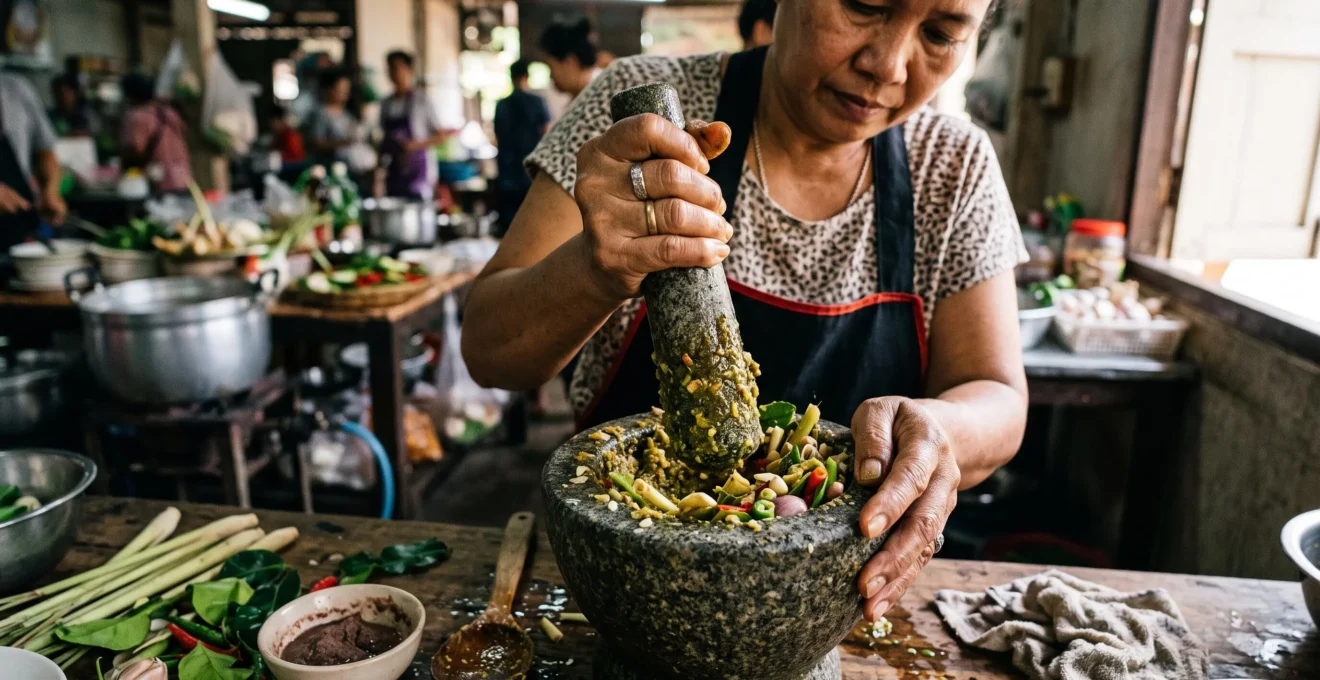
Traditional Thai curry paste can take 45 minutes or longer to pound because fibrous aromatics must be crushed into a cohesive, fragrant mixture. A mortar and pestle bruises and grinds ingredients rather than merely chopping them. However, 45 minutes is not a universal requirement: paste composition, preparation, batch size, and equipment all influence the time needed.
The distinction begins with the ingredients. Lemongrass has tough fibers, galangal is dense, and makrut lime peel contains aromatic oils. Garlic, shallots, fresh chilies, and fermented shrimp paste have different textures. Processing them together creates a paste whose quality depends on how thoroughly these components become incorporated.
A heavy granite mortar applies impact, compression, and friction. These actions break down plant tissues and expose fragrant compounds. A food processor instead relies primarily on rapidly moving blades that cut and shear ingredients. Both techniques can produce usable curry paste, but their resulting textures may differ, especially when dealing with tough fibers.
Blending can warm ingredients through friction, although the degree of heating varies. It would be misleading to claim that every blender irreversibly destroys essential oils or that pounding always preserves more aroma. The practical difference is better assessed through fragrance, consistency, and how the paste cooks.
In Mark Wiens‘s Southern Thai curry-paste demonstration, preparing a batch of approximately 20 tablespoons takes around 90 minutes in total, including roughly an hour of pounding. The paste progresses from recognizable pieces of ingredients into a smooth, oily mixture. The demonstration also illustrates why a fixed 45-minute rule cannot define readiness.
About 1 hour
The pounding time documented for one Southern Thai curry-paste preparation. This is a recipe-specific observation, not a standard duration for all Thai pastes.
Mark Wiens, Eating Thai Food, Southern Thai curry-paste demonstration.
For many curry pastes, beginning with tougher or drier ingredients makes pounding more manageable. Toasted dry spices, when a recipe uses them, are generally ground before incorporation. Fibrous aromatics benefit from being reduced into small pieces before softer ingredients are added. Sticky shrimp paste may be easier to incorporate near the end.
That is a practical working sequence rather than an immutable rule. In the documented Southern Thai preparation, the order of most ingredients is flexible, while shrimp paste is deliberately added last because its stickiness makes further pounding difficult.
Readiness is sensory. A well-worked paste should smell integrated rather than like unrelated chopped ingredients. Large, tough fragments should no longer dominate, and the mixture should become cohesive enough to fry evenly.
When observing a cooking class in Thailand, look for a cook who checks the paste’s texture and aroma instead of relying exclusively on elapsed time. Ask whether the mortar changes the consistency, whether some ingredients are processed separately, and how the cook knows the mixture is ready.
If using a food processor at home, chop fibrous ingredients finely before processing, use short pulses, scrape the bowl, and avoid unnecessary warming. Resting a processed paste may help its temperature settle, but it cannot be assumed to restore lost aroma. Fry the finished paste attentively, judging its development through smell and appearance rather than automatically extending cooking time.
Once the paste is ready, the next challenge is preserving the ingredients whose aromas are too delicate to survive the same treatment. Fresh herbs require an almost opposite approach.
How to Add Thai Basil and Cilantro: Why Timing Means the Difference Between Aroma and Mush
Thai basil and cilantro should be added according to which part of the plant is being used and what the dish needs. Cilantro roots and some tender stems can contribute to an aromatic foundation early in cooking, while fresh leaves are generally best added near the end. Thai basil leaves are particularly effective when introduced just before serving, allowing them to wilt without prolonged simmering.
This distinction separates two functions that home cooks often treat as identical: building aromatic depth and preserving fresh top notes.
Cilantro roots are used in various Thai aromatic preparations, frequently alongside garlic and white pepper. Their character is intentionally incorporated into a cooked foundation. Cilantro leaves, by contrast, contribute recognizable fresh aroma and color when added late or used as a finishing ingredient.
Thai basil has a distinctive sweet, anise-like fragrance. Prolonged boiling can reduce its fresh aromatic character and leave the leaves excessively soft or discolored. A small amount of wilting is normal and often desirable; completely limp, darkened leaves suggest excessive exposure to heat if a bright basil finish was intended.
Rather than applying one rule to every herb, match the ingredient to a stage of cooking.
| Ingredient | Best stage for its intended role | Desired result |
|---|---|---|
| Cilantro roots | Early aromatic preparation | Integrated savory-herbal depth |
| Suitable tender herb stems | Early cooking or later additions, depending on the recipe | Background aroma or fresh herbal character |
| Thai basil leaves | Final moments of cooking or off-heat | Fragrant leaves, lightly wilted |
| Cilantro leaves | Off-heat or at serving | Freshness, recognizable aroma, and color |
Consider a coconut-based red curry. Once the curry paste has been cooked and the liquid, protein, and vegetables have reached the intended consistency, the cook can turn down or switch off the heat before adding Thai basil. The leaves need contact with the hot sauce, not another extended simmer.
The exact method varies by dish. Some Thai stir-fries add basil over active heat for a very brief final toss. Other preparations use cilantro leaves only as a garnish. The common principle is deliberate exposure rather than an inflexible prohibition on heating leaves.
For travelers attending a market cooking class, herb timing is particularly revealing. Watch whether the cook separates roots, stems, and leaves before turning on the stove. Notice which portions enter the mortar, which enter the simmering sauce, and which are held back until service.
A home recreation may taste less vibrant than a dish prepared in Thailand for several reasons, including ingredient freshness, paste quality, and herb variety. Observing when herbs are added helps isolate one of those variables without assuming that timing alone explains every difference.
This separation between foundations and finishing ingredients also explains why Thai curry paste functions differently from familiar European aromatic preparations.
Thai Curry Paste vs French Mirepoix: How Do Aromatic Foundation Techniques Differ?
French mirepoix and Thai curry paste both establish a dish’s aromatic foundation, but they commonly use different ingredients, preparation methods, and cooking conditions. Mirepoix typically combines chopped onion, carrot, and celery, often cooked gently to develop sweetness. Thai curry paste concentrates pounded or ground aromatics, chilies, and sometimes spices or fermented ingredients before being cooked in fat or coconut cream.
Mirepoix offers a useful comparison for cooks trained in European kitchens. Its vegetables are often kept as identifiable pieces and gently softened before liquid is added. The resulting foundation contributes sweetness, moisture, and vegetal depth to stocks, sauces, soups, and braises.
Thai curry paste can instead bring several intense components into contact before the cooking begins: citrus-scented lemongrass, pungent galangal, garlic, shallots, chilies, and aromatic peel. Some recipes incorporate coriander seeds, cumin, peppercorns, or fermented shrimp paste.
The Institute of Culinary Education‘s article on professional seasoning describes both European and Thai aromatic foundations within the broader professional practice of building flavors in stages. The important lesson is that sequential flavor development is not exclusive to Thai cuisine.
The differences become more apparent when each foundation meets the pan.
| Technique | Thai curry paste | French mirepoix |
|---|---|---|
| Typical ingredients | Lemongrass, galangal, chilies, shallots, garlic, and recipe-dependent spices | Onion, carrot, and celery |
| Preparation | Pounding or grinding into a concentrated mixture | Chopping vegetables into pieces |
| Common initial cooking | Blooming or frying in fat or reduced coconut milk | Gentle sweating, sometimes browning |
| Primary contribution | Concentrated aromatics, pungency, spice, and fermented depth where included | Sweet, vegetal, savory foundation |
| Cooking flexibility | Often developed before substantial liquid is added | Often develops further during subsequent cooking |
The practical consequence is a change in how time is used. A gently sweated mirepoix may continue contributing to a slowly cooked sauce, while a Thai curry paste can require close attention during a relatively concentrated initial frying stage.
However, neither cuisine has a monopoly on fast or slow flavor development. French cooks also use high heat, aromatic infusions, and last-minute finishing. Thai cuisine includes slow-cooked preparations and dishes whose flavors evolve over extended periods.
Modern Thai-French cooking can combine these methods. A chef might use gently cooked vegetables for body and a Thai aromatic paste for a separate concentrated flavor layer. Such an approach is technically possible, although it should be understood as a deliberate adaptation rather than a universal traditional method.
Once that distinction is understood, controlling the temperature of the pan becomes the next major variable. Even a carefully prepared paste can deliver disappointing results if it is cooked improperly.
The Heat Level That Kills Thai Curry Flavor: Why Medium Heat Produces Pale, Weak Curries
Medium heat does not inherently ruin Thai curry flavor. The real problem is insufficient heat for the particular paste, pan, and cooking method. Curry paste needs enough energy to cook its raw aromatics and develop fragrance without scorching. Some recipes achieve this over medium heat, while others use more vigorous frying. The correct setting is determined by observable changes, not a universal burner position.
The first distinction is between cooking heat and chili heat. Increasing the stove temperature does not automatically make a curry spicier. Instead, temperature influences evaporation, contact with fat, and how quickly aromatic ingredients change during cooking.
When paste enters hot oil, it should cook rather than merely remain suspended in moisture. A gentle but definite sizzle can indicate that frying is occurring. With coconut-based curries, reducing a suitable portion of coconut milk until fat separates is another established way to prepare the cooking medium.
In Praew‘s Thai red-curry recipe, one-third of the coconut milk is heated over medium heat until it thickens and coconut oil begins separating. The curry paste is then stirred into the reduced coconut milk until fragrant, before the remaining liquid is incorporated.
That example directly contradicts the idea that medium heat always produces pale, weak curries. It demonstrates that the condition of the coconut milk, concentration of the paste, and cooking sequence matter more than the label on the stove control.
Look for three useful sensory indicators:
- Sound: the paste or concentrated coconut mixture should produce the frying activity appropriate to the recipe, rather than remaining inert in a watery sauce.
- Appearance: some coconut-based curries develop visible colored oil around the paste as fat separates and carries pigments from ingredients such as chilies.
- Aroma: the sharpness of uncooked aromatics should become more integrated and fragrant, without the acrid smell associated with burning.
Not every curry requires dramatic oil separation. Water-based curries and other Thai preparations have different cooking foundations. Similarly, a darker paste edge is not necessarily proof of desirable Maillard browning; the color may reflect chilies, spices, concentration, or excessive cooking.
For a coconut curry, a useful temperature sequence is to concentrate the initial cooking medium, develop the paste while stirring, add the remaining liquid, and then adjust the heat for the ingredients being simmered. Once liquid has been introduced, maintaining the initial frying intensity may be unnecessary.
The opposite mistake is using excessive heat without enough movement or moisture. Garlic, shallots, chilies, and other small particles can scorch. Burning introduces harsh flavors that are difficult to disguise, and adding extra palm sugar afterward may simply produce a sweet curry with persistent bitterness.
Proper heat develops the foundation, but it does not determine the finished seasoning balance. That requires a series of decisions made as the sauce changes.
When to Seasoning in Thai Cooking: The 4 Tasting Checkpoints Professionals Never Skip
Four tasting checkpoints provide a practical way to control a Thai curry: evaluate the aromatic foundation, taste after liquid is added, assess the main seasoning balance, and make a final check after the heat is reduced or switched off. These are instructional checkpoints rather than a formally documented universal professional rule. Each stage answers a different question about the developing dish.
The advantage is diagnostic precision. Tasting only at the end makes it difficult to determine whether a weak result came from underdeveloped paste, excessive dilution, insufficient seasoning, or missing fresh aroma.
Checkpoint 1: After developing the curry paste. Evaluate whether the aromatics smell cooked and integrated. The question is whether the foundation has developed sufficiently, not whether the concentrated paste is already a balanced finished sauce. Avoid tasting dangerously hot oil or raw ingredients that require thorough cooking.
Checkpoint 2: After adding liquid. Once the mixture is safely cooked and suitable for tasting, assess whether coconut milk, stock, or water has diluted the base excessively. A fragrant paste can become indistinct when dispersed in too much liquid. Further reduction may improve concentration if the recipe permits it.
Checkpoint 3: After incorporating balancing ingredients. Fish sauce introduces saltiness and savory depth; palm sugar contributes sweetness; sour ingredients such as lime or tamarind alter brightness. Their proportions depend on the dish. Taste for the intended relationship rather than attempting to make every flavor equally intense.
Checkpoint 4: At the finish. After adjusting the heat and incorporating late ingredients, evaluate the final aroma, texture, and seasoning. The dish may need only a small correction. Fresh lime, when appropriate, is often particularly effective late because prolonged heating changes its fresh character.
The same quantity of seasoning can produce different results depending on the cooking stage. Fish sauce contributes salt that remains as moisture evaporates, so reduction can make the finished sauce taste saltier. Palm sugar dissolves into the sauce and changes the balance of perceived sweetness. Fresh lime contributes acidity and aroma, with the latter especially sensitive to cooking.
When the finished curry seems unbalanced, identify the dominant problem before making an adjustment. A flat but appropriately salted curry may need acidity or a fresher aromatic finish, not more fish sauce. A watery curry may require controlled reduction rather than additional sugar. An overly salty curry generally needs dilution or rebalancing of the underlying sauce, not a large dose of sweetness.
A five-action curry tasting checklist
- Record the aromatic base. After cooking the paste, note whether its aroma is still sharp and raw, fully developed, or beginning to smell scorched. Deliverable: one descriptive observation.
- Assess concentration. Once the liquid is incorporated and the curry is safe to taste, classify the sauce as concentrated, balanced, or diluted. Deliverable: one concentration judgment.
- Identify the dominant taste. After the main seasonings enter, name the strongest and weakest relevant taste dimensions. Deliverable: two taste descriptors.
- Make one controlled adjustment. Change only the ingredient most likely to address the diagnosed problem, then stir and taste again. Deliverable: a recorded before-and-after comparison.
- Check the finished aroma. After adding any late herbs or sour ingredients, note whether the finish is vibrant, muted, or overpowering. Deliverable: a final sensory assessment.
During a cooking class in Thailand, observing repeated tasting can be more instructive than memorizing measurements. A cook can alter seasoning in response to ingredient strength, sauce reduction, and the intended dish. At home, the same habit helps account for differences between locally available fish sauces, coconut milks, and aromatics.
However, tasting cannot restore aromatic compounds that were never present in the ingredients. The quality of the starting materials determines how much complexity the technique can develop.
Why Thai Curry Paste Takes 45 Minutes to Make: The Pounding That Releases Essential Oils (Ingredient Quality and Selection)
The quality of Thai curry paste begins before pounding. Fresh, aromatic lemongrass, sound galangal, fragrant makrut lime leaves or peel, and suitable chilies provide the raw material from which the paste develops its character. A mortar can break down these ingredients, but it cannot recreate the fragrance absent from old, poorly stored, or heavily dried-out produce.
Lemongrass should have a firm, sound lower stalk and release a recognizable citrus aroma when cut or bruised. Excessively dry, brittle outer layers can be removed, although usable inner portions may remain. Galangal should be sound and fragrant when freshly cut; mature rhizomes can be naturally fibrous without necessarily being unusable.
Fresh chilies should generally be sound and free from spoilage. Dried chilies should retain their characteristic appearance and aroma without signs of moisture damage or mold. Makrut lime leaves should smell distinctly citrusy when lightly bruised, whether fresh or appropriately preserved.
Ingredient substitutions deserve particular care because they can change the identity of an aromatic layer, not merely its strength.
| Original ingredient | Possible substitute | Likely compromise |
|---|---|---|
| Galangal | Ginger | Different pungency and aromatic character; not an equivalent flavor |
| Makrut lime leaves | Ordinary lime zest | Provides citrus notes but not the characteristic leaf aroma |
| Thai basil | Italian sweet basil | Different herbal and anise-like profile |
| Fresh lemongrass | Frozen lemongrass | Potential texture and aroma changes, but retains the same botanical ingredient |
| Freshly made curry paste | Commercial Thai curry paste | Composition, texture, and aromatic intensity vary by product |
Substitutions are not necessarily failures. Frozen lemongrass or makrut lime leaves can be practical alternatives when fresh ingredients are unavailable. Ginger can provide pungency in an adapted recipe, provided the cook recognizes that the result will differ from one prepared with galangal.
Some swaps eliminate a distinctive dimension altogether. Replacing Thai basil with Italian basil may preserve general herbal freshness but cannot be expected to reproduce the same fragrance. Similarly, lime zest is not a one-for-one replacement for makrut lime leaves in every preparation.
The duration of pounding must also be interpreted in context. Small batches of finely chopped, tender ingredients are not equivalent to large batches containing tough roots and dried spices. A heavy granite mortar is useful for fibrous curry pastes, while a lighter clay mortar may be better suited to other Thai preparations.
Stop when the texture is appropriate for the particular paste rather than forcing every batch to reach a predetermined number of minutes.
Making paste ahead introduces another trade-off. Refrigeration and freezing improve convenience, while exposure to air and storage conditions can gradually change fragrance. Properly packaged frozen paste may be entirely satisfactory for everyday cooking, especially when it will be cooked into a strongly seasoned curry.
For a dish intended to showcase subtle fresh aromatic notes, preparing the paste close to cooking may be worth the additional effort. Stored paste should be kept under appropriate food-safe conditions and discarded if spoilage is suspected.
Ingredient quality matters just as much at the finishing stage. Fresh herbs, in particular, can lose their intended impact through ordinary preparation and storage mistakes.
How to Add Thai Basil and Cilantro: Why Timing Means the Difference Between Aroma and Mush (Common Mistakes and Fixes)
Common Thai herb mistakes include adding roots, stems, and leaves at the same time; simmering delicate leaves unnecessarily; bruising basil too far ahead; and treating dried herbs as direct replacements for fresh ones. Each mistake affects a different part of the intended flavor profile. Some can be corrected with fresh herbs at serving, while others require rebuilding part of the aromatic base.
Adding all the herbs simultaneously is perhaps the easiest mistake to recognize. Cilantro roots intended for an aromatic paste have a different function from leaves intended to provide a fresh finish. If both are added only at the end, the dish may have freshness but lack the intended cooked herbal foundation.
The reverse error is boiling tender cilantro leaves until their fresh aroma becomes subdued. Thai basil exposed to extended simmering can also lose much of its distinctive fresh character. The finished dish may still taste herbal, but the effect will differ from a curry finished with freshly wilted leaves.
Preparing basil too early introduces another issue. Excessive crushing or rough handling can bruise leaves, while prolonged storage after cutting may encourage discoloration and deterioration. This does not mean every darkened leaf becomes bitter, but it can affect appearance and freshness.
Storage matters before the pan is heated. Herbs should be washed when needed, handled gently, and dried appropriately before use. Excess surface moisture can accelerate deterioration in some storage conditions. Thai basil can be sensitive to chilling, so storage should minimize cold damage while maintaining food safety; wilting or darkening indicates that the method may need adjustment.
The following diagnostic approach separates errors that can be improved from those that cannot be fully reversed.
| Observable problem | Likely missing layer | Practical response |
|---|---|---|
| Curry tastes cooked but lacks fresh fragrance | Late herbal aroma | Add an appropriate quantity of fresh leaves near serving |
| Fresh garnish is present but the base seems incomplete | Cooked aromatic foundation | Review whether roots or aromatics belonged in the original paste |
| Basil is excessively limp or dark | Fresh leaf character | Use a fresh finishing addition and shorten heat exposure next time |
| Herbal flavor differs markedly from the intended dish | Ingredient-specific aroma | Check whether the correct variety was used |
| Leaves taste stale or lack fragrance | Ingredient freshness | Replace deteriorated herbs rather than increasing their quantity |
A curry with overcooked basil can often be improved by adding fresh basil just before serving. That restores a fresh aromatic impression but does not undo the flavor changes that occurred during prolonged cooking. Adding cilantro leaves can similarly improve freshness without recreating the depth of cilantro roots originally intended for the paste.
If a crucial foundation ingredient was omitted entirely, a garnish is unlikely to solve the problem. Preparing a separate aromatic component and incorporating it appropriately may help an adaptable recipe, but this is effectively rebuilding part of the dish rather than merely seasoning it.
Dried herbs are another frequent shortcut with limitations. Dried basil and dried cilantro leaves generally offer different aromatic characteristics from their fresh counterparts. They may have a place in adapted cooking but should not automatically be measured as interchangeable equivalents.
Thinking diagnostically turns these mistakes into useful sensory information. A curry that lacks fragrance, one that lacks savory aromatic depth, and one that simply contains tired herbs do not require the same correction.
With the foundations, heat, and finishing aromas understood, the remaining task is to integrate the major taste dimensions without allowing one to overwhelm the others.
Key takeaways before balancing the final dish
- Correct the cause, not just the symptom. Weak aroma, excessive dilution, and insufficient seasoning require different interventions.
- Preserve ingredient identity. Substitutions and poorly timed additions can remove a flavor dimension that extra salt, sugar, or chili cannot replace.
- Choose the smallest meaningful correction. Evaluate the complete dish after each change rather than repeatedly adding multiple seasonings.
How Thai Cooks Balance Sweet, Sour, Salty, Bitter, and Spicy in Every Dish
Thai cooks balance sweet, sour, salty, bitter, and spicy elements according to the identity of each dish, not by following one universal ratio. A curry may emphasize richness, saltiness, and chili heat, while a salad may foreground acidity and freshness. The essential technique is to identify which flavor dominates, which is missing, and whether one controlled adjustment will improve their relationship.
The five-taste framework provides a useful language for evaluating Thai food, but it does not mean every dish must display all five dimensions equally. Some preparations intentionally emphasize only a subset, and aroma, savory depth, temperature, and texture also shape the overall experience.
The Institute of Culinary Education’s overview of Thai cuisine describes the importance of sweet, sour, salty, bitter, and spicy elements while emphasizing regional diversity and the fact that individual dishes need not contain all five in equal measure.
The five dimensions also interact perceptually. Sweetness may soften the impression of chili heat or bitterness. Acidity can make a rich sauce seem brighter. Salt can influence how other flavors are perceived, while fat can change the experience of pungency and mouthfeel.
These interactions explain why adding seasoning along a single axis can produce unexpected results. A curry may taste too sweet not because it contains an inherently excessive amount of sugar, but because its balancing salty or sour components are insufficient for the intended style.
Likewise, a dish that seems overly hot may require a change in the overall balance or richness rather than another sweet ingredient added indiscriminately. The appropriate correction depends on the recipe and how the dish is supposed to taste.
Aroma is the dimension that a five-taste checklist alone cannot explain. Lemongrass, galangal, makrut lime, basil, and other aromatic ingredients influence complexity without functioning simply as sweetness, acidity, saltiness, bitterness, or chili heat. Texture contributes as well: a rich coconut sauce carries flavors differently from a clear broth.
This is where the 12-layer teaching model becomes useful. A cook can examine the finished profile as a sequence of decisions rather than reducing the dish to five separate seasoning quantities.
- Select fresh ingredients with the intended aromatic character.
- Prepare fibrous aromatics for efficient crushing or grinding.
- Develop dry spices separately when the recipe requires them.
- Combine the aromatic components into a coherent paste.
- Incorporate fermented ingredients where the recipe calls for them.
- Cook the aromatic foundation under appropriate heat.
- Add coconut milk, stock, or other liquids in the intended sequence.
- Cook proteins and vegetables to their required degree of doneness.
- Assess concentration and the intended savory-salty foundation.
- Adjust sweetness and acidity according to the dish.
- Introduce delicate herbs and fresh finishing aromas at the appropriate stage.
- Taste the complete dish and make a final, restrained adjustment.
These twelve stages form an analytical model, not a prescribed traditional sequence. Some Thai dishes have no curry paste; others contain no coconut milk, added sugar, or fresh herbs. Certain ingredients may enter earlier or later according to regional practice and the specific recipe.
Regional differences make this flexibility especially important. Southern Thai dishes may emphasize intense chilies and ingredients associated with local seafood traditions. Central Thai cooking includes a range of coconut-based curries and other preparations, while northern and northeastern cuisines bring different ingredients, textures, and seasoning preferences.
A coconut-rich curry, a clear soup, and a sharply dressed salad therefore should not be corrected toward the same target ratio. Balance means achieving the intended character of the particular dish, not making all five tastes equally detectable.
For a repeatable final tasting method, begin by deciding what kind of dish is being prepared. Then identify its dominant sensation, evaluate which supporting sensation is missing, and adjust only the relevant ingredient. Stir thoroughly, allow the adjustment to distribute, and taste again at a safe temperature.
If saltiness dominates, first examine whether the sauce has reduced too far and whether appropriate dilution is possible. If richness makes the dish feel heavy, consider whether acidity belongs in that recipe. If sweetness overwhelms the profile, do not automatically add large amounts of fish sauce or lime; use small changes guided by the dish’s intended character.
Bitterness also needs diagnosis. A deliberate bitter vegetable is different from scorched curry paste. The latter cannot be reliably repaired by increasing sugar, because the underlying burnt flavor remains.
For the next Thai dish prepared at home, choose one familiar recipe and taste it deliberately at the four major transitions. Record what changes after paste development, liquid addition, seasoning, and finishing. Repeating that exercise reveals how the layers interact and makes flavor complexity a skill that can be developed rather than a mystery to imitate.
Do traditional Thai recipes actually use twelve flavor layers?
No standardized twelve-layer Thai cooking system is established by the sources discussed here. The twelve stages in this guide are a teaching framework for understanding ingredient preparation, aromatic development, liquid incorporation, seasoning, and finishing. Traditional methods vary considerably between dishes and regions.
Can store-bought Thai curry paste produce a complex, well-balanced curry?
Yes. Commercial curry paste can provide a practical aromatic foundation, although its composition and intensity vary. Cooking the paste appropriately, controlling dilution, balancing seasoning, and adding fresh finishing ingredients can all improve the resulting curry. Homemade paste offers greater control over individual aromatics but is not compulsory for a satisfying dish.
Why does Thai curry sometimes taste better after resting?
Resting allows temperature to change and ingredients already incorporated into the sauce to remain in contact, which can affect the perception of flavor. However, not every Thai preparation benefits equally from waiting. Curries with delicate fresh herbs or finishing citrus may lose some of their intended brightness during extended holding or reheating. Perishable dishes must also be cooled and stored safely.
Is coconut oil separation necessary for an authentic Thai curry?
No. Visible coconut oil separation is a useful cooking indicator in certain coconut-based curry methods, including the red-curry preparation described earlier. It is not a universal requirement across Thai curries. Water-based preparations and different cooking traditions use other methods to develop their aromatic foundations.
What should a home cook focus on first when learning Thai flavor layering?
Begin with one curry and concentrate on three observable decisions: whether the paste has developed its intended aroma, whether the liquid has diluted the foundation excessively, and whether fresh finishing ingredients are added at the right moment. Once those stages become consistent, the four tasting checkpoints provide a structured way to refine seasoning without relying exclusively on fixed measurements.