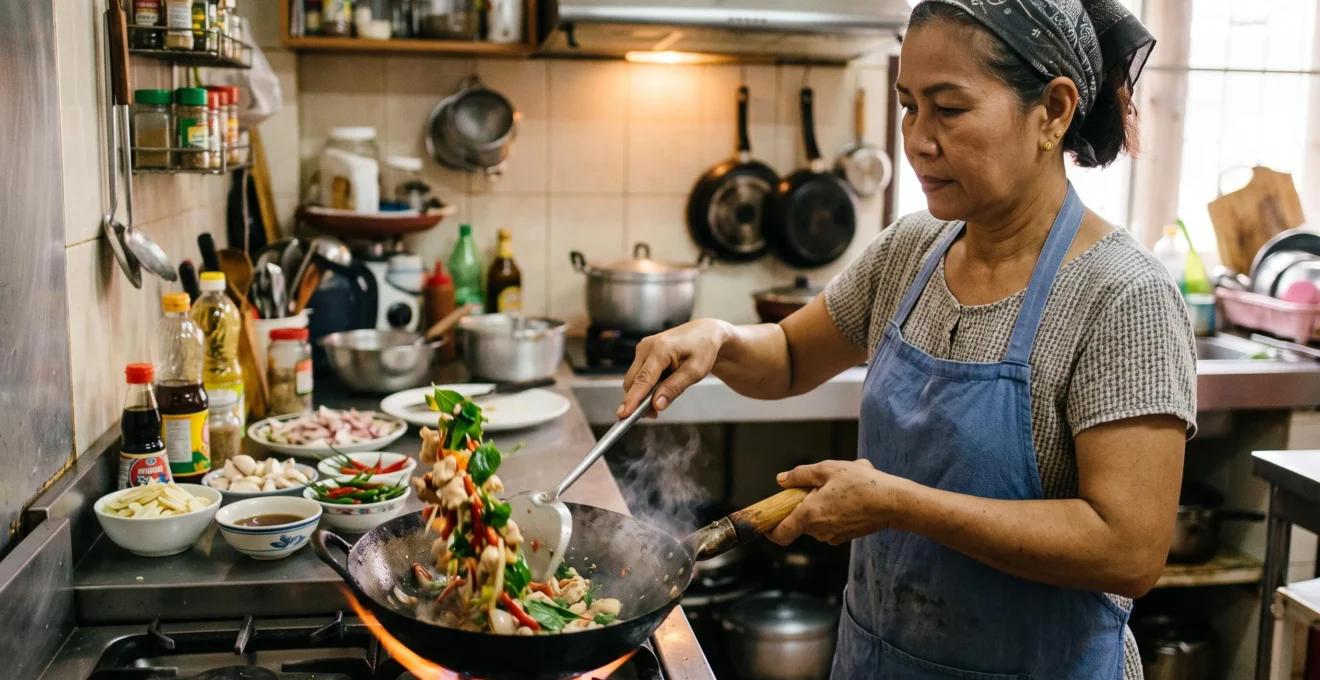
Your Thai curry contains every ingredient listed in the recipe. The fish sauce is measured, the coconut milk is simmering, and the basil looks right. Yet the result tastes strangely flat compared with dishes eaten in Thailand.
The missing element may not be an ingredient at all. It may be how the garlic was crushed, when the curry paste entered the fat, how much moisture remained in the wok, or whether the lime juice was added before or after cooking.
Thai cooking is not governed by one universal method. Southern curries, northeastern salads, central Thai stir-fries, and everyday family soups follow different culinary priorities. What connects many of them is an approach built around ingredient preparation, controlled heat, seasoning judgment, and the timing of aromatic additions.
Learning those techniques makes recipes more useful rather than obsolete. It also helps explain why attempting to reproduce a smoky street-food noodle dish is a different challenge from preparing a balanced family meal.
Authentic Thai Cooking: What Matters Most
- Technique precedes intensity. Crushing aromatics properly, controlling moisture, and frying suitable curry pastes in fat often matter more than adding extra seasoning.
- Balance depends on the dish. Fish sauce, acidity, sweetness, and chili should be adjusted according to the ingredients and regional style, not forced into one universal ratio.
- Freshness and sequence build character. Use distinctive herbs where they matter, prepare ingredients before heating the pan, and add delicate aromas late.
- Why Thai Home Cooking Tastes Different From Restaurants: The Simplicity Tourists Never Taste
- How to Achieve Wok Hei in Thai Stir-Fries: The High-Heat Technique Home Stoves Can’t Replicate
- Thai Taste-and-Adjust vs Western Recipe Precision: Why Thai Cooking Resists Exact Measurements
- The 5 Thai Ingredients You Cannot Substitute: Why Lime Leaf Isn’t « Like Bay Leaf »
- When to Shop for Thai Ingredients: The Thursday-Friday Asian Market Restocking Window
- How to Achieve Wok Hei in Thai Stir-Fries: The High-Heat Technique Home Stoves Can’t Replicate
- The 5 Thai Ingredients You Cannot Substitute: Why Lime Leaf Isn’t « Like Bay Leaf »
- How Thai Cooks Build 12-Layer Flavor Profiles: The Technique Behind « Impossibly Complex » Tastes
Why Thai Home Cooking Tastes Different From Restaurants: The Simplicity Tourists Never Taste
The Thai food served in overseas restaurants represents only part of what people cook and eat in Thailand. Everyday household meals may feature uncomplicated stir-fries, gently seasoned clear soups, and dishes designed to accompany rice. Their quality depends less on dramatic intensity than on fresh ingredients, appropriate seasoning, and techniques that suit the dish.
Consider gaeng jeud, a lightly seasoned clear soup that may contain pork, tofu, vegetables, garlic, cilantro, and white pepper. Its appeal comes from a clean broth and carefully handled ingredients, not the intense sourness or chili heat associated with internationally familiar tom yum.
As chef Pailin Chongchitnant explains in Serious Eats’ guide to traditional Thai soups, clear soups are familiar components of family meals in Thailand, including households with children. These preparations demonstrate a side of Thai cooking that restaurant visitors may overlook.
That does not mean restaurant cooking is inherently less authentic. Street vendors and professional kitchens are also fundamental to Thailand’s food culture. Nor does every household prepare its own stock and curry paste from scratch. Some Thai home cooks use bouillon products and commercially prepared pastes for convenience.
The useful distinction is between cooking objectives, not between authentic homes and inauthentic restaurants. A noodle vendor may prioritize rapid frying and browned surfaces. A family preparing soup may prioritize a delicate aromatic broth that complements other dishes on the table.
To recalibrate your palate, try a controlled comparison with two versions of a similar curry: one from a restaurant and one prepared at home. Taste them alongside plain rice, then record impressions of sweetness, saltiness, aromatic freshness, richness, and heat.
This is a personal sensory exercise, not evidence that restaurants systematically add more sugar or flavor enhancers. Preparation methods, recipes, regions, and individual cooks differ too much for that generalization.
One particularly useful observation is how individual aromatics remain recognizable. Fresh lemongrass, galangal, and lime leaves can deliver distinct impressions even when the overall dish is gently seasoned. Higher intensity is not automatically greater complexity.
Once the desired style is clear, heat becomes easier to manage. A fast, smoky noodle stir-fry requires different priorities from a gently cooked household dish, and confusing those goals often leads to unnecessary frustration.
How to Achieve Wok Hei in Thai Stir-Fries: The High-Heat Technique Home Stoves Can’t Replicate
Wok hei is the distinctive roasted, smoky character associated with certain high-heat wok preparations. Powerful commercial burners help produce it through rapid surface browning, intense heat transfer, and interactions between food, oil, and flame. Most household stoves cannot reproduce those conditions exactly, but careful batch size, moisture control, and pan preparation can still produce excellent Thai stir-fries.
The phrase is Chinese in origin, and its place in Thai cooking deserves qualification. Wok hei is particularly relevant to certain fried-rice and noodle preparations, including some street-food dishes. It is not the defining objective of all Thai stir-frying.
In Pailin Chongchitnant’s guide to Thai stir-fries in Serious Eats, the chef distinguishes ordinary Thai household stir-frying from restaurant and street-vendor techniques that deliberately pursue wok hei.
The practical challenge at home is heat recovery. When cold ingredients, vegetables containing water, or too much sauce enter a pan, its surface temperature falls. Water must evaporate before substantial browning can occur.
A manageable batch is often more useful than a larger flame applied to an overcrowded pan. Even powerful equipment struggles to brown ingredients efficiently when the cooking surface becomes saturated with moisture.
For a small home-kitchen stir-fry, use this adaptable method:
- Slice protein and vegetables evenly so they cook at predictable rates.
- Drain washed vegetables thoroughly and blot wet proteins before cooking.
- Mix the seasoning sauce in a separate bowl before switching on the stove.
- Preheat an appropriate wok or skillet according to its material and manufacturer’s guidance, then add suitable cooking oil.
- Cook a modest quantity of food at a time, allowing moisture to evaporate without prolonged steaming.
- Add aromatics at a stage that lets them release flavor without burning. Depending on the dish, meat may be browned separately first.
- Add sauce when the main ingredients are ready for it, reducing briefly if the preparation requires a concentrated coating.
Recipes sometimes insist on garlic first, protein second, and sauce last. That sequence works for some stir-fries, but it is not universal. Delicate garlic may burn before thicker cuts of meat brown, making separate cooking the better choice.
Likewise, a carbon-steel wok can be excellent without being mandatory. Thai households also use other cookware, including aluminum, stainless steel, and nonstick pans.
A flat skillet may outperform a round-bottom wok on an incompatible electric hob because more of its base makes direct contact with the heating surface.
Do not attempt to recreate commercial flames indoors with improvised burners, flambéing, or deliberately overheating oil. Good ventilation and cookware appropriate to the stove matter more than a theatrical plume of smoke.
When the desired smoky character remains out of reach, focus on correctly cooked protein, fresh aromatics, and balanced seasoning. These are not substitutes for wok hei; they are essential qualities in their own right and lead naturally to the next skill.
Thai Taste-and-Adjust vs Western Recipe Precision: Why Thai Cooking Resists Exact Measurements
Thai recipes benefit from measurements, but final seasoning still requires tasting. Fish sauces vary in saltiness and aroma, limes differ in acidity, and chilies vary considerably in strength. A precise quantity can therefore produce different results with different ingredients. The practical solution is to follow the recipe’s structure while adjusting its seasoning to the specific dish and ingredients.
A recipe calling for fish sauce, lime juice, and palm sugar provides a starting framework, not a guarantee of identical flavor across kitchens.
Thai cooks often develop judgment by tasting repeatedly. The aim is not simply to maximize four familiar dimensions—salty, sour, sweet, and spicy—but to decide which qualities should lead and which should remain in the background.
A northeastern salad, a central Thai coconut curry, and a mild clear soup do not require the same balance. Some dishes contain very little sweetness; others are intentionally sweet-savory. Some depend on sourness, while others contain no significant sour component.
Taste for the intended character of the dish before correcting a perceived imbalance. A dish that seems insufficiently sweet may actually need salt. One that tastes heavy may need an acidic accent, provided acidity belongs in that preparation.
For a dish containing salty, sour, and sweet seasonings, the following procedure offers a practical training exercise rather than an obligatory Thai culinary rule:
- Begin with a measured recipe, initially reserving a portion of ingredients that are easy to adjust later.
- Taste a representative spoonful, allowing it to cool enough for comfortable tasting.
- Evaluate saltiness and savory depth. Adjust gradually if necessary.
- Evaluate acidity only if sourness is part of the intended flavor profile.
- Adjust sweetness where appropriate, then check the overall balance again.
- Reassess chili heat and aromatic freshness without assuming every dish needs additional spice.
For delicate lime-based dishes, adding juice near the end can preserve a fresher citrus impression. For a preparation using tamarind as part of a cooked sauce, acidity may be integrated earlier. These approaches are different, not contradictory.
One useful experiment is to divide an underseasoned sample into three small portions. Add a little fish sauce to the first, a little lime juice to the second, and a little sugar to the third. Compare each separately with the untouched dish.
This exercise helps isolate sensory effects. It is more informative than continually modifying the entire pan without knowing which adjustment actually helped.
Five Actions to Train Your Thai Seasoning Palate
- Create a flavor baseline: Taste the dish before final adjustments and write four brief notes describing saltiness, acidity, sweetness, and chili heat.
- Check your fish sauce: Record its brand and how strongly it seasons a small test portion, producing a reference for the next recipe.
- Test acidity separately: Add lime or another recipe-appropriate sour ingredient to one sample and note the resulting difference.
- Compare sweeteners: Prepare two otherwise identical seasoning samples using palm sugar and a possible alternative, then record the flavor differences.
- Document the final adjustment: Note what you changed, why you changed it, and whether the finished dish moved closer to the intended flavor.
Seasoning judgment becomes especially important when an ingredient has a distinctive aromatic identity. Correcting the salt level cannot restore galangal’s fragrance if it has been replaced entirely with ginger.
The 5 Thai Ingredients You Cannot Substitute: Why Lime Leaf Isn’t « Like Bay Leaf »
Makrut lime leaves, galangal, Thai basil, fish sauce, and palm sugar each contribute recognizable qualities that common Western alternatives cannot reproduce perfectly. Nevertheless, substitution is not equally damaging in every dish. Makrut lime leaves are especially difficult to imitate, while palm sugar and certain herbs permit practical alternatives when the resulting flavor change is understood.
Ingredient authenticity depends on the preparation. A substitute that changes a dish’s defining aroma is more consequential than one that makes a modest difference to its sweetness.
Here is how the five ingredients behave and where substitutions create the greatest compromises.
Makrut lime leaves deliver an intensely fragrant citrus character unlike the woody, resinous aroma of Mediterranean bay leaves. Their distinctive double-lobed shape makes them recognizable, but their aromatic contribution is the culinary reason to seek them out.
Whole leaves can be lightly bruised and infused in soups or curries, then removed or left aside rather than eaten. For dishes requiring finely distributed fragrance, remove the tough central rib and slice the leaves into very thin ribbons.
Galangal contributes earthy, citrusy, somewhat pine-like notes. Ginger is sharper and warmer in a different way. Replacing galangal with ginger in tom kha changes one of the soup’s defining aromatic characteristics.
Thai basil brings an anise-like dimension to certain curries and stir-fries. However, it must not be confused with holy basil, the herb traditionally associated with phat ka-phrao, often written pad kra pao in English. Thai basil can be an acceptable fallback in some versions, but it does not reproduce holy basil’s characteristic flavor.
Fish sauce supplies salinity together with fermented savory depth. Soy sauce can season a dish, but its bean-derived aroma is different. For recipes in which fish sauce is central, replacing it changes more than the salt content.
Palm sugar contributes sweetness accompanied by flavors that may suggest caramel, butterscotch, or smoke. White sugar supplies sweetness more directly. The difference may be subtle in a strongly seasoned stir-fry but more noticeable in a dressing or sauce where sugar is a prominent component.
The distinctions are explored in Serious Eats‘ Thai pantry ingredient reference, which also emphasizes regional variation and the practical value of selecting substitutes according to the recipe.
| Ingredient | Common alternative | Expected compromise |
|---|---|---|
| Makrut lime leaf | Lime zest in selected recipes | Citrus freshness without the same floral, leafy aroma; bay leaf is not an equivalent |
| Galangal | Ginger | Noticeably different aroma and sharper pungency; poor replacement in galangal-led soups |
| Thai basil | Holy basil or other available basil, according to the dish | Different herbal and anise-like character; holy basil is preferable for traditional phat ka-phrao |
| Fish sauce | Soy sauce or an appropriate alternative seasoning | Provides saltiness but not the same fermented seafood character |
| Palm sugar | Another Southeast Asian palm sugar or, when necessary, a different sugar | Sweetness remains, but caramel-like notes and overall flavor may change |
Where a substitute is unavoidable, choosing a different dish may be more satisfying than attempting to imitate an aroma that is central to the original.
Storage also matters. Galangal and makrut lime leaves freeze well, making them useful ingredients to buy in larger quantities. Fresh leafy herbs are more fragile and benefit from careful refrigeration and prompt use.
Once the important ingredients are identified, the next practical challenge is finding them in good condition. That requires more than choosing a particular shopping day.
When to Shop for Thai Ingredients: The Thursday-Friday Asian Market Restocking Window
Thursday and Friday can be useful days to check Asian grocery stores for fresh ingredients ahead of weekend cooking, but there is no established universal restocking schedule. Delivery days vary by retailer, supplier, location, and season. The most reliable strategy is to ask the store when herbs arrive, inspect their condition, and shop soon after a confirmed delivery.
For cooks outside Thailand, freshness can be one of the largest obstacles to recreating a dish’s intended aroma. Lemongrass may have dried out, basil may have darkened, and galangal may have spent too long in storage.
A late-week visit is worth testing if it suits the store’s operating pattern. However, treating Thursday or Friday as a guaranteed delivery window can lead to disappointing purchases, especially in smaller towns where shipments are less frequent.
Ask a practical question: « Which day do you usually receive fresh Thai basil, galangal, and lime leaves? »
If the answer differs by ingredient, plan accordingly. A supplier may deliver sturdy roots separately from delicate greens, while frozen ingredients may be replenished on another schedule.
Physical inspection remains essential regardless of the delivery schedule. Use these practical indicators when selecting produce:
- Thai basil: Look for lively leaves and healthy stems. Avoid bunches with widespread blackening, sliminess, or pronounced wilting.
- Galangal: Choose firm pieces without extensive soft or moldy areas. A dry exterior does not necessarily mean the interior is unusable.
- Makrut lime leaves: Prefer intact, aromatic leaves without widespread browning or decay. Some curling or surface dullness alone does not establish spoilage.
- Lemongrass: Look for firm stalks with sound inner layers rather than severely dried or decaying bases.
- Fresh chilies: Check for firmness and avoid mold, leakage, and large soft patches.
A useful purchasing system separates preserved staples from ingredients whose aroma deteriorates quickly.
| Purchase category | Examples | Shopping approach |
|---|---|---|
| Shelf-stable staples | Unopened fish sauce, dried chilies, canned coconut milk, packaged curry paste | Replenish according to consumption and labeled storage instructions |
| Freezer-friendly aromatics | Galangal, makrut lime leaves, prepared curry paste | Buy when quality is good; portion and freeze appropriately |
| Fresh herbs and vegetables | Thai basil, holy basil, cilantro, fresh chilies, leafy greens | Buy close to cooking day and prioritize freshness |
For someone living far from an Asian grocery, a monthly pantry order combined with an occasional fresh-ingredient trip may be more realistic than weekly travel. Specialist online retailers can also be useful for shelf-stable products.
When fresh galangal or makrut lime leaves are unavailable locally, frozen versions can be more suitable than unrelated fresh substitutes. Fresh herbs deserve more careful consideration because texture and aroma may deteriorate after freezing.
Reliable ingredients establish the foundation, but cooking technique still determines what reaches the plate. The next step is selecting cookware and organizing the rapid sequence of a Thai stir-fry.
How to Achieve Wok Hei in Thai Stir-Fries: The High-Heat Technique Home Stoves Can’t Replicate
Choosing suitable cookware and completing preparation before heating are the most dependable ways to improve home stir-frying. A carbon-steel wok responds quickly to changes in heat, while a flat-bottom skillet may perform better on an electric or induction stove. Neither guarantees wok hei: the key is matching the pan to the burner and cooking a quantity the equipment can handle.
Many English-language recipes concentrate on ingredient quantities while giving only vague instructions such as « stir-fry over high heat. » That leaves out the relationship between pan shape, burner contact, ingredient moisture, and timing.
A traditional round-bottom wok concentrates heat near the bottom and provides sloping sides for moving ingredients through hotter and cooler zones. It works especially well when paired with a compatible burner.
A flat-bottom carbon-steel wok offers broader contact with typical domestic hobs. A wide stainless-steel skillet can also work well, particularly when it provides a stable cooking surface and sufficient space for ingredients.
Cast iron retains heat effectively but is heavy and slower to respond to changes in burner output. Its advantages may suit certain preparations without making it the most convenient tool for rapid tossing.
| Cookware | Main advantage | Main limitation |
|---|---|---|
| Round-bottom carbon-steel wok | Well suited to compatible high-heat wok burners and tossing | Poor contact or instability on unsuitable household hobs |
| Flat-bottom carbon-steel wok | Responsive heating with better domestic hob compatibility | Performance still depends on burner size and power |
| Stainless-steel skillet | Stable cooking surface and useful browning capability | Requires careful temperature and sticking management |
| Cast-iron skillet | Strong heat retention | Heavy and less responsive to rapid heat adjustments |
Mise en place is essential when cooking proceeds rapidly. Once the pan is hot, there may be little opportunity to wash vegetables, slice garlic, or search for fish sauce without disrupting the cooking process.
Place the ingredients within easy reach: aromatics prepared, proteins portioned, vegetables dried, seasonings combined, and serving plates ready. Group items by the order in which the particular dish requires them.
That final qualification matters. For a garlic-based vegetable stir-fry, garlic may enter the oil early. For thickly sliced meat, browning the meat before adding garlic can prevent the aromatics from burning.
Neutral-flavored cooking oils are generally suitable for stir-frying. Select an oil appropriate to the cooking temperature, observe its handling instructions, and do not deliberately allow it to overheat or ignite. Commercial wok techniques are not a reason to compromise household fire safety.
When a stir-fry fails, inspect its symptoms rather than assuming the burner is inadequate.
- Watery sauce: Excess vegetable moisture, overcrowding, or adding too much sauce before sufficient evaporation.
- Steamed rather than browned protein: Too many pieces in contact with the pan at once, wet surfaces, or inadequate heat recovery.
- Burnt garlic: Aromatics added too early for the temperature or the cooking time required by the main ingredients.
- Soggy vegetables: Excess cooking time, insufficient draining, or a pan loaded beyond its effective capacity.
- Harsh smoky bitterness: Burnt seasonings, aromatics, or oil rather than desirable controlled browning.
There is no universally correct five-minute stir-fry. Cooking duration depends on the ingredients, their dimensions, pan capacity, and burner performance. Thorough cooking of meat and seafood remains necessary regardless of the desired speed.
Heat control preserves texture, but the final aroma still depends on the ingredients themselves. Two especially revealing examples are makrut lime leaves and fish sauce, both of which behave differently depending on how and when they are introduced.
The 5 Thai Ingredients You Cannot Substitute: Why Lime Leaf Isn’t « Like Bay Leaf »
Makrut lime leaves, fish sauce, and palm sugar show why ingredient preparation matters as much as ingredient selection. Lime leaves can be infused whole or sliced finely, fish sauce can season a dish during cooking or at the end, and palm sugar contributes more than sweetness. Their effects change with timing, concentration, and the surrounding ingredients.
Start with makrut lime leaves. Their double-lobed appearance is visually distinctive, but the important feature in the kitchen is the fragrant material contained in the leaves.
For an infused soup or curry, lightly bruise the leaves to help expose their aromatic surfaces. They can then flavor the liquid without needing to be eaten. Whole leaves may remain too tough to chew comfortably.
For a dish in which finely cut leaves are intended to be distributed throughout the food, remove the tough central rib and stack the leaf sections before slicing them into extremely fine strips.
Whole-leaf infusion and fine slicing are different techniques with different results. One introduces fragrance into the surrounding liquid; the other distributes small pieces of aromatic leaf through the finished dish.
Fish sauce provides another example of timing. When incorporated into a cooked sauce, it helps distribute saltiness and savory character throughout the preparation. When used as part of a finishing dressing or condiment, its aroma can remain more prominent.
There is no single universal ranking that makes one fish sauce best for every dish. Brands differ in intensity and flavor profile. A useful home-cooking habit is to taste and compare small quantities of different products in the same simple dressing rather than assuming equal measurements produce equal results.
Palm sugar also deserves deliberate comparison. Depending on its source and processing, it may provide caramel-like, smoky, or butterscotch notes that refined white sugar does not contribute in the same way.
A straightforward sensory test uses two small, otherwise identical portions of a suitable Thai-style dressing. Dissolve palm sugar in one and white sugar in the other, adjusting carefully so neither sample is overwhelmingly sweeter. Taste both with the same accompanying food.
This is an informal tasting exercise rather than a controlled scientific experiment. Its purpose is to recognize how different sugars affect flavor, not to prove that one ingredient is universally superior.
Preservation is equally important. Keep makrut lime leaves in a well-sealed freezer-safe container and freeze galangal in practical portions. Freezing whole or sliced galangal helps preserve a supply for later use, although texture may change.
For fresh Thai basil, refrigeration with appropriate moisture management is usually preferable when the leaves will be served fresh. Freezing delicate herbs can damage their texture. Freezing herbs in water may be convenient for some cooked applications, but it should not be treated as a universally established traditional Thai household method.
Hand-pounding deserves a place alongside these storage skills. Tough aromatics such as galangal, lemongrass, and citrus zest are more efficiently crushed before moisture-rich shallots and garlic are incorporated. That sequence creates a workable paste without unnecessarily diluting it.
These decisions illustrate a broader principle: flavor is built in stages. The final technique brings together pounding, frying, seasoning, and aromatic timing into one coherent approach.
Key Takeaways Before Building Flavor
- Separate ingredients that need mechanical crushing from those that only need brief aromatic extraction.
- Understand whether a seasoning belongs in the cooked foundation or is intended to remain perceptible in the finished dish.
- Compare cooking sequences before increasing ingredient quantities; a change in order may explain a flavor difference more clearly than another spoonful of seasoning.
How Thai Cooks Build 12-Layer Flavor Profiles: The Technique Behind « Impossibly Complex » Tastes
Complex Thai flavor develops when ingredients are processed and introduced in ways that preserve their different contributions. Pounded aromatics form a concentrated foundation; suitable curry pastes are fried in fat; sauces establish savory balance; and delicate herbs or citrus may be added near serving. The result can taste richly layered without requiring a fixed number of ingredients or flavor stages.
The phrase « 12-layer flavor profile » is a useful descriptive metaphor, not an established Thai culinary system with twelve scientifically defined layers. Thai cooks do not need to count flavor layers to create a successful dish.
The more practical concept is flavor development through preparation and sequence.
A single curry paste can contain lemongrass, galangal, chilies, garlic, shallots, citrus zest, herbs, spices, and fermented shrimp paste. Crushing these ingredients changes their physical structure and brings their flavors into closer contact.
A mortar and pestle is particularly useful for fibrous aromatics. Beginning with harder materials and incorporating softer, wetter ingredients later makes pounding more efficient. The goal is to reduce coarse pieces and create a cohesive, aromatic paste.
Blenders and other mechanical tools can also make effective curry pastes. A food processor may leave a coarser texture, while adding excessive water to facilitate blending creates an additional obstacle during subsequent frying.
The next stage is especially significant in many coconut-based Thai curries: frying the paste.
As Pailin Chongchitnant explains in her technical guide to Thai curry pastes, many curry preparations begin by cooking the paste in fat to develop the flavors of its aromatics and spices.
In some coconut curries, concentrated coconut cream is heated until part of its fat separates from the liquid. The paste then cooks in that released fat, producing a different result from simply dissolving it in a large volume of water.
Oil separation is a technique to understand, not a universal finish line. Some coconut products contain stabilizers that affect separation, and some authentic Thai curries do not involve an initial paste-frying step at all. Certain sour curries, for example, follow different methods.
Where paste frying is appropriate, avoid treating maximum heat as the objective. Finely ground ingredients can burn, producing bitterness. Controlled heating is more valuable than scorching the mixture in pursuit of rapid oil separation.
The same principle applies to caramelization. Palm sugar can be gently heated in preparations that intentionally develop a caramel-like character, but prolonged browning is not required in every curry or dressing. Sugar that burns will introduce bitterness rather than the intended rounded sweetness.
To understand flavor stacking, consider how a single dish changes across three stages:
- The foundation: Pounded or otherwise properly prepared aromatics establish the characteristic fragrance of the dish.
- The cooked structure: Where appropriate, frying develops the paste’s flavor, while meat, vegetables, coconut milk, or broth create body and context.
- The finishing character: Final seasoning and delicate additions, such as fresh herbs or lime juice where the recipe requires them, preserve flavors that prolonged cooking might weaken.
Some dishes involve additional stages, such as toasting dried spices or preparing a separate aromatic dressing. Others are simpler. The relevant cooking method determines the sequence.
For a practical comparison, prepare the same basic stir-fry three times using identical ingredients and portions, changing only the sequence of additions.
In the first version, cook the ingredients according to a trusted recipe. In the second, brown the protein separately before adding the aromatics. In the third, compare a version in which the sauce is incorporated at a different suitable stage. Keep the portions manageable and ensure all ingredients are cooked safely.
Taste the completed dishes side by side and record differences in aromatic freshness, browning, sauce concentration, and texture. These are hypothetical experimental variations, not claims that one sequence is traditionally correct for every stir-fry.
The same kind of comparison can be applied to curry paste: evaluate a recipe-appropriate fried-paste preparation against a deliberately simplified version where the paste is added directly to liquid. Differences in texture and aroma help reveal what the frying stage contributes, without implying that all Thai curries must be prepared alike.
Start with one familiar dish rather than a complicated banquet: prepare it, record the method, and repeat it while changing one technique at a time. The aim is not to imitate every restaurant flavor, but to recognize which decisions make Thai cooking taste as intended.
Can store-bought Thai curry paste produce authentic results?
Yes. Commercial curry pastes are used in Thai home cooking as well as professional kitchens. Their suitability depends on the dish, product composition, and preparation method. A ready-made paste can be enhanced with fresh aromatics or additional seasonings when appropriate. Proper frying, dilution, and final seasoning can matter more than making every paste entirely from scratch.
Is a mortar and pestle necessary for Thai cooking?
No. A mortar and pestle is particularly effective for crushing fibrous aromatics and developing cohesive curry pastes, but blenders and other suitable appliances can also work. The important factors are ingredient preparation, texture, moisture control, and whether the resulting paste can be cooked appropriately.
What is the best beginner dish for practicing Thai cooking techniques?
A simple garlic-based vegetable or protein stir-fry is useful for practicing preparation, aromatics, pan temperature, batch size, and sauce adjustment. An herb-infused soup is another accessible option for learning how lemongrass, galangal, and lime leaves contribute fragrance without prolonged frying. Choose a reliable recipe and repeat it before introducing major variations.
Can frozen Thai aromatics replace fresh ones?
Frozen galangal and makrut lime leaves are practical alternatives when fresh supplies are difficult to obtain. They may undergo some changes during storage, but they retain more of the appropriate ingredient identity than unrelated substitutes. Delicate basil leaves are less suitable when fresh texture is essential, although frozen herbs may still be useful in some cooked preparations.
Why does my Thai curry taste harsh or bitter after frying the paste?
One possible cause is excessive heat that scorches the finely ground aromatics or spices. Insufficient fat or allowing the pan to become too dry can also contribute. Use controlled heat, stir as needed, and follow the method appropriate to the specific curry. Remember that not every Thai curry requires frying its paste or cooking coconut cream until oil separates.