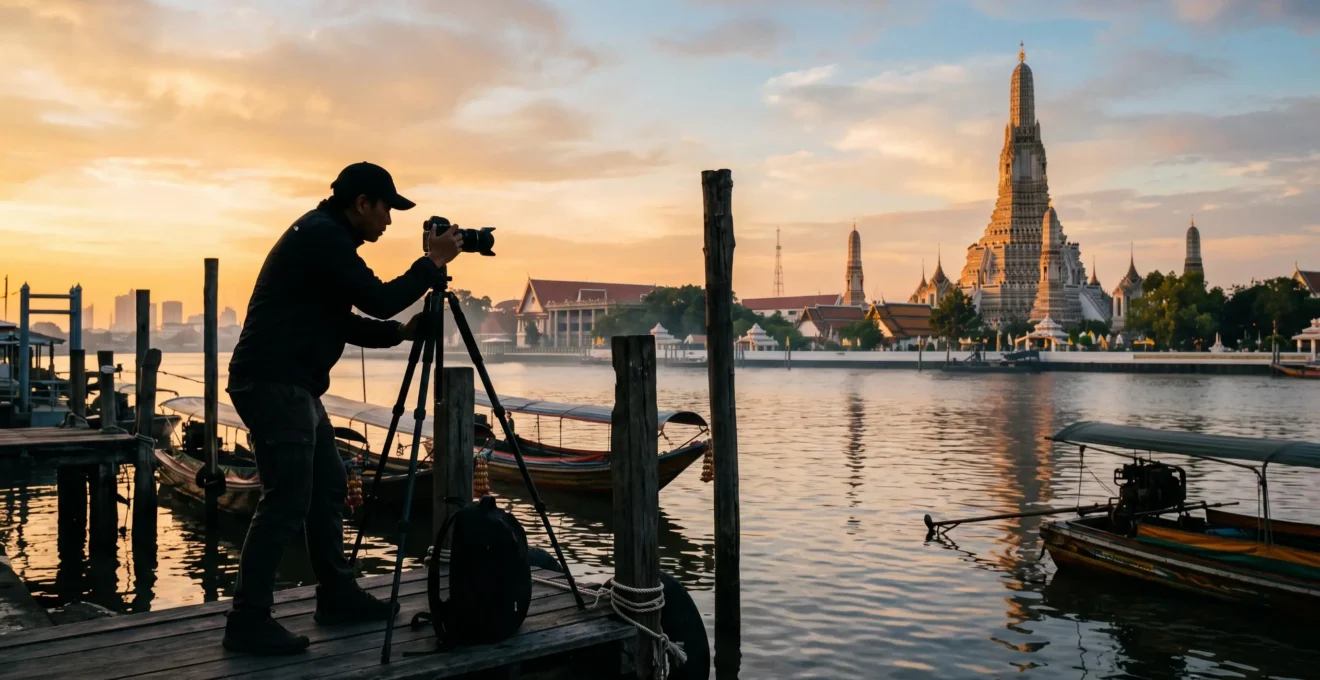
Wat Arun rewards photographers who understand the direction of light before choosing a riverbank. The Temple of Dawn stands on the western bank of Bangkok’s Chao Phraya River, where its porcelain-covered central prang rises above the surrounding buildings. At first light, its intricate surfaces can reveal subtle colors and textures that stronger overhead sunlight often obscures.
For the iconic skyline photograph, start by scouting the eastern bank around Tha Tien, looking west across the river toward the temple. Sunrise generally occurs behind the photographer from this viewpoint, although the exact lighting on the prang changes with season, weather and neighboring structures. Crossing to the Thonburi side serves a different purpose: exploring the temple’s immediate surroundings and, once access opens, photographing its mosaics at close range.
The strongest approach combines careful sunrise planning, flexible composition and an understanding of the ceramics themselves. Ferry schedules, temple access and atmospheric conditions matter as much as camera equipment.
Wat Arun dawn photography essentials
- Photograph the iconic temple skyline from accessible eastern-bank viewpoints near Tha Tien, ideally beginning before sunrise.
- Use low-angle light, controlled exposure and carefully chosen viewpoints to reveal porcelain textures without losing bright highlights.
- Check ferry operations and temple opening hours before planning close-up photography or a climb; exterior dawn photography does not guarantee early temple access.
- Why Wat Arun Is Covered in Broken Chinese Porcelain: The Ballast Ship History Behind the Mosaics
- How to Reach the Best Wat Arun Photo Position: The £0.15 Cross-River Ferry Photographers Use
- Wat Arun at Dawn for Photos or 10am for Climbing: Which Experience Do You Prioritize?
- The Wat Arun Timing That Ruins Photos: Why Midday Sun Washes Out the Porcelain Details
- When to Climb Wat Arun’s Central Prang Without Queuing: The 3pm-5pm Crowd Gap
- How to Reach the Best Wat Arun Photo Position: The £0.15 Cross-River Ferry Photographers Use
- The Lighting That Reveals Porcelain Mosaic Colors: Why Dawn and Dusk Beat Midday for Photography
- How Thai Temples Transformed Broken Porcelain Into Intricate Mosaics: The Recycled Art Technique
Why Wat Arun Is Covered in Broken Chinese Porcelain: The Ballast Ship History Behind the Mosaics
Wat Arun’s distinctive surface decoration reflects Thailand’s historic trade connections with China. Its spires incorporate imported porcelain fragments, shells and glazed ceramics. A widely repeated historical explanation holds that some porcelain arrived as ballast aboard Chinese trading vessels before being reused in temple decoration. The association is plausible and well established in visitor accounts, although individual fragments cannot generally be traced to particular shipments.
Chinese merchant vessels needed ballast to maintain stability when carrying lighter cargo. Ceramics and other heavy materials could serve this purpose, while damaged or unwanted pottery provided a potential supply of decorative material after arrival. An independent Wat Arun visitor website describes porcelain previously used as ballast in Chinese trading junks.
The distinction between historical explanation and proven material provenance matters. The account does not establish that every fragment on Wat Arun originated as ballast, or that King Rama II personally selected specific pieces. The temple underwent major architectural development during the early Bangkok period, with later construction and restorations contributing to its present appearance.
For photographers, the value of this history lies in what the surface reveals. Glazed petals, flower clusters, decorative bands and Chinese-influenced figures interrupt the pale stucco with small reflective surfaces. Their curved edges and uneven relief respond differently to directional sunlight.
Look for compositions that include three visual layers: the larger architectural form, a recognizable decorative motif and the individual glazed fragments. A moderate telephoto lens can isolate a band of ornament from a legally accessible position, while a closer lens may reveal differences between shiny ceramics and weathered mortar.
Restoration introduces further variation. The independent visitor resource documents extensive work between 2013 and 2017, including efforts to preserve decorative patterns and colors. Photographers should therefore avoid assuming that every surface preserves an identical historical finish.
Once these patterns become recognizable, the next decision is where to stand so that the temple’s architecture and its reflective surfaces receive useful light.
How to Reach the Best Wat Arun Photo Position: The £0.15 Cross-River Ferry Photographers Use
The most reliable starting point for Wat Arun’s classic riverfront photograph is the eastern bank around Tha Tien, where the temple can be framed across the Chao Phraya. The inexpensive cross-river ferry connects this area to Wat Arun on the western bank, but crossing is not necessary for the familiar across-the-water composition. Use the ferry when you want to change perspective or visit the temple itself.
According to Tha Tien–Wat Arun ferry schedule and fare information, updated in June 2026, the crossing costs approximately 5.5 THB per person in one direction. The guide reports departures around every 10 minutes, operating hours of approximately 05:00–19:00 and cash payment.
These are reported operating details, not a guaranteed live timetable. The sterling amount in the section title is an illustrative comparison rather than a fixed or verified conversion. Pier arrangements, prices and service availability should be checked locally before an early departure.
The choice between banks is primarily a question of geometry. Because Wat Arun stands on the west side of the river, an eastern-bank camera generally looks west toward the temple. At sunrise, the sun rises in the eastern sector of the sky, placing it broadly behind or beside that camera, depending on the season.
That arrangement can help illuminate the river-facing architecture. On the western bank, by contrast, a photographer facing east may use the bright morning sky for backlighting, silhouettes or environmental compositions. The western shoreline is not automatically a better location for a front-lit portrait of the entire prang.
At the riverside, test several foreground treatments. Pier posts provide strong vertical elements; passing boats create scale and movement; reflections can anchor a wider composition when the water is relatively calm. A 24–70mm zoom offers framing flexibility, while longer focal lengths help compress architectural details from suitable distances.
Boat traffic requires patience. For a clean reflection, wait for wakes to settle. For a photograph conveying Bangkok’s working river, include a boat deliberately rather than allowing one to obscure the spire accidentally.
The ferry is therefore a useful photographic connection, not a substitute for scouting sunrise direction. Choosing between the exterior photograph and access to the temple itself determines the next stage of the itinerary.
Wat Arun at Dawn for Photos or 10am for Climbing: Which Experience Do You Prioritize?
Choose dawn if your priority is photographing Wat Arun’s skyline in soft light, and choose a visit after opening if you want to explore its decorated architecture and any accessible terraces. These experiences have different access requirements. The classic exterior view is possible from suitable public riverside positions, whereas entering the temple and using its staircases depend on current visitor rules.
The difference is important because a successful dawn photograph may happen before the temple admits visitors. In contrast, arriving at 10am can provide access to the grounds but expose pale ceramics to stronger sunlight and place more visitors within architectural compositions.
The practical trade-offs are easier to compare directly.
| Decision factor | Dawn exterior session | 10am temple visit |
|---|---|---|
| Main photographic opportunity | Riverfront skyline, changing sky, reflections and atmospheric light | Architectural close-ups, decorative details and accessible terraces |
| Temple access | Usually before regular visitor opening; do not assume admission | Generally within published visiting hours, subject to current rules |
| Lighting | Low-angle light with rapidly changing exposure | Higher sun, potentially stronger reflections and contrast |
| Crowd considerations | Often fewer early visitors at accessible exterior viewpoints | Visitor activity may complicate clean compositions |
| Preparation | Advance scouting, early arrival and low-light equipment | Access checks, suitable clothing and heat management |
Published opening times have not been entirely consistent. The Tourism Authority of Thailand‘s overview of Bangkok’s major temples, published in 2021, listed 08:00–17:30 for Wat Arun. Other visitor information reports 08:00–18:00. These published figures should not be mistaken for a verified schedule on a future travel date.
Likewise, references to climbing Wat Arun describe access to terraces, not a climb to the summit of the central spire. The precise accessible level can change with conservation work or operating restrictions.
A two-session strategy provides the most flexibility. Photograph from the eastern bank before sunrise, then return after opening to study the mosaics. This could be arranged during one longer morning or as separate visits if transport, fatigue and weather make that preferable.
Five checks before your Wat Arun dawn shoot
- Check the sunrise direction and weather for your travel date; save a screenshot showing the expected sun position.
- Identify an accessible eastern-bank viewpoint; save a map pin and an alternative position.
- Verify temple opening hours and ferry arrangements; record the information and the date checked.
- Pack a charged camera, spare battery, suitable lens and tripod where permitted; complete an equipment checklist.
- Test exposure bracketing and highlight warnings before leaving; save a sample RAW exposure sequence.
For photographers who can make only one visit, the strongest decision criterion is whether the subject is the complete riverside silhouette or the decorated architecture at close range.
The Wat Arun Timing That Ruins Photos: Why Midday Sun Washes Out the Porcelain Details
Midday sunlight can make Wat Arun’s porcelain mosaics more difficult to photograph because bright glazed fragments and pale stucco may reflect intense light toward the camera. This can produce clipped highlights and reduce visible relief in the decorative patterns. However, noon does not automatically ruin photographs: surface orientation, cloud cover, exposure and the intended composition all influence the result.
The problem begins with the materials. Glazed ceramics produce small, concentrated reflections, while pale stucco often appears bright over a much larger area. When both occupy the same frame, the sensor must preserve highlights without turning the recesses between fragments into featureless dark regions.
Lower-angle light can reveal shallow relief through directional shadows. Higher sunlight may shorten some shadows and reduce the apparent depth of decoration on surfaces facing upward, although vertical faces react differently according to their orientation.
The most reliable diagnosis comes from the camera rather than the clock. If important bright fragments blink as overexposed in the highlight warning, inspect the RAW histogram and reduce exposure when necessary.
A histogram pressed against the right-hand edge can indicate lost highlight detail. Yet the overall histogram cannot always identify which small mosaic fragments are clipped. Magnified image review, highlight alerts and the photographer’s intention provide additional context.
If midday is your only available shooting window, use a controlled recovery strategy:
- Protect significant highlights. Reduce exposure until important glazed surfaces retain texture, accepting deeper shadows if necessary.
- Test a circular polarizer. Rotate it while observing reflections on nonmetallic glazed surfaces; its effectiveness changes with viewing angle.
- Seek directional shade. Examine temple faces and recesses that are not receiving direct overhead light.
- Concentrate on smaller compositions. Tight photographs can exclude distracting bright areas and simplify exposure.
Long-distance views across the Chao Phraya may also become less crisp when heat shimmer is present. This depends on conditions and shooting distance; it is not a constant feature of every afternoon. Heavy visitor activity may further limit unobstructed compositions.
A useful practical test is to photograph the same pattern at two exposures, then compare the visibility of both the glazed surface and the recesses between fragments. If neither result preserves the intended depth, switch orientation or subject rather than repeatedly brightening the highlights.
When access and conditions permit, a later afternoon visit may offer a better combination of directional light, detailed architecture and opportunities to explore the temple’s accessible levels.
When to Climb Wat Arun’s Central Prang Without Queuing: The 3pm-5pm Crowd Gap
The period between 3pm and 5pm may be worth considering for a Wat Arun visit, but it is not a verified queue-free interval. Visitor numbers depend on tour schedules, holidays, weather and any restrictions affecting the staircases. Check the visible queue and permitted access levels on arrival rather than planning around an assumed daily crowd gap.
Wat Arun’s central prang is the dominant architectural feature of the temple complex. Its steep stairways are part of the visitor experience described in travel resources, although access is limited and can change. Photographers should not expect to reach the summit or obtain unrestricted panoramic views from the highest level.
Where a terrace is open, the elevated perspective changes the relationship between the river, surrounding rooftops and temple ornament. Instead of photographing a complete skyline from across the water, it becomes possible to explore architectural layering and details visible from the authorized visitor route.
Late-afternoon sunlight can be useful because the sun is lower, producing longer shadows and potentially stronger modeling across projecting ceramic decorations. The result depends on which temple face receives sunlight at the time of the visit.
A west-facing element may receive late-day light differently from the river-facing eastern side. Photographing the details from within the grounds therefore requires active observation rather than assuming that all decorated faces will glow simultaneously.
Plan the visit around three checks: the current admission period, the location of any accessible stairs and the actual waiting time. The wider 3–5pm window should be treated as a possible planning opportunity, not a documented statistical pattern.
Stairways can be physically demanding. Wear secure footwear, keep equipment compact and avoid stopping where photographs would obstruct visitors. If access to an elevated section is closed, the temple’s lower-level architectural details still provide worthwhile subjects.
Remaining in the surrounding area toward dusk may create another opportunity to photograph the illuminated temple from across the river. Evening lighting, public access and transport arrangements should be checked independently before committing to that plan.
The best results may come from keeping the afternoon flexible and choosing a riverside or architectural composition according to the actual light rather than the planned time alone.
How to Reach the Best Wat Arun Photo Position: The £0.15 Cross-River Ferry Photographers Use
Beyond the familiar eastern-bank view near Tha Tien, photographers can explore accessible positions on the Thonburi side, viewpoints associated with riverside businesses and compositions from moving boats. Each option changes the balance between temple scale, foreground and background. The ideal position depends on whether the photograph emphasizes the complete prang, the river environment or the architectural details.
Start by evaluating the available viewpoints according to what each physically permits. Open public spaces can offer flexibility, but piers are working transport facilities and some attractive terraces belong to private businesses.
Eastern-bank riverside viewpoints generally offer the clearest conceptual starting point for a classic photograph of Wat Arun across the Chao Phraya. Depending on the accessible position, a photographer can frame the prang above boats, water and nearby riverfront structures.
Western-bank positions provide closer views of the temple precinct and possible context with local riverside activity. They are not interchangeable with the eastern-bank panorama: building placement and viewing direction may obstruct the full outline of the central prang.
Views from boats add a moving perspective and lower river-level angles. A cross-river ferry is an inexpensive way to experience the change in alignment, but its short crossing offers little time for precise composition.
A separately arranged long-tail boat trip may allow more control over the route. A hypothetical 20–30-minute photography outing could be discussed with a licensed operator, but pricing, route, stopping permissions and availability must be negotiated locally. No verified charter fare is established by the supplied evidence.
For moving-boat photographs, use a shutter speed fast enough to manage motion, with the precise setting chosen for the boat’s movement, focal length and stabilization. A tripod is generally more useful at a stationary, permitted position than aboard a small moving vessel.
At a fixed dawn viewpoint, arrive while there is still time to refine the composition before the light changes. Use exposure bracketing if the sky is significantly brighter than the temple, and adjust white balance deliberately rather than allowing every frame to drift toward a different color interpretation.
The social and operational environment matters. Do not block boarding areas, place tripod legs in pedestrian routes or assume that a restaurant terrace allows unrestricted photography without becoming a customer. Seek permission when entering private property.
After selecting a position, the next variable is the quality and direction of the light reaching the temple’s glazed surfaces.
The Lighting That Reveals Porcelain Mosaic Colors: Why Dawn and Dusk Beat Midday for Photography
Dawn and dusk often reveal Wat Arun’s porcelain decoration more expressively because lower-angle illumination can emphasize relief, separate glazed fragments from stucco and produce warmer color relationships. The effect is not identical throughout the temple. Surface orientation, direct sunlight, cloud cover and the photographer’s viewpoint determine whether the mosaics show warm highlights, cool shadows or strong reflective glare.
Glazed porcelain is particularly interesting in changing light because its appearance combines material color with surface reflection. A pale fragment can carry a warm reflection without changing its actual pigment, while recesses around it remain cooler and darker.
The most compelling detail photographs often preserve both effects. Rather than making every ceramic fragment bright, aim for recognizable color separation and small directional shadows that describe its shape.
Dawn and dusk also provide different compositional opportunities. Morning light supports riverfront photography when the sunrise direction and weather are favorable. Evening may offer changing sky color followed by architectural illumination, creating a transition from natural to artificial lighting.
Calm water and mist are possible at dawn, but neither is guaranteed. Atmospheric haze may soften the distant temple instead of improving clarity. Seasonal cloud cover can also prevent direct sunlight from reaching the surfaces at the expected moment.
For a stationary camera, begin with low ISO, an aperture appropriate for the desired depth of field and a shutter speed based on the available light. In aperture-priority or manual mode, review highlight warnings frequently as the sun rises.
Exposure bracketing can preserve options when the sky and architecture differ strongly in brightness. Capture multiple exposures without changing composition, then select a single frame or combine them carefully if the resulting image needs greater tonal range.
A tripod is useful for longer exposures where permitted and safe. However, river traffic introduces moving elements, so a long exposure may blur boats and reflections even if the temple itself remains sharp.
White balance requires equal attention. A fixed setting can make a sequence easier to compare, whereas automatic white balance may compensate for the warmth that motivated the dawn session. RAW capture preserves flexibility for later adjustment.
Adobe‘s technical explanation of photographic histograms supports using highlight distribution to diagnose clipping. The same principle applies when reviewing porcelain reflections, although it does not provide temple-specific exposure settings.
Once the lighting is controlled, knowledge of the decorative technique helps determine which motifs deserve closer examination.
Key takeaways before photographing the mosaics
- Choose a motif with recognizable form, not simply the most reflective surface.
- Preserve glaze highlights and the small shadows separating individual ceramic pieces.
- Work only from authorized positions, since conservation barriers may restrict close-up access.
How Thai Temples Transformed Broken Porcelain Into Intricate Mosaics: The Recycled Art Technique
Wat Arun’s decorative mosaics demonstrate how ceramic fragments can become architectural ornament when arranged into repeated patterns and embedded into prepared surfaces. Imported porcelain, glazed ceramic pieces and shells contribute color, reflection and relief to the temple’s prangs. The visible result combines small decorative elements into larger flowers, bands and figurative arrangements that photographers can explore at several scales.
The underlying craft requires more than attaching broken pottery at random. To create coherent designs, artisans must organize pieces by shape, color and surface character. Curved fragments can suggest petals or leaves, while smaller pieces form borders, repeated geometric elements and textured infill.
At Wat Arun, the decorative compositions are integrated with molded stucco and broader architectural features. The relationship between the ceramic surface and the supporting structure is essential to the final visual effect.
For photography, examine the transition between one decorative layer and another. A broad view may show the repeated rhythm of bands along the prang. A tighter photograph can isolate a floral motif, while a close-up emphasizes the individual glazed pieces and mortar joints.
This distinction helps develop an intentional sequence of images: architecture first, ornament second and material texture third. Together, these views explain the structure more effectively than a collection of unrelated close-ups.
The tradition belongs to a wider Bangkok architectural context. Chinese-influenced decorative ceramics also appear in other important temple settings, including Wat Pho. Their use reflects the historical movement of materials, artistic ideas and specialist craftsmanship between Thailand and China.
Nevertheless, similar appearance does not prove that every temple used identical manufacturing techniques or materials obtained through the same supply chain. Specific claims about historic fragment preparation, bonding materials or individual artisans require more specialized conservation evidence.
Restoration further complicates interpretation. Wat Arun has undergone repeated conservation campaigns, and replacement or repaired sections may differ in color, alignment and surface condition. The available visitor sources do not identify which individual prang faces contain the finest surviving original ceramic work.
Photographers should therefore select subjects by what is visibly present and accessible rather than relying on assumptions about authenticity. Look for coherent motifs, interesting material transitions and directional light that reveals three-dimensional form.
A short telephoto or close-focusing lens may capture rich detail without approaching fragile surfaces. Do not touch, lean equipment against or cross barriers around decorated architecture. Conservation boundaries protect the materials that make these photographs possible.
For a purposeful next session, choose one accessible motif, study how its reflections change with the light and photograph it at several scales. A strong Wat Arun portfolio combines the riverside silhouette with the quieter evidence of craftsmanship embedded in the stonework.
Can you photograph Wat Arun at sunrise without entering the temple?
Yes. Wat Arun can be photographed from suitable accessible positions across the Chao Phraya River without entering the temple grounds. The eastern-bank area near Tha Tien is a logical starting point for the classic riverfront composition. Confirm public access to your exact viewpoint, especially if using a private riverside terrace or active pier.
Does the sunrise appear behind Wat Arun when photographed from Tha Tien?
Generally, no. Tha Tien is on the eastern bank, looking west toward Wat Arun, while the sun rises in the eastern sector of the sky. This can create front or side illumination of the temple, depending on the date and local obstructions. For a backlit composition, assess an accessible viewpoint on the western side and check the specific sunrise azimuth.
Is a tripod necessary for Wat Arun dawn photography?
A tripod is useful for steady low-light exposures, repeated compositions and exposure bracketing, but it is not essential when a fast enough shutter speed and suitable stabilization are available. Tripod permission varies by location. Avoid obstructing pedestrians, ferry passengers or temple visitors.
How much does the ferry from Tha Tien to Wat Arun cost?
A route-specific guide updated in June 2026 reported a fare of 5.5 THB per person for a one-way crossing. This is a dated reported price rather than a guaranteed current fare. Confirm the amount, payment method and operating schedule at the pier before travelling.
Can photographers reach the top of Wat Arun’s central prang?
Visitors should not expect access to the summit of the central prang. Some stairways and terrace areas may be accessible when permitted, but the exact areas available depend on current visitor and conservation rules. Verify access at the temple and photograph only from authorized positions.