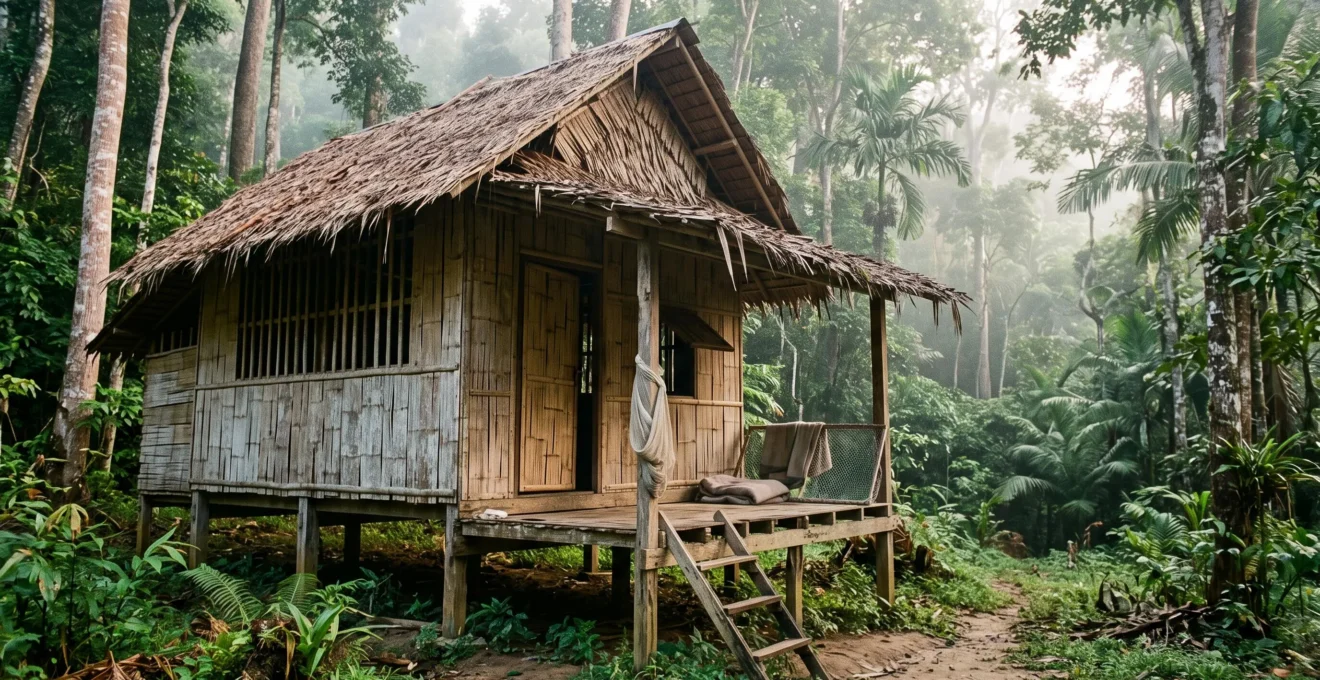
A bamboo bungalow in Thailand can mean two very different things: a lightweight structure that works with the tropical climate, or a conventional hotel room decorated with bamboo panels. Both may look appealing in photographs. Only a closer examination of construction, energy use, water management, and local ownership reveals what the environmental claims actually mean.
Authentic bamboo accommodation often trades sealed rooms and predictable temperatures for natural airflow, closer contact with the landscape, and simpler infrastructure. That experience can be rewarding in Khao Sok’s rainforest, beside a river in Kanchanaburi, or in a northern mountain village. It can also mean insects, damp bedding, limited electricity, and considerably less acoustic privacy.
The goal is not to find the most rustic-looking hut. It is to identify a property whose construction and daily operations support credible sustainability claims while meeting your actual comfort needs. The following criteria help you evaluate photographs, question operators, recognize regional weather risks, and choose an accommodation that delivers the nature experience you intended to book.
How to recognize a genuinely sustainable bamboo bungalow
- Inspect the structure, not the decoration: ventilated bamboo walls, sensible foundations, and evidence of repair are more informative than bamboo furniture or an eco label.
- Verify operations: ask about electricity, water, wastewater, waste disposal, bamboo sourcing, and the people who own and maintain the property.
- Match the season and comfort level to your destination. Fan-only rooms, regional monsoons, and boat access can determine whether a stay feels restorative or frustrating.
- Why Real Bamboo Bungalows Don’t Have Air-Con: The Natural Ventilation Trade-Off
- Where to Find Authentic Eco-Bamboo Bungalows: The 8 Properties Actually Built Sustainably
- Bamboo Bungalows or Boutique Hotels: Which Delivers the Thailand Nature Experience You Want?
- The Monsoon Bamboo Bungalow Mistake: Why Beach Eco-Lodges Close May-October
- When to Stay in Fan-Only Bamboo Bungalows: The November-February Cool Season Window
- Why Real Bamboo Bungalows Don’t Have Air-Con: The Natural Ventilation Trade-Off (What to Check Before You Book)
- Bamboo Bungalows or Boutique Hotels: The Sustainability Question Behind Your Choice
- How to Experience Khao Sok’s 160-Million-Year-Old Rainforest Without a Cookie-Cutter Tour
Why Real Bamboo Bungalows Don’t Have Air-Con: The Natural Ventilation Trade-Off
Traditional bamboo bungalows often rely on natural ventilation rather than air-conditioning because their permeable walls and openings allow outdoor air to circulate. Sealing those openings would change how the building works. However, air-conditioning is not definitive evidence of greenwashing: a bamboo structure can incorporate enclosed spaces, and sustainability depends on more than its cooling system.
In an open-air bungalow, thermal comfort comes from moving air rather than holding a fixed indoor temperature. Woven bamboo panels, slatted walls, elevated floors, and shaded openings can support circulation. Deep roof overhangs help keep direct rain and sunlight away from vulnerable wall sections.
Research on traditional buildings in Nakhon Si Thammarat documents woven and slatted bamboo walls that encourage natural ventilation in hot, humid conditions. The researchers also found buildings combining bamboo with other materials, demonstrating why research on traditional bamboo architecture in southern Thailand supports examining construction details rather than insisting every component must be bamboo.
For travelers, the first inspection can happen before booking. Look for photographs that reveal how the building actually handles heat, rain, and insects.
- Walls: Visible woven panels, split bamboo, or ventilated slats, rather than decorative bamboo fixed over opaque masonry.
- Floor: Raised construction with a clear explanation of the supporting structure and its foundation.
- Roof: Generous overhangs and rain protection suited to the location.
- Openings: Mosquito screens or bed nets that protect sleeping areas without eliminating airflow.
- Orientation: An operator who can describe prevailing breezes, afternoon sun exposure, and shade.
Fan-only accommodation has consequences. Tropical humidity can make bedding feel damp, air movement may become inadequate during still weather, and a fan is useful only when electricity is available. A solar-powered lodge may have battery limitations, while a grid-connected property may offer continuous power. Neither arrangement should be assumed.
A listing promising both fully sealed, air-conditioned luxury and authentic open-air bamboo living deserves closer inspection. The combination is not impossible, but it may describe a concrete or masonry room with a bamboo exterior. Ask for an unedited photograph of the wall structure before drawing conclusions.
Travelers who need reliable climate control for health, sleep, or personal comfort should favor accommodation that provides it. A genuinely sustainable booking is not one that requires guests to tolerate conditions unsuitable for them.
Once the building itself makes sense, the next challenge is finding operators willing to document what they actually built.
Where to Find Authentic Eco-Bamboo Bungalows: The 8 Properties Actually Built Sustainably
Thailand offers promising regions for authentic bamboo accommodation, but eight individual properties cannot responsibly be certified as sustainably built from the available evidence. A credible shortlist needs property-specific information about structural materials, sourcing, treatment, ownership, and operations. Until those claims are independently checked, geographic candidates are more useful than an unsupported ranking of eight supposedly verified lodges.
The research should begin with the building’s lifecycle. Ask whether structural bamboo was treated against insects and decay, whether borax-based treatments or other preservation methods were used, and how treated material is handled at replacement. Untreated bamboo may require more frequent maintenance, but the appropriate treatment and replacement interval depend on exposure, design, species, and workmanship.
Local sourcing matters as well. Rather than accepting an arbitrary sourcing radius, ask which materials come from nearby communities, who harvests or supplies the bamboo, and whether local craftspeople participate in construction and repairs. Request information about selective harvesting, material replacement, and waste handling.
Eight useful accommodation search areas can be grouped by ecosystem. These are search starting points, not eight verified sustainable properties.
| Setting | Search area | What to verify |
|---|---|---|
| Rainforest | Khao Sok village | Wall materials, ventilation, drainage, and local operation |
| Rainforest and lake | Cheow Lan Lake | Raft construction, wastewater systems, and boat logistics |
| Jungle river | Sai Yok, Kanchanaburi | Riverbank impacts, foundations, and sewage disposal |
| Jungle river | Sangkhlaburi region | Flood exposure, sourcing, and local ownership |
| Island | Koh Phayam | Storm resilience, material transport, and seasonal operation |
| Coastal | Trang coastal islands | Boat access, shoreline impacts, and water management |
| Mountain | Chiang Mai province | Cold-night comfort, local craftsmanship, and smoke-season exposure |
| Mountain | Mae Hong Son province | Locally sourced materials, wastewater, and community participation |
A lake raft, a coastal hut, and a mountain bungalow face different engineering pressures. A design appropriate for sheltered inland terrain cannot automatically be considered safe or sustainable on an exposed beach. Likewise, a building with minimal concrete may still require engineered foundations or anchoring to withstand local hazards.
Independent certification provides another line of inquiry. The GSTC announcement of its certified hotel directory explains how travelers can investigate accommodation certified through accredited certification bodies. The directory is not a bamboo-construction registry, however, and smaller family-run lodges may operate responsibly without participating in formal certification programs.
What documented bamboo construction can establish
A scientific study examined six vernacular buildings incorporating bamboo in two communities in Nakhon Si Thammarat. It documented traditional wall techniques, local material use, and craftsmanship.
The findings demonstrate relevant construction practices, not the environmental performance of commercial bungalows. They cannot establish that any individual accommodation business is sustainable.
Nearby copycat properties may reproduce a successful eco-lodge’s visual language without copying its practices. To test a listing, ask for a construction photograph, the name or location of its bamboo supplier, and a description of its wastewater system. Specific, consistent answers are more informative than promotional claims about living in harmony with nature.
A shortlist becomes dependable only after each operator supplies verifiable evidence. That groundwork also makes it easier to decide whether rustic accommodation is the right experience in the first place.
Bamboo Bungalows or Boutique Hotels: Which Delivers the Thailand Nature Experience You Want?
A bamboo bungalow is generally the better fit for travelers seeking direct exposure to the natural environment, including outdoor sounds, moving air, and less separation from wildlife. A boutique hotel suits travelers who want access to natural settings while retaining controlled temperatures, privacy, and predictable amenities. Neither category automatically delivers a more sustainable or meaningful experience.
The difference often becomes obvious after sunset. In an open-air bamboo bungalow, insects may gather around lights, frogs and cicadas become part of the soundscape, and neighboring guests may be audible through thin walls. A boutique hotel can offer the same forest view while insulating guests from those conditions.
For some travelers, hearing gibbons at dawn without leaving bed is the reason to choose a bungalow. Others want a quiet night’s sleep before spending the day trekking. Both preferences are legitimate.
| Criterion | Open-air bamboo bungalow | Boutique hotel |
|---|---|---|
| Nature immersion | Direct exposure to weather, wildlife sounds, and outdoor air | Nature primarily experienced through views and activities |
| Temperature | Dependent on ventilation, fans, and weather | Often controlled through enclosed rooms and air-conditioning |
| Noise and privacy | Sound passes more easily through lightweight walls | Generally better separation, depending on construction |
| Bathrooms | May be shared, detached, or partially open-air | More often private and enclosed |
| Wildlife and insects | Greater potential for direct encounters | Reduced exposure in properly sealed accommodation |
| Transport | Remote sites may require boats or additional transfers | Access depends on location and property type |
| Environmental performance | Potentially lower operational energy demand, requiring verification | Highly variable; credible sustainability measures are possible |
Nightly rates can be misleading. A simple bungalow may require a long-tail boat transfer, national park admission, meals supplied by the operator, or a separately booked guide. A hotel with a higher room price may be accessible by road and provide transport or breakfast. Compare the total cost of the stay, including transfers and activities, rather than room prices alone.
Privacy also deserves consideration. A bamboo wall may visually screen a sleeping area while doing little to suppress conversations. Some properties have shared outdoor bathrooms, while others offer enclosed private facilities. Ask directly rather than assuming rustic means communal.
A useful compromise is a hybrid itinerary: spend one or two nights in an open-air bungalow and use a more comfortable hotel before or afterward. That approach lets travelers experience rainforest mornings without requiring every night of their holiday to involve the same level of exposure.
Comfort preferences are only half the equation. Even a well-matched accommodation can disappoint if its location is affected by seasonal weather or unreliable transport.
The Monsoon Bamboo Bungalow Mistake: Why Beach Eco-Lodges Close May-October
Some Thai beach eco-lodges close during the southwest monsoon because rough seas, exposed shorelines, difficult boat transfers, or seasonal maintenance make operations less practical. However, May through October is not a universal closure period. The Andaman coast and the Gulf of Thailand experience different rainfall patterns, and individual opening schedules must be confirmed directly.
The southwest monsoon generally affects Thailand from mid-May to mid-October, while the northeast monsoon typically influences the country from mid-October to mid-February. The northeast system can also bring substantial rain to southern Gulf-facing areas, including late in the year. These regional differences are explained in the Thai government explanation of monsoon patterns.
For a bungalow beside the Andaman Sea, changing sea conditions may make a boat transfer more consequential than the rainfall itself. A remote island lodge that relies on boats for guests, provisions, and emergency access faces different risks from a road-accessible inland lodge.
Lightweight bamboo construction also requires appropriate protection from persistent moisture, wind-driven rain, and deterioration. Yet bamboo does not inherently mean a building is unsafe during storms: design, maintenance, exposure, foundations, and engineering matter. Some operators may close seasonally or remove lightweight components, but this should not be assumed for every property.
| Region | Broad seasonal pattern | Booking implication |
|---|---|---|
| Andaman coast | Southwest monsoon commonly brings wetter conditions from around May to October | Confirm boat services, sea exposure, and actual opening dates |
| Southern Gulf coast | Northeast monsoon can bring substantial rain later in the year | Do not assume November and December are uniformly dry |
| Inland rainforest | Rainfall patterns differ from exposed coastal destinations | Ask about trails, flooding, access roads, and activity cancellations |
| Northern mountains | Cooler, drier conditions often occur during the northeast monsoon | Check overnight temperatures and regional air quality |
Even when a lodge remains open, services can vary. Boat schedules, restaurant operations, staffing, and excursions may change in poor weather. These are property-specific possibilities, not verified conditions at any particular lodge.
Before paying a deposit, request confirmation that the exact accommodation category is operational throughout your stay. Ask whether access depends on sea conditions, which transfers are included, and what happens if transport cannot operate safely. A booking-platform availability calendar is not a substitute for those answers.
Rainy-season rainforest stays can still be worthwhile for travelers who enjoy dramatic vegetation, rain sounds, and flexible outdoor plans. Lower prices may be available at some properties, but neither discounts nor daily operating conditions can be assumed without checking.
Once the destination’s rainfall pattern is understood, the next decision is whether the nights will be comfortable enough without mechanical cooling.
When to Stay in Fan-Only Bamboo Bungalows: The November-February Cool Season Window
November through February is often the most comfortable period for fan-only bamboo bungalows in much of northern and central Thailand. Cooler nights and reduced humidity can make natural ventilation more pleasant. The recommendation is less reliable in southern Gulf-facing destinations, where substantial rain may persist, and it does not eliminate local variations in temperature or weather.
During cooler nights, the same ventilation that seems insufficient in hot, still weather becomes one of the bungalow’s strengths. Air can move through the structure without the noise or energy demand of air-conditioning, and shaded interiors may feel comfortable well into the morning.
However, a fan-only room does not guarantee a comfortable temperature. Elevation, tree cover, orientation, building materials, and the weather on a particular night all influence sleeping conditions. In an exposed northern mountain bungalow, a blanket may be more useful than a fan. In a lowland tropical setting, humidity can remain noticeable even during the cooler season.
The hours before sunrise are often the coolest part of the night because the ground and surrounding surfaces have been losing heat since sunset. Travelers sleeping beneath thin walls or roofs may notice that change more clearly than guests in insulated buildings.
This period can also coincide with strong demand at popular national parks, islands, and nature destinations. The trade-off is straightforward: weather that favors passive cooling may also attract more visitors. Booking ahead can improve your accommodation choices, while carefully selected shoulder-season dates may provide a different balance between comfort and visitor numbers.
Northern Thailand introduces another consideration. Seasonal agricultural and landscape burning can contribute to haze and poor air quality, particularly during parts of February through April, although severity and timing vary. Before committing to an open-air stay in Chiang Mai or Mae Hong Son, review current air-quality conditions rather than relying solely on temperature forecasts.
For night-by-night planning, think in terms of three distinct experiences: early evening may retain warmth from the day, the middle of the night may feel cooler as surfaces lose heat, and the pre-dawn hours may require an additional layer in mountain settings. These are general expectations, not a substitute for a location-specific forecast.
Once the season looks suitable, the final accommodation check should move beyond climate into sanitation, insect protection, security, and everyday maintenance.
Why Real Bamboo Bungalows Don’t Have Air-Con: The Natural Ventilation Trade-Off (What to Check Before You Book)
Before booking an open-air bamboo bungalow, verify how its walls are built, how the sleeping area is screened, what electricity is available, and how guests protect belongings and bedding. A property can have convincing bamboo architecture yet still be unsuitable if its mosquito netting is damaged, its drainage is poor, or its security arrangements are unclear.
Start with photographs that show the sleeping area, ceiling, wall joints, floor, bathroom, and exterior foundations. Wide-angle marketing images may reveal a beautiful setting without showing whether gaps are protected, whether the roof leaks, or whether the mattress is raised away from moisture.
Ask whether mosquito protection covers the entire bed and whether screens are fitted around the sleeping area. A decorative mosquito net is not enough if it has holes or cannot be tucked or closed properly. Mattress condition, dry linen storage, and clean bedding are similarly important in humid locations.
Bamboo also requires maintenance. Weathering, replacement panels, or repaired joints can reflect an actively maintained structure, especially where exposed material is periodically renewed. However, visible deterioration should not be interpreted automatically as authenticity. Structural damage, unstable flooring, significant rot, or poorly secured connections are warning signs, not badges of sustainability.
Insect protection is a health consideration as well as a comfort issue. The CDC Yellow Book guidance for Thailand identifies malaria risk in particular rural and forested border areas rather than treating the entire country as equally exposed. Travelers should check recommendations for their precise itinerary, including whether preventive medication is appropriate.
Mosquito avoidance remains sensible beyond malaria-risk areas because mosquitoes can transmit other illnesses. For open-air accommodation, consider suitable repellent, protective clothing, intact bed nets, and any destination-specific recommendations from a qualified travel-health professional.
Five checks to complete before paying for a bamboo bungalow
- Request construction evidence: Obtain at least one clear photograph showing exterior walls, structural supports, and the foundation, and record the operator’s description of the primary building materials.
- Confirm sleeping protection: Request a photo or written confirmation of intact bed nets or screens, together with mattress and linen arrangements.
- Check essential services: Obtain written details of electricity hours, fan availability, drinking water, toilet type, and wastewater treatment.
- Verify maintenance and security: Ask when the bamboo structure was last inspected or repaired and confirm whether doors, windows, and valuables storage can be secured.
- Document environmental claims: Record answers about bamboo sourcing, treatment, local ownership, solar power, waste separation, and any composting-toilet claims, keeping the operator’s responses with your booking confirmation.
Composting toilets and solar power deserve particular scrutiny. A claimed composting toilet should have a clear management and maintenance process. A solar-powered bungalow should be able to explain which systems run on solar electricity, whether batteries or backup generation are used, and whether power is available overnight.
For travelers carrying medication requiring refrigeration, expensive equipment, or important mobility aids, reliable facilities may be non-negotiable. Open-air accommodation should be selected around those needs rather than justified solely by its appearance.
When the practical conditions are acceptable, the remaining question is whether the bungalow’s environmental and social benefits are as convincing as its construction.
Bamboo Bungalows or Boutique Hotels: The Sustainability Question Behind Your Choice
A genuinely low-impact bamboo bungalow may use fewer energy-intensive materials and less operational electricity than a conventional air-conditioned hotel room. It may also support local livelihoods through construction, maintenance, and staffing. But neither benefit is automatic: overall sustainability depends on the entire building lifecycle, energy supply, water management, waste disposal, and distribution of tourism income.
The material comparison begins with structure rather than appearance. Bamboo wall panels attached to a conventional concrete building do not erase the impacts of that building. Equally, a bungalow incorporating some concrete in carefully designed foundations is not necessarily environmentally inferior to a completely bamboo-clad structure.
Construction quantities, durability, transport, maintenance, and end-of-life treatment all matter. Without comparable lifecycle assessments for specific properties, a precise claim about how much carbon one option saves would be unjustified.
Operational electricity presents a more straightforward comparison in principle. A fan-only room generally requires less electricity for cooling than an otherwise comparable air-conditioned room. The actual difference depends on equipment, operating hours, climate, occupancy, and other building characteristics. Solar generation can influence the electricity supply, but it does not independently establish that the whole operation is sustainable.
Water and sanitation can change the assessment. A lodge with minimal electricity use but untreated wastewater entering a nearby river may cause serious local environmental harm. Conversely, a well-managed hotel with substantial amenities may have carefully documented waste, water, and energy practices.
Local economic impact should be assessed separately from material impact. Locally owned accommodation employing nearby craftspeople and guides may retain more tourism value within the community. Yet this is a plausible benefit to investigate, not a guaranteed characteristic of every bamboo bungalow.
Ask who owns the business, who maintains the buildings, where food is purchased, and whether guiding work goes to local operators. Community participation should be evidenced through specific arrangements, not simply through the presence of traditional decorations.
Hypothetical booking comparison: what would make the difference?
Imagine two accommodation options. The first is a locally owned bamboo bungalow using fans, treated greywater, and locally contracted maintenance. The second is an air-conditioned boutique hotel with independently assessed sustainability practices and a documented water-treatment system.
Choosing between them requires information about construction, energy, water, waste, and employment. The bungalow may have a smaller operational energy demand, while the hotel’s documented systems may offer stronger assurance in other areas. Neither option can be declared the overall winner from appearance alone.
A useful final question is what you are actually buying. Is it a closer relationship with the landscape, evidence of low-impact operations, support for a local business, or the reliability of established amenities? Different priorities can produce different responsible choices.
This values-based approach becomes particularly important in Khao Sok, where the choice between a mainland lodge and a floating lake bungalow changes both the experience and the practical demands of the trip.
Key takeaways before planning Khao Sok
- Choose the landscape first: a mainland rainforest lodge and a floating lake bungalow offer different access to wildlife, trails, and guided activities.
- Investigate wastewater management and local guiding arrangements as carefully as bamboo construction, especially for accommodation built directly over water.
- Reserve enough flexibility for transfers, weather, and early-morning activities; the most immersive option is not necessarily the most convenient.
How to Experience Khao Sok’s 160-Million-Year-Old Rainforest Without a Cookie-Cutter Tour
To experience Khao Sok beyond a standard group excursion, choose accommodation according to the habitat you want to explore and prioritize smaller guided activities with time for observation. A mainland lodge offers flexibility around trails and local services, while a floating bungalow on Cheow Lan Lake places you deeper within the lake landscape but adds boat logistics and operational considerations.
Khao Sok is widely described as an ancient rainforest landscape, with the 160-million-year figure used in destination descriptions. That age reference should not be confused with evidence that individual trees or today’s forest ecosystem have existed unchanged for that entire period.
For travelers evaluating bamboo accommodation, the most useful distinction is between mainland and lake-based stays.
| Consideration | Mainland lodge | Floating lake bungalow |
|---|---|---|
| Landscape | Forest-edge terrain and access to land-based activities | Open water, limestone cliffs, and surrounding rainforest |
| Access | Typically reached by road | Requires boat transport |
| Activities | Guided walks and excursions arranged from the mainland | Lake-based excursions and activities determined by the operator |
| Flexibility | Greater freedom to arrange meals, transport, and activities | More dependent on scheduled transport and accommodation arrangements |
| Environmental checks | Land drainage, wastewater, and building materials | Wastewater containment, waste removal, raft construction, and boat operations |
Floating accommodation should not automatically be labeled a bamboo bungalow. Some raft houses incorporate other materials, and their actual construction varies. Ask what supports the floating platform, what the sleeping-room walls are made from, and how sewage and greywater are managed. A traditional-looking raft with poor wastewater practices would undermine the environmental case for staying there.
Standard group excursions may combine a boat trip, meal, cave visit, and several viewpoints into a tightly organized schedule. These activities can be enjoyable, but they leave limited time for listening, waiting, or following fresh wildlife signs.
A smaller guided experience may offer more room for early starts, slower observation, and adapting the route to conditions. When comparing operators, ask who leads the excursion, how many guests participate, whether a local guide accompanies the group, and how much of the itinerary is spent actually observing the forest.
Wildlife expectations should remain realistic. Visitors may hear gibbons calling before seeing any primates at all. Hornbills and macaques are possible sightings, but their presence at any given location or time is not guaranteed. Wild elephants require still more luck, suitable habitat, and appropriate distance. A knowledgeable guide improves identification, interpretation, and responsible viewing; no guide can promise encounters.
For a more immersive itinerary, consider spending two or three nights in the wider Khao Sok area rather than relying exclusively on a single day trip. A hypothetical plan could use an initial mainland night for orientation and a guided walk, followed by a lake stay with a properly arranged dawn activity. Confirm transport, available accommodation, guide arrangements, and national park requirements before treating that plan as bookable.
Access from Phuket, Krabi, or other Andaman coast destinations usually involves road transport toward the Khao Sok area, followed by additional travel if continuing to Cheow Lan Lake. Transfer arrangements, journey times, and boat departure points depend on the exact starting location and operator, so they should be confirmed rather than estimated from promotional maps.
Khao Sok’s rainforest also responds differently to the seasons than an exposed beach. Rain may be central to the atmosphere, but heavy downpours can affect trail safety, visibility, boat operations, and particular activities. Build flexibility into the itinerary and follow local safety instructions, especially around caves, waterways, and changing weather.
For your next booking decision, request construction details, wastewater information, and a written activity plan from your preferred Khao Sok operator. Choose the stay whose environmental practices, transport arrangements, and level of immersion match your priorities—not simply the bungalow that looks most authentic in photographs.
Is a bamboo bungalow automatically more environmentally friendly than a concrete hotel?
No. Bamboo construction can offer material and ventilation advantages, but environmental performance also depends on durability, foundations, energy, transport, water use, waste management, and maintenance. A responsible comparison requires evidence about actual operations and construction rather than judging properties by their appearance.
Does a sustainable bamboo bungalow need to have a composting toilet?
Not necessarily. Composting toilets can be one wastewater-management option, but they require suitable design and ongoing maintenance. Other well-managed sanitation systems may also be appropriate. The important question is how sewage and wastewater are collected, treated, and kept out of surrounding ecosystems.
Can a family-run bamboo lodge be sustainable without an eco-certification?
Yes. Formal certification can provide useful independent assurance, but the absence of certification does not prove poor practices. Small operators may have limited resources for certification. Travelers should seek specific evidence about materials, energy, waste, ownership, and community participation, while recognizing that self-reported claims are not independently verified.
Are bamboo bungalows suitable for travelers with limited mobility?
Accessibility varies significantly. Raised floors, steps, uneven paths, detached bathrooms, and boat-only access can create barriers. Some properties may provide more accessible arrangements. Request photographs and measurements of entrances, walkways, beds, and bathrooms, and obtain confirmation that the required facilities will be available throughout the stay.
What should travelers do if a bungalow’s eco claims cannot be verified?
Ask for specific evidence rather than assuming dishonesty. Useful requests include construction photographs, details of local sourcing, an explanation of wastewater disposal, and information about energy supply. If important claims remain unanswered, treat them as unverified and compare other properties. Uncertainty is a valid reason to choose a more transparent operator.