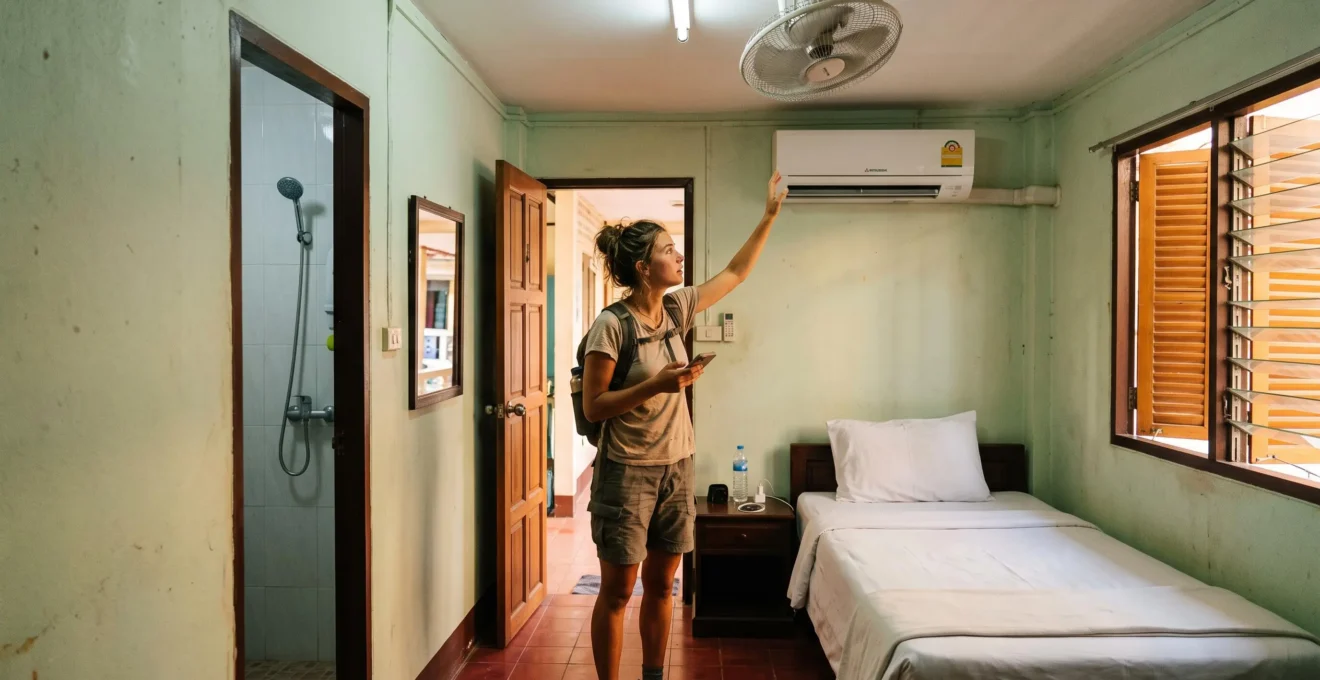
A traditional Thai guesthouse does not have to mean sleeping under a noisy fan, struggling with unreliable internet or taking cold showers. Across Thailand, travellers can find family-run properties and historic buildings that retain their local character while offering air-conditioning, modern bathrooms and practical connectivity.
The challenge is identifying which properties actually provide these comforts. A listing marked “free Wi-Fi” says little about connection quality. A photograph showing an air-conditioning unit does not prove that every room has one. Even “hot water” can describe very different shower arrangements.
Start by filtering for air-conditioning, private bathroom, hot water and Wi-Fi, then verify each amenity against photographs, recent reviews and direct confirmation from the property. Pay particular attention to the exact room category and rate.
This approach helps budget-conscious travellers distinguish genuinely upgraded Thai guesthouses from basic accommodation without automatically paying boutique-hotel prices.
Finding a comfortable Thai guesthouse: the essentials
- Check the exact room: confirm that air-con, a hot shower and Wi-Fi are included in the room category you are booking.
- Verify performance, not just availability: inspect bathroom and air-con photographs, recent reviews and room-specific internet speed evidence.
- Match comfort to the trip: climate, season, length of stay and sleeping preferences determine whether a fan room is a sensible saving.
- Why Some Thai Guesthouses Refuse to Install Air-Con: The Authenticity-Versus-Comfort Debate
- Where to Find Thai Heritage Architecture With Modern Comfort: Boutique Adaptive Reuse Hotels
- Basic Fan Room or Modern AC Room: Is the Upgrade Worth It? Assessing Price Against Comfort in Thailand
- The Thai Guesthouse « Wi-Fi » That Can’t Stream Video: How to Verify Internet Speed Before You Book
- How to Find Recently Upgraded Thai Guesthouses: Reading ‘Renovated’ Signals in Listings and Reviews
- Fan Room or AC Room — Budget Allocation Rules for Longer Stays and Group Trips
- When ‘Renovated 2023’ Is Marketing vs. Reality — Spotting Surface-Level Upgrades
- How to Choose Thai Accommodation: Hotels, Guesthouses, Hostels, or Homestays for the Comfort You Want
Why Some Thai Guesthouses Refuse to Install Air-Con: The Authenticity-Versus-Comfort Debate
Some Thai guesthouses remain fan-only because air-conditioning would require substantial electrical upgrades, changes to an older building or investment that the business cannot easily recover. Preserving traditional architecture can also influence the decision, but the absence of air-con is not necessarily an intentional authenticity statement. For travellers, the important question is whether the room’s natural ventilation is sufficient for their dates and sleeping needs.
Older timber houses and converted shophouses were not necessarily designed around modern compressor units. Installing split air-conditioning may involve electrical capacity checks, refrigerant piping, drainage, external condenser placement and suitable mounting locations. In a heritage building, protecting original materials can complicate the work.
For a small family-run guesthouse, equipment purchases, installation, servicing and electricity are ongoing business considerations. Owners may prefer to maintain inexpensive fan rooms rather than reposition the property at a higher price point.
Season and room design matter more than the word “authentic”. The Thai government‘s overview of Thailand’s seasons identifies a hot season broadly from mid-February to mid-May, with the hottest weather around mid-April. The cool season generally runs from mid-October to mid-February. These are national seasonal patterns, not predictions of indoor room temperature.
Use the following criteria to judge a fan-only listing:
- Potentially suitable: a naturally ventilated room with shaded windows, high ceilings, cross-breezes and a location experiencing relatively cooler nights.
- Higher discomfort risk: a top-floor room beneath a heat-absorbing roof, a poorly ventilated building or a lowland destination during particularly hot and humid weather.
- Personal considerations: light sleepers, travellers sensitive to humidity and guests who need daytime rest may benefit more from air-conditioning.
Inspect the bedroom photographs for ceiling or pedestal fans, operable windows, shutters and evidence of ventilation. If no air-conditioning unit appears anywhere, ask whether any room category has one. Descriptions such as “traditional style” or “natural cooling” do not establish the actual equipment.
Fan-only properties can still offer valuable experiences: timber interiors, shaded verandas, shared courtyards and closer interaction with local hosts. Those advantages are meaningful when the sleeping conditions are acceptable.
A fan room is a reasonable choice when ventilation, climate and personal tolerance align. Travellers who want traditional surroundings without sacrificing predictable cooling should also consider thoughtfully modernised heritage accommodation.
Where to Find Thai Heritage Architecture With Modern Comfort: Boutique Adaptive Reuse Hotels
Thai heritage architecture and modern amenities can coexist in restored shophouses, converted historic residences and carefully adapted timber buildings. Phuket Old Town is a useful starting point, while Chiang Mai and Bangkok offer additional architectural styles worth investigating. The key is to verify that the original character is accompanied by functional air-conditioning, dependable bathroom plumbing and room-level Wi-Fi coverage, rather than relying on the word “boutique”.
The Tourism Authority of Thailand‘s Phuket Old Town information describes historic Sino-European terraced buildings, including properties converted into accommodation. Streets such as Thanon Dibuk, Thanon Phang Nga, Thanon Krabi and Soi Romanee offer a practical geographical starting point for researching converted shophouse accommodation.
Other useful architectural search categories include Lanna-inspired or historic timber properties around Chiang Mai and traditional riverside wooden houses in Bangkok. These are search directions, not guarantees that a specific building is historic or renovated.
The quality of adaptive reuse depends on work that may be invisible in promotional photographs. A split air-con unit needs appropriate installation and drainage. Thick walls and unusual room layouts can complicate wireless coverage. Older plumbing may need modifications before modern showers provide consistent water temperature.
Look beyond attractive courtyards and decorative floor tiles. Bedroom photographs should reveal the actual cooling equipment, while bathroom images should show the shower arrangement. If the property advertises fast internet, confirm whether access points serve the bedrooms rather than only reception.
Original heritage buildings and heritage-style new construction are not equivalent. Original floorboards, weathered structural features, deep shophouse layouts and consistent street surroundings can support a property’s historical description, but photographs alone cannot authenticate its age. Check historical or conservation information where available, and ask the owner directly about the building’s history.
For an efficient search, identify a historic district on Google Maps, examine accommodation options inside that area, filter listings by required amenities and compare current guest photographs with the property’s professional images. Search for “restored shophouse hotel”, “heritage guesthouse with air conditioning” or “converted timber house private bathroom”.
Prime-location heritage accommodation can also cost more than an ordinary family-run guesthouse. Compare the full nightly price against nearby conventional hotels, not just against low-cost fan rooms.
The goal is a property whose traditional setting improves the stay without concealing practical shortcomings. Once suitable buildings are shortlisted, the next decision is how much extra comfort is worth paying for.
Basic Fan Room or Modern AC Room: Is the Upgrade Worth It? Assessing Price Against Comfort in Thailand
Upgrading from a fan room to an air-conditioned room is usually worth considering when heat, humidity or sleep disruption could affect the following day. However, the right choice depends on the actual price difference, travel season, room quality and how long the traveller will spend inside. An AC room is not automatically better if its bathroom, noise insulation or overall condition is inferior.
Start by comparing room rates for the same property and travel dates. A fixed upgrade assumption, such as £8 per night, is only useful as a hypothetical budgeting scenario. Actual differences can change across destinations, room categories, availability and booking conditions.
Consider a hypothetical booking where an air-conditioned room costs £8 more per night. Over seven nights, that is £56 more before any other price differences. Whether the additional cost is worthwhile depends on how much sleep comfort it provides and which other amenities are included.
Seasonal conditions can change the decision significantly. Thailand’s nationally defined hot season makes cooling particularly relevant around April, while relatively cooler conditions in parts of northern Thailand during December may make naturally ventilated rooms more appealing. However, humidity, building design and individual tolerance remain important even outside the hottest months.
Compare the complete room experience rather than the cooling label alone:
| Criterion | Fan room | Air-conditioned room |
|---|---|---|
| Temperature control | Depends on ambient conditions and ventilation | Can provide adjustable cooling if properly maintained |
| Humidity | Limited direct humidity control | May reduce indoor humidity during cooling |
| Windows and insects | Open windows may require effective screens | Closed windows may reduce insect entry |
| Street noise | Open-window ventilation can increase exposure | Closed windows may reduce outside noise |
| Hot shower | Must be verified separately | Must be verified separately |
| Price | May be cheaper | May cost more or be included in the base rate |
Air-conditioned rooms do not necessarily include better beds, improved soundproofing or hot water. Those features sometimes accompany renovated room categories, but each requires independent confirmation.
A useful compromise is an AC room where cooling can be used only during sleeping hours. Ask whether the unit has a working timer, whether electricity is included and whether the guest controls the temperature. For a fan room, check the number and condition of fans, the window arrangement and whether an additional portable fan is available.
Paying for cooling makes sense when it improves the part of the trip that matters most: restorative sleep. For travellers who also work online, internet performance needs an equally practical assessment.
The Thai Guesthouse « Wi-Fi » That Can’t Stream Video: How to Verify Internet Speed Before You Book
A Thai guesthouse advertising free Wi-Fi may offer anything from a reliable connection in every room to weak coverage near the bedroom door. The listing label confirms neither speed nor stability. Before booking, remote workers and frequent video callers should obtain recent evidence of download speed, upload speed and connection quality from the actual room or at least the same floor.
Internet performance depends on several components: the external connection supplied to the building, the number of users sharing it, wireless equipment, room location and interference. Even a fast fibre connection can perform poorly if guests connect through an overloaded router or weak wireless repeater.
According to Cisco Meraki‘s technical documentation on Wi-Fi signal range, wall materials, wall thickness and radio-frequency interference affect indoor wireless coverage. An advertised internet plan therefore cannot establish the signal available in a particular guesthouse bedroom.
Ask the property whether it uses fibre internet, another fixed broadband connection or mobile connectivity. Then request a recent speed-test screenshot taken inside the room category being offered, ideally at a time when other guests are using the network.
For remote work, verify three different characteristics: download throughput for receiving data, upload throughput for sending video and files, and latency or connection stability for responsive calls. A single strong download result does not establish all three.
For context, Zoom‘s published Web App requirements specify approximately 3.8 Mbps upload and 3.0 Mbps download for 1080p individual video calls. These are application bandwidth specifications, not a guarantee that a connection meeting those values will remain stable during a meeting. Network variation and other users can still affect performance.
The specific room matters. A speed test taken beside reception does not establish the connection available through several walls or on a different floor. Ask for the room number, access-point location and recent guest feedback about connectivity.
Five checks to complete before booking a connected guesthouse
- Identify the room: save the exact room category and any assigned room number in your shortlist.
- Confirm the internet service: obtain a written answer naming the connection type and whether Wi-Fi reaches the bedroom.
- Request a speed test: save a dated screenshot showing download, upload and latency measured from the relevant room or floor.
- Review recent experiences: record at least the available dated comments addressing video calls, disconnections or weak signals, noting when no useful reviews exist.
- Plan a backup: identify a suitable local SIM or eSIM option and check reported mobile coverage around the property before relying on it.
Even convincing evidence cannot guarantee future internet performance. If work commitments are critical, consider a mobile-data backup and ask whether the property has a suitable desk, accessible power sockets and a quiet area for calls.
A credible internet listing should survive questions about room location, upload speed and reliability. Similar scrutiny is useful when a guesthouse claims to have been renovated recently.
How to Find Recently Upgraded Thai Guesthouses: Reading ‘Renovated’ Signals in Listings and Reviews
Recently upgraded Thai guesthouses can be identified by comparing room photographs, renovation descriptions and dated guest reviews rather than relying on a renovation label alone. The strongest evidence concerns individual improvements: visible air-con units, updated bathrooms, functioning hot-water systems and documented changes in guest experience. Always confirm whether those upgrades apply to the room rate being offered.
Search accommodation descriptions for terms such as “recently renovated”, “refurbished rooms”, “new bathrooms”, “new air-conditioning” and “hot shower”. On platforms with keyword search, these phrases can narrow the shortlist, although a dedicated filter for a specific renovation year may not exist.
Modern split air-conditioning units, contemporary shower fittings, glass bathroom partitions and updated electrical outlets can be useful visual clues. They do not establish when work took place, whether installations are functional or whether photographs show the room being booked.
Review dates are often more informative than marketing dates. Compare older comments with newer ones, looking for changes in references to cooling, bathroom condition, water temperature, cleanliness and internet performance.
For example, a hypothetical review sequence might show older complaints about cold showers followed by recent comments reporting newly installed water heaters. That pattern would justify further investigation, but it would not prove that every room has been upgraded or that the showers operate reliably today.
Distinguish three renovation levels:
- Cosmetic refresh: new paint, reception furniture, lighting or decorative finishes.
- Bedroom refurbishment: updated beds, cooling units, windows, flooring or electrical fittings.
- Functional infrastructure upgrade: work affecting bathroom plumbing, water heating, wiring, internet distribution or other building systems.
The third category is especially relevant to travellers who prioritise practical comfort, but it may be difficult to assess from photographs. Ask whether the room has a dedicated shower heater, whether air-conditioning is included and whether its internet access has been improved.
Do not assume image metadata is available. Booking platforms may resize or process uploaded pictures, removing useful original camera information. Instead, compare photograph publication context where available, visible fixtures and dated customer images.
A guesthouse with verified improvements may provide more comfort than a visually impressive but poorly maintained property. For longer trips, the next consideration is whether that comfort remains affordable across the entire stay.
Fan Room or AC Room — Budget Allocation Rules for Longer Stays and Group Trips
For longer stays and group bookings, the best fan-versus-AC decision depends on total accommodation cost rather than the nightly room supplement alone. An upgrade that seems minor for a weekend can become significant over several weeks or multiple rooms. Weekly rates, room-specific discounts and travellers’ differing sleeping preferences can make a mixed accommodation strategy more economical than choosing one standard for everyone.
Start with the number of nights and rooms. Multiply the actual nightly difference by the booking duration and number of rooms affected, then compare the resulting total with any available long-stay prices.
Hypothetical example: allocating a cooling budget
Suppose a guesthouse offers a fan room and an air-conditioned room with a hypothetical £8 nightly difference. For a couple sharing one room over 14 nights, the additional cooling cost would be £112 if the nightly rates remained unchanged.
If a group booked three separate rooms for the same period and upgraded all three, the hypothetical additional cost would be £336. Upgrading only one room would reduce that difference to £112. These figures illustrate budgeting arithmetic, not verified Thai guesthouse prices or available offers.
Before committing to several weeks, ask whether weekly or monthly rates apply, which services are included and whether electricity is charged separately. A long-stay discount can change the comparison, while a separate cooling charge can make a nominally cheaper room less attractive.
For couples, consider whether both occupants sleep comfortably at the same temperature. One partner’s sensitivity to heat or fan noise can make an AC room worth more than the apparent price difference suggests.
Groups have additional flexibility. They can book different room categories if the property offers them, prioritising air-conditioning for light sleepers while others choose fan rooms voluntarily. Confirm that all rooms meet the group’s minimum bathroom and security requirements.
Use a comfort-per-baht comparison instead of evaluating air-con in isolation. Rate each candidate room against the factors that matter to the travellers, such as sleeping temperature, hot-water reliability, mattress condition, noise, Wi-Fi and location.
| Priority | What to verify | Why it matters |
|---|---|---|
| Sleep quality | Cooling, bed, noise and ventilation | Determines overnight comfort |
| Bathroom | Private facilities and working hot shower | Affects everyday convenience |
| Connectivity | Room-level Wi-Fi and backup options | Supports work and communication |
| Full-stay cost | Room rate, electricity and additional fees | Reveals the actual financial commitment |
For extended trips, the location may also influence comfort. A well-ventilated fan room near essential services may suit a flexible traveller, while someone spending working hours indoors may benefit more from reliable cooling and internet access.
The most useful budget is one that protects essential comfort without purchasing amenities nobody needs. That principle becomes especially important when a property advertises renovations whose scope remains unclear.
When ‘Renovated 2023’ Is Marketing vs. Reality — Spotting Surface-Level Upgrades
“Renovated 2023” indicates a claimed refurbishment period, not necessarily a complete modernisation of the guesthouse. The work may have involved paint, furnishings or public areas while bedrooms, showers and electrical systems remained unchanged. To judge the claim, identify which improvements were made, which rooms received them and whether construction has fully finished before the intended stay.
A property’s renovation date can be accurate but insufficiently specific. Refurbishing a reception desk and repainting corridors are materially different from fitting new air-conditioning units, upgrading electrical circuits or installing reliable hot-water systems.
Examine photographs for evidence corresponding to the amenity that matters. New curtains do not prove improved cooling. Modern bathroom tiles do not establish water pressure or consistent heating. A visible split AC unit demonstrates equipment presence, but not its age, maintenance or performance.
Ask about the booked room, not the building. Some properties renovate accommodation in stages. An advertised refurbishment may cover premium rooms while lower-priced categories continue using older facilities. Ask the host whether the named room category was included in the work and whether the photos are current.
A concise written message can resolve several uncertainties: “Was this exact room category included in the renovation? Does it now have working air-conditioning, a private hot shower and Wi-Fi inside the room? Are the photographs of the room being offered?”
Renovation timing also matters. Improvements undertaken during an operating season can create noise, dust, temporary access restrictions or unavailable communal facilities. Ask whether work has finished and whether any additional construction is scheduled during the booking dates.
Check recent reviews for references to drilling, maintenance workers, unfinished bathrooms or closed spaces. Such comments are clues requiring confirmation, particularly when the situation may have changed since the review was posted.
When answers are vague, request updated photographs or consider a refundable booking option if available. Avoid assuming that an attractive renovation date carries a particular standard of facilities.
A credible renovation should be evident in the facilities the guest will actually use. With the specific upgrades verified, the final step is choosing the accommodation category most likely to deliver the required experience.
Key takeaways before choosing your accommodation
- Decide whether reliable cooling, private hot water and room-level internet access are essential requirements or negotiable preferences.
- Compare property categories using the total price and the exact room facilities, not accommodation labels alone.
- Confirm amenities and any additional charges in writing before finalising a booking.
How to Choose Thai Accommodation: Hotels, Guesthouses, Hostels, or Homestays for the Comfort You Want
The right accommodation type in Thailand depends on how much consistency you need from the facilities and how much local character you want. Hotels may offer more standardised room amenities, while guesthouses and homestays can provide a more personal experience with greater room-to-room variation. Hostels occupy a middle ground, ranging from shared dormitories to private rooms with modern conveniences. In every category, the final decision should be based on verified amenities rather than the property label.
A family-run guesthouse can offer a well-equipped private room alongside simpler fan-only accommodation. A homestay may provide modern facilities but operate them differently from a conventional hotel. Meanwhile, a hostel may have excellent communal Wi-Fi but offer limited privacy or shared showers.
Use accommodation categories as an initial search guide, not a guarantee of quality.
| Accommodation type | What to expect | What to verify |
|---|---|---|
| Conventional hotel | Often more standardised facilities, depending on property and room tier | Air-con inclusion, private bathroom, hot water and Wi-Fi quality |
| Family-run guesthouse | Potentially varied room categories and more individual character | Exact room facilities, cooling charges and bathroom configuration |
| Hostel | Shared or private accommodation, sometimes with modern communal facilities | Dormitory cooling, shower sharing, quiet hours and bedroom connectivity |
| Homestay | Residential surroundings with property-specific facilities | Heating arrangements, electricity costs and where Wi-Fi is accessible |
| Heritage boutique property | Traditional architectural character with potentially upgraded facilities | Functional renovations, room-level coverage and total price |
Price bands alone do not establish whether air-conditioning or hot showers are standard. Higher-priced accommodation may offer more conveniences, but the specific property, destination and room rate determine what is included. Conditions can differ between major cities, islands and rural areas without any universal price threshold.
Pay particular attention to how amenities are delivered and charged. A hot shower might use a compact instantaneous electric heater rather than a central hot-water system. That arrangement is not inherently inadequate, but working temperature control and water pressure still need confirmation.
Likewise, “air-conditioning available” might describe certain upgraded rooms, or cooling that attracts a separate electricity charge during longer stays. “Wi-Fi available” may mean coverage in reception or common areas rather than in the bedroom.
The most reliable booking sequence is straightforward: define essential amenities, filter accommodation categories within budget, inspect the exact room photographs, compare recent reviews and obtain written confirmation of any unclear details. For stays involving online work, add room-level internet verification and a backup connectivity plan.
Shortlist two or three properties that meet your non-negotiable requirements, compare their full-stay prices and message each property with the same specific questions about air-con, Wi-Fi and hot showers. Book the room whose facilities, conditions and total cost have been confirmed—not simply the listing with the most attractive photographs.
Do Thai guesthouses usually include hot showers?
Hot showers are available in many types of Thai accommodation, but they should not be assumed in every guesthouse or room category. Check for a private bathroom with hot water, inspect shower photographs and ask whether the heater is working. An electric instantaneous shower heater can provide hot water without a central boiler.
Can a Thai guesthouse charge separately for air-conditioning?
Yes, separate cooling or electricity charges are possible, particularly under certain long-stay arrangements. Ask whether AC use is included in the quoted rate, whether electricity is metered separately and whether any usage restrictions apply. Obtain the total price and conditions in writing before booking.
How can travellers confirm amenities when guesthouse photographs are outdated?
Compare recent guest-uploaded photographs with promotional images, prioritise dated reviews and request current pictures of the exact room category. Ask the property to show the air-conditioning unit, shower fittings and relevant room features. If the operator cannot confirm the amenities, treat the listing as unverified.
Is mobile data a reliable alternative to guesthouse Wi-Fi in Thailand?
A local SIM or eSIM can provide an important backup, but performance depends on mobile coverage, building materials, network congestion and the chosen plan. Verify compatibility with your phone, check coverage at the accommodation and confirm whether hotspot use is permitted under the selected plan. Critical video calls should not depend on an untested mobile connection.
Should travellers test air-conditioning and hot water immediately after check-in?
Yes. Switch on the air-conditioning and confirm that it cools the room, test the shower carefully for comfortable warm water, and connect to Wi-Fi from the bedroom. Report any problem promptly, ideally before unpacking, so the host can investigate or discuss available alternatives. This does not replace pre-booking checks, but it helps identify issues early.