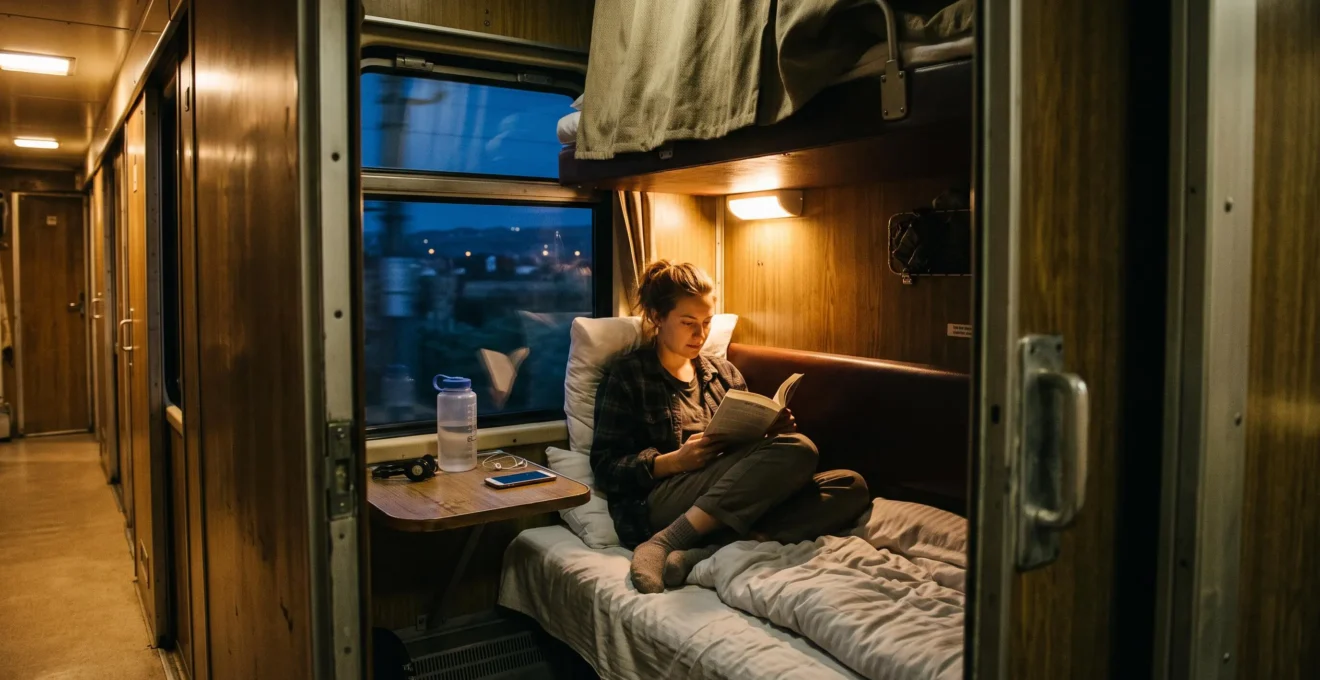
There is a particular pleasure in leaving Bangkok after dark, watching station lights slip past your window, and waking as northern Thailand emerges from the morning mist. The Bangkok–Chiang Mai sleeper train offers something a flight cannot: the feeling of travelling somewhere rather than simply arriving.
But romance comes with practical compromises. You may spend the night behind a curtain rather than a compartment door, feel the carriage sway beneath you, and arrive with less sleep than you would have enjoyed in a hotel. Some trains use modern sleeping cars; others retain older configurations with distinctly vintage fittings.
Booking the right sleeper means choosing the train, carriage class and berth position together. It also means understanding when tickets become available, whether air-conditioning is worth paying for, and how an overnight arrival fits into the next morning’s plans.
For travellers who appreciate railway history without expecting hotel-level comfort, those decisions can turn an unpredictable night into a memorable part of a Thailand itinerary.
Bangkok–Chiang Mai sleeper trains: the essentials
- Book the berth, not just the train. Second-class lower bunks generally provide more space; upper bunks cost less but are narrower.
- Choose the experience deliberately. An overnight train can replace a hotel night, but uninterrupted sleep is never guaranteed.
- Check official availability early. Eligible Thai rail services have an announced advance-booking limit of up to 180 days, subject to service-specific conditions.
- Why Sleeper Trains Save Money but Cost You Sleep: The Rest-Quality Reality
- Thai Sleeper Train Fan Class or Air-Con: Which Upgrade Is Worth It?
- Overnight Train or Flight: Is the 12-Hour Rail Journey Worth Skipping the 1-Hour Plane?
- The Sleeper Train Berth That Ruins Sleep: Why Upper Bunks Cost Less for Good Reason
- When to Book Bangkok-Chiang Mai Sleeper Trains: The Advance Booking Window
- Fan Class or Air-Con: Practical Trade-Offs Most Reviews Skip
- Berth Position, Luggage and Night Routine: Making Any Bunk Work
- How to Travel Between Thai Provinces: The Bus, Train, and Flight Decision Matrix
Why Sleeper Trains Save Money but Cost You Sleep: The Rest-Quality Reality
A Thailand sleeper train can reduce accommodation expenses by combining a night’s transport with a place to lie down. However, a sleeping berth is not equivalent to a hotel bed. Carriage movement, shared spaces, station stops and unfamiliar surroundings can interrupt rest, making the train most attractive when the journey itself matters as much as the potential saving.
Two kinds of fatigue shape the comparison. Transport fatigue comes from vibration, noise, movement and interrupted sleep. Logistical fatigue comes from airport transfers, security procedures, baggage handling and navigating unfamiliar terminals. The train reduces some logistical demands while creating a different sleeping environment.
Neither is inherently worse. A traveller who sleeps easily on moving vehicles might reach Chiang Mai reasonably refreshed. Someone who wakes whenever a door closes may spend much of the night listening to the train.
Before booking, assess your sleeping habits against three practical criteria:
- Noise sensitivity: Do small sounds wake you, or can you sleep through conversations and mechanical noise?
- Movement tolerance: Can you fall asleep in a moving vehicle, even when the motion is irregular?
- Comfort requirements: Do you need a wide mattress, a particular sleeping position or a consistently controlled temperature?
Second-class sleeper accommodation is an open-plan environment separated by individual curtains. Train attendants convert daytime seating into beds and provide bedding. These features create a recognisable overnight railway experience, but they do not eliminate movement or neighbouring activity.
Intermediate station stops can bring changing noise and light conditions. Announcements and platform activity vary by service, so it would be misleading to predict a precise number of sleep interruptions.
Earplugs, an eye mask and a small overnight bag can help. Choosing a suitable berth also matters more than buying accessories after discovering that the bunk itself is uncomfortable.
Importantly, no reliable sleep study in the supplied evidence establishes that passengers lose a fixed number of hours on Thai sleeper trains. The amount of rest remains individual.
The sleeper train works best when the night is part of the holiday rather than an inconvenient substitute for a proper bedroom. Once that expectation is established, carriage class becomes the next meaningful choice.
Thai Sleeper Train Fan Class or Air-Con: Which Upgrade Is Worth It?
Air-conditioning is generally the more predictable choice for travellers concerned about heat and humidity, while a fan-equipped sleeper appeals to those who prefer natural ventilation and an older railway atmosphere. Neither is universally better. Availability, weather, carriage design, sensitivity to cold air and the actual fare difference determine whether paying extra provides meaningful comfort.
Thailand’s second-class sleepers are not all identical. As documented in The Man in Seat Sixty-One’s Thailand train guide, second-class sleeping accommodation can be air-conditioned or non-air-conditioned, with configurations that vary by train.
In a conventional second-class sleeper, facing seats become a lower berth, while an upper berth folds down above. Curtains provide individual privacy. This differs substantially from first-class sleeping accommodation, where passengers occupy enclosed compartments.
The distinction between fan and air-con should therefore not be confused with the distinction between private and shared accommodation.
| Comfort factor | Fan-equipped sleeper | Air-conditioned sleeper |
|---|---|---|
| Airflow | Ceiling fans and opening windows on documented older configurations | Mechanically cooled air inside the carriage |
| Temperature | More exposed to external weather conditions | Less dependent on outside heat, but potentially cold |
| Noise | Fan noise and potentially greater external noise | Ventilation noise and possible airflow near the berth |
| Sleeping atmosphere | Traditional open-air railway feeling | More enclosed, climate-controlled environment |
| Suitability | Travellers comfortable with variable temperatures | Travellers prioritising protection from overnight heat |
Season matters. Warm, humid conditions can make a fan-only carriage less appealing, while cooler weather may reduce the value of air-conditioning. Northern Thailand can feel different from Bangkok, but the temperature inside a specific coach cannot be predicted reliably from the destination alone.
For couples, berth proximity may outweigh the air-conditioning decision. Two places in the same class do not necessarily mean adjacent bunks. First-class connecting compartments exist on certain trains, but their availability requires confirmation.
Price differences also change. An £8 upgrade may sound attractive, but it should be treated as a hypothetical budget example, not a verified current fare. Compare live prices for the same departure and berth category.
Cheaper accommodation can also become unavailable before more expensive options. There is no verified universal sell-out order, making simultaneous availability checks more useful than assumptions about which class will remain on sale.
Air-conditioning can improve comfort without guaranteeing better sleep. The next question is whether the entire overnight journey makes more sense than flying.
Overnight Train or Flight: Is the 12-Hour Rail Journey Worth Skipping the 1-Hour Plane?
Flying from Bangkok to Chiang Mai is substantially faster in elapsed travel time, while the overnight sleeper train offers accommodation and transport in one journey. The train becomes attractive when avoiding a hotel night, enjoying rail travel and arriving in the morning outweigh the cost of potentially poorer sleep. Neither option is automatically cheaper once transfers and accommodation are included.
The published timetable for Bangkok–Chiang Mai Special Express 13 gives a useful reference point: departure from Krung Thep Aphiwat at 20:05 and arrival in Chiang Mai at 08:45 the following day, a scheduled journey of 12 hours and 40 minutes.
These timings come from RailThailand’s train 13 timetable, updated in January 2026. They are scheduled times rather than a guarantee of punctuality and should be confirmed before departure.
By contrast, FlightConnections’ Bangkok–Chiang Mai flight schedule lists a direct flight duration of approximately 1 hour and 20 minutes between Suvarnabhumi Airport and Chiang Mai International Airport.
The difference in time spent aboard is substantial. However, comparing a flight duration with an overnight train journey omits everything that happens before and after boarding.
| Factor | Overnight sleeper train | Direct flight |
|---|---|---|
| Scheduled onboard journey | 12 hours 40 minutes for train 13 in the cited timetable | Approximately 1 hour 20 minutes for the cited airport pair |
| Departure preparation | Station transfer, ticket and platform checks | Airport transfer, check-in and security |
| Overnight accommodation | Sleeping berth serves as overnight accommodation | Separate accommodation may be needed |
| Rest quality | Variable, with railway movement and shared spaces | Depends on the wider itinerary and accommodation |
| Arrival planning | Morning arrival on the cited service, subject to delays | Depends on the selected flight schedule |
For cost comparisons, calculate the complete travel scenario: ticket, luggage charges where applicable, station or airport transfers, overnight accommodation and any additional expenses resulting from arrival time.
Consider a hypothetical traveller choosing between a sleeper fare and a low-cost flight. If the flight requires an additional hotel night, the train may have a financial advantage even with a more expensive ticket. If the traveller already has accommodation booked, that saving disappears.
Three questions help settle the decision:
- Is arriving in Chiang Mai during the morning genuinely useful for the itinerary?
- Will replacing one accommodation night materially improve the overall budget?
- Can you sleep sufficiently well in a moving, shared railway carriage?
Travellers answering yes to all three have a strong practical reason to consider the sleeper. Those prioritising uninterrupted rest and minimum elapsed journey time will usually find flying more suitable.
Avoid booking an expensive, non-refundable activity immediately after the scheduled train arrival. Delays are possible, even though the supplied evidence does not establish their frequency.
The transport decision is only half the calculation. If the sleeper wins, the difference between an upper and lower berth can have a surprisingly large effect on the night.
The Sleeper Train Berth That Ruins Sleep: Why Upper Bunks Cost Less for Good Reason
Lower berths are generally wider and more convenient to access, while upper berths are narrower, require climbing and offer limited space for sitting upright. That explains why upper berths are commonly cheaper. Nevertheless, an upper bunk can suit an agile, budget-conscious traveller who values separation from daytime seating activity more than extra sleeping width.
Traditional Thai second-class sleepers begin the journey as rows of facing seats. During the evening, staff convert the seating into sleeping accommodation, with one passenger using the lower berth and another using the fold-down upper bunk.
The lower berth usually offers more sleeping width and easier movement between bed and aisle. Its disadvantage is that it occupies the space used for daytime seating, so passengers need to coordinate around the bed-conversion routine.
The upper berth can feel more secluded, but access involves a ladder or climbing arrangement, and overhead clearance is restricted. Tall passengers, restless sleepers and people who regularly get up during the night may find these limitations significant.
Airflow adds another complication. Depending on the carriage, an upper bunk may be nearer an air-conditioning outlet or experience different temperatures from the lower berth. Neither warmer nor colder conditions can be assumed across every train type.
For couples, sharing a pair of nearby berths can be practical, but the ticketing interface must confirm the actual places allocated. It is particularly important not to assume that booking two passengers automatically produces adjacent positions.
If one traveller has restricted mobility, the lower berth is generally the more accessible arrangement within a conventional second-class sleeper. However, lower does not necessarily mean wheelchair-accessible: entrances, corridors, toilets and carriage layouts still need individual verification.
The fare difference pays primarily for a different physical position and amount of space, not for guaranteed silence or better sleep.
Before paying, inspect the booking details for the coach, class and berth position. If the interface does not clearly identify upper or lower placement, seek confirmation through the booking channel rather than hoping to exchange places after boarding.
A suitable lower berth may be worth paying more for, but even the best position cannot compensate for a booking made too late to secure the preferred train.
When to Book Bangkok-Chiang Mai Sleeper Trains: The Advance Booking Window
Book Bangkok–Chiang Mai sleeper trains as soon as your dates and preferred berth are reasonably certain, especially around busy travel periods. Thailand announced advance reservations of up to 180 days for eligible services, rather than a universal 75-day window. The applicable booking horizon and seat availability must still be checked for the specific service and sales channel.
In September 2024, Thailand’s Government Public Relations Department published an announcement extending advance railway reservations from 90 to 180 days. The announcement identifies 58 trains across several railway routes and service categories.
The Thai government’s railway advance-booking announcement identifies three official reservation channels: the D-Ticket system, railway stations nationwide and the State Railway of Thailand call centre at 1690.
Up to 180 days
Maximum advance reservation window announced for eligible Thai railway services in September 2024. This is not a guarantee of availability or a confirmed booking window for every departure in October 2026.
Thailand Government Public Relations Department, September 2024 railway reservation announcement.
Advance-booking limits should not be confused with the date on which an individual reseller begins accepting confirmed reservations. Third-party agencies may use different sales processes, and the supplied evidence does not establish that they receive inventory at the same moment as official channels.
Demand also depends on the calendar. International tourism seasons are relevant, but Thai holidays and long weekends can increase domestic travel demand regardless of international visitor numbers. A quiet-looking tourist date is not necessarily a quiet railway date.
For travellers whose itinerary depends on a particular night train, waiting until the day before departure creates unnecessary uncertainty. Last-minute reservations may succeed during quieter periods, but they should not be treated as a dependable strategy for securing a specific sleeping berth.
Use the official booking channel as the reference for train availability and fare conditions. Station staff can also help clarify an uncertain seat allocation, although no evidence establishes that ticket counters consistently provide more inventory or greater booking reliability than the official digital system.
If a preferred sleeper is unavailable, widen the search in stages: first check other berth positions on the same departure, then other available sleeping classes or services. Next, consider alternative travel dates or a different departure point if the resulting itinerary is genuinely convenient. Finally, compare an overnight bus or flight rather than relying on an unconfirmed rail connection.
Five checks before confirming your sleeper ticket
- Identify your departure and destination stations, travel date and preferred train number; save these details in your itinerary.
- Check the official booking system for the chosen service and record which sleeping classes are actually available.
- Select an upper or lower berth deliberately and verify its coach and position before proceeding to payment.
- Review the displayed fare, passenger details, cancellation conditions and payment total; retain the booking summary.
- After payment, save the ticket or reservation confirmation and verify the boarding station and scheduled departure time.
Keep in mind that information published in 2024 does not by itself verify every operating rule in 2026. The specific service’s current booking display is the decisive practical reference.
Once the ticket is secured, comfort comes back into focus. Ventilation noise, cold air and luggage security are easy to overlook when the only comparison on screen is the fare.
Fan Class or Air-Con: Practical Trade-Offs Most Reviews Skip
The difference between fan and air-conditioned sleepers extends beyond temperature. Both can introduce noise, uneven airflow and compromises in personal comfort. The better choice depends on which conditions disturb your sleep, the particular carriage operating on your train, and the actual price difference. Paying more for cooling does not automatically buy a quieter night.
In a non-air-conditioned carriage with opening windows and ceiling fans, passengers experience a more direct connection with the outside environment. That may be part of the attraction: changing air, passing stations and the mechanical rhythm of an older train.
It also means greater exposure to variable air temperatures and potentially more external sound. Opening windows do not provide the same environment as mechanically cooled accommodation.
An air-conditioned sleeper changes the problem rather than eliminating it. Cooling can be welcome during warm nights, yet ventilation outlets may produce a persistent airflow or make particular sleeping positions feel chilly. A light extra layer can be useful for passengers who dislike cold air.
The value of an upgrade is personal. Imagine a hypothetical £8 difference between two available sleeping options over a night in which a traveller expects to use the berth for eight hours. The simple additional cost would be £1 per anticipated berth-hour. That calculation illustrates expenditure, not a measurable increase in sleep quality.
For someone highly sensitive to heat, the additional expense might be easy to justify. Someone who sleeps comfortably in variable temperatures but finds mechanical airflow irritating may reasonably choose differently.
Security deserves similar attention. Curtains provide privacy, but they are not lockable compartment doors. In ordinary second-class sleeping accommodation, keep essential valuables in a small bag close to you rather than leaving them loose or visible in a large suitcase.
First-class compartments provide a different privacy arrangement, but a compartment should not be treated as a guarantee against theft. Sensible precautions remain appropriate across all classes.
Before booking, distinguish between confirmed carriage features and subjective passenger impressions. A review describing a particularly cold bunk may accurately reflect one journey without predicting conditions on every departure.
The aim is not to find a perfectly silent or climate-controlled railway bed. It is to understand the environment well enough to prepare for it, especially when deciding what to bring aboard.
Berth Position, Luggage and Night Routine: Making Any Bunk Work
A comfortable sleeper-train routine starts before the attendant prepares the bed. Keep overnight essentials separate, confirm where luggage can be stowed, and understand how to reach the aisle safely from your berth. Upper and lower bunks require different compromises, but a little preparation reduces unnecessary movement, misplaced belongings and interruptions once the carriage settles for the night.
Thai sleeper arrangements vary by train and carriage. Documented storage options include luggage racks, spaces beneath seating and areas beside the seats. Do not assume every coach has an identical luggage compartment or that a large suitcase will fit beneath your particular berth.
A practical packing arrangement separates bulky luggage from items needed between departure and arrival.
- Keep your ticket, phone, charging cable and essential medication within easy reach.
- Pack earplugs, an eye mask and a light extra layer in a compact overnight bag.
- Store larger luggage only in an appropriate available space, without blocking aisles or exits.
- Keep money, passport and other valuables close rather than buried in unattended luggage.
In traditional second-class sleeping cars, the daytime seats are converted by an attendant, who prepares the mattress, pillow and bedding. This is part of the experience and removes the need for passengers to assemble their own sleeping platform.
Before the conversion, retrieve anything that might become difficult to access when seats are rearranged. Travellers in upper bunks benefit particularly from doing so because climbing down repeatedly can become tiresome.
Train catering requires advance thought. Major overnight services may offer restaurant-car facilities or onboard food arrangements, but exact availability, serving hours and menus depend on the service. Bringing suitable water and a modest snack avoids relying on facilities that have not been confirmed for the departure.
Train 13’s published route includes intermediate stops such as Ayutthaya, Phitsanulok, Nakhon Lampang, Khun Tan and Lamphun. This gives the journey a distinctive progression through the night and early morning, but individual stops should not be interpreted as guaranteed opportunities to leave the train or purchase food.
No verified universal lights-out time or restaurant closing time applies across every sleeper service in the supplied evidence. Follow the actual carriage arrangements and staff instructions rather than organising the night around an assumed timetable.
Travellers with limited mobility should investigate carriage entry, toilet access, corridor width and assistance arrangements before purchasing. Exact berth dimensions and accessibility features are not established for every coach type, so a generic second-class description is insufficient for determining whether a journey will be manageable.
Tall passengers should pay particular attention to bunk width and clearance. Where possible, confirm the rolling-stock type and inspect reliable carriage photographs before selecting a position.
As Chiang Mai approaches, organise belongings while there is still time. Keep footwear accessible, check the sleeping area carefully, and avoid treating the scheduled arrival as an exact deadline for onward travel.
By morning, the real benefit of good preparation becomes clear: less time sorting bags in the aisle and more attention available for the arrival itself. The same planning principles apply to other journeys across Thailand.
Key takeaways before planning other Thai routes
- Compare complete journeys, including accommodation, transfers and the effect of overnight travel on the following day.
- Verify that a direct railway service actually exists before building a multi-province itinerary around trains.
- Keep independent connections flexible, particularly when a delay could affect a ferry, flight or onward bus.
How to Travel Between Thai Provinces: The Bus, Train, and Flight Decision Matrix
Choose transport between Thai provinces according to the available network, total journey time, comfort requirements and budget rather than distance alone. Trains are particularly attractive on suitable intercity corridors, buses often reach places without direct rail connections, and flights can save substantial time on longer routes. The Bangkok–Chiang Mai sleeper is a useful comparison model, not a universal solution.
Thailand’s railway network serves specific corridors rather than every provincial destination. A station’s presence in the wider region does not necessarily mean a direct service exists between the two places a traveller wants to visit.
For instance, Ayutthaya lies on the northern railway corridor, making train travel relevant for many journeys involving Bangkok and points further north. Surat Thani functions as an important southern rail gateway, although onward transport may be required for destinations beyond the station.
Udon Thani belongs to a different intercity travel corridor, while journeys combining northern provinces may require a mixture of train and road transport. The appropriate connection must be checked against the actual route rather than inferred from geographic proximity.
Use the following matrix as a planning framework rather than a timetable or a claim about fares.
| Journey type | Transport to investigate first | When another option makes sense |
|---|---|---|
| Short intercity trip with a direct rail link | Train | Bus or road transport if station access makes rail inconvenient |
| Medium-distance provincial journey | Train or bus, depending on the corridor | Road transport where rail connections are indirect |
| Long journey with a suitable overnight service | Sleeper train when accommodation and experience matter | Flight when elapsed travel time is the priority |
| Route without direct rail service | Bus or combined transport | Train plus onward road or ferry connection where practical |
| Time-sensitive multi-province itinerary | Most reliable feasible direct connection | Flight or alternative route where rail transfers introduce excessive risk |
Distance alone cannot determine the best choice because transport networks, connection times and departure schedules shape the journey. A reasonably short route requiring awkward changes may take longer than a more distant direct service.
The Bangkok–Chiang Mai comparison illustrates the broader principle. A night train provides the dual function of transport and sleeping accommodation, but that benefit disappears when an itinerary requires daytime travel, poor connections or an arrival time that creates additional accommodation expenses.
Connecting tickets also need careful treatment. Purchasing separate rail, bus, ferry or flight segments does not automatically create a protected connection. The supplied sources do not establish a universal rule covering missed connections across operators or online reservation platforms.
For independently booked segments, leave enough time to absorb plausible disruption. The appropriate margin depends on route frequency, alternative services, luggage arrangements and the consequences of missing the next departure. Avoid inventing a single safe connection interval for every province.
The strongest itineraries use trains where their route and timetable are advantageous, not merely because rail travel sounds appealing. A sleeper can become a journey highlight without turning every subsequent transfer into a test of endurance.
Start with the actual timetable for your preferred travel date, confirm available seats and onward connections, and then decide whether the sleeper’s atmosphere justifies the time and comfort compromises. The best night-train itinerary is one that leaves room to enjoy the journey and the destination.
Do Bangkok–Chiang Mai sleeper trains all use old carriages?
No. Carriage types differ between services. Specialist railway documentation identifies trains 9 and 10 as using modern Chinese-built sleeping cars introduced in 2016, while other services have different configurations. Confirm the train number rather than assuming every sleeper uses vintage rolling stock.
Are second-class sleeper berths private?
Second-class sleeping accommodation generally uses an open-plan arrangement with individual berth curtains rather than private lockable rooms. First-class sleepers offer enclosed compartments on applicable services. Check the class and carriage configuration before booking if privacy is a priority.
Which Bangkok station should passengers use for the Chiang Mai sleeper?
Long-distance Bangkok–Chiang Mai services documented in the supplied railway guides use Krung Thep Aphiwat Central Station rather than the former Hua Lamphong terminus. Always confirm the departure station on your actual ticket because boarding at the wrong station can invalidate otherwise careful planning.
Can two passengers book a private sleeper compartment together?
First-class sleeping accommodation includes enclosed compartments, and certain configurations offer connecting compartments. Availability is train-specific and depends on the seats or rooms remaining for sale. Two tickets in second class should not be mistaken for a private compartment.
Is breakfast guaranteed on the overnight train to Chiang Mai?
No. Food services and restaurant-car arrangements differ across trains and operating conditions. The available documentation does not guarantee breakfast on every departure. Check the service information and bring something suitable to eat if you need breakfast before reaching Chiang Mai.