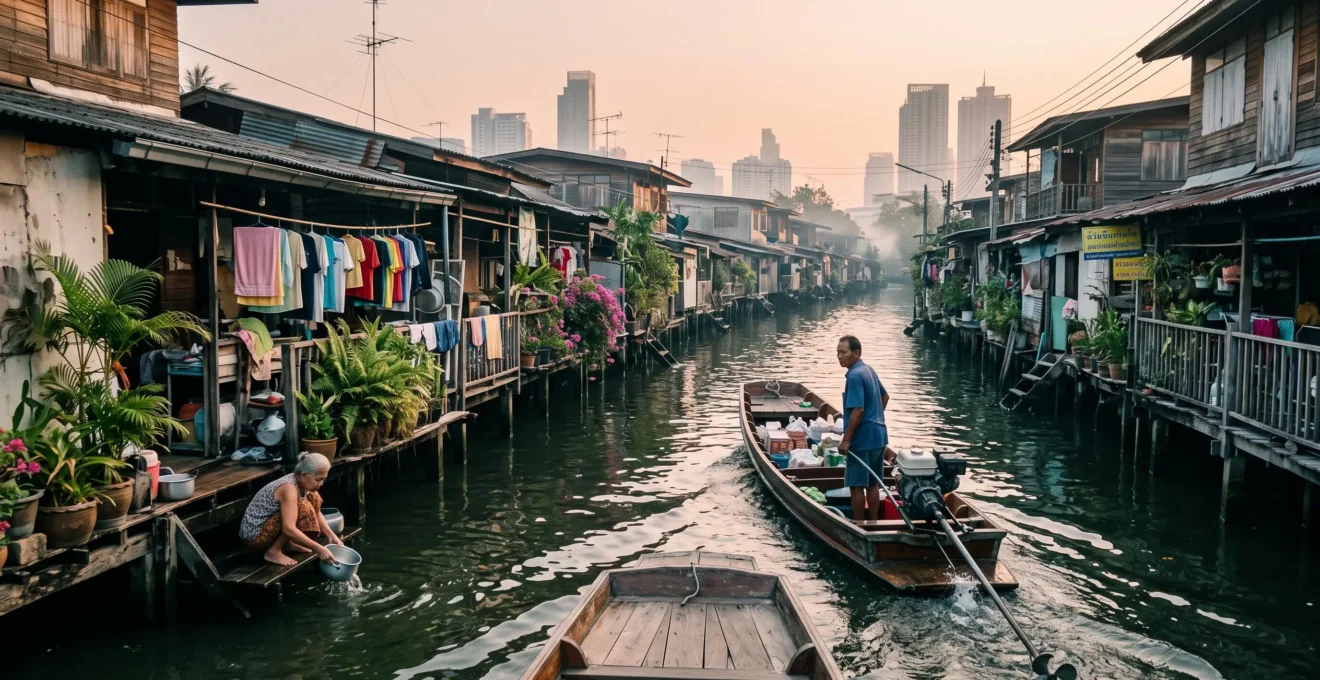
Beyond Bangkok’s elevated railways, shopping districts and glass towers, residential canals still carry traces of a city once organized around water. In parts of Thonburi, particularly around Khlong Bangkok Noi and Khlong Bang Luang, wooden houses stand beside waterways, small landing platforms connect homes to boats, and neighborhood life continues alongside a changing urban landscape.
These are not reconstructed villages or attractions maintained exclusively for tourists. They are places where people live, work, raise families and negotiate the pressures of modern Bangkok. Some stretches welcome visitors through local businesses and community activities; others remain entirely residential.
Visiting responsibly means choosing an appropriate waterway, understanding what ordinary canal life looks like, and accepting that access to someone’s neighborhood does not imply access to their private life. A carefully arranged boat journey can reveal Bangkok’s older urban geography while directing spending toward the people who sustain it.
Visiting Bangkok’s living canal communities: essential decisions
- Where to go: Explore Thonburi waterways such as Khlong Bangkok Noi and Khlong Bang Luang, prioritizing routes with identifiable community access points.
- How to visit: Choose a resident guide or locally operated boat where available, confirm the actual route, and prefer quieter journeys over high-speed sightseeing.
- How to behave: Treat waterside houses as private homes, ask permission before photographing residents, and adapt to local routines rather than expecting a performance.
- Why Thonburi Still Has Canal Villages While East Bangkok Became Skyscrapers: The Development Divide
- How Canal Residents Live on Bangkok’s Khlongs: The Daily Rhythms Tourists Never See
- Bangkok Khlong Villages vs Damnoen Saduak Floating Market: Tourist Attraction or Living Community?
- The Canal Community Photography Mistake That Violates Privacy: Why Homes Aren’t Tourist Attractions
- When to Visit Bangkok’s Canal Communities: Timing, Seasons and Conditions on the Water
- How to Plan a Responsible Khlong Community Visit: Boats, Guides and Etiquette
- Beyond the Boat: Combining Khlong Visits With Bangkok’s Broader Water Heritage
- Practical Realities and Common Mistakes: Making Your Khlong Visit Succeed
Why Thonburi Still Has Canal Villages While East Bangkok Became Skyscrapers: The Development Divide
Thonburi retains recognizable canal-side neighborhoods because parts of Bangkok’s western waterway network remained integrated into residential landscapes while other districts underwent extensive road-led urbanization. The contrast is real, but not absolute: waterways survive on both sides of the Chao Phraya, and development has also transformed western Bangkok.
Historically, Bangkok’s canals connected houses, temples, orchards, markets and agricultural land. Boats provided practical movement through areas where road access was limited. As the city expanded, roads, reclaimed land and engineered water-management systems changed the functions and continuity of that network.
Scientific research on the fragmentation of Bangkok’s canal networks, published in 2025, compares historical maps with contemporary conditions in three selected canal systems. It documents unequal patterns of canal loss and urbanization rather than a simple disappearance of eastern canals and preservation of western ones.
36% canal-length loss
Approximate reduction in the studied Pra Khanong canal network between 1940 and 2024. The same research reports approximately 18% loss in the Omnont network and 17% in the Sanamchai network. These are findings for selected networks, not Bangkok-wide percentages.
Nantavisai and colleagues, Landscape Architecture Frontiers, 2025.
For visitors, the difference is visible in the relationship between buildings and transport. A modern commercial district typically organizes movement around roads and rail. Along sections of Khlong Bangkok Noi or Khlong Bang Luang, landing platforms, houses facing the canal and narrow waterside passages reveal an older spatial arrangement.
These communities should not be described as surviving merely by accident. Geography, infrastructure decisions, property arrangements and residents’ adaptations all matter. Their continued presence is also not guaranteed.
Historical research on housing and land tenure in Bangkok’s canal communities documented a housing-upgrading initiative involving nine canal settlements. Its account of community participation and tenure negotiations shows why waterside housing is inseparable from questions of land rights and development policy. The findings are historical, not a current eviction assessment.
Rising redevelopment interest and changing land uses may reshape individual waterways, but no reliable disappearance timetable applies to these neighborhoods collectively.
The most revealing comparison is not between an old city and a new one, but between urban systems that have evolved differently. Once on the water, the next step is learning how to recognize the everyday functions of the neighborhood.
How Canal Residents Live on Bangkok’s Khlongs: The Daily Rhythms Tourists Never See
Daily life along Bangkok’s residential canals is organized around homes, family routines, neighborhood access and changing relationships with the water. Visitors may observe small boats, landing platforms, local businesses and ordinary household activity, but these sights are not scheduled performances. Some residents still use water transport; others rely primarily on roads.
A stilt house is more than a picturesque wooden structure. Elevation can reflect the need to accommodate changing water conditions, while the platform beneath or beside the dwelling may provide storage, access or a place to handle household tasks. A narrow private pier can serve the practical purpose that a front gate serves elsewhere.
Look for the functional details: a moored canoe, steps descending toward the water, household objects stored above the canal, or a modest connection between the waterside dwelling and a street behind it. These features communicate more about canal living than an isolated photograph of traditional architecture.
Historical water-based activities included fishing, agricultural transport, washing and trade. Such practices should not automatically be assumed to continue at every present-day settlement. Likewise, seeing a household use a boat does not mean that every family in the neighborhood depends on one.
Morning can offer a window onto ordinary movement. Depending on the community, visitors might encounter local vendors, residents preparing for work, or religious activities. Boat-based alms giving and school transport are possibilities in relevant areas, not guaranteed daily spectacles or verified schedules for a particular route.
Not everything visible from a boat is meant for public observation. Eating, washing, caring for children and resting are private activities even when a house opens directly onto the water. A resident’s proximity does not create an invitation to watch.
To distinguish a visitor-friendly area from a residential stretch, look for community information boards, publicly accessible shops, clearly identified workshops or guidance from someone authorized to welcome visitors. An open doorway, unmarked landing or occupied veranda does not qualify as an attraction.
A local guide can help interpret these boundaries, especially where public access and private structures stand close together.
The most authentic encounter may be an uneventful one: a short passage through a neighborhood where ordinary life continues without changing for the boat. That expectation becomes particularly important when comparing residential canals with floating markets.
Bangkok Khlong Villages vs Damnoen Saduak Floating Market: Tourist Attraction or Living Community?
Damnoen Saduak Floating Market and Bangkok’s residential khlongs offer different experiences. Damnoen Saduak is an established visitor-oriented market with historical trading roots, while Thonburi’s residential waterways are primarily neighborhoods. Choose the market for accessible shopping and boat-vendor activity; choose the communities for quieter observation of waterside urban life, with greater obligations toward residents.
Damnoen Saduak is in Ratchaburi Province, approximately 80 kilometers from Bangkok. According to Thailand’s official tourism directory entry for Damnoen Saduak Floating Market, the canal historically supported transportation and agricultural trade, and the market was promoted as a tourist attraction from 1967.
Calling the entire market fake would erase that history. Its present-day commercial emphasis, however, differs from the everyday residential character of the waterways around Khlong Bang Luang and Khlong Bangkok Noi.
| Decision factor | Damnoen Saduak Floating Market | Bangkok’s residential khlongs |
|---|---|---|
| Primary purpose | Established market destination with substantial visitor-oriented commerce | Residential neighborhoods where tourism may be a secondary activity |
| Typical experience | Boat vendors, shopping, food and market activity | Canal-side architecture, household access points and neighborhood life |
| Visitor expectations | Vendors and services generally prepared for customers | Residents may have no interest in interacting with tourists |
| Planning | Travel outside Bangkok and arrange market access | Confirm a suitable canal route and any community-approved stops |
| Photography | Commercial areas may be accustomed to visitors, but personal consent still matters | Residential privacy requires particular care |
| Best suited to | Travelers seeking market commerce and a more structured outing | Travelers interested in living urban heritage and low-impact observation |
The choice does not have to be binary. Some canal neighborhoods combine permanent residences with cafés, small businesses, workshops or visitor activities. Tourism and community life can coexist, although the presence of a business does not make every nearby home publicly accessible.
Judge a destination by its everyday functions rather than by whether it contains tourists. Permanent homes, routine errands, local places of worship and non-tourist services indicate a neighborhood with a life beyond visitor spending.
Conversely, souvenir stalls and organized boat rides are not automatically evidence of a fabricated community. The useful question is whether residents control and benefit from how visitors enter their space.
A residential canal visit offers less predictability than a market outing. In exchange, it can reveal how water still shapes Bangkok’s urban life. That opportunity carries an immediate responsibility: recognizing where observation should stop.
The Canal Community Photography Mistake That Violates Privacy: Why Homes Aren’t Tourist Attractions
The most serious photography mistake on a residential khlong is treating an open waterside home as a public exhibit. A boat may pass within a few meters of someone’s kitchen, bedroom or family gathering place, but visibility is not consent. Responsible visitors photograph the wider waterway and seek permission before making identifiable residents the subject.
Traditional canal architecture creates an unusual privacy challenge. Houses may have open terraces and large openings facing the water because that side historically functioned as an entrance, working area or connection to transport.
From a passing boat, a camera can frame the inside of a house without the photographer ever stepping onto private land. The apparent openness of the structure can disguise the fact that a family is living behind the scene.
Photograph architecture without turning domestic life into a spectacle. A wide view of boats, reflections, building exteriors and canal vegetation usually communicates the setting without concentrating on a person’s private activities.
When people become the main subject, ask first. A smile or casual glance should not automatically be interpreted as permission, particularly when language barriers make intentions unclear.
Practical boundaries include:
- Keep lenses away from doorways, bedrooms and open windows, even when the boat passes close to them.
- Ask before taking identifiable portraits, especially of children or people engaged in household tasks.
- Do not request that residents repeat religious practices, household work or ordinary interactions for a photograph.
- Lower the camera immediately if someone appears uncomfortable or asks not to be photographed.
- Follow the boat operator’s instructions about sensitive stretches and places where photography should stop.
A boat operator who regularly serves a neighborhood may depend on relationships with its residents. The operator’s judgment should matter more than a passenger’s desire for a particular image.
Intrusive behavior can damage trust and may encourage communities to discourage future visitors. This is a plausible collective risk, not a documented claim that specific Bangkok neighborhoods have restricted access because of photographers.
Publishing also matters. Before posting an image online, consider whether it exposes a household’s location, captures someone in a vulnerable situation, or presents ordinary domestic activity as an exotic curiosity.
Restraint leaves room for genuine hospitality. A visitor who respects personal boundaries is better positioned to appreciate the neighborhood without disrupting it, especially during the busier parts of the day.
When to Visit Bangkok’s Canal Communities: Timing, Seasons and Conditions on the Water
Early morning is generally a practical choice for exploring Bangkok’s residential canals because temperatures are often more manageable and routine neighborhood movement may be visible. Seasonal conditions matter, but no month guarantees ideal water levels, clear weather or specific community activities. Confirm the route and boating conditions locally before committing.
The Thai Meteorological Department identifies three broad seasonal periods: a hotter season from approximately mid-February to mid-May, a rainy season from mid-May to mid-October, and a cooler season from mid-October to mid-February. These boundaries vary with annual weather conditions.
The Thai Meteorological Department’s explanation of Thailand’s seasons provides the climate framework, but not navigability predictions for individual Bangkok waterways.
| Season | Potential advantage | What to check |
|---|---|---|
| Cooler season: approximately mid-October to mid-February | Often more comfortable for an open-air excursion | Actual temperatures, water conditions and operator availability |
| Hot season: approximately mid-February to mid-May | Morning departures can avoid some of the day’s strongest heat | Sun exposure, hydration, shade and travel duration |
| Rainy season: approximately mid-May to mid-October | Changing weather can reveal the relationship between canals and urban drainage | Rainfall, storms, water conditions and possible route changes |
Rainfall can affect water levels and appearance, but its consequences depend on local infrastructure and controls. Bangkok’s waterways are managed through systems that include gates and pumping facilities. A rainy-season visit does not automatically mean impassable canals, just as dry weather does not guarantee comfortable or unrestricted navigation.
Canal water may look murky, and odors or exposed margins may be noticeable in some conditions. These possibilities are site-specific rather than reliable seasonal forecasts.
Time of day deserves equal attention. Morning provides a reasonable opportunity to encounter everyday movement without requiring residents to perform for visitors. Late afternoon can offer softer light, although boat services and local businesses may have different operating patterns.
Rather than designing an itinerary around an assumed alms round or school-boat sighting, let ordinary encounters remain unplanned.
Contact the operator the day before departure to confirm weather, water conditions, the proposed route and the possibility of cancellations or adjustments.
Seasonal planning reduces avoidable discomfort, but it cannot replace the knowledge of someone navigating the waterway. Choosing that person carefully is the next important decision.
How to Plan a Responsible Khlong Community Visit: Boats, Guides and Etiquette
A responsible khlong visit begins with choosing an operator who understands residential waterways, can explain access boundaries and is transparent about payment. Long-tail boats offer broad coverage, smaller paddled boats may suit narrow or quieter areas where permitted, and resident-led guides can provide deeper context. None of these options automatically guarantees that money reaches the community.
Begin by deciding whether your priority is covering several waterways, moving slowly through one neighborhood, or learning about community history through conversation.
Boat size matters. Motorized long-tail boats can cover greater distances, but engine noise and wake require consideration near homes and small landings. Smaller craft may permit a slower experience, although availability, safety and suitable waterways vary.
| Option | Strength | Main consideration |
|---|---|---|
| Private long-tail boat | Flexible route and potentially broader waterway coverage | Confirm whether the operator knows residential sections and can travel considerately |
| Small paddled boat | Potentially quieter, slower observation where services exist | Limited availability, capacity and suitable routes |
| Resident-led guided visit | Greater opportunity to understand history, access rules and daily life | Verify local involvement and what the guide is authorized to show |
| General sightseeing tour | Convenient booking and predefined logistics | May prioritize landmarks and through-traffic over neighborhood engagement |
A locally operated boat can direct a larger share of spending to people working in the area, but ownership and revenue arrangements must be checked rather than assumed. A large booking platform may act as an intermediary, while a small local business may still employ people from elsewhere.
Ask straightforward questions: Who owns or operates the boat? Is the guide a neighborhood resident? Are local stops included? Does the operator work with community businesses? How is payment handled?
Once aboard, treat the operator as a host rather than simply a driver. Ask which areas welcome stops, where cameras should remain lowered and whether the proposed route includes genuinely residential waterways.
Speak quietly near homes, wear clothing appropriate for a residential neighborhood, and avoid blocking narrow landings. Modest, comfortable clothing is particularly useful if the journey includes religious sites.
Do not distribute sweets, money or gifts to children spontaneously. If you want to contribute, ask whether there is a community-organized activity, local enterprise or appropriate way to support residents.
Five checks to complete before boarding a khlong boat
- Request the route: Obtain a written or mapped outline naming the canals to be visited and identifying any planned stops.
- Confirm the total payment: Record the agreed amount, currency, whether it applies per boat or per passenger, and what is included.
- Verify community involvement: Note who operates the boat, whether a resident guide is involved and which local businesses may receive visitor spending.
- Agree on conduct: Confirm the operator’s instructions on photographs, residential privacy, noise and permission to disembark.
- Recheck departure conditions: Obtain confirmation of the meeting point, departure time, life jackets and weather-related cancellation arrangements.
These checks turn an appealing excursion into a practical agreement. They also reduce the risk of paying for a generic sightseeing loop when the intention was to encounter canal-side community life.
Once the boat and route are settled, the excursion can become part of a broader day exploring Bangkok’s interconnected water heritage rather than a stand-alone activity.
Beyond the Boat: Combining Khlong Visits With Bangkok’s Broader Water Heritage
Bangkok’s canals make more sense when experienced alongside the Chao Phraya River. The river reveals the scale of the city’s water-based geography, public riverboats demonstrate contemporary transport, and the smaller khlongs reveal the residential connections that once formed a wider network. Combining these layers creates a more coherent visit without treating every waterway as a tourist attraction.
The Chao Phraya historically functioned as a major transport and settlement corridor. Canal networks extended water access into neighborhoods, agricultural landscapes and areas farther from the riverbanks.
The familiar description of Bangkok as the « Venice of the East » evokes that historic network, but it can also obscure the city’s distinct geography and the considerable changes brought by urban development.
Rather than chasing a nostalgic image, build an itinerary around three different scales of water-based movement.
- The main river: Begin with a public Chao Phraya ferry or riverboat service to observe commuting, crossings, riverside buildings and major religious sites from the water.
- A residential khlong: Arrange a locally appropriate boat journey through part of the Khlong Bangkok Noi or Khlong Bang Luang area, subject to confirmed navigation and access.
- An authorized neighborhood stop: Visit a public temple, community-facing business or cultural activity that explicitly welcomes visitors, allowing time to support a local enterprise.
These stages do not imply that one boat service connects every destination. Transfers, departure points and operating arrangements should be confirmed individually.
Wat Arun, overlooking the Chao Phraya, offers one possible contrast between the river’s monumental architecture and the smaller scale of canal-side neighborhoods. Another option is to combine the water journey with a publicly accessible part of a Thonburi community where local businesses operate.
At Khlong Bang Luang, a visitor may encounter an area where cultural activity and residential life exist close together. Participating in an explicitly public activity is different from entering surrounding private lanes or jetties.
A riverside market can add another dimension, provided it is approached as an active commercial place rather than proof that historical trading patterns remain unchanged.
The environmental history is also visible. Canals have served transport, irrigation and drainage purposes, and modern flood-control infrastructure affects how the system operates. Observing water gates, embankments and changing waterfront construction helps explain why present-day Bangkok cannot be understood as an untouched canal city.
Use public transport where practical and arrange specialist boating only for the portions that genuinely require it. The result is a journey connecting contemporary mobility, urban history and neighborhood life.
The itinerary should remain flexible enough to respect community boundaries and changing boating conditions. Its success depends less on the number of places visited than on understanding what each waterway contributes to the city’s story.
Before you book: three decisions that prevent disappointment
- Ask for the actual canal route, not just a tour name or photograph of traditional houses.
- Make sure the proposed experience matches your expectations: quiet residential observation is not a floating-market performance.
- Confirm total costs, boat safety, boarding arrangements and the possibility of weather-related route changes before departure.
Practical Realities and Common Mistakes: Making Your Khlong Visit Succeed
A successful visit to Bangkok’s khlong communities depends on accurate expectations and clear arrangements. The most common practical disappointments arise when travelers expect market activity from a residential neighborhood, book an unspecified boat route, or overlook the heat, spray and limited comfort of open-water travel. Most can be avoided before boarding.
The first mistake is confusing proximity to a canal with an opportunity to see traditional residential life. Bangkok contains waterways serving different functions, including busy transport corridors and canals bordered by contemporary buildings.
A tour advertised as a canal trip may prioritize famous landmarks, fast motorboat travel or brief passes through residential areas. If the purpose is understanding waterside neighborhoods, ask the operator to identify the relevant sections of Khlong Bangkok Noi, Khlong Bang Luang or another suitable community route.
The second mistake is expecting constant activity. Residents may be working elsewhere, staying indoors during the heat or simply going about their lives without using boats. A quiet canal is not necessarily a failed excursion.
The third mistake is failing to understand the price structure. Before paying, establish whether the quoted price covers the entire vessel or each passenger, whether it includes a guide, and whether additional stops or waiting time cost extra. No universal tariff should be assumed.
For a hypothetical booking, a description such as « private canal tour » could refer to either exclusive use of a boat or an individually arranged place within a larger service. The operator should clarify this distinction in writing before payment.
Physical conditions are another consideration. Open boats can expose passengers to strong sunlight, engine noise and occasional spray. Carry drinking water, sun protection and a secure bag for electronics. Wear footwear suitable for boarding small craft and use a properly fitted life jacket.
Accessibility should be checked in advance. Boat boarding may involve steps, narrow platforms or changing gaps between the pier and vessel. Do not assume a route is suitable for passengers with mobility limitations without direct confirmation.
Finally, distinguish a public landing from a private household platform. A boat stopping beside someone’s home does not create permission to disembark, explore adjoining walkways or enter buildings.
Choose one suitable residential waterway, agree on a transparent route with a knowledgeable operator, and give the neighborhood the courtesy you would expect outside your own home. The aim is not to collect images of an endangered lifestyle, but to understand a living community without making its residents pay the price of your curiosity.
Can visitors explore Bangkok’s canal communities without joining a tour?
Visitors can independently explore publicly accessible temples, streets and businesses near some canals. Traveling through narrower residential waterways generally requires a suitable boat service. Independent exploration does not permit entry onto private jetties, domestic walkways or household property.
Are all traditional stilt houses in Bangkok still occupied?
No universal conclusion is possible from a building’s appearance. Canal-side structures can be occupied homes, businesses, modified buildings or properties with other uses. Historical architecture alone does not establish present-day occupancy, ownership or residents’ dependence on water transport.
Is Khlong Bang Luang suitable for travelers interested in local culture?
Khlong Bang Luang is a useful area to investigate because residential canal life and publicly oriented cultural activities can exist close together. Travelers should verify current visitor access, opening arrangements and available boat services rather than assuming every part of the neighborhood is open to tourism.
Do visitors need to speak Thai to arrange a canal visit?
Thai-language knowledge can make local interactions easier, but it is not necessarily required when an operator can confirm arrangements in English. Travelers should ensure that the route, payment terms, meeting point and privacy expectations are mutually understood. Translation assistance may be useful where communication is limited.
Does paying for a canal tour directly support the residents?
Not automatically. Payment may be divided among booking platforms, transport providers, guides and other intermediaries. Travelers who want to support a neighborhood should ask who owns the boat, whether guides live locally, and which community businesses receive spending. Without transparent information, the local share of tour revenue cannot be established.