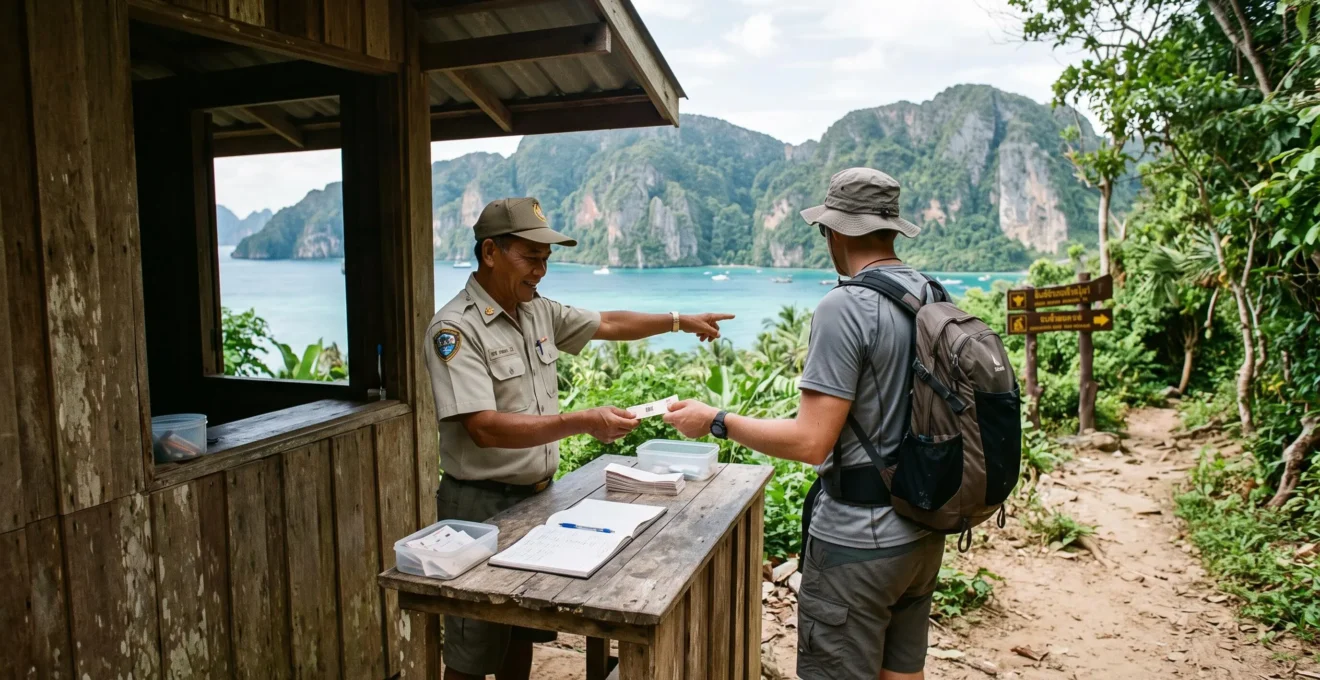
Visiting Thailand’s national parks responsibly means more than avoiding litter. It requires understanding which protected areas permit tourism, paying the correct entrance fee, respecting designated routes and wildlife, and checking whether a destination is open before travelling.
Thailand’s tropical forests, limestone islands, coral reefs and coastal habitats attract visitors precisely because their ecosystems remain valuable. Yet recreation can create pressure through trampling, wildlife disturbance, inappropriate boat operations and concentrated visitor traffic. Regulations are designed to manage those risks, although their details vary between protected areas.
For environmentally conscious travellers, the most useful approach is practical: verify each park’s current regulations through the Department of National Parks, Wildlife and Plant Conservation (DNP), choose authorized activities and operators, and adjust plans when ecological protection or visitor safety requires restrictions.
Responsible tourism is ultimately measured by what happens during the visit—not by how remote the destination looks in photographs.
Responsible visits to Thailand’s protected areas: essentials
- Check the official entrance tariff, legal designation and current opening status of every protected area before booking.
- Stay on designated routes, never feed wildlife, keep a precautionary distance of at least 10 metres where safe and appropriate, and follow stricter species-specific rules.
- Respect seasonal closures, avoid damaging marine habitats and favour quieter visiting periods without treating remote ecosystems as unrestricted attractions.
- Why Foreigners Pay £8 When Thais Pay £1 — And Where to Find Untouched Marine Life in the Andaman Sea: The 5 Islands 90% of Tourists Miss
- How to Photograph Thai Wildlife Without Disturbing It: The Rules Most Guides Ignore
- National Parks vs Wildlife Sanctuaries: Which Thai Protected Areas Actually Work?
- The Park Closure That Surprises Tourists: Why Nesting Seasons Trump Your Holiday Schedule
- When to Visit Thai National Parks Without Weekend Crowds: The Timing Windows That Change Everything
- Why Foreigners Pay £8 When Thais Pay £1: Where to Find Untouched Marine Life in the Andaman Sea
- When to Visit Thai National Parks Without Weekend Crowds
- Where to Find Untouched Marine Life in the Andaman Sea: The Islands Most Tourists Miss
Why Foreigners Pay £8 When Thais Pay £1 — And Where to Find Untouched Marine Life in the Andaman Sea: The 5 Islands 90% of Tourists Miss
Thailand’s national parks can charge different entrance fees according to visitor category, including different rates for Thai nationals and international visitors. However, £8 versus £1 is not a universal or permanently fixed comparison. Actual tariffs depend on the park and applicable schedule. For marine visitors, paying the official fee is one part of accessing protected ecosystems responsibly.
The DNP publishes national park entrance tariffs through Thailand’s official national park entrance-fee dataset. Its government catalogue identifies Thai-baht fee information and downloadable tariff resources, but the catalogue overview does not establish a single national price for every destination.
The distinction matters when estimating costs. A pound-sterling conversion can change with exchange rates, while a tariff applicable to one island park may not apply elsewhere. Check the destination’s published charges, visitor category and any additional authorized activity fees before paying.
Park revenue belongs within the broader financing and administration of protected areas. Rangers, wildlife protection, visitor infrastructure, waste handling and marine management all require resources. However, it would be misleading to claim that a specific ticket payment is automatically allocated to a particular patrol, nest or mooring buoy without park-level financial evidence.
Always use an authorized payment channel and retain proof of admission. Avoid unofficial landing arrangements or offers to bypass park checkpoints. A cheaper shortcut is not evidence of legal access.
Choosing a less crowded Andaman destination introduces a second responsibility: distinguishing a genuinely suitable protected marine site from a remote location where tourism infrastructure is limited or access is restricted.
The following five island groups provide geographical starting points for further investigation, not a verified ranking of untouched reefs or places visited by fewer than 10% of tourists.
| Island or island group | Access to investigate | Protection and visitor considerations | Seasonal checks |
|---|---|---|---|
| Surin Islands | Authorized boat excursion or organized overnight visit | Marine national park; confirm permitted landing, snorkeling areas and accommodation arrangements | Marine park opening period, sea conditions and individual site restrictions |
| Similan Islands | Authorized excursion boat or dive trip | Marine national park; investigate daily capacity controls and permitted marine activities | Seasonal access, diving conditions and site-specific closures |
| Tarutao archipelago | Scheduled or authorized local boat connections | National park territory; distinguish accessible visitor areas from sensitive habitats | Boat availability, park operating arrangements and weather |
| Adang–Rawi island area | Authorized local boat services where available | Associated with Tarutao National Park; verify individual island and beach permissions | Sea state, landing permissions and locally applicable restrictions |
| Trang island area, including Ko Kradan | Local boat or authorized excursion | Check the relevant protected-area boundaries and permitted activity zones | Marine conditions, visitor access and any temporary restrictions |
These destinations differ in infrastructure, exposure and visitor intensity. None should be represented as universally uncrowded or ecologically untouched. In particular, a popular island can have highly protected areas, while a remote island can still suffer from anchor damage, coral stress or unmanaged waste.
A useful selection method combines four checks: official protected status, authorized transport, current access conditions and an operator capable of explaining where boats may stop or visitors may enter the water.
Publishing supposedly secret locations also creates a conservation dilemma. Recommendations can redirect demand toward habitats with less infrastructure and weaker capacity to absorb disturbance.
The stronger choice is not necessarily the least-known island. It is the destination where visitor access is lawful, local management is understood and the planned activity can take place without unnecessary ecological pressure.
How to Photograph Thai Wildlife Without Disturbing It: The Rules Most Guides Ignore
Photograph Thai wildlife from established viewing locations, using a telephoto lens instead of moving closer. A precautionary 10-metre separation is a useful minimum planning guideline, not a universal Thai legal distance or a guarantee of safety. Larger, sensitive or dangerous animals may require substantially more space, and park-specific instructions always take priority.
Wildlife photography becomes intrusive when an animal changes its behaviour because of the photographer. Moving away, making alarm calls, freezing, abandoning an activity or repeatedly watching a nearby visitor can indicate disturbance. These reactions are reasons to increase distance or end the encounter, not opportunities for a more dramatic photograph.
Thailand’s government-published visitor guidance explicitly instructs people not to feed wild animals and not to leave designated routes. These obligations are described in Thailand’s government-published national park visitor rules.
Remaining on a marked trail can also protect nesting areas and understory vegetation that are difficult to recognize from the path.
For practical field photography, select equipment and settings that reduce the need for interaction. A longer focal length, image cropping, stabilization and patient observation can help preserve a natural encounter. Avoid flash when it may disturb nocturnal wildlife, and never use food, recorded calls or deliberate provocation to create a shot.
Drone photography requires separate attention. Do not assume that ordinary recreational drone authorization permits flying inside a national park. Confirm the relevant aviation requirements and obtain any necessary park-specific authorization before operating a drone.
A photograph is not worth interrupting feeding, resting or breeding behaviour. If visibility is poor, accept the missed image rather than moving beyond barriers or into protected vegetation.
Tour guides and wildlife-watch operators can affect the outcome. Before a trip, ask whether the guide maintains wildlife separation, avoids feeding and follows ranger instructions. If an operator proposes approaching macaques, hornbills or marine animals more closely, a direct response can prevent the interaction:
- “Please keep the boat or vehicle at a respectful distance.”
- “I would rather use my zoom than disturb the animal.”
- “Please don’t feed or call wildlife for photographs.”
- “Can we follow the ranger’s instructions for this species?”
Feeding wildlife creates a particularly harmful incentive. Animals may begin associating visitors with food, leading to increased approaches, changes in natural foraging and potentially dangerous encounters. The longer-term management consequences depend on the species and situation; they should not be presented as inevitable outcomes of any single incident.
Animal encounters should remain voluntary from the animal’s perspective. That includes avoiding crowded observation positions and leaving animals an unobstructed escape route.
The underlying principle extends beyond photography: responsible observation allows animals to continue their ordinary activities without being compelled to respond to visitors.
National Parks vs Wildlife Sanctuaries: Which Thai Protected Areas Actually Work?
Thai national parks and wildlife sanctuaries perform different conservation functions. National parks can accommodate regulated recreation alongside ecosystem protection, while wildlife sanctuaries prioritize wildlife and habitat conservation under a different legal framework. Neither category is inherently more effective in every situation: outcomes depend on the ecological threat, management capacity, enforcement and permitted human activities.
Thailand recognizes distinct categories of protected areas rather than applying one visitor-access policy to all conservation land.
The Wildlife Conservation and Protection Act, B.E. 2562 (2019), addresses wildlife protection, sanctuaries and non-hunting areas. Its legal scope is documented in UNEP’s legal record of Thailand’s Wildlife Conservation and Protection Act. National parks are governed by a separate national park legal framework.
For travellers, the legal designation determines which questions to ask before attempting entry.
| Protected-area category | Primary management emphasis | Visitor implications |
|---|---|---|
| National park | Ecosystem conservation with regulated public recreation where permitted | Official entrance arrangements, designated routes and park-specific activity restrictions may apply |
| Wildlife sanctuary | Protection of wildlife populations and sensitive habitats | Public access is more restricted; permission requirements must be verified individually |
| Non-hunting area | Wildlife protection and restrictions on hunting-related activities | Access rules depend on the site’s legal designation and management regulations |
It is important not to interpret the word “sanctuary” as an automatic promise of public access or ethical tourism. A wildlife sanctuary is a statutory designation; a privately marketed elephant sanctuary may be an entirely different type of operation.
Before booking an attraction, identify its precise name and location. Then confirm its official designation through the DNP or the competent protected-area administration. Ask whether the proposed activity is authorized and whether entry requires prior permission.
A tour agency’s use of the term “national park” is not sufficient evidence that its itinerary is permitted inside a protected area.
Effectiveness also requires careful interpretation. A national park may provide structured visitor access and monitoring while still experiencing trail erosion or concentrated tourism. A wildlife sanctuary may reduce recreational disturbance while confronting different pressures, including encroachment or insufficient enforcement resources.
Without comparable ecological monitoring data, it is not possible to rank the two designations as universally better or worse.
Wildlife attractions outside the formal protected-area system deserve independent scrutiny. For elephant-related tourism, favour observation without riding, forced performances or compulsory direct contact. Ask how animals are housed, managed and protected from stressful visitor interactions. Marketing labels alone do not demonstrate welfare standards.
Legal access and ethical operation are separate questions. A permitted activity can still be poorly managed, while an attractive-sounding destination may not have permission to admit tourists at all.
Once the area’s designation is confirmed, the next question is whether its current environmental and seasonal conditions permit the proposed visit.
The Park Closure That Surprises Tourists: Why Nesting Seasons Trump Your Holiday Schedule
Thai national parks can temporarily close islands, beaches, trails and marine zones to protect ecosystems and manage visitor safety. Wildlife breeding or nesting protection may contribute to particular restrictions, but not every seasonal closure concerns nesting. Weather, rough seas, flash-flood risks and ecological recovery also influence access, and the applicable dates vary by destination.
Thailand’s government announced a 2026 seasonal closure programme in January 2026, identifying environmental recovery and visitor safety among the reasons for restrictions. The announcement explains that schedules vary between parks, reflecting local conditions.
Travellers can consult the Thai government’s 2026 national park seasonal closure announcement as a starting point. Because it is a dated programme rather than a live guarantee, current restrictions still require direct confirmation before departure.
A closure is a management decision, not simply an inconvenience imposed on tourists. Reducing activity during sensitive periods may help vegetation and wildlife recover from disturbance. Restricting access in dangerous weather also protects visitors and rescue personnel.
Closure notices require careful reading. A complete island closure is different from a restriction affecting one beach, hiking route, bay, dive site or snorkeling zone. A park may remain open while specific activities or locations are inaccessible.
Likewise, a boat operating in the surrounding waters does not establish that landing on a particular island is permitted. Transport schedules and protected-area access permissions answer different questions.
Some closure violations may carry legal consequences, but applicable penalties should be verified from the relevant rules rather than inferred from a general seasonal announcement.
The most reliable planning method is to verify the exact destination, date, permitted activities and landing arrangements before paying for a tour.
Five checks before booking a protected-area visit
- Identify the exact destination: record the park’s official name and the specific beach, trail, island or marine zone you intend to visit.
- Find the current access announcement: save the dated DNP or park-office notice relevant to the proposed travel period.
- Confirm the restrictions: write down which locations and activities remain open, including any landing or boating limitations.
- Verify the operator’s itinerary: obtain written confirmation that every planned stop is authorized under the current access conditions.
- Prepare an alternative: record one verified open destination and the applicable cancellation or rescheduling conditions.
The government announcement identifies the DNP national park information portal as an official resource. It also provides National Park Office contact numbers, including +66 (0) 2562 0760-3 and +66 (0) 2561 0777, extensions 1743 and 1744. Current contact availability should be confirmed before relying on these details.
For an illustrative itinerary, imagine a planned marine excursion whose target bay becomes inaccessible. Instead of asking a boat operator to approach the restricted zone, the traveller could switch to a separately verified open trail or another authorized park. The alternative must be checked independently; proximity alone does not imply access.
Do not treat an old opening calendar as a current access permit. Even a published annual schedule may be followed by destination-specific updates.
Flexible planning makes ecological restrictions easier to respect and creates opportunities to choose quieter destinations without compromising safety.
When to Visit Thai National Parks Without Weekend Crowds: The Timing Windows That Change Everything
Midweek visits, particularly Tuesday through Thursday, can be a useful starting point for avoiding weekend leisure traffic in Thai national parks. However, there is no verified nationwide rule guaranteeing fewer visitors on those days. Public holidays, school breaks, international travel patterns, park accessibility and tour departure schedules can all change crowd levels.
The aim is to combine several low-demand conditions rather than relying on a single day of the week. A Tuesday during a major holiday period may be more crowded than an ordinary weekend at a less accessible destination.
Visitor pressure often varies within the same day. Parks connected to major tourism centres may experience organized excursion arrivals, while remote hiking routes may attract smaller groups with different schedules.
An early arrival can help when park opening hours, transport arrangements and safety conditions allow it. For popular viewpoints, consult official route guidance and consider visiting less congested permitted sections first.
Walking farther is not automatically more responsible. Route difficulty, weather exposure, wildlife sensitivity and the need to remain on marked trails are more important than reaching an isolated location.
Seasonal planning introduces another trade-off: quieter conditions may coincide with rain, limited boat services, reduced visitor facilities or complete closure of particular marine destinations.
| Planning window | Potential advantage | Important limitation |
|---|---|---|
| Ordinary weekdays outside public holidays | May reduce overlap with domestic weekend trips | Organized tours can still create peak visitor periods |
| Early entry during an authorized opening period | May avoid some later-arriving groups | Transport availability and safe operating hours vary |
| Shoulder-season periods | Potentially lower visitor demand | Weather disruption and reduced services can affect access |
| Rainy or monsoon-affected periods | Some accessible inland locations may be less busy | Trail hazards, rough seas and seasonal closures can rule out activities |
| Peak holiday or excursion periods | Some operators and visitor facilities may run fuller schedules | Greater pressure at popular routes, landing points and viewpoints |
Travellers can investigate likely demand by comparing recent, dated visitor reports, photographs and official park updates. These provide clues rather than authoritative visitor counts. A quiet-looking photograph cannot establish the total number of visitors permitted or present.
Where capacity limits or advance entry arrangements apply, verify them directly with the park or authorized booking system. Arriving early does not override reservations, quotas or restrictions.
Lower crowd concentration has potential conservation benefits. Visitors dispersing across authorized visiting periods may reduce bottlenecks at trails and landing sites, while appropriately managed boat schedules can help limit pressure on sensitive marine environments.
Yet spreading tourists into normally undisturbed habitats is not an acceptable solution. The priority remains using designated infrastructure within the park’s ecological limits.
Once a suitable time window is identified, the next step is ensuring that entrance payments and marine activities support responsible use rather than introducing avoidable impacts.
Why Foreigners Pay £8 When Thais Pay £1: Where to Find Untouched Marine Life in the Andaman Sea
Different national park tariffs should be checked against the DNP’s current published schedules, not interpreted through a fixed £8 versus £1 assumption. For visitors seeking marine wildlife, the more important connection is that official admission, authorized operators and careful behaviour all form part of responsible access to protected reefs.
The existence of differentiated visitor tariffs does not, by itself, prove how much revenue is allocated to conservation or why every rate was selected. The available government entrance-fee information confirms an official charging system but does not establish a precise relationship between foreign visitor payments and individual reef-restoration activities.
Nevertheless, paying through authorized channels is an essential compliance decision. It provides legitimate evidence of admission and avoids bypassing the system established to regulate visitor access.
Keep the ticket or digital proof as requested by the park. Where operators include admission in an excursion price, ask whether the fee is included and how proof of entry is provided.
Marine-life expectations also need adjustment. “Untouched” is not a scientific guarantee, and visible coral quality or animal encounters can vary with site conditions, water clarity, currents, depth, season and individual animal movements.
A shallow snorkeling site and a deeper dive location offer different observation opportunities. Neither can promise sightings of turtles, reef fish, sharks or other marine animals on a specific trip.
Ask a locally knowledgeable, appropriately authorized dive or snorkeling operator about current visibility, sea conditions, reef sensitivity and any permitted routes. The operator should be willing to explain why a site is appropriate for the group’s experience and the prevailing conditions.
Low-impact marine conduct begins before entering the water. Choose suitable equipment, avoid overcrowded excursions where possible and discuss wildlife approach rules before departure.
- Never touch, stand on or deliberately kick coral formations.
- Maintain buoyancy and fin control to avoid contact with reef structures.
- Do not remove shells, coral fragments, plants or marine organisms.
- Do not chase, corner, feed or touch marine wildlife.
- Use authorized moorings where applicable and avoid anchoring on reef habitat.
- Consider sun-protective clothing and suitable sunscreen practices to reduce potential marine contamination.
- Bring reusable essentials and return with all personal waste.
These practices should not be confused with a claim that park entrance fees specifically purchase every individual conservation service. The connection is broader: formal park management and responsible visitor conduct are complementary requirements.
For species such as whale sharks, the precautionary 10-metre planning distance introduced earlier must not replace applicable encounter rules or instructions. Operators should maintain the separation required for the species and location, including larger distances where appropriate.
Remote marine sites may be particularly vulnerable when there are limited waste facilities, rescue resources or monitoring personnel. An appealing absence of other boats is therefore insufficient justification for visiting an unauthorized reef.
Choosing an appropriate reef involves evaluating what can be observed without interference, not maximizing the number of wildlife encounters promised by a tour description.
When to Visit Thai National Parks Without Weekend Crowds
For a potentially quieter national park visit, start with a non-holiday weekday and then check current entry arrangements, tour schedules and recent visitor activity. A Tuesday-to-Thursday window may help in some destinations, but conditions differ between parks and seasons. Advance booking matters whenever visitor capacity or transport availability could prevent access.
A practical crowd-reduction strategy therefore has two separate elements: securing lawful admission and avoiding unnecessary concentration at already busy facilities.
For heavily visited island parks, first establish whether the proposed date falls within an authorized opening period. Then confirm whether advance reservations, daily visitor limits, designated boat departure times or tour-specific arrangements apply.
Do not assume that every Thai national park operates the same booking system. Requirements should be confirmed for the precise destination rather than extrapolated from another park.
Next, examine recent information. Time-stamped park announcements may identify closures or temporary operational changes. Recent visitor photographs and reviews can help identify busy viewpoints, crowded boats or periods of intense activity, but they are imperfect indicators and should never override official notices.
Consider the following hypothetical comparison: a traveller can visit an authorized forest trail on a normal Wednesday or a public-holiday weekend. If weather, transport and access are otherwise comparable, Wednesday may provide a reasonable opportunity to encounter fewer groups. It remains a planning hypothesis, not a verified park-specific forecast.
When organizing the day, avoid creating unnecessary pressure on narrower trails or viewing platforms. Allow other visitors to pass safely, use designated resting areas and follow instructions if rangers temporarily restrict access.
Quieter travel should also remain compatible with local services. Book through legitimate operators, respect established departure schedules and avoid pressuring boat crews to access reefs outside permitted hours or locations.
A quieter visit is not automatically a lower-impact visit. Distance travelled, group conduct, habitat sensitivity and compliance with park management all influence the outcome.
This approach supports the final destination decision: selecting a marine area because it can accommodate a responsible visit, rather than because it appears absent from mainstream itineraries.
Key takeaways before choosing an Andaman island
- Prioritize confirmed protected-area status and legal access over claims that an island is secret, untouched or undiscovered.
- Match the destination to suitable transport, licensed or otherwise appropriately authorized operators, current conditions and visitor capacity.
- Choose a marine experience that remains worthwhile without guaranteed wildlife sightings or access to restricted habitats.
Where to Find Untouched Marine Life in the Andaman Sea: The Islands Most Tourists Miss
The most responsible way to find less-pressured marine experiences in the Andaman Sea is to shortlist authorized sites using current park access, visitor infrastructure, local operator knowledge and seasonal conditions. No reliable evidence in the supplied official sources identifies five islands that 90% of tourists miss, and remoteness alone does not establish that marine life is untouched.
A destination can have abundant marine wildlife while experiencing meaningful tourism pressure. Conversely, a rarely visited reef may be ecologically sensitive, difficult to monitor or legally inaccessible.
Start with the island groups introduced earlier, treating them as candidates for verification rather than guaranteed wildlife destinations. Protected marine areas around the Surin and Similan islands, the Tarutao archipelago and sections of the Trang coast represent different combinations of authorized tourism, island infrastructure and marine access.
The relevant choice is not which island has the most appealing label. It is whether the particular snorkeling site, dive route, beach or landing location is currently open and appropriately managed.
Use the following screening criteria when comparing prospective destinations:
- Official protection status: identify the national park or other relevant protected-area authority and confirm whether the planned activity is permitted.
- Access arrangements: determine whether visitors can use an authorized boat, scheduled connection, guided excursion or another permitted transport method.
- Ranger and visitor infrastructure: establish whether designated landing points, supervision, visitor facilities or emergency procedures exist.
- Operator suitability: choose providers that can explain park permissions, safe marine conditions and wildlife protection practices.
- Current conservation restrictions: confirm closures, capacity limits, protected zones and any rules for snorkeling or diving.
- Waste and habitat management: ensure that visitors can remove their waste and avoid damaging reefs, beaches and coastal vegetation.
Be cautious with the word “liveaboard” in island recommendations. A vessel-based itinerary is not blanket permission to dive or enter every marine zone it passes. Site permissions and current park restrictions remain relevant regardless of the accommodation or transport method.
Similarly, the presence of a ranger station does not imply open access to every surrounding beach or reef. Authorized visitor facilities and restricted ecological zones can exist within the same protected area.
Once on site, use the marked routes provided, follow ranger instructions and avoid entering shallow coral areas where swimming or fin movement could damage fragile structures. Do not approach animals to fulfil a planned photography shot or wildlife checklist.
Where boat capacity is limited, respect the operator’s authorized passenger arrangements and avoid encouraging overcrowding. Carry reusable water containers where suitable and take all waste back to a place equipped for proper disposal.
The most effective recommendation may sometimes be not to visit a specific island. If restrictions are unclear, weather makes marine access unsafe or an operator cannot explain where visitors are permitted, choose another confirmed open destination.
Responsible travel also means accepting uncertainty. A reef visit can be rewarding without rare sightings; a forest trail can offer ecological value without an animal encounter; and a seasonal closure can protect the very environment visitors hope to experience.
Before departure, write down the destination’s legal designation, entrance requirements, current access status, authorized operator and essential low-impact rules. Confirm those details through the relevant park authority, and be prepared to change plans when protection or safety requires it. That is how an individual visit can respect Thailand’s protected ecosystems rather than simply consume them as attractions.
Do foreign visitors pay higher entrance fees at Thai national parks?
Thai national park tariffs can distinguish between Thai and foreign visitors. However, rates vary by destination and applicable tariff schedule. A fixed comparison expressed in British pounds should not be assumed to apply nationwide. Confirm the official fee in Thai baht for the specific park and visitor category before visiting.
Is staying 10 metres away from wildlife a legal requirement in every Thai national park?
No universal statutory 10-metre wildlife photography threshold is established by the supplied government visitor guidance. Ten metres can serve as a precautionary minimum planning guideline where appropriate, but safe and ethical distances depend on the species, conditions and applicable park rules. Never approach an animal simply because it appears calm or remains more than 10 metres away.
Can tourists visit wildlife sanctuaries in Thailand without permission?
Access conditions must be checked for the individual sanctuary. Wildlife sanctuaries are distinct legal protected areas, and tourism access may be restricted or require specific authorization. A guide’s advertisement or the presence of nearby visitor facilities does not establish permission to enter protected sanctuary territory.
Does a seasonal park closure mean the entire destination is inaccessible?
Not necessarily. Restrictions may affect an entire park or individual beaches, trails, islands and marine zones. The scope and dates depend on the official notice. Confirm precisely which activities remain permitted rather than assuming that a general park closure announcement prohibits every nearby excursion.
Is a remote island always better for conservation-focused snorkeling?
No. Remote islands may lack waste collection, visitor supervision or infrastructure, and some habitats may have restricted access. A managed site with authorized operators, clear activity boundaries and appropriate visitor controls can be a more responsible choice than an unregulated or inaccessible reef, even if it receives more visitors.