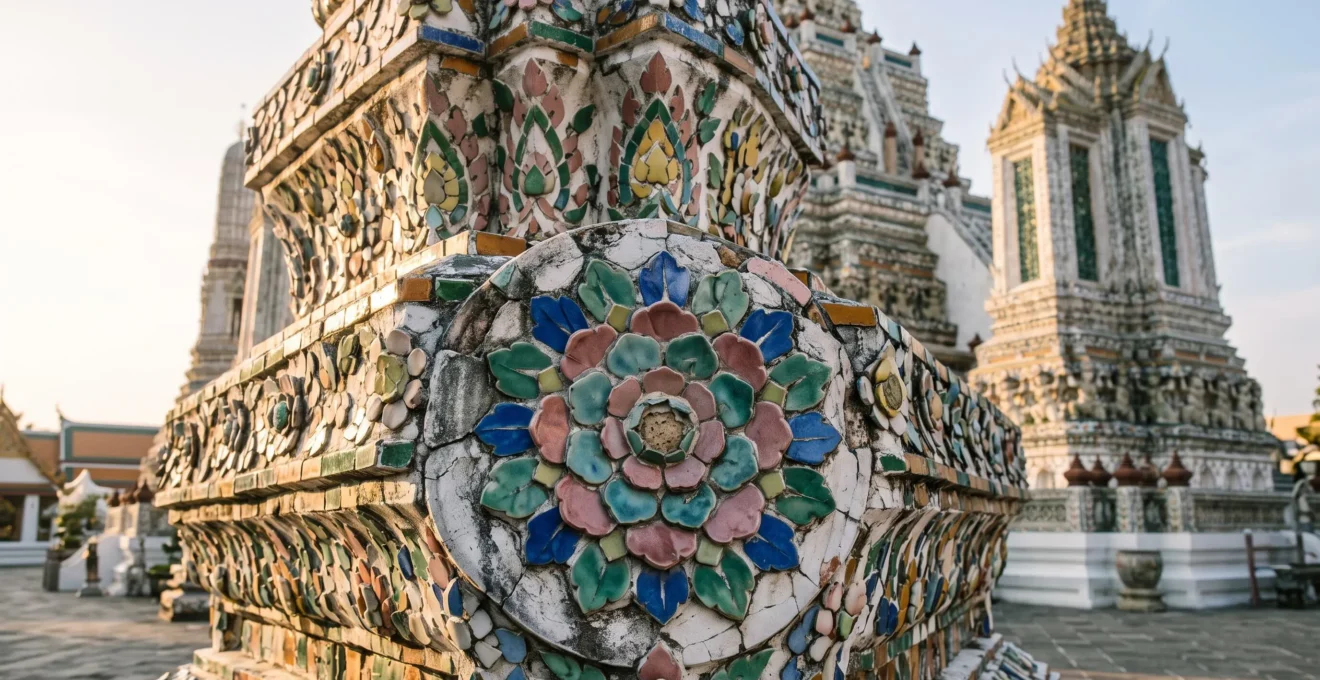
Look closely at the floral patterns covering Bangkok’s Wat Arun, and an extraordinary transformation becomes visible. What initially appears to be elaborate ceramic ornament consists of countless pieces of glazed porcelain arranged across sculpted architectural surfaces. Broken vessels, fragments of imported ceramics and carefully positioned decorative elements become petals, leaves and shimmering fields of color.
This craftsmanship reveals a distinctive chapter in Thai decorative arts. Chinese maritime commerce supplied ceramic materials, while Siamese artisans incorporated them into temple architecture shaped by local religious imagery and royal patronage. The result was not simply decoration made from discarded objects, but an architectural language in which individual fragments contributed to monumental Buddhist symbolism.
The technique becomes easier to appreciate when viewed at two distances: from across a courtyard, where porcelain creates an uninterrupted floral composition, and from close range, where separate fragments, shaped mortar and repairs become apparent. Bangkok’s historic temples offer opportunities to examine both perspectives, although the surviving surfaces often combine different periods of craftsmanship and restoration.
Thai porcelain temple mosaics: the essentials
- Chinese porcelain supplied decorative material that Thai artisans arranged into elaborate patterns on sculpted temple surfaces.
- Wat Arun and Wat Pho offer particularly clear examples, but much of their visible decoration belongs to the Rattanakosin period rather than the eighteenth century.
- Fragment shapes, mortar joints, lighting and documented restoration histories help visitors appreciate the craftsmanship without mistakenly assuming every old-looking shard is original.
- Why Riverside Bangkok Temples Use Porcelain Mosaics Instead of Gold Leaf That Peels in Humidity
- Where to See Original 18th-Century Porcelain Mosaics Before Modern Restoration Replaces Them
- Thai Porcelain Mosaics vs Islamic Tilework: How Does Thailand’s Broken-Shard Method Differ?
- The Lighting That Reveals Porcelain Mosaic Colors: Why Dawn and Dusk Beat Midday for Photography
- When to See Porcelain Mosaic Restoration in Action: The Annual Temple Maintenance Windows
- Where to See Original 18th-Century Porcelain Mosaics Before Modern Restoration Replaces Them
- Thai Porcelain Mosaics vs Islamic Tilework: How Does Thailand’s Broken-Shard Method Differ?
- How to Read a Thai Temple: The 6 Architectural Elements That Reveal Its Century and Purpose
Why Riverside Bangkok Temples Use Porcelain Mosaics Instead of Gold Leaf That Peels in Humidity
Glazed porcelain offers practical advantages for exposed temple decoration because its fired ceramic surface is relatively resistant to moisture and weathering. Gold leaf, meanwhile, depends on its underlying preparation and adhesion. However, Bangkok’s climate alone does not explain the historical choice of porcelain, and there is no demonstrated universal rule that porcelain replaced gold leaf because the latter peeled in humidity.
The material’s story begins with maritime trade. Chinese ceramics reached Siam through commercial networks that connected ports, merchants and royal consumers. One frequently repeated historical explanation describes broken porcelain being carried as ballast aboard Chinese trading vessels. Such fragments could be repurposed as building ornament instead of discarded. Reporting on Wat Arun’s restoration identifies this ballast tradition, although surviving shipping records are not established here as proof that every visible shard came from a trading ship.
For a temple artisan, porcelain offered more than inexpensive material. Its glazed surface supplied permanent color through a fired ceramic finish, while irregular fragments could be assembled into petals, leaves and ornamented reliefs. Pressing and setting numerous pieces into a prepared plaster or mortar ground turned the sculpted surface into a composition of contrasting colors and textures.
The important distinction is between **the durability of the ceramic itself** and the durability of the entire mosaic. Porcelain can resist moisture while mortar joints, supporting stucco and structural surfaces remain susceptible to deterioration. Tropical rainfall, water movement and repeated repairs still affect the finished decoration.
Gold leaf and porcelain also serve different visual and ritual purposes. Gold leaf is especially prominent on sacred images and gilded architectural details, often in protected settings. Porcelain is conspicuous on external prangs, chedis and ornamental figures. These are overlapping artistic traditions rather than mutually exclusive temple-building systems.
At Wat Arun, the Thailand’s World Heritage tentative-list submission for Wat Arun describes multicolored glazed porcelain covering the monumental prang. The submission associates this distinctive architectural decoration with the Rattanakosin artistic tradition.
The next question is not simply where the mosaics survive, but how accurately their present appearance represents the workmanship of earlier centuries.
Where to See Original 18th-Century Porcelain Mosaics Before Modern Restoration Replaces Them
Wat Arun and Wat Pho are among the clearest places to examine historic porcelain ornament in Bangkok, while Wat Phra Kaew offers a valuable comparison of royal decorative traditions. Yet identifying intact eighteenth-century fragments is considerably harder than identifying an eighteenth-century temple foundation. Much of the celebrated porcelain decoration dates to nineteenth-century Rattanakosin construction, and later conservation has altered surviving surfaces.
**Wat Arun**, on the western bank of the Chao Phraya River, provides the most dramatic starting point. Its monumental central prang rises above smaller prangs and associated structures, with porcelain forming decorative patterns across its architectural relief. The temple has Ayutthaya-period origins, but the enlarged, richly ornamented principal prang belongs principally to its later Rattanakosin development under royal patronage, notably that of Rama III.
**Wat Pho** offers a different experience. Rather than concentrating attention on a single towering monument, its compound distributes decorative interest across royal chedis, gates and subsidiary structures. The four principal royal chedis are particularly instructive: their green, white, yellow and dark-blue decorative schemes commemorate successive kings of the early Chakri dynasty, as explained in Wat Pho’s official description of the four royal chedis. The celebrated Reclining Buddha is an essential attraction, but its pavilion should not be confused with the principal examples of porcelain-clad chedi decoration.
At **Wat Phra Kaew**, within the Grand Palace complex, visitors can compare porcelain and ceramic ornament with gilding, mirrored embellishment and intricate royal architecture. These contrasting materials help explain why Thai temple decoration cannot be reduced to a single technique.
Smaller neighborhood temples in Thonburi may also reward careful observation, particularly around less-prominent chedis and courtyard structures. Their actual dates and conservation histories, however, require examination of temple records rather than assumptions based on their appearance.
4 royal chedis
Wat Pho’s principal group uses green, white, yellow and dark-blue decorative schemes associated with Rama I, Rama II, Rama III and Rama IV respectively. These provide a visible sequence of royal commemoration, not a guarantee that every mosaic fragment survives from its initial construction.
Wat Pho, official architectural documentation.
On site, examine the spacing between fragments, the color of adjoining mortar, the shapes of individual pieces and any obvious repair boundaries. Irregular arrangements may suggest handwork or different construction campaigns; unusually uniform sections may suggest later intervention. Neither observation proves a date.
Faded color is similarly inconclusive. Glaze appearance varies with ceramic composition, weathering, cleaning, accumulated dirt and lighting. A bright fragment might be historic and recently cleaned, just as an older-looking fragment might have been installed during a later restoration.
For the visitor seeking genuinely original material, the most reliable evidence is a documented conservation history or a specialist assessment, not a visual checklist alone.
Thai Porcelain Mosaics vs Islamic Tilework: How Does Thailand’s Broken-Shard Method Differ?
Thai porcelain-shard ornament often adapts fragments of finished ceramics to sculpted architectural forms, emphasizing flowers, foliage and religious imagery. Moroccan zillij, one important Islamic tilework tradition, uses deliberately cut glazed ceramic pieces arranged into carefully designed geometric compositions. Both transform smaller ceramic elements into monumental decoration; neither tradition can be reduced to a simple opposition between broken pieces and whole tiles.
In Bangkok, the relevant craft process begins with a decorated stucco form and ceramic pieces selected or shaped to contribute to its surface pattern. A lotus petal might contain several differently colored fragments, while a raised floral motif can combine outward-facing glazed surfaces with the sculptural depth of its supporting relief.
This relationship between fragment and form matters. Artisans can arrange relatively small pieces around curved ornament, producing variations in angle that catch light differently. The visual unity comes from the placement of many separate elements rather than from the continuous surface of a single manufactured tile.
Moroccan zillij offers a revealing comparison. The Metropolitan Museum’s educational resource on Moroccan zillij documents cut, polychrome-glazed tilework combined with carved stucco and other architectural materials. Its illustrated Moroccan Court uses repeating geometric patterns, including stars and interlacing forms.
Comparing these traditions highlights differences in artistic planning without imposing false limitations. Moroccan craftspeople may cut pieces to fit predetermined geometric designs. Thai decorative compositions frequently organize ceramic fragments around sculpted plants, floral medallions and sacred architectural imagery. Yet both approaches involve skilled cutting, placement and control of joints.
Islamic architectural tilework is also too diverse to describe universally as a system of whole, flat tiles. Persian, Ottoman, Moroccan and Andalusian ceramic traditions differ in construction, geometry and decoration. Cut-tile techniques and curved architectural settings are not exclusive to Thailand.
| Craft feature | Thai temple porcelain ornament | Moroccan zillij |
|---|---|---|
| Typical ceramic element | Fragments or shaped pieces of glazed porcelain | Purposefully cut pieces of glazed tile |
| Visual organization | Floral patterns, sculptural relief and religious ornament | Repeating geometric units and interlacing designs |
| Architectural relationship | Often follows shaped stucco ornament and curved monuments | Forms geometric decoration within architectural surfaces |
| Role of the craftsperson | Selects, shapes and arranges fragments to complete decorative forms | Cuts and assembles ceramic pieces into planned patterns |
| Historical context | Siamese architectural traditions and Chinese ceramic commerce | Moroccan and Andalusian architectural craft traditions |
Chinese imported porcelain, including white and decorated wares, belongs to the broader exchange history underlying Bangkok’s mosaics. Benjarong also illustrates cross-cultural ceramic tastes associated with Siam and Chinese production, but its presence in the wider ceramic tradition does not establish that a particular temple shard came from a Benjarong vessel.
No direct line of technical descent from Persian or Moroccan mosaic craftsmen to Thai temple artisans is demonstrated by the sources considered here. Their similarities are best understood as a comparison of ceramic-working solutions within different artistic settings.
For observers, the most productive comparison begins not with deciding which tradition is more sophisticated, but with watching how each individual piece contributes to the larger composition.
The Lighting That Reveals Porcelain Mosaic Colors: Why Dawn and Dusk Beat Midday for Photography
Early morning and late-afternoon light often make Thai porcelain mosaics easier to photograph because oblique illumination creates small shadows around raised fragments and mortar joints. Strong midday sunlight can produce bright reflections that obscure glaze colors or flatten subtle surface details. The ideal moment still depends on weather, building orientation, shade and the particular face of the monument being photographed.
Glazed porcelain reflects light directionally as well as diffusely. When direct sunlight reaches the surface at a reflective angle, bright highlights can overwhelm the underlying blue, green, white or rose-colored glaze. A softer angle often permits the camera to record both the ceramic color and the relief of the surrounding mortar.
To understand this visually, compare two photographs of the same floral medallion. In direct, harsh light, a white highlight may occupy much of a glazed fragment. Under softer side illumination, the same fragment can retain a recognizable color while its edges cast small shadows that reveal the individual placement of the ceramic pieces.
**Wat Arun** offers especially rewarding experiments because the prang can be viewed from different sides and from across the river. Late-afternoon sunlight may illuminate selected west-facing surfaces, while sunset viewpoints from the opposite bank can produce a backlit silhouette of the monument. These are distinct effects: backlighting may emphasize its profile and luminous atmosphere without necessarily revealing every shard’s color.
At **Wat Pho** and **Wat Phra Kaew**, sheltered courtyards and surrounding buildings complicate sunlight direction. Morning visits may provide softer illumination and fewer people in some areas, but particular walls can remain shaded while others receive direct light. It is more effective to observe the illumination of the specific ornament than to assume the entire temple has one universally favorable photography hour.
A practical photographic sequence starts with an establishing shot showing the decorated structure, then moves toward a medium view of one floral motif and finally a close detail recording individual shards. Where permitted, adjusting the camera angle slightly can eliminate disruptive reflections without changing location.
Overcast conditions also deserve attention. Diffuse cloud-filtered light may reveal glaze colors more evenly than dramatic sunset illumination, particularly where accurate color is more important than pronounced relief.
Visitors without cameras can follow the same method with their eyes. Approach the mosaic from different viewing positions and notice when individual petal fragments become distinguishable from the larger flower. A change in viewing angle may be as informative as a change in time.
Light reveals the arrangement of fragments, but understanding whether those fragments have been moved, reset or replaced requires a separate look at conservation.
When to See Porcelain Mosaic Restoration in Action: The Annual Temple Maintenance Windows
There is no verified fixed annual public schedule for watching porcelain mosaic restoration at Bangkok’s major temples. Conservation depends on the condition of particular structures, project funding, institutional decisions and access restrictions. Drier weather may make certain exterior treatments easier to organize, but visitors should not assume that every temple conducts visible shard-setting work during the same months each year.
Conserving architectural mosaics involves more than replacing missing porcelain. Before intervention, specialists may need to determine whether deterioration affects individual fragments, mortar joints, decorative plaster or the supporting structure. Treatment choices then depend on the material and its condition.
A visible worksite might include scaffolding, protected ornamental sections, newly prepared mortar, fragments awaiting installation or artisans working along an architectural relief. These signs do not prove that a particular technique is being performed at that moment, nor do they guarantee that observers will be permitted nearby.
Where historic ceramic fragments remain firmly attached, responsible conservation may favor retaining existing material. Missing or severely damaged areas present more complicated questions about compatible replacement ceramics, the visual appearance of repairs and the preservation of historical evidence.
Wat Arun’s restoration demonstrates why these decisions matter. In 2017, debate followed the unveiling of renovated surfaces whose brighter appearance and altered visual texture attracted criticism. Khaosod English‘s reporting on Wat Arun’s 2017 restoration documented reactions and concerns about the treatment of older ceramic decoration. It did not establish a definitive percentage of original tiles retained or replaced.
The same reporting cannot confirm current conservation arrangements. To investigate whether work may be visible during a forthcoming visit, consult a temple’s official announcements or inquire directly with its administration. Local social media reports or observations from river transport operators can offer secondary clues, but they should not be treated as an authoritative maintenance calendar.
If conservation work happens to be visible from an authorized public area, observe the relationship between material preparation, fragment selection and placement. Any opportunity to see artisans at work is incidental rather than an advertised or guaranteed attraction, and protective barriers must take precedence over photography.
The conservator’s work also raises a deeper historical question: when decoration is repaired over successive generations, what should count as the original mosaic?
Where to See Original 18th-Century Porcelain Mosaics Before Modern Restoration Replaces Them
Authentic eighteenth-century porcelain decoration cannot be reliably identified simply by looking for faded colors or irregular joints. Bangkok’s monumental temple surfaces often combine historical construction, later additions and successive repairs. Establishing an eighteenth-century date requires documentary or material evidence, particularly at Wat Arun, where much of the celebrated porcelain-clad architecture belongs to the nineteenth-century Rattanakosin period.
The issue is best understood through the idea of **conservation layers**. A decorated wall or chedi may preserve old ceramic pieces alongside later repairs. Individual fragments could remain in place while surrounding joints have been renewed. Elsewhere, damaged pieces may have been removed and replaced, changing the visible surface without changing the monument’s overall form.
This makes the word “original” potentially ambiguous. It might refer to the first decoration on a particular structure, material from an early restoration, or fabric that has remained in position since a historically significant rebuilding campaign. Those categories should not be combined without evidence.
Wat Arun’s much-discussed 2017 renovation provides a documented example. Public criticism focused partly on the visual effect of renovated areas, while questions remained about precisely how much earlier porcelain survived. The reported difference between irregular older decoration and some flatter-looking repaired surfaces illustrates how conservation can affect a monument’s appearance.
For a visitor, a careful examination starts with three visible characteristics:
- Fragment arrangement: Are the ceramic pieces irregularly spaced, individually shaped or unusually consistent in size?
- Mortar transitions: Do particular patches have visibly different joint colors, surface levels or textures?
- Decorative continuity: Does an ornamental pattern change unexpectedly across a boundary or appear to have been reconstructed?
These observations identify questions worth investigating, not definitive answers about age. A restoration may deliberately reproduce historical irregularities, while cleaning can make genuine old porcelain appear strikingly bright.
The less-photographed sides of courtyards, subsidiary structures and sheltered architectural recesses may provide useful comparative views. However, their lower visibility does not demonstrate that they contain older or untouched materials. For any specific claim, consult restoration documentation or qualified conservation expertise.
Wat Arun’s 2017 restoration debate
Following extensive renovation, the appearance of Wat Arun’s porcelain-clad decoration drew public attention, including concerns about whiter surfaces and changes to historical texture.
Contemporary reporting recorded contrasting assessments and uncertainty over the proportion of historic ceramic material retained. The documented controversy demonstrates the importance of conservation transparency, but it does not establish that any particular visible fragment dates from the eighteenth century.
Preservation also depends on conduct within the temple. Do not handle ceramic fragments, lean against decorated surfaces or enter restricted areas to inspect apparent repair lines. Even where a fragment looks firmly attached, close physical examination belongs to trained personnel with appropriate authorization.
Once those layers are recognized, the comparison between traditional craft methods becomes more meaningful: the surface is both an artistic composition and a record of interventions.
Thai Porcelain Mosaics vs Islamic Tilework: How Does Thailand’s Broken-Shard Method Differ?
In practical craftsmanship, Thai porcelain ornament frequently follows a sculpted floral or figurative design, while Moroccan zillij specialists prepare cut tiles for geometric arrangements. The contrast concerns how ceramic elements relate to a planned composition, not whether one tradition possesses planning and the other relies on improvisation. Both demand control of shape, alignment and the materials holding the pieces in place.
Imagine examining a floral ornament on a Bangkok chedi from close range. The artisan must make numerous ceramic pieces fit the contours of raised petals and recessed spaces. Each fragment contributes a colored area, and the assembled pattern gains depth from the underlying sculpted stucco.
The selection of fragments creates practical decisions. A piece may offer the right color but an unsuitable shape, or fit the outline while exposing an undesirable edge. The craft therefore involves adaptation, whether through selecting an existing fragment, shaping it further or arranging neighboring pieces to complete the design.
Now consider a geometric zillij panel. Its individual cut elements must contribute to repeating shapes and interlocking lines. The maker’s precision becomes apparent in the consistency of the tesserae and the way separate units assemble into a coherent design. The Metropolitan Museum‘s Moroccan Court provides a documented modern example of this established craft tradition.
At a distance, the two forms can create different visual effects. A Thai prang may read first as a sculpted architectural mass covered with flowers and colored relief. A geometric zillij panel may direct attention toward repeating stars, lines and mathematical relationships. On close inspection, both reveal individual ceramic pieces and the precision required to assemble them.
These are tendencies rather than exclusive categories. Thai ornament can be highly regular, while Islamic decorative arts include extensive floral and curvilinear designs. Both traditions may use patterned compositions prepared before the pieces are installed.
A five-step field guide to reading a ceramic mosaic
- Photograph the complete decorated structure from an authorized viewing point, producing one contextual image that records the architectural setting.
- Select a single floral or geometric motif and record a closer image identifying the individual ceramic pieces.
- Observe whether the fragments follow raised sculptural contours or a repeating geometric arrangement, and write a one-sentence description of their relationship to the design.
- Note at least two visible construction details, such as ceramic edges, mortar joints or surface relief, without assigning an unsupported date.
- Compare the detail with an official temple or museum description and produce a short observation note separating documented facts from personal interpretations.
The history of cultural exchange adds another dimension. Chinese glazed ceramics circulated into Siam, while Islamic ceramic traditions developed across other trading and cultural networks. These broad connections are real historical contexts, but they do not by themselves prove that one specific mosaic technique originated from another.
The most rewarding next step is to apply this close observation to the whole temple, reading porcelain as one element of an interconnected architectural system.
Key takeaways before exploring the whole temple
- A temple’s founding period does not necessarily date its visible architecture or decorative ceramic surfaces.
- Porcelain patterns become more meaningful when interpreted alongside the shape, ritual role and religious symbolism of the structure they cover.
- Move from the overall monument to its guardians, sacred halls and smaller structures, documenting what each feature reveals without relying on appearance alone.
How to Read a Thai Temple: The 6 Architectural Elements That Reveal Its Century and Purpose
Thai temple architecture can be interpreted through six recurring elements: the prang or chedi, ubosot, viharn, mondop, ho trai and guardian figures. Together, they help explain ritual functions, religious imagery and changes in artistic patronage. Their decoration can suggest a historical context, but identifying the construction century requires corroboration from inscriptions, records or architectural scholarship.
Porcelain mosaics are particularly useful because they link structural form to surface ornament. A floral pattern on a chedi contributes to the appearance of a sacred monument, while the decorative treatment of a guardian figure may emphasize its symbolic function within the complex.
Begin with the six architectural features:
- Prang or chedi: A prang is a tower-like religious monument, while a chedi is generally associated with Buddhist sacred or commemorative functions, often including relic-related traditions. Their forms vary across Thai architectural periods. At Wat Arun, the monumental prang’s porcelain decoration is closely associated with Rattanakosin development, despite the temple’s earlier origins.
- Ubosot: The ordination hall provides a consecrated setting for important monastic activities. Boundary markers and the hall’s ritual function help distinguish it from other religious buildings. Decoration may reflect the patronage and reconstruction history of the complex.
- Viharn: An assembly hall commonly accommodates Buddha images and religious ceremonies. It is often a focus of lay devotion. The building’s proportions, imagery and ornament may differ from those of the ubosot.
- Mondop: A pavilion-like structure that may shelter a sacred image, Buddha footprint or another revered object. Its architectural form and location can help indicate what is being honored.
- Ho trai: A building used to house Buddhist scriptures. Its role in preserving religious texts is more informative than any assumed decorative style, since its construction can differ between temples and historical periods.
- Guardian figures: Protective beings, including yaksha or other mythological figures, appear in temple decoration. Their iconography connects the sacred compound to broader Buddhist and Thai artistic traditions. Their materials and ornament should be examined individually rather than assumed to be porcelain-covered throughout.
Wat Arun supplies a strong example of how architecture and iconography work together. The principal prang represents Mount Meru in Buddhist cosmology, while its associated figures include celestial beings, garudas, asuras, monkeys and Indra riding Erawan. The porcelain decoration therefore belongs to a larger symbolic design rather than existing as an independent ornamental layer.
At Wat Pho, the four royal chedis provide an additional historical reading method. Their distinct colors and royal associations offer a more secure interpretation than any attempt to date individual fragments from glaze appearance. This demonstrates why identifying a building’s purpose and documented patronage should come before assigning dates to its decoration.
A useful walking sequence begins at the main monument. Observe the silhouette, then move toward the gates and guardian figures before exploring the principal assembly and ordination halls where visitor access permits. Continue to pavilions and subsidiary structures, comparing their functions and decorative materials.
As you proceed, separate three kinds of evidence: **architectural form**, which describes the structure; **religious function**, which explains its purpose; and **documented chronology**, which identifies known construction or restoration phases. Porcelain ornament can contribute to all three interpretations but cannot independently establish them.
On your next visit to a Bangkok temple, choose one chedi or prang, observe its mosaics from both near and far, and identify the surrounding architectural features. Recording those observations alongside documented temple history turns visual admiration into an informed appreciation of Thai craftsmanship.
Were all the porcelain fragments on Thai temples originally broken Chinese dishes?
No. Imported Chinese ceramics form an important part of the material history, and broken vessels are frequently associated with the tradition. However, temple decoration can incorporate fragments or purposefully shaped ceramic elements from different periods. Without material analysis or documentation, a fragment’s original use cannot be established simply by looking at it.
Is Wat Arun an eighteenth-century porcelain mosaic monument?
Wat Arun has historical roots reaching into the Ayutthaya period, but its celebrated enlarged, porcelain-decorated principal prang is principally associated with nineteenth-century Rattanakosin construction and royal patronage. Its present surface also reflects subsequent restoration. The age of the temple should not be confused with the date of every surviving decorative element.
Can visitors tell which porcelain shards are original without a guide?
Visitors can observe differences in fragment arrangement, glaze appearance and mortar, which may reveal possible repair areas. These characteristics do not conclusively establish age or authenticity. Reliable identification requires conservation records, specialist examination or other supporting historical evidence.
Can broken porcelain mosaics be repaired without changing their historical appearance?
Conservation aims to balance material stability with the retention of significant historic fabric, but outcomes depend on the condition of the surface and the treatment selected. Replacement pieces, altered joints or extensive cleaning may affect appearance. Wat Arun’s 2017 restoration debate illustrates how visually noticeable those changes can become.
Are Thai porcelain mosaics related to the Japanese art of kintsugi?
Both can involve broken ceramics, but their purposes and methods differ. Kintsugi is associated with repairing ceramic objects, often using lacquer and highlighting repair lines. Thai temple porcelain ornament uses ceramic pieces to create architectural decoration. A shared interest in fragmented material does not establish a direct historical connection between the practices.