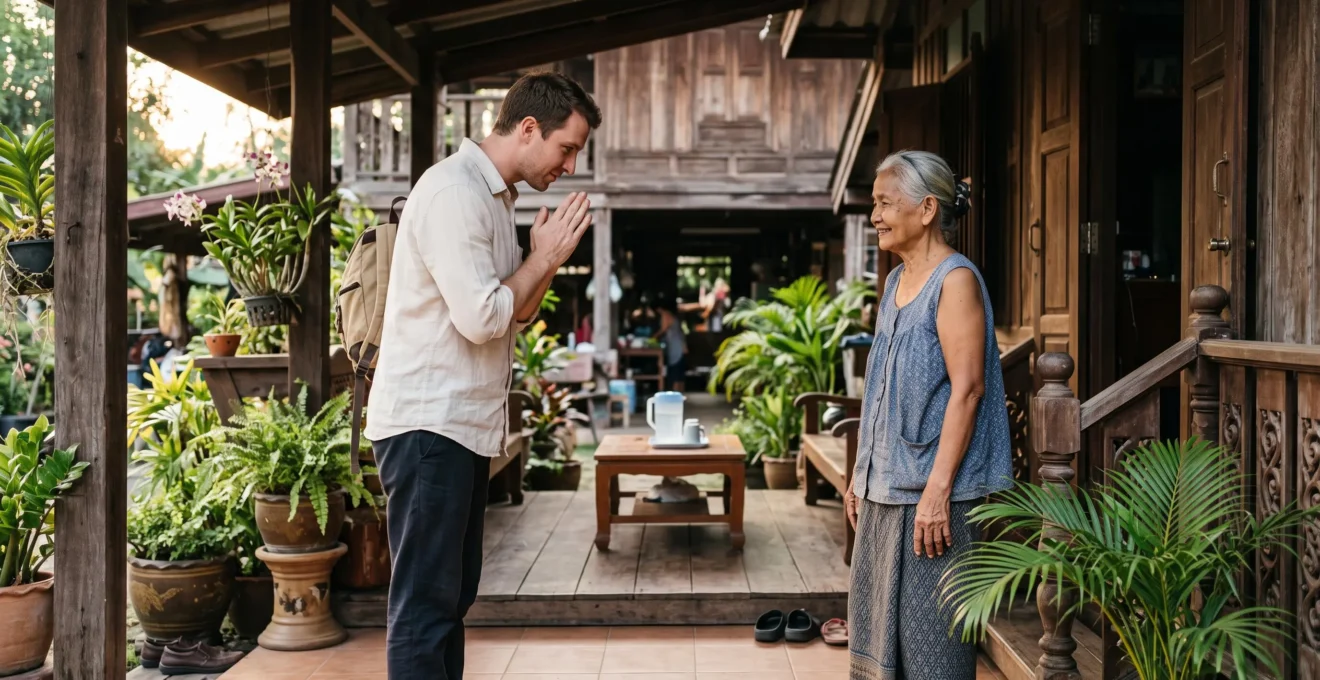
A Thai wai can look deceptively simple: press your palms together, bow your head and smile. Yet the distance between your thumbs and your face communicates something important about the person standing opposite you. A wai offered to a friend is not performed exactly like one offered to an elderly host or a Buddhist monk.
In Thailand, the height of the hands and the depth of the bow express different degrees of respect. Getting the gesture right means understanding who initiates it, how to acknowledge one and when a smile is more appropriate than another wai.
Traditional explanations distinguish three principal wai variations and a separate receiving gesture called rab wai. Together, these provide a practical four-part framework for travelers, although they should not be confused with four officially standardized hand-height categories.
The most useful principle is straightforward: consider the other person’s age, social relationship and religious position before choosing how high to raise your hands. Once that becomes familiar, the wai feels less like a memorized ritual and more like a natural way of showing respect.
Thai Wai Etiquette at a Glance
- Hand position changes with respect: a gentle chest-level gesture suits ordinary interactions, thumbs near the nose honor elders, and thumbs between the eyebrows are used for monks.
- Not every wai requires an identical response: older people and customers may acknowledge a greeting with a reduced wai, smile or nod depending on the context.
- The wai is more than hello: it can express gratitude, apology and formal farewell, including when leaving an elder or host.
- Why Thais Don’t Wai the Waiter: The Status Asymmetry Foreigners Misread
- When to Wai in Thailand: Arrival, Thanks, and Apology – But Not Departure
- Thai Wai vs Cambodian Sampeah: How Do Southeast Asian Palm-Press Greetings Differ?
- The Wai Error That Marks You as Clueless: Returning a Child’s Wai
- When to Wai During Temple Visits: The Three Moments Thai Buddhists Never Skip
- When to Wai in Thailand: Arrival, Thanks, and Apology – But Not Departure
- Thai Wai vs Cambodian Sampeah: How Do Southeast Asian Palm-Press Greetings Differ?
- How to Read Thailand’s Unspoken Respect Hierarchy: The Age, Status, and Monk Gradations
Why Thais Don’t Wai the Waiter: The Status Asymmetry Foreigners Misread
In a typical Thai service interaction, a customer does not need to initiate a formal wai toward a waiter, driver or shop assistant. The wai traditionally reflects relative age, seniority and social position, so responding to every service employee with the same elaborate greeting can seem socially misplaced. A friendly smile and spoken thanks are usually sufficient.
The important distinction is between acknowledging someone’s courtesy and reproducing their gesture. Those are not always equivalent actions in Thai etiquette.
In relationships shaped by hierarchy, the younger or more junior person commonly initiates the wai. A senior person may respond with a reduced gesture rather than mirroring the original bow.
Hospitality settings introduce another layer: receptionists and other employees may use a formal wai as part of their professional welcome. The gesture expresses hospitality and respect, but it does not necessarily establish a personal relationship calling for an equally formal response.
The Thailand Foundation‘s cultural explanation distinguishes between the gesture offered to show respect and the receiving gesture known as rab wai. This distinction is particularly useful for understanding why Thai greeting exchanges are not always symmetrical. Its description of the wai’s social and religious functions appears in the Thailand Foundation’s explanation of the wai.
Consider a hypothetical arrival at a Bangkok hotel. A receptionist places her palms together and welcomes a guest. The traveler smiles, nods slightly and says thank you. This response recognizes the welcome without assuming that every professional wai calls for an identical one.
Now imagine being invited into a Thai family’s home. The interaction is no longer a straightforward commercial exchange. An elderly host may deserve a more deliberate wai, even if nobody is being paid to provide a service.
The practical distinction is the relationship, not simply the person’s occupation. A waiter who is also a respected family elder, for example, would not necessarily be approached according to the same conventions as an unfamiliar employee.
A misplaced wai is generally better understood as an etiquette misunderstanding than an intentional insult. Visitors should avoid treating every imperfect gesture as a serious cultural transgression. A calm manner, appropriate acknowledgment and willingness to follow local cues matter more than exaggerated ceremony.
This same asymmetry becomes particularly important when greetings involve children, teachers or monks, where the relationship between the two people is more clearly defined.
When to Wai in Thailand: Arrival, Thanks, and Apology – But Not Departure
The Thai wai is used for greetings, expressions of gratitude and apologies. It can also accompany formal farewells, especially when leaving an elder, teacher or respected host. The idea that Thais never wai when departing is incorrect: traditional Thai etiquette recognizes both arrival and departure, although casual goodbyes often require nothing more than words or a wave.
For travelers, the challenge is therefore not remembering a universal rule about when to wai, but identifying which moments genuinely call for a respectful gesture.
Four everyday situations illustrate the difference:
- Meeting a friend’s parents: a respectful wai is often appropriate, particularly when meeting them for the first time.
- Receiving meaningful help or a gift: a wai may accompany spoken thanks when the relationship and circumstances justify a more formal expression of appreciation.
- Being introduced to someone senior: a wai can acknowledge the person’s age or position, with hand height adjusted accordingly.
- Entering someone’s home: greet the host respectfully, taking cues from the household’s level of formality.
The wai also functions as an apology. When a person makes an interpersonal mistake, joining the palms and lowering the head can reinforce a verbal expression of regret. The gesture is not an automatic solution to a dispute, however. Sincerity, appropriate words and corrective behavior remain essential.
Thai expressions commonly accompanying these gestures include khop khun for thanks and kho thot for an apology, with polite particles such as khrap or kha depending on the speaker and customary usage.
When leaving a restaurant after an ordinary meal, a verbal thank-you and smile are usually enough. When leaving a respected elder after a family visit, a farewell wai may be appropriate because the relationship carries a different degree of respect.
If uncertainty remains, observe briefly before acting. The common advice to mirror every wai immediately is incomplete: an elder, child, service employee and monk may each require a different kind of acknowledgment.
The timing of a wai only tells part of the story. Its physical execution changes across cultures, even in neighboring countries where joining the palms is also customary.
Thai Wai vs Cambodian Sampeah: How Do Southeast Asian Palm-Press Greetings Differ?
The Thai wai and Cambodian sampeah both use joined palms and variations in hand height to communicate respect. They are related but not interchangeable. Thai etiquette commonly distinguishes three main wai variations plus a receiving gesture, whereas descriptions of traditional Cambodian sampeah recognize five positions. Travelers should follow each country’s conventions instead of transferring hand heights directly.
The similarity is visually striking. In both cultures, the palms come together and the head may incline. Yet the precise relationship between hand position, bow and recipient differs.
The Cambodian sampeah is described in five graduated forms by Visit Angkor, ranging from chest-level greetings between peers to higher positions for parents, teachers, monks and sacred figures. This five-position account is useful for understanding the traditional system, although it is a tourism-oriented explanation rather than a universal rule for every Cambodian interaction.
For practical visitors, Cambodia’s official visitor etiquette advice recommends a simple sampeah with joined hands at chest height and a slight bow.
The differences can be summarized without assuming that either tradition is more respectful than the other.
| Feature | Thai Wai | Cambodian Sampeah |
|---|---|---|
| Basic movement | Joined palms with a head inclination | Joined palms with a head inclination |
| Traditional gradations | Three principal variations plus a receiving gesture | Five positions in a commonly described traditional classification |
| Everyday peers | Relatively low, restrained gesture | Hands near chest level |
| Elders and teachers | More elevated, respectful wai | Higher positions according to relationship |
| Religious context | Higher wai or more elaborate devotional gesture | Higher sampeah or devotional gesture |
| Gratitude and apology | Recognized uses | Recognized uses |
One difference that should not be exaggerated is the claim that Cambodia universally enforces junior-first greeting rules more rigidly than Thailand. The available cultural guidance does not establish such a ranking, and expectations can vary by family, institution and setting.
Neighboring Laos also has a related palm-press greeting known as the nop, while India’s namaste belongs to a broader family of joined-hand gestures. Their shared resemblance does not imply identical etiquette.
Once the regional distinction is clear, the next challenge is recognizing when another person’s wai should receive a deliberately less elaborate response.
The Wai Error That Marks You as Clueless: Returning a Child’s Wai
When a Thai child wais an adult, the adult does not normally need to reproduce the child’s full gesture. A smile, gentle nod or reduced acknowledgment can be appropriate. Returning a wai is not categorically forbidden, however: Thai etiquette also recognizes a reduced receiving gesture, so the real mistake is assuming that respect must always be exchanged symmetrically.
Children are commonly taught to wai parents, teachers and older relatives. The gesture is part of learning how to recognize age and social relationships.
Consider a hypothetical encounter outside a neighborhood school. A young student sees an adult acquaintance, brings her palms together and bows slightly. The adult acknowledges her warmly, rather than making an elaborate bow equivalent to the student’s gesture.
That response preserves the intended relationship without ignoring the child’s courtesy.
The Cultural Atlas reference on Thai greetings explains that an older or higher-status person may return a junior person’s wai using the reduced rap wai. This makes the distinction more precise than a simple prohibition against responding to children.
Similar considerations apply when students greet teachers or younger employees greet more senior colleagues. The recipient can acknowledge the greeting without matching every feature of the original wai.
Monks represent another form of asymmetry, although the underlying relationship is religious rather than simply age-based. A layperson offers respect to a monk without expecting the monk to answer in the same form.
The opposite mistake is becoming so concerned about etiquette that every junior person’s greeting receives a blank expression. That can appear unnecessarily distant. Respectful acknowledgment is still an active response, even when it does not involve joining the palms.
Understanding this distinction prepares visitors for religious settings, where the difference between offering and receiving respect becomes even more pronounced.
When to Wai During Temple Visits: The Three Moments Thai Buddhists Never Skip
Three important religious situations involve the wai: paying respect before a Buddha image, greeting or honoring monks, and participating respectfully in blessings or other devotional exchanges. These are significant traditional contexts rather than three universal obligations that every Buddhist performs identically. Visitors should follow the temple’s practice and distinguish ordinary greetings from formal acts of devotion.
Inside a Thai Buddhist temple, the wai does more than recognize someone’s social seniority. It may express reverence for the Buddha, respect for the monastic community or gratitude for religious instruction and blessings.
For a wai addressed to a monk, the traditional elevated position brings the thumbs toward the area between the eyebrows, accompanied by a deeper inclination of the head.
Devotion before a Buddha image may involve a higher or more elaborate gesture, including prostration according to the setting. A formal prostration is not simply another ordinary hand-height category.
When a monk gives a blessing, the recipient may respond with a respectful wai. A monk is not expected to return the gesture as an ordinary exchange between peers, so visitors should not stand waiting for an identical greeting.
Offering or receiving objects in a religious setting requires separate attention. It is not always practical or appropriate to perform a wai while holding something. Set objects down safely when possible and follow the guidance of temple attendants about posture, placement and transfers.
Modest clothing, respectful positioning and avoiding disruptive photography are also important. When taking photographs, do not assume that standing directly in front of a Buddha image for a casual pose is welcome. Observe posted rules and ask before photographing monks.
Specific procedures differ across temples, ceremonies and monastic traditions. Visitors should not assume that one illustrated wai position replaces instructions from the people conducting a religious activity.
Religious settings make the hierarchy especially visible, but everyday professional and social encounters also require attention to when a wai starts and how an interaction ends.
When to Wai in Thailand: Arrival, Thanks, and Apology – But Not Departure
In business environments, Thai wai timing depends on the relationship between participants and the formality of the encounter. A wai may be appropriate when meeting a senior Thai colleague or host, while handshakes are also accepted in international professional settings. At departure, a wai can express respect or gratitude, although it is not required after every routine meeting.
Imagine a hypothetical first meeting with a Thai company director. A visiting professional may encounter a wai, a handshake or a combination of greeting conventions influenced by the workplace’s international character.
Rather than beginning with an elaborate gesture, the visitor can observe how the host initiates the exchange. If a handshake is offered, accepting it is generally appropriate. If the host gives a wai, a respectful acknowledgment can fit the interaction, with the form adjusted to relative seniority.
In a familiar office where colleagues interact every day, a repeated ceremonial wai at every encounter would often be unnecessary. The more established the working relationship, the more ordinary spoken greetings can become.
Departure is a context-dependent moment, not a prohibition. A casual goodbye to coworkers may call for a verbal farewell, while leaving a respected mentor’s office after a significant meeting can justify a formal wai.
The apology wai deserves particular care. When a misunderstanding occurs, combining a modest bow with an appropriately respectful hand position can reinforce verbal regret. However, the gesture should not be treated as a guaranteed way to settle a disagreement.
In professional situations, repairing an error might require an explanation, an acknowledgment of responsibility or a practical correction. The wai supports that communication; it does not replace it.
A Five-Step Wai Decision Checklist for Travelers
- Identify the relationship: decide whether the other person is a peer, elder, professional contact or monk. Your result is a clear relationship category.
- Identify the occasion: determine whether the interaction involves greeting, gratitude, apology or farewell. Your result is a specific reason for the gesture.
- Observe the first movement: notice whether the other person initiates a wai or handshake. Your result is a cue about the formality of the exchange.
- Choose your response: select an appropriate wai height, reduced acknowledgment or verbal greeting. Your result is a gesture matched to the situation.
- Check the interaction: complete the greeting calmly, without repeated gestures or exaggerated bowing. Your result is a natural exchange that recognizes the other person’s response.
The checklist is a traveler-oriented decision aid, not a formal Thai etiquette regulation. It becomes most useful when applied flexibly rather than mechanically.
For travelers continuing from Thailand into Cambodia, the same observational habit is useful, but the physical gesture itself needs to be reconsidered.
Thai Wai vs Cambodian Sampeah: How Do Southeast Asian Palm-Press Greetings Differ?
Thai and Cambodian joined-hand greetings share a broader South and Southeast Asian cultural heritage associated with gestures of respect and Buddhist traditions. However, their modern social conventions developed within different societies. Their precise hand-height classifications, rules of acknowledgment and ceremonial applications should therefore be learned locally rather than interpreted as one identical regional system.
The Thai wai is commonly connected to the Indian anjali mudra tradition. Cambodia’s sampeah belongs to a related family of respectful palm-press gestures.
That shared heritage does not establish a precise historical chronology for every modern hand position. Nor does it prove that one national system is inherently stricter or more hierarchical than the other.
The Cambodian classification described by Visit Angkor uses five positions:
- Chest level for friends or people of comparable age.
- Mouth level for older people and those in higher positions.
- Nose level for parents, grandparents and teachers.
- Eyebrow level for monks or royalty.
- Forehead level in religious devotion before sacred figures.
These positions come from Visit Angkor’s explanation of the five sampeah positions. They provide a traditional framework, not a requirement that visitors perform all five forms in routine situations.
Consider three hypothetical cross-border encounters.
| Traveler Situation | Thailand | Cambodia |
|---|---|---|
| Meeting a homestay host | A modest wai can suit the introduction, raised appropriately if the host is an elder. | A simple chest-level sampeah is a practical starting point, adjusted for age and context. |
| Meeting a local official | Observe the official’s greeting and choose a respectful response suited to their seniority. | A more elevated sampeah may be appropriate in a formal hierarchy, guided by local protocol. |
| Thanking an elderly vendor | Spoken thanks and a smile may suffice; a wai depends on the personal interaction. | Respectful thanks are appropriate; a sampeah may be used when the relationship and situation call for it. |
These examples demonstrate decision principles, not verified accounts of particular people or guaranteed expectations in every community.
The central cross-border skill is observation. Start with the locally recognized everyday greeting, take account of the other person’s response and avoid unnecessarily elaborate religious or ceremonial forms.
Back in Thailand, the most reliable way to select a wai is to understand the hierarchy encoded in its hand positions, rather than memorizing a single universal movement.
Key Takeaways Before Choosing Your Wai Height
- Hand height is meaningful only when considered alongside age, relationship, social position and religious context.
- Traditional Thai descriptions identify three principal wai variations; a reduced receiving gesture helps explain why greetings are not always symmetrical.
- Monks, elders and peers call for different degrees of formality, while everyday service interactions do not automatically require a full wai.
How to Read Thailand’s Unspoken Respect Hierarchy: The Age, Status, and Monk Gradations
The most reliable way to choose a Thai wai is to identify whom you are addressing. Peers generally receive a modest gesture, elders and respected seniors a higher one, and monks a more elevated religious wai. A fourth useful category is the reduced receiving gesture, although it is not technically a fourth traditional respect-height level.
The movements are small, but their differences are significant. A slightly lowered head with joined hands communicates something different from a deeper bow that brings the thumbs close to the eyebrows.
The traditional framework described by the Thailand Foundation separates the joined-palm foundation, called anchalii, from the accompanying bow or inclination, called wantaa. The receiving gesture, rab wai, provides another distinction.
For travelers, these can be organized into a practical reference chart.
| Form | Hand and Head Position | Typical Relationship or Use |
|---|---|---|
| 1. Ordinary respectful wai | Palms together around the chest; gentle head inclination without raising the thumbs to the nose. | Everyday respectful exchanges, including interactions among peers where a wai is appropriate. |
| 2. Elevated wai for elders | Bow so the thumbs approach or touch the tip of the nose, with the fingertips rising toward the eyebrows. | Parents, elders, teachers and highly respected people. |
| 3. Higher wai for monks | Deeper head inclination, bringing the thumbs toward the point between the eyebrows. | Buddhist monks and appropriate religious contexts. |
| 4. Reduced receiving wai | Joined palms near chest level, with little or no accompanying bow depending on convention. | Acknowledging a wai from a junior or younger person without reproducing the full gesture. |
These are four practical forms for understanding common interactions, not four equally ranked ceremonial positions. The third form also should not be confused with full devotional prostration.
The person receiving the respect determines the appropriate elevation. A younger traveler greeting an elderly Thai host should consider the host’s seniority, not simply copy the hand position used with a friend.
There is another nuance in monastic settings. Within Thai Buddhism, monastic seniority is associated with time since ordination, not simply a monk’s apparent age. A traveler usually cannot identify that distinction by looking at someone.
For a lay visitor, the practical approach is to treat monks with the high degree of respect appropriate to their religious role, rather than attempting to calculate monastic rank.
A wai also works as a coordinated movement, not just a height marker. The palms should meet naturally, elbows remain relatively close to the body, and the head inclination should fit the chosen gesture. Excessive movement can make the greeting appear theatrical instead of respectful.
In an ordinary encounter, the decision can be made quickly:
- Recognize whether the person is an everyday peer, elder, respected senior or monk.
- Consider whether the occasion calls for initiating a wai or merely acknowledging one.
- Choose the corresponding hand position and a restrained, natural bow.
These principles leave room for individual differences and changing social customs. Younger Thais and people in international environments may use less formal greetings, while religious and family occasions may retain more traditional practices.
On your next visit to Thailand, practice the ordinary wai and the higher form used for elders, then learn to recognize a reduced response. Those distinctions, combined with watching how people around you greet one another, will help you choose respectful gestures without turning every interaction into a ceremony.
Should tourists wai everyone they meet in Thailand?
No. A wai is not necessary in every casual exchange. Travelers can use ordinary greetings, smiles and spoken thanks with many service employees or acquaintances. A wai becomes more appropriate when the situation involves respect for an elder, host, teacher, monk or another person in a relationship that calls for it.
What happens if you perform the wrong wai height?
An incorrect wai may signal unfamiliarity with Thai etiquette, but it should not automatically be regarded as an intentional insult. Respond naturally, avoid exaggerated corrections and pay attention to local examples. If the mistake occurs in a particularly formal or religious setting, follow the guidance of the host or temple attendant.
Can you wai while sitting down?
A wai can be performed from a seated position, although appropriate posture depends on the setting. Temple ceremonies may involve kneeling or other devotional positions. The supplied cultural references do not establish one universal seated-wai procedure, so visitors should follow local practice rather than improvising a ceremonial posture.
Do Thai people ever use a handshake instead of a wai?
Yes. Handshakes are accepted in international settings, including some business interactions. The preferred greeting depends on the participants and the workplace or social environment. If someone offers a handshake, responding to it is generally reasonable; if a wai is initiated, consider whether a full or reduced acknowledgment fits the relationship.
Is the Thai wai the same as the Indian namaste?
No. Both belong to a broader tradition of joined-palm gestures, and the Thai wai has historical connections with Indian anjali mudra. Their social meanings and expected movements are not identical. Visitors should learn the etiquette of the country they are in instead of assuming that every palm-press greeting follows Thai hand-height conventions.