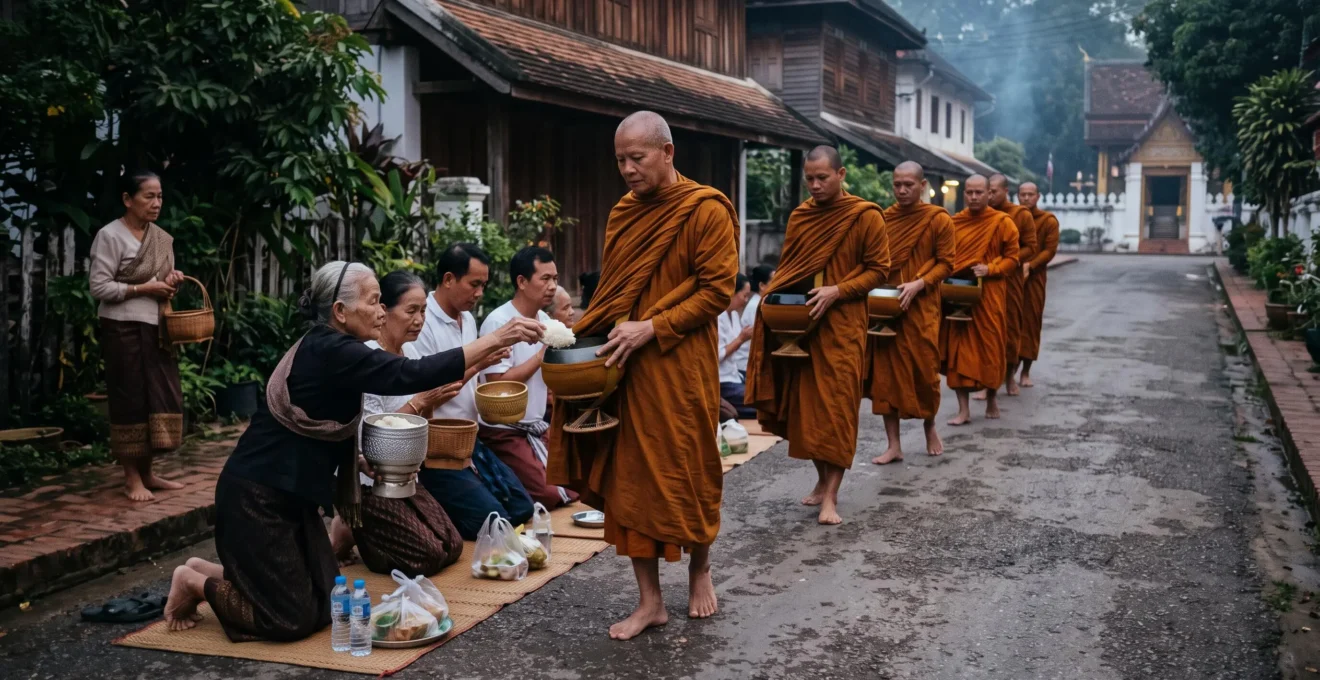
Before sunrise in Thailand, Buddhist monks may walk quietly through neighborhoods carrying alms bowls while residents wait with prepared food. This daily offering tradition, known as tak bat, is an expression of Buddhist generosity and merit-making, not a performance arranged for visitors.
To participate respectfully, prepare suitable food, dress modestly, position yourself where local donors gather, and remain quiet as monks approach. When the local custom calls for kneeling, lower yourself before the procession arrives, keep your head respectfully lowered, place the offering in the bowl without touching the monk, and allow the monk to pass before standing. Blessings, gestures, and positioning vary by community, so observing local participants matters more than imposing a fixed ceremony.
Six practical rules guide the experience: arrive early, bring appropriate food, follow local posture, avoid physical contact, respect the monk’s silence, and never interrupt the ritual for photographs. Understanding why these rules exist makes participation more meaningful than simply memorizing gestures.
Thai Monk Alms-Giving: Essential Etiquette at a Glance
- Prepare before dawn: Bring fresh, ready-to-eat food, cover your shoulders and knees, and confirm the local alms route and time.
- Follow the giving sequence: Sit or kneel where appropriate, lower your head, wait for the monk, deposit the food without touching the monk, and remain respectfully positioned until the monk passes.
- Protect the ritual: Avoid direct physical contact, loud conversation, intrusive photography, unsuitable offerings, and attempts to purchase a religious experience.
- Why Buddhist Monks Don’t Cook Their Own Food: The Alms Rule That Sustains Monastic Life
- What to Offer Thai Monks During Alms Rounds: The Foods Locals Give and Tourists Get Wrong
- Bangkok Alms-Giving vs Village Tak Bat: Which Offers the Authentic Versus Commercialized Experience?
- The Photography That Ruins Monk Alms-Giving: Why Flash and Close-Ups Break Meditative Focus
- When to Wake for Monk Alms-Giving in Thailand: The Regional Timing Differences
- What NOT to Offer Thai Monks: Items and Gestures That Locals Never Use at Dawn
- How to Photograph Tak Bat Respectfully: A Practical Framework for Discreet Dawn Photography
- How Theravada Buddhism Shapes Thai Social Behavior: The Merit-Making System Foreigners Misunderstand
Why Buddhist Monks Don’t Cook Their Own Food: The Alms Rule That Sustains Monastic Life
Theravada Buddhist monastic discipline generally prohibits monks from cooking their own meals and restricts the consumption of ordinary food stored after its permitted period. Lay supporters therefore play an important role in providing meals. Morning alms rounds express this relationship between monastics and the community, although not every Thai monastery depends exclusively on daily street collections.
The monastic code, or Vinaya, governs much more than the public exchange of food. It regulates what monks may accept, how food is handled, and when ordinary meals may be consumed. The practice of collecting alms is commonly called pindapata, while the Thai expression tak bat refers to placing offerings in a monk’s alms bowl.
As explained in The Buddhist Monastic Code’s chapter on food, monks are restricted from cooking their own meals, but the rules recognize exceptions and distinctions. Reheating food prepared by others is permitted under specified conditions, and designated storage arrangements exist. The familiar statement that monks can never prepare or store anything is therefore inaccurate.
The eating schedule is equally important. Under the Theravada Vinaya, ordinary food is generally consumed from dawn until solar noon. Certain drinks, medicines, and tonics follow different rules, as detailed in The Buddhist Monastic Code’s food rules.
This morning eating window helps explain the significance of early offerings. It does not mean that every monastery follows the same alms-round route, that monks necessarily eat only once, or that all food must arrive through a street procession.
For the donor, giving food is also an expression of tham bun, or merit-making. In Thai Buddhist belief, generosity is spiritually meaningful. A monk’s quiet acceptance should not be interpreted as indifference or a failure to thank the donor. Gratitude and blessings may be expressed differently according to context, and spoken thanks are not the purpose of the exchange.
Calling this practice begging misses its religious structure. Monks receive what is appropriately offered while laypeople practice generosity; the encounter does not require conversation, personal attention, or physical contact.
The practical lesson is straightforward: an appropriate offering supports a religious discipline, not a tourist interaction. That distinction should guide what goes into the bowl.
What to Offer Thai Monks During Alms Rounds: The Foods Locals Give and Tourists Get Wrong
The safest foods to offer Thai monks are freshly prepared, ready-to-eat items that can be accepted and consumed within the appropriate monastic eating period. Cooked rice, simple savory dishes, fruit, and suitable sweets are practical choices. Regional customs matter: sticky rice is common in some communities, but it is not the universal staple of every Thai alms round.
Ordinary offerings reflect what people eat locally. In areas where glutinous rice is a daily staple, villagers may prepare it in baskets or covered containers. Elsewhere, cooked jasmine rice or prepared meals may be more familiar. The purpose is to provide usable nourishment rather than an elaborate or expensive gift.
Typical options include:
- Cooked rice: Sticky rice where locally customary, or another freshly prepared rice variety.
- Ready-to-eat savory food: Suitable cooked dishes in clean containers, following the monastery’s preferences.
- Fresh fruit: Clean, manageable portions that can be accepted and eaten without substantial preparation.
- Simple sweets: Fresh or appropriately packaged items that fit local offering practices.
Because monks generally do not cook their own meals, the preparation state of the food matters. A bag of raw ingredients may not serve the same purpose as a cooked meal. Food that requires refrigeration, extensive cooking, or uncertain handling should not be treated as an automatically suitable offering.
When transferring food, keep it clean and avoid using a spoon that has already touched your mouth. A clean serving spoon or appropriate container is preferable where that is the local practice. Do not place your hands against the monk’s hands, and never force an item into a bowl that the monk has not presented for receiving food.
A useful food-selection test asks three questions: Is it safe and ready to eat? Can it remain suitable until consumption? Is it appropriate under local monastic practice? These questions are more reliable than assuming that every packaged food or every traditional-looking gift is acceptable.
If an offering cannot be used, it may need to be redirected, handled separately, or declined. There is no basis for assuming that every unsuitable item is discarded, but avoiding inappropriate food prevents unnecessary complications for the receiving community.
Food is not the only way to support monastic life. Robes, personal-care supplies, and practical temple donations may be welcomed through suitable channels. These are generally better arranged with the temple than inserted indiscriminately into a morning food bowl.
Choosing something modest, fresh, and familiar to the local community is usually more respectful than offering a costly item that a monk may have difficulty accepting or using.
Bangkok Alms-Giving vs Village Tak Bat: Which Offers the Authentic Versus Commercialized Experience?
Village tak bat and urban alms rounds in Bangkok or Chiang Mai can both be genuine religious practices. Authenticity depends less on geography than on whether the ceremony serves an actual monastic community and whether visitors respect its established rhythm. A quiet city offering may be more meaningful than a village ceremony approached primarily as a photography opportunity.
In a rural neighborhood, donors may already know the monks’ usual route. Participants often prepare food at home, gather near familiar roadside locations, and follow customs learned through everyday participation. A visitor entering that setting should treat it as a community religious activity rather than an attraction.
Urban rounds can be different without becoming less legitimate. Monks may walk through crowded streets, receive offerings from shopkeepers and residents, or pass places where tourists are already present. The presence of cameras, guided visitors, or organized accommodation does not by itself establish that a ceremony is staged.
The comparison below provides practical criteria rather than a definitive ranking.
| Criterion | Village Tak Bat | Bangkok or Chiang Mai Tak Bat |
|---|---|---|
| Typical setting | Residential roads and established community routes | Neighborhood streets, temple surroundings, and urban routes |
| Participants | Often familiar local donors | Residents, workers, and sometimes visitors |
| Visitor experience | Potentially intimate, with limited space for outsiders | Potentially easier to observe, but sometimes busier |
| Photography concerns | Intruding into a small community ritual | Blocking pathways or obstructing multiple donors |
| Best authenticity indicator | Established local participation and a normal monastic route | Established local participation and a normal monastic route |
Commercialization becomes a concern when organizers reshape religious activity primarily to entertain paying spectators. A procession repeatedly arranged for cameras, pressure to purchase a packaged offering, or demands for payment supposedly required by the monk should prompt questions.
However, a paid tour is not automatically fraudulent. A guide may legitimately charge for transportation, interpretation, or accompanying visitors to a public ceremony. That fee should not be confused with a religious requirement to pay for merit or permission to make an offering.
The same distinction applies to riverside experiences, market-based activities, and ceremonies included in boat excursions. Some may involve genuine religious participation; others may be primarily visitor-oriented. Their legitimacy cannot be determined from the setting alone.
Before joining, establish which monastery the monks belong to, whether the activity follows an existing local practice, and whether participation would continue normally without tourists. Observe whether residents take part voluntarily and whether organizers allow donors to act without staging repeated gestures.
Do not assume that every unfamiliar robe, organized procession, or paid visitor arrangement represents an illegitimate monk. Where something seems questionable, politely ask a local temple representative rather than publicly confronting participants.
The most respectful experience is not necessarily the most photogenic one. It is the one in which a visitor contributes without changing what the community would otherwise do.
The Photography That Ruins Monk Alms-Giving: Why Flash and Close-Ups Break Meditative Focus
Intrusive photography disrupts Thai monk alms-giving when it blocks participants, forces monks to respond to cameras, or changes the pace of the procession. Flash, close-ups, and requests for posed images are therefore best avoided. Discreet photography may be acceptable where locally permitted, but recording the event never takes priority over the religious activity.
Alms rounds are associated with disciplined conduct, restraint, and mindful movement. Some monks practice particular forms of attentiveness while walking, although it would be inaccurate to claim that every participant is engaged in an identical formal meditation throughout the route.
A flash directed toward a monk’s face can be distracting, especially in dim morning conditions. A photographer standing directly in front of a procession may create a more immediate problem by interrupting movement or obstructing someone trying to offer food.
Thailand’s official tourism guidance provides a clear baseline. The Tourism Authority of Thailand’s temple etiquette advice discourages obstructing worshippers or people making donations for photographs. It also emphasizes quiet behavior and respectful interactions with monks.
This principle is more useful than inventing a universal camera-distance requirement. There is no single number of meters that guarantees respectful photography in every Thai village or city street. The appropriate distance is whatever allows the ceremony to proceed without disruption.
Whenever photography is welcome, choose a position before the monks arrive. Remain to the side, stay seated or low when appropriate, switch off flash, and avoid raising equipment into anyone’s path. A silent or quieter camera setting is helpful, but it is a practical recommendation rather than a universal monastic rule.
There is an important difference between documenting an event and directing it. Taking a few unobtrusive photographs from an accepted position may leave the ceremony unchanged. Asking a monk to pause, requesting that a donor repeat an offering, or stepping between a villager and the procession turns the religious act into a performance.
In smaller communities, it is sensible to ask a nearby participant or local guide whether photography is welcome. A smile or friendly nod is not automatically permission to photograph an identifiable person, especially at close range.
When uncertain, put the camera away. The absence of a photograph does not diminish the experience, while a disrupted offering cannot simply be repeated for an observer’s convenience.
Once the boundary between observation and interference is understood, the next practical challenge is being present at the right time without making the monks or villagers wait.
When to Wake for Monk Alms-Giving in Thailand: The Regional Timing Differences
Thai monk alms rounds commonly take place in the early morning, often around dawn and sometimes before 7 a.m., but there is no universal nationwide schedule. The starting time depends on the monastery, local sunrise, customary route, and religious calendar. Confirm the local time in advance and arrive before the procession rather than relying on a generic travel guide.
Sunrise is a useful starting point for planning, not an exact timetable. A monastery might follow a well-established route earlier or later than another monastery in the same region. Seasonal daylight changes can also affect how early the surroundings become bright enough for outdoor activities.
Regional expectations should therefore remain flexible:
- Chiang Mai and northern Thailand: Confirm the specific neighborhood or temple route instead of assuming a single citywide starting time.
- Bangkok: Different monasteries and neighborhoods may follow different arrangements, with urban activity influencing the surrounding environment.
- Island towns: Local temple practices determine whether, where, and when public morning rounds occur.
- Rural villages: Familiarity with an established route may make local residents a particularly useful source of practical information.
Arriving only after sunrise may be too late in some places. A short procession can pass a particular roadside location quickly, leaving no opportunity for a visitor who has not prepared an offering or chosen a position.
Your Five-Step Tak Bat Morning Preparation Checklist
- Confirm the route: Ask your accommodation or a local temple representative where and when the monks usually pass; record the location and expected time.
- Prepare appropriate food: Arrange fresh cooked rice or another accepted ready-to-eat offering; have it ready in a clean container.
- Choose respectful clothing: Prepare an outfit covering your shoulders and knees, with footwear suitable for the setting.
- Position yourself early: Reach an appropriate waiting place before the monks arrive and check that you are not obstructing the route.
- Review the gesture sequence: Be ready to lower yourself where customary, wait, offer without physical contact, remain quiet, and let the monk pass before standing.
Buddhist holy days, local festivals, and special ceremonies can alter the usual arrangements. Some events take place at a temple rather than along an ordinary neighborhood route. Observing where residents gather or asking knowledgeable locals is more reliable than assuming the same schedule applies every day.
Prepare food close enough to the ceremony to maintain freshness and safety. Purchasing suitable offerings the previous evening may be convenient for packaged goods, while freshly cooked food may need to be obtained on the morning itself.
Once the location, food, and timing are settled, the remaining preparation is behavioral: knowing which objects and gestures to avoid prevents avoidable discomfort during the actual exchange.
What NOT to Offer Thai Monks: Items and Gestures That Locals Never Use at Dawn
Do not offer alcohol, cigarettes, inappropriate gifts, or food that cannot safely be accepted and consumed. Avoid touching monks, placing objects directly into their hands without following the proper method, pointing your feet toward them, or interrupting the procession. Women in particular should avoid physical contact with monks and use a locally appropriate indirect method of presenting offerings.
The distinction between unsuitable food and unsuitable behavior is important. A visitor can bring perfectly acceptable cooked rice yet still create an awkward situation by touching a monk’s arm, standing in his path, or attempting a photograph during the exchange.
Inappropriate offerings include:
- Alcohol: An intoxicating drink conflicts with Buddhist monastic discipline.
- Cigarettes: These are not an appropriate choice for respectful morning food offerings.
- Food needing substantial preparation: Raw ingredients requiring cooking may not fit the practical purpose of an alms bowl.
- Unsafe perishable food: Items that cannot remain safe before consumption should be avoided.
- Cash placed directly in a monk’s bowl: Theravada monastic discipline restricts monks’ acceptance of money; financial support should be arranged through an appropriate temple channel.
Women should be especially attentive to the established contact restrictions. Thai Buddhist etiquette advises women not to touch a monk or his robes. When passing a separate object, an indirect method may involve placing it down for collection or having an appropriate intermediary pass it on.
During an ordinary food round, the monk’s bowl provides a means of receiving offerings without direct hand-to-hand contact. The exact gesture should follow the local practice, and a woman should not attempt to touch or physically guide the monk while depositing food.
These rules concern monastic conduct rather than a judgment about the donor. A woman can participate meaningfully in merit-making while respecting the traditional boundary on physical contact.
Posture also communicates respect. Where residents kneel or sit low, follow their example if physically able. Keep your feet from pointing toward monks and avoid stepping over offerings or people sitting for the ritual. A visitor who cannot kneel should ask about an appropriate seated or standing alternative rather than risking injury.
There is no need to force a wai greeting, ask for conversation, or wait for verbal thanks. If the monk offers a blessing, remain still and attentive. Some participants may respond with a wai or another locally familiar gesture.
Should a mistake occur, the best response is generally quiet correction. Withdraw the unsuitable object, move out of the way, or adjust your posture without demanding that the monk explain the rule publicly. A brief apology may be appropriate when an interaction has been interrupted.
The same restraint should carry into any decision to photograph the ceremony. Respect does not stop once the food has left the donor’s hands.
How to Photograph Tak Bat Respectfully: A Practical Framework for Discreet Dawn Photography
Respectful tak bat photography begins with permission and positioning, not camera equipment. Choose an unobtrusive place before the monks arrive, avoid flash, keep the camera quiet, and take only a limited number of photographs if photography is welcome. Never move into the procession, direct a participant, or interfere with someone making an offering.
A useful approach is to decide what you will not photograph before taking out the camera. Close-up images of people who have not agreed to be photographed, a monk’s face during an exchange, or a donor’s private moment of prayer may be better left unrecorded.
The actual process can be simple:
- Choose a position: Stand or sit where locals indicate observers may remain, without obstructing the procession or donors.
- Set up in advance: Disable flash and unnecessary camera sounds before the monks arrive.
- Use existing light: Work with the available dawn illumination rather than adding light that could disturb participants.
- Keep a consistent distance: Do not approach monks or donors just to improve a composition.
- Finish quickly: Take a small number of frames where acceptable, then put the camera away and allow the ritual to continue.
Early morning light may create softer shadows and gentle contrasts, but low light can also make photography technically difficult. That difficulty is not a reason to add flash or move closer. A darker photograph, or no photograph at all, is preferable to disrupting the event.
Before raising the camera, ask: Would photographing from this position change anyone’s behavior? If the shot requires a monk to stop, a villager to move, or the photographer to stand directly in the route, abandon it.
The question of consent continues after the picture is taken. A photograph made discreetly may still be shared disrespectfully if its caption treats a monk or donor as an exotic spectacle rather than a participant in a living religious practice.
Captions should describe what is actually visible without inventing a blessing, emotional state, monastery affiliation, or personal story. For close portraits or commercial publication, obtain appropriate permission rather than assuming that public visibility gives unlimited consent.
A photograph showing the relationship between donor, monk, and surrounding community can provide context without relying on intrusive facial close-ups. Wide compositions may also make it easier to respect personal space, although framing alone does not resolve consent concerns.
Photography is ultimately an optional part of a religious encounter. Understanding merit-making offers a deeper explanation of why participation, silence, and restraint matter even when no camera is present.
Key Takeaways Before Participating
- Religious purpose comes first: Alms-giving supports monks while allowing laypeople to practice Buddhist generosity.
- Local practice determines the details: Food, posture, timing, blessings, and photography expectations can vary among communities.
- Respect is visible through restraint: Quiet participation without touching, obstructing, directing, or purchasing special treatment is the most dependable approach.
How Theravada Buddhism Shapes Thai Social Behavior: The Merit-Making System Foreigners Misunderstand
Theravada Buddhism helps shape many Thai customs through ideas of merit, generosity, respect, and disciplined conduct. Giving food to monks is one expression of tham bun, or merit-making, in which an intentional act of generosity carries spiritual significance. Understanding this purpose helps visitors avoid treating tak bat as a charitable transaction or a cultural performance.
In Buddhist teaching, generosity is associated with the cultivation of wholesome intention. The benefit is not simply the material value of what changes hands. Offering an ordinary meal willingly and respectfully can therefore be more consistent with the spirit of the practice than purchasing an expensive package for the sake of appearance.
The Thailand Foundation describes food offerings to monks as a familiar form of merit-making connected with Buddhist beliefs about karma and blessings. Its article on honey-offering traditions also illustrates how particular communities develop distinctive ceremonies, including the offering of honey among Mon communities in central Thailand.
Such variation matters. There is no single Thai ritual sequence that applies unchanged to every monastery, region, and religious occasion. Familiarity with one local custom should not be mistaken for a complete understanding of Thai Buddhist practice.
Several wider social behaviors can help visitors recognize the values surrounding alms-giving:
- The wai: A respectful greeting or acknowledgment whose form depends on context and the people involved.
- Deference toward monks: Monks are often treated with particular respect in public settings, including seating arrangements and physical interactions.
- Respectful positioning: Lowering one’s posture where customary and avoiding pointing feet toward monks reflect broader cultural expectations concerning bodily conduct.
- Calm behavior: The Thai expression jai yen, commonly associated with keeping a cool or calm disposition, offers a useful cultural reminder to avoid impatience and unnecessary confrontation.
These examples should not be turned into rigid universal rules. The wai has different forms, public transportation arrangements vary, and ideas concerning sacred space or monks’ shadows do not establish identical obligations in every community.
Visitors also sometimes misunderstand the absence of ordinary conversational exchange. A monk’s silence does not mean a donor has been ignored. Nor does participation create an obligation for the monk to pose, speak, provide a personalized blessing, or acknowledge a tourist’s journey.
The idea that merit can simply be purchased through a commercial tour is equally misleading. A visitor may pay for legitimate logistical assistance, but a ticket does not establish the spiritual value of an offering. Buddhist understandings of merit emphasize intention and conduct rather than commercial price.
A respectful participant therefore adapts to the community’s established rhythm: prepare food thoughtfully, dress appropriately, approach the moment without expectation of reward, and allow the monk to continue uninterrupted.
Before your next early morning in Thailand, confirm a local monastery’s route, prepare a suitable offering, and observe the residents’ gestures. Kneel or sit where appropriate, lower your head, wait for the monk, place the food into the presented bowl without physical contact, receive any blessing quietly, and let the monk pass before standing. The goal is not to perform perfect etiquette for an audience, but to participate without disturbing the religious practice.
Can tourists participate in tak bat without being Buddhist?
Non-Buddhist visitors may be welcome to participate in local alms-giving, provided the community permits it and participants follow established etiquette. Ask a local temple representative or knowledgeable resident before joining, and approach the offering as a religious act rather than a sightseeing activity.
What should I do if a monk passes without accepting my offering?
Remain calm and do not chase, call out to, or block the monk. There may be practical or religious reasons why an offering is not accepted. Keep the food with you and, if appropriate, ask a local temple representative afterward about another suitable way to make an offering.
Can a woman offer food directly into a Thai monk’s alms bowl?
Women can participate in alms-giving, but they should avoid physical contact with monks and their robes. Placing food into a presented alms bowl without touching the monk is a commonly used method. For objects outside the ordinary food-offering exchange, follow the monastery’s instructions concerning indirect transfer.
Is it necessary to understand or recite a Buddhist blessing during tak bat?
Visitors are not generally required to memorize a Pali chant simply to offer food respectfully. If a monk gives a blessing, remain quiet and attentive. Watch local donors for the appropriate posture or gesture, and avoid interrupting to request an explanation during the procession.
What if I cannot kneel because of limited mobility?
Kneeling is not a universal requirement for every Thai alms-giving setting. Where local donors normally kneel, ask beforehand whether you can participate from a suitable chair or another accessible position. Avoid painful movements or unsafe attempts to imitate a posture, and prioritize quiet, respectful participation.