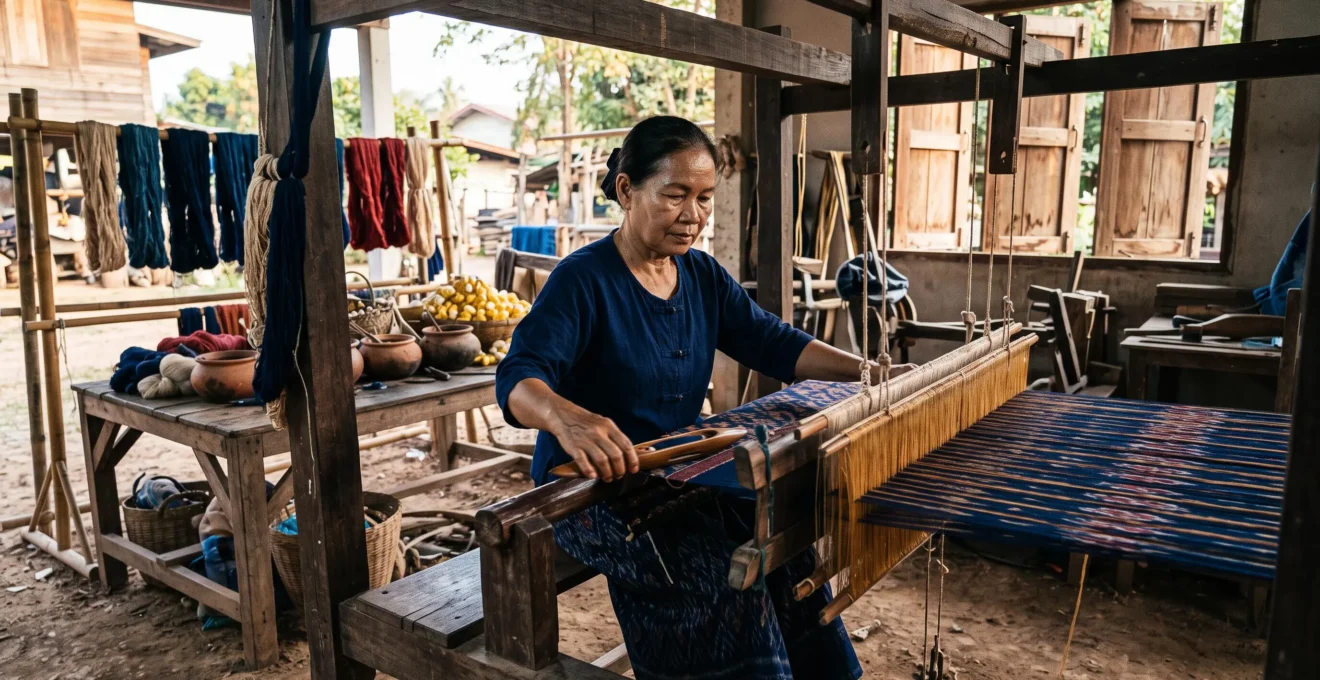
The most revealing Thai craft encounters rarely begin with a scheduled demonstration. They begin in a working household, where a loom holds an unfinished commission, silk threads are prepared between other responsibilities, and an artisan may be more concerned with completing an order than entertaining visitors.
For travelers seeking Thailand’s living cultural heritage, the distinction matters. A staged weaving performance can teach a technique, but it cannot necessarily explain why a family still produces ceremonial cloth, how skills pass between generations, or whether traditional craftsmanship provides a meaningful livelihood.
Northeastern Thailand, particularly weaving communities in Khon Kaen and Surin, offers valuable starting points. Northern communities maintaining embroidery and other textile traditions provide different encounters with identity, household production and cultural continuity. Neither region guarantees unrestricted workshop access, and authentic craftsmanship is not defined by the absence of tourism.
The better question is whether the craft continues beyond the visitor’s presence. Understanding that distinction changes how to choose villages, recognize genuine production, purchase textiles and approach artisans respectfully.
Finding Thailand’s living craft traditions
- Start with producing communities: investigate active weaving groups around Chonnabot in Khon Kaen, textile communities in Surin and locally organized craft visits in northern Thailand.
- Look beyond the demonstration: ongoing commissions, unfinished work, identifiable makers and functioning production networks provide stronger evidence than polished visitor presentations.
- Make spending count: ask who made each item, how it was produced and how the purchase compensates the artisan before treating a product as authentic handmade craftsmanship.
- Why So Many of Thailand’s Traditional Craft Villages Have Disappeared in 20 Years: The Urbanization Impact
- How to Buy Thai Handicrafts That Actually Support Village Artisans, Not Bangkok Wholesalers
- Hill Tribe Embroidery vs Thai Silk: Which Textile Tradition Matches Your Cultural Curiosity?
- The ‘Village Tour’ That’s Actually a Theme Park: How to Spot Staged Cultural Experiences
- When to Experience Thai Cultural Heritage in Context: The Festival Calendar Locals Follow
- How to Identify Authentic Hand-Reeled Thai Silk: The Texture Test and Price Reality
- Hill Tribe Embroidery vs Thai Silk: Matching the Tradition to Your Route and Travel Style
- Where to See Traditional Thai Silk Weaving Still Practiced, Not Demonstrated for Tourists
Why So Many of Thailand’s Traditional Craft Villages Have Disappeared in 20 Years: The Urbanization Impact
Thailand’s traditional craft communities face overlapping pressures from changing employment opportunities, interrupted apprenticeship, industrial production and shifting consumer demand. Migration can reduce the number of younger people available to learn complex techniques, while cheaper manufactured goods challenge household workshops. However, there is no substantiated nationwide count in the supplied evidence establishing how many villages disappeared over the past twenty years.
Craft transmission depends on more than preserving tools. A young person learning silk weaving must acquire knowledge of thread preparation, tension, pattern construction, dyeing and finishing. That competence develops through repeated work, often alongside experienced relatives or established artisans.
When younger household members pursue opportunities in cities such as Bangkok or Chiang Mai, the time available for apprenticeship may diminish. This is a plausible mechanism of decline, although its relative importance varies among communities and cannot be quantified from the available evidence.
Three different outcomes can emerge:
- Discontinued production: weaving tools or inherited textiles remain, but no active makers continue the tradition locally.
- Adapted production: workshops retain certain techniques while introducing machinery, purchased threads or standardized designs to remain commercially viable.
- Continuing household or community production: artisans weave for commissions, local customers, cultural use or supplementary income, sometimes alongside farming and other employment.
The third category is especially valuable for travelers interested in living heritage, but it should not be romanticized. A functioning weaving group may use modern equipment for some stages while maintaining important traditional skills elsewhere.
UNESCO‘s case study of traditional silk weaving in Surin documents practices among Khmer, Kui and Thai-Lao communities, including natural dyeing, patterned weaving, family transmission and master-apprentice learning. It also identifies professional and supplementary forms of weaving income.
Living heritage in Surin Province
UNESCO describes Surin silk production as a network of interconnected activities: mulberry cultivation, silkworm raising, thread preparation, dyeing, pattern tying and weaving.
Knowledge passes through households, experienced makers and institutional programmes. The case demonstrates that traditional production can remain economically active while adapting to modern markets, although it does not establish how many workshops are currently operating.
Commercial survival also introduces tension. Producing standardized souvenirs may provide revenue while gradually displacing distinctive local patterns. Conversely, refusing every commercial adaptation can make craft production financially difficult to sustain.
The most useful survival indicator is active knowledge transmission. Ask whether apprentices are learning, whether households still receive commissions and whether customers order pieces for purposes beyond tourist purchases.
For travelers, the practical implication is immediate: choosing an identifiable maker instead of an anonymous factory souvenir can help sustain demand for skilled production. That leads to the question of where the purchase money actually goes.
How to Buy Thai Handicrafts That Actually Support Village Artisans, Not Bangkok Wholesalers
Buying directly from an identifiable artisan or transparently managed weaving cooperative offers a clearer connection between your spending and craft livelihoods than purchasing an untraceable souvenir. Yet a workshop purchase is not automatically fair, and an urban retailer is not automatically exploitative. The essential test is traceability: who made the object, where production occurred and how the maker is compensated.
Begin by identifying the actual production location. A seller might accurately name a province while sourcing products through multiple intermediaries. A more informative answer identifies the village, weaving group, maker or production arrangement.
At a workshop, look for unfinished textiles, thread preparation, current orders and artisans who can explain the methods involved. Watching someone operate a loom is useful, but it does not by itself prove that every item displayed for sale was made there.
Direct purchasing can reduce the number of intermediaries, potentially allowing the maker to retain more of the sale price. However, no universal margin can be assumed. Retailers may provide transport, inventory financing, marketing and customer access, while a cooperative may distribute revenue among members according to its own arrangements.
Likewise, the workshop price is not guaranteed to be lower than the Bangkok retail price. Material quality, labor, exclusivity, cooperative costs and seller pricing practices all matter. A high price in a city is not proof of superior craftsmanship, just as a low workshop price is not proof of fair compensation.
Responsible intermediaries can still serve artisans well. Look for named maker attribution, identifiable cooperative membership, community-enterprise information and credible explanations of how purchases support production.
Thailand’s One Tambon One Product (OTOP) initiative may help identify locally associated products, but an OTOP designation should not be mistaken for an independent guarantee of artisan wages or wholly handmade manufacture.
Five checks before buying a Thai handmade craft
- Record the maker: ask for the artisan’s or producing group’s name and retain it with your receipt or notes.
- Confirm the production location: write down the village and province where the item was made.
- Identify the technique: ask which stages were performed by hand and note whether machinery or purchased components were used.
- Clarify the payment relationship: ask whether you are buying from the maker, a cooperative or a reseller, and record the explanation.
- Keep product details: request available material, care and certification information and match it to the specific item purchased.
Bargaining deserves particular sensitivity. A standardized souvenir may contain room for negotiation, but an individually commissioned textile may represent extensive skilled labor. Ask how the price was determined before proposing a discount.
If a piece exceeds your budget, purchasing a smaller work or paying for a separately offered workshop experience can be more respectful than pressuring the maker to undervalue substantial labor.
Once provenance becomes the priority, the next decision concerns the tradition itself: different textile communities offer distinct techniques, cultural meanings and opportunities for engagement.
Hill Tribe Embroidery vs Thai Silk: Which Textile Tradition Matches Your Cultural Curiosity?
Thai silk weaving is generally the stronger choice for travelers who want to observe a continuous technical process, from thread preparation to patterned cloth. Textile and embroidery traditions among northern ethnic communities offer different opportunities to understand identity, clothing and inherited knowledge. Neither is inherently more authentic: the meaningful distinction is whether production and cultural use continue within the community.
The term « hill tribe » is common in tourism, but it groups culturally distinct peoples together. Hmong, Karen and Lisu communities have different textile practices, histories and design traditions. Their work should not be treated as one interchangeable style.
Thai silk traditions are equally varied. In Isan, mudmee uses resist-dyed threads to create patterns during weaving. A textile’s motifs may reflect regional identity, ceremonial uses or the preferences of the maker and purchaser.
The following comparison helps match a cultural interest with an appropriate type of visit.
| Criterion | Thai silk weaving | Northern ethnic embroidery and textiles |
|---|---|---|
| Commonly associated communities | Regional weaving households and groups, including Thai-Lao, Khmer and Kui makers | Distinct communities including Hmong, Karen and Lisu, with varying practices |
| Main techniques | Sericulture, reeling, dyeing, mudmee pattern tying and loom weaving | Community-specific embroidery, stitching, appliqué and woven textile techniques |
| Cultural meanings | Regional identity, ceremonial textiles, clothing and inherited patterns | Dress traditions, community identity and motifs whose meanings vary by group |
| Where to investigate | Khon Kaen, Surin and other northeastern weaving communities | Community-organized textile visits in northern Thailand |
| Typical learning opportunity | Following textile production through successive technical stages | Speaking with makers about clothing, techniques and cultural context |
| Verification priority | Thread origin, fiber composition, handweaving and certification | Named maker, community provenance and distinction from mass-produced imitations |
A silk workshop can offer a visually understandable production sequence. A visitor may encounter cocoons, dyeing materials, tied yarns and looms, depending on which stages the group performs and what work is underway.
Embroidery encounters may be less structured. Techniques can be practiced at home, alongside agricultural work or other obligations. This can provide meaningful personal contact, but only where makers have agreed to receive visitors.
Motifs deserve careful interpretation. Not every textile pattern is an ancient symbol, and not every design conveys lineage or spiritual significance. Some are contemporary adaptations. Ask the maker what a particular motif means rather than applying a generalized ethnic interpretation.
Purchasing also requires different scrutiny. For silk, investigate the production method and material. For embroidered work, identify the community and individual maker instead of assuming that an item labeled « tribal style » was produced by the people associated with its design.
Whether observing a loom or discussing embroidery, the visitor’s next challenge is recognizing when access has been arranged for genuine cultural exchange rather than a standardized sales performance.
The ‘Village Tour’ That’s Actually a Theme Park: How to Spot Staged Cultural Experiences
A staged craft experience is one organized primarily around visitor entertainment rather than ongoing production. Warning signs include a demonstration that starts only when a tour group arrives, repetitive performances, no evidence of current commissions and a retail area with unexplained product origins. None of these signals alone proves deception, but their combination warrants closer questioning.
The underlying commercial model matters. Package tours sometimes organize visits around fixed departure schedules, convenient stops and opportunities for retail commissions. Those incentives can favor predictable presentations over the irregular working rhythms of a household workshop.
A scheduled demonstration may still be taught by a genuine artisan. The ethical issue arises when an educational performance is presented as evidence of ordinary production without clarification.
Consider these distinctions:
- Fixed demonstrations: a scheduled activity is not inherently inauthentic, but ask whether the artisan also produces commissioned work outside visitor sessions.
- Display-only materials: a tidy demonstration station may serve educational purposes; look for evidence of broader production rather than expecting every workspace to appear disorganized.
- Retail pressure: mandatory shopping stops and unexplained product origins suggest that sales may be central to the itinerary.
- Repeated tour formats: identical descriptions across operators can indicate a standardized experience, although they may also reflect legitimate partnerships with one community.
- Production conversations: artisans who can discuss current orders, finishing work, material sourcing and delivery timelines provide useful signs of commercial practice.
Location is another imperfect clue. A workshop near a major road might be entirely genuine, while an isolated venue may still stage performances. Difficulty of access should never be treated as proof of cultural authenticity.
Instead, examine the relationship between the host and the visitor. Is the program organized by the community or an outside operator? Does the price include teaching time? Are photographs optional? Can participants meet the makers whose goods are sold?
Independent travel and community-based tourism may offer more direct contact, but neither guarantees ethical conditions. Good organization can protect artisans from interruptions, manage group sizes and compensate them for explaining their work.
The strongest encounters acknowledge both sides of the transaction: the visitor gains knowledge, while the artisan retains control of working time, personal space and remuneration. Timing the visit around real community activity adds another layer of understanding.
When to Experience Thai Cultural Heritage in Context: The Festival Calendar Locals Follow
The most meaningful time to encounter Thai craftsmanship is often when textiles, carvings or ceremonial objects are being prepared for actual use. Temple observances, ordinations, weddings and seasonal celebrations can reveal why these skills matter. However, major festivals are not necessarily representative of everyday workshop production, and dates should be verified locally before making travel arrangements.
Thailand’s cool season, broadly November through February, is often comfortable for exploring northern and northeastern communities. It can also coincide with busy travel periods and local celebrations. Nevertheless, craft activity follows household orders, agriculture and community obligations rather than a universal visitor season.
Several calendar anchors help travelers plan.
| Period | Cultural context | What to investigate |
|---|---|---|
| November–February | Cool-season community gatherings and regional celebrations | Local textile exhibitions, temple activities and active weaving groups |
| April | Songkran and associated family, community and religious observances | Local traditions and ceremonial textile use, without assuming open workshops |
| Around the beginning of Buddhist Lent, usually July | Candle offerings and Buddhist ceremonies | Wax craftsmanship and temple preparations, especially in Ubon Ratchathani |
| Around the end of Buddhist Lent, usually October | Regional religious celebrations and associated festivities | Community observances, regional craft displays and locally organized events |
Ubon Ratchathani provides a particularly instructive example. Its Candle Festival brings elaborate wax carving into a public religious and cultural setting. The festival is associated with the beginning of Buddhist Lent, rather than its end.
The Tourism Authority of Thailand’s account of the 2025 Ubon Candle Festival documents large carved wax floats depicting Buddhist stories and local beliefs, alongside processions and regional performances. The reported 2025 activities took place from 10 to 13 July; those dates should not be reused as a calendar for future editions.
A major procession can showcase technical achievement and ceremonial symbolism, but its scale may obscure more intimate community practices. A temple-level event or a maker’s preparation for local use may provide a different perspective, provided the community welcomes visitors.
When planning around festivals, expect changing lunar-calendar dates, potential crowding, accommodation pressure and workshops that may close while families participate in celebrations.
The most responsible approach is to verify both the event and the workshop separately. A festival’s occurrence does not guarantee that a specific weaving household will be available.
Festival visits explain cultural context; workshop visits reveal production. Combining the two can be rewarding, but the value of any silk purchase still depends on understanding the material and techniques behind it.
How to Identify Authentic Hand-Reeled Thai Silk: The Texture Test and Price Reality
Authentic hand-reeled Thai silk cannot be verified through texture alone. Irregular thread thickness, visible slubs and slight variations in mudmee pattern alignment can support an assessment of hand production, but they are not conclusive evidence. The strongest practical approach combines inspection, questions about each production stage, identifiable maker provenance and applicable textile certification.
Begin by distinguishing three separate questions: whether the fiber is silk, whether the filament was reeled by hand and whether the fabric was woven by hand. A product can satisfy one or two conditions without satisfying all three.
Hand-reeling can produce variations in thread thickness. Under natural light, these may appear as slight changes in sheen or small thickened sections. However, carefully made hand-reeled threads can be relatively consistent, while machine-produced fabrics can deliberately imitate irregularity.
Texture is a clue, not a certificate. Compare a piece against other textiles whose production methods the workshop can explain. Ask the maker to identify which characteristics come from the thread, which come from weaving and which arise during dyeing or finishing.
In mudmee weaving, yarns are tied and resist-dyed before being arranged and woven into a pattern. Slight variations in alignment may reflect the complexity of matching dyed sections on a loom. Yet deliberate geometric irregularity can be reproduced in industrial textiles, and excellent handmade workmanship may show little obvious misalignment.
Fiber burn tests are sometimes suggested for identifying silk, but they are unsuitable for routine shopping. They require damaging a sample, introduce a fire hazard and cannot reliably establish the complete manufacturing history of a textile. Finishes and blended fibers can further complicate interpretation.
Certification offers a more structured way to investigate production claims.
The Thai government’s Royal Peacock silk certification explanation distinguishes four product categories according to materials and manufacturing methods.
| Certification | Official designation | Relevant distinction |
|---|---|---|
| Gold Peacock | Royal Thai Silk | Emphasizes traditional materials and production processes, including premium handwoven manufacture |
| Silver Peacock | Classic Thai Silk | Recognizes handwoven silk meeting the corresponding quality and production requirements |
| Blue Peacock | Thai Silk | Allows some modern production processes while retaining specified silk standards |
| Green Peacock | Thai Silk Blend | Accommodates specified blended materials or alternative manufacturing techniques |
The categories do not reduce to a simple genuine-versus-fake distinction. A correctly described silk blend can be a legitimate product, while an unsupported claim of entirely traditional handmade production remains questionable.
Ask to see the certification information for the particular textile, rather than assuming that a sign displayed in a shop covers everything on sale. Absence of certification alone does not establish that a textile is counterfeit.
Thread construction also affects appearance and weight. Two-ply and four-ply describe the number of strands combined in a yarn construction, but those labels are not universal guarantees of quality or evidence that reeling was performed manually. Yarn specifications and finished fabric structure should be discussed separately.
Natural dyes may be culturally significant, but chemical dyes are not automatically evidence of machine weaving. Similarly, a handwoven fabric made from commercially reeled thread remains handwoven, even though it is not wholly handmade from cocoon to cloth.
Prices should reflect the actual combination of fiber, complexity, dimensions, labor and production methods. Intricate hand-tied mudmee patterns and extensive preparation may require substantial work, but there is no defensible universal minimum price for authentic Thai silk in the supplied evidence.
Rather than relying on an arbitrary bargain threshold, compare textiles within a documented production group and ask why one costs more than another. A maker may explain differences in pattern complexity, thread preparation, finishing or the amount of skilled labor required.
Once the technical distinction is clear, it becomes easier to plan a workshop visit around the process you most want to observe instead of choosing a destination solely because its products carry a traditional label.
Hill Tribe Embroidery vs Thai Silk: Matching the Tradition to Your Route and Travel Style
Choose Thai silk weaving if your route already includes northeastern Thailand and your priority is observing technical production. Choose northern community textile traditions if your itinerary centers on mountain communities and your main interest is cultural interpretation and maker relationships. Both can fit a responsible journey, but planning around verified community access is better than adding remote stops simply for an advertised demonstration.
For travelers visiting Khon Kaen or nearby northeastern provinces, a weaving-group visit may fit into a regional excursion. The amount of time required depends on transport, the group’s location, available activities and whether arrangements have been made in advance.
For travelers based in Chiang Mai or traveling through northern mountain areas, community-managed textile visits may be appropriate. However, an ethnic community should never be treated as an automatically accessible tourist site.
Meaningful visits may require a local guide, advance permission or an organized community arrangement. An invitation to observe embroidery does not necessarily include access to homes, religious spaces or private family activities.
| Travel consideration | Northeastern silk weaving | Northern community textiles |
|---|---|---|
| Best regional fit | Khon Kaen, Surin and wider Isan itineraries | Northern routes involving consenting community hosts |
| Visit organization | Contact a weaving cooperative or community enterprise | Arrange access through a community organization or responsible local host |
| Primary learning focus | Silk preparation, dyeing, weaving and textile commissions | Community-specific techniques, clothing and cultural meanings |
| Practical uncertainty | Whether specific production stages are underway | Whether makers are available and willing to receive visitors |
| Time commitment | Allow substantial time for observation and discussion | Allow additional flexibility for introductions, interpretation and community schedules |
Neither option has a fixed duration or guaranteed level of accessibility. Public transport may reach a district center without reaching a particular household workshop conveniently. Likewise, a guided visit is not automatically more respectful than an independent one; the crucial factor is the arrangement with the host community.
Seasonal work patterns matter. Some weaving activities historically take place around agricultural obligations. A loom can be inactive because the artisan is farming, preparing thread, waiting for an order or attending a family event.
This is why advance confirmation of actual activity is more useful than an advertised opening time. Ask what stage of production may be observable, whether interpretation is available and whether payment is expected for the visit.
If your itinerary allows only one substantial encounter, prioritize depth. Watching several production stages, understanding the role of an artisan group and discussing a finished piece can provide more insight than visiting multiple souvenir-focused stops in quick succession.
Once the route and craft tradition are chosen, the final planning task is identifying actual producing communities and establishing whether their workshops can welcome visitors.
What to establish before visiting a working craft village
- Confirm that the community currently produces textiles or other crafts independently of visitor demonstrations.
- Ask a local weaving group or community organizer which production stages visitors may observe and whether an appointment is appropriate.
- Plan to compensate artisans for their time and respect their right to decline access, photography or interruptions.
Where to See Traditional Thai Silk Weaving Still Practiced, Not Demonstrated for Tourists
Northeastern Thailand is a particularly promising region for finding working silk-weaving communities. Ban Hua Fai in Chonnabot District, Khon Kaen, offers a documented starting point, while Surin maintains significant traditional silk production associated with several cultural communities. Additional textile groups in Udon Thani provide alternatives. However, published recognition does not guarantee active weaving or visitor access on a particular day.
The Tourism Authority of Thailand identifies the Mud-mee Silk Weaving Community Enterprise in Ban Hua Fai Village, Po Daeng Subdistrict, Chonnabot District, Khon Kaen Province. Its published information associates the community with traditional mudmee production and local textile designs.
The same tourism authority describes the Ban Non Kok Ancient Weaving Group in Nong Na Kham Subdistrict, Mueang Udon Thani District, Udon Thani Province. The group’s work includes textiles incorporating dyes derived from waterlilies, and its documented visitor activities include dyeing experiences.
These are identifiable communities rather than invented workshop recommendations. Their published descriptions provide a research starting point, not independent confirmation that particular looms will be operating during a visit in October 2026.
Surin offers another meaningful regional focus. Traditional silk practices there encompass natural dyes, patterned textiles and production networks connected to Khmer, Kui and Thai-Lao cultural heritage.
Chaiyaphum can also be considered when exploring northeastern textile traditions, but the available source pack does not verify a specific active workshop or community contact there. Travelers should seek current local confirmation rather than treating the province itself as a guaranteed weaving destination.
For named communities in Khon Kaen and Udon Thani, the Tourism Authority of Thailand‘s Khon Kaen and Udon Thani textile itinerary provides community descriptions and published contact information. Because the article dates from 2023, those contact details and visiting arrangements require reconfirmation.
Contact the producing group before traveling. Ask whether the group is currently weaving, which processes can be observed and whether visitors are welcome during ordinary production rather than only during a booked demonstration.
A genuine sericulture visit may reveal several interconnected stages. Not every household performs them all, since specialized work can be distributed among members of a community.
- Mulberry and silkworm cultivation: the agricultural foundation of silk production, where locally practiced.
- Cocoon preparation and reeling: drawing silk filaments from cocoons and combining them into usable thread.
- Dyeing and pattern preparation: working with natural or other dyes, including the tying and dyeing processes used in mudmee.
- Loom weaving: constructing cloth through repeated manipulation of warp and weft threads.
- Finishing and sales: preparing completed textiles, fulfilling orders and communicating with buyers.
Working arrangements vary. A family may specialize in weaving while obtaining yarn from another producer; a collective may distribute tasks among members. This division of labor does not make the workshop inauthentic.
Visitors should therefore ask what is actually happening on the day, not demand a complete production sequence. An artisan concentrating on a commission may have limited time to explain techniques. Another household may be preparing yarn rather than operating a loom.
A meaningful visit benefits from allowing several hours where appropriate, with the duration agreed in advance. Ask permission before entering work areas, touching materials or photographing people. Children, private household spaces and ceremonial items deserve particular care.
Payment is equally important. If a community offers a hosted workshop visit, respect its stated fee. If an artisan generously explains their work, ask whether an honorarium or a purchase would be appropriate, rather than assuming conversation and access are free services.
Buying directly can be valuable, but a purchase should not be a condition imposed on a household without prior agreement. Some makers may prefer scheduled appointments, cooperative sales or commissioned orders.
The most reliable evidence of living heritage is neither a picturesque building nor the complete absence of visitors. It is the continued exercise of craft knowledge in a functioning production and social environment, with local people deciding how their work is shared.
For a practical first step, identify a weaving group in Khon Kaen or Surin, establish direct contact through a recognized community channel, confirm that production is active, and arrange a visit on the group’s terms. Arrive ready to learn about the work already taking place rather than expecting artisans to stage a tradition for the camera.
Can visitors enter traditional Thai weaving workshops without booking?
Some community enterprises may accommodate walk-in visitors, but access should never be assumed. Household workshops are private workplaces, and production schedules can change with agricultural work, commissions and family obligations. Contacting the community in advance is the more respectful and reliable approach.
Does a paid weaving demonstration mean the experience is inauthentic?
No. Genuine artisans may offer paid educational sessions to supplement production income. The important distinction is whether the activity is presented transparently. Ask whether the host also produces commissioned textiles, how teaching time is compensated and whether the merchandise comes from identifiable makers.
Is Thai silk without a Royal Peacock label necessarily fake?
No. The Royal Peacock scheme provides meaningful distinctions among certified silk categories, but an uncertified textile is not automatically counterfeit. Ask about fiber composition, thread production, weaving methods and maker provenance. A generic « 100% Thai silk » description does not establish that every production stage was performed by hand.
How can a traveler support artisans without buying an expensive textile?
Consider smaller items with clear maker provenance, a paid learning session offered by the community or an agreed contribution for a hosted visit. Respecting photography rules, compensating time and recommending identifiable artisan groups can also support responsible cultural exchange. Avoid assuming that exposure or social-media promotion replaces fair payment.
What should visitors do when a weaving workshop is closed or no one is producing?
Do not pressure a household to restart work for an unscheduled visit. Ask an authorized community contact whether another time or a different production group would be suitable. A temporarily inactive loom is not proof that a tradition has disappeared: artisans may be preparing thread, working elsewhere or waiting for their next commission.